

Can dogs eat spinach? Yes, most healthy dogs can eat small amounts of plain spinach occasionally. But whether it’s a good choice for your dog depends on how much they ate, whether it was plain, and their medical history. A single leaf dropped from your cutting board is very different from a bowl of creamed or seasoned spinach your dog helped themselves to off the counter.
Spinach is relatively high in oxalates, which matters most for dogs with a history of calcium oxalate urinary stones or certain medically managed diets. VCA specifically advises dogs that have previously developed calcium oxalate bladder stones not to be fed high-oxalate foods such as spinach.
If you’re here because your dog just ate spinach, start with what they actually ate. If you’re deciding whether to offer spinach intentionally, the answer is more useful than a simple “safe” or “unsafe.”
Your Dog Ate Spinach — Start With What Actually Happened
A Small Amount of Plain Spinach
If your otherwise healthy dog snagged one or two plain spinach leaves and is acting normally, this is very different from eating a large quantity or a prepared spinach dish.
Keep an eye out for digestive upset, such as vomiting, diarrhea, loss of appetite, or obvious discomfort. If your dog remains well, an isolated small exposure is generally less concerning than repeated feeding or a large ingestion.
A Larger Amount Changes the Question
If your dog ate a substantial amount, don’t rely on a universal “safe serving.” A handful is proportionally much more food for a Chihuahua than for a Labrador.
Consider:
- your dog’s size and approximate weight
- roughly how much spinach was eaten
- whether it was raw, cooked, canned, or part of another dish
- whether other ingredients were present
- whether your dog has kidney or urinary problems
- whether any symptoms have developed
If the amount was large or impossible to estimate, or your dog becomes unwell, contact your veterinarian for advice rather than trying to calculate an oxalate dose at home.
Spinach From Your Dinner Needs an Ingredient Check

This is where the situation can change quickly. If your dog ate spinach from a salad, curry, pasta dish, dip, casserole, or restaurant meal, check the entire recipe—not just the spinach.
Look specifically for:
- onion
- garlic
- chives
- leeks
- heavy seasoning
- excessive salt
- rich sauces
- butter, cream, or large amounts of cheese
Onion, garlic, and chives belong to the Allium family. ASPCA warns that these foods can cause gastrointestinal irritation and damage red blood cells in dogs, potentially leading to anemia depending on the amount consumed.
So if your dog steals garlic-butter spinach, the spinach may not be the ingredient that determines what you should do next.
If You Don’t Know What Was in the Dish
If the spinach came from a restaurant, takeaway meal, premade dip, or another food you didn’t prepare yourself, don’t assume it was plain.
Try to gather:
- the packaging, ingredient label, menu, or recipe
- approximately how much your dog ate
- when they ate it
- your dog’s approximate weight
- any symptoms you’ve noticed
- relevant kidney, urinary, or dietary history
That gives your veterinarian far more useful information than simply saying, “My dog ate spinach.”
Quick Decision Box
This is more likely to be a monitoring situation if:
- the amount was very small
- the spinach was plain
- your dog is otherwise healthy
- your dog is behaving normally
Call your veterinarian for individual advice if:
- the amount was large or unknown
- your dog has kidney or urinary disease
- your dog has previously had calcium oxalate stones
- your dog is on a prescription urinary or renal diet
- vomiting, diarrhea, loss of appetite, discomfort, or other concerning signs persist
Treat the other ingredients as a separate concern if:
- the dish contained onion or garlic
- it contained an unknown sauce, seasoning, or dip
- your dog is visibly unwell
The Most Useful Question Isn’t “Is Spinach Toxic?”

Spinach isn’t best understood as a simple poison-or-not-poison question. The more useful question is whether the amount, frequency, preparation, and individual dog’s health make spinach appropriate in that particular situation.
That distinction matters because a healthy dog stealing one plain leaf and a dog with previous calcium oxalate bladder stones being fed spinach every day are not facing the same risk.
Hazard and Exposure Are Not the Same Thing
Spinach naturally contains oxalates. That fact matters, but the presence of a potentially problematic compound doesn’t automatically mean every exposure will cause harm.
Context matters:
amount + frequency + dog size + preparation + medical history
For dogs that have already developed calcium oxalate bladder stones, the recommendation becomes much stricter. VCA advises avoiding high-oxalate foods, specifically including spinach, and notes that these dogs are often managed with a therapeutic diet to help reduce recurrence risk.
One Accidental Taste Is Different From Daily Feeding
A dog that steals a leaf once has had a one-time exposure. A dog getting spinach mixed into meals every day is experiencing an ongoing dietary pattern.
Don’t assume that because your dog ate spinach once without a problem, it automatically makes sense as a daily addition. Frequency deserves its own consideration, especially when a dog has urinary disease or is already eating a veterinarian-directed diet.
Dog Size Changes the Meaning of “A Little”
The same spoonful represents very different portions for a toy breed and a large dog.
That’s why rigid advice such as “give every dog X leaves” can be misleading. Portion decisions should account for the dog’s size, overall diet, health history, and how frequently the food is being offered rather than relying on one universal serving.
Why Oxalates Deserve Context, Not Panic

What Oxalates Are
Oxalates are naturally occurring compounds found in spinach and a number of other foods. They can interact with calcium and are relevant to the formation of calcium oxalate urinary stones in susceptible dogs.
The important point for owners isn’t that every spinach leaf will create a stone. It’s that high-oxalate foods become much less appropriate when a dog already has a history of calcium oxalate uroliths or is being medically managed to prevent their recurrence.
Calcium Oxalate Crystals and Stones
Calcium oxalate is one of the common types of urinary stone found in dogs. Merck Veterinary Manual identifies calcium oxalate and struvite among the most common canine urolith types.
For a dog that has previously developed calcium oxalate stones, diet is part of the long-term management strategy. VCA specifically recommends avoiding high-oxalate foods such as spinach in these dogs.
That’s a much more useful distinction than telling every dog owner that spinach either “causes kidney stones” or is completely harmless.
Kidney Disease and Calcium Oxalate Stones Are Not the Same Diagnosis
These conditions shouldn’t be lumped together.
A dog with chronic kidney disease may have specific nutritional needs set by their veterinarian. A dog with calcium oxalate bladder stones may have a different therapeutic feeding plan aimed at reducing recurrence.
In either case, don’t add spinach—or any supposedly healthy extra—to a prescription diet without checking with the veterinarian managing that dog.
Why a Healthy Dog and a Stone-Prone Dog May Get Different Answers
The dog’s medical history can matter more than the vegetable itself.
A healthy adult dog with no relevant urinary history has more dietary flexibility than a dog whose veterinarian is actively trying to reduce the chance of another calcium oxalate stone.
Dogs that need a different answer before being given spinach regularly include those with:
- a history of calcium oxalate bladder stones
- known calcium oxalate crystals in the urine
- diagnosed kidney disease
- a prescription renal or urinary diet
- recurrent urinary problems under veterinary management
General feeding advice shouldn’t override an individual veterinary diet plan.
Before Offering Spinach, Run This Quick Check
- Is the spinach plain and unseasoned?
- Is the amount small relative to my dog’s size?
- Is this an occasional extra rather than a daily habit?
- Is it free from onion, garlic, excessive salt, rich sauces, and unknown seasonings?
- Does my dog have no known calcium oxalate stone history or relevant kidney/urinary condition?
- Is my dog already eating a complete and balanced diet?
If all six answers are yes, a small occasional amount is a much more reasonable choice for a healthy dog. If one of the medical or ingredient questions gives you pause, skipping the spinach is simpler than trying to make it fit.
Spinach Changes Depending on How It Reaches the Bowl
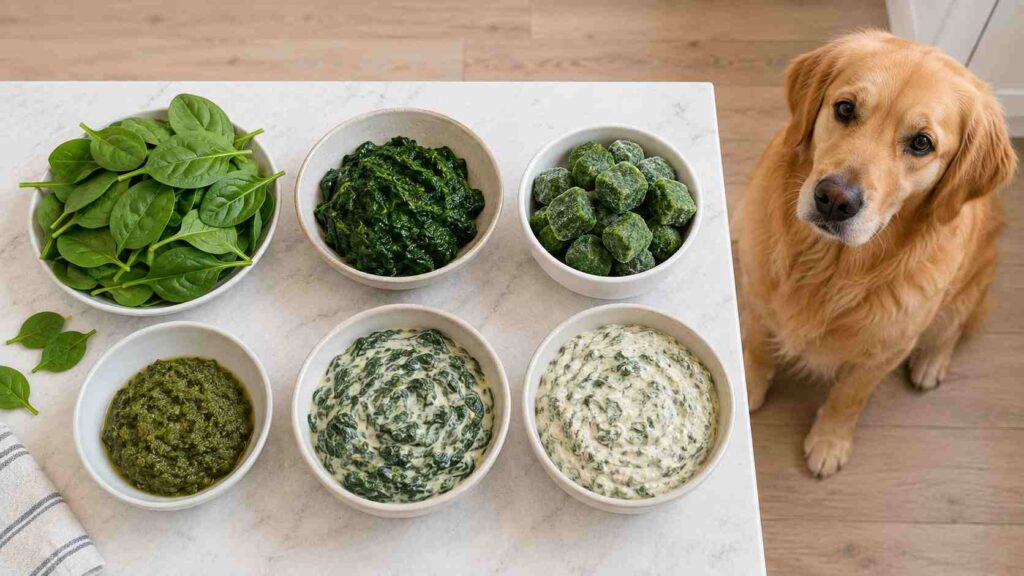
| Spinach Form | Main Thing to Check | Practical Use | Main Concern |
|---|---|---|---|
| Fresh/raw | Clean and appropriately chopped | Small occasional amount | Texture, digestive tolerance, oxalates |
| Steamed | No seasoning added | Simple occasional option | Portion and frequency still matter |
| Boiled | Kept plain | Can be offered occasionally | Cooking doesn’t make unlimited feeding appropriate |
| Baby spinach | Treat it like other spinach | Same occasional-use decision | “Baby” doesn’t remove the oxalate consideration |
| Frozen | Check the ingredient list | Plain frozen spinach may be suitable | Added sauces or seasonings |
| Canned | Sodium and additives | Less straightforward choice | Often contains added salt |
| Creamed spinach | Check the entire recipe | Generally best skipped | Rich dairy, fat, salt, and possible onion/garlic |
| Spinach dip | Full ingredient list | Not equivalent to plain spinach | Several unsuitable ingredients may be present |
| Restaurant spinach | Recipe may be unknown | Requires extra caution | Hidden onion, garlic, salt, fat, or seasoning |
Raw, Cooked, or Steamed — What Preparation Actually Changes
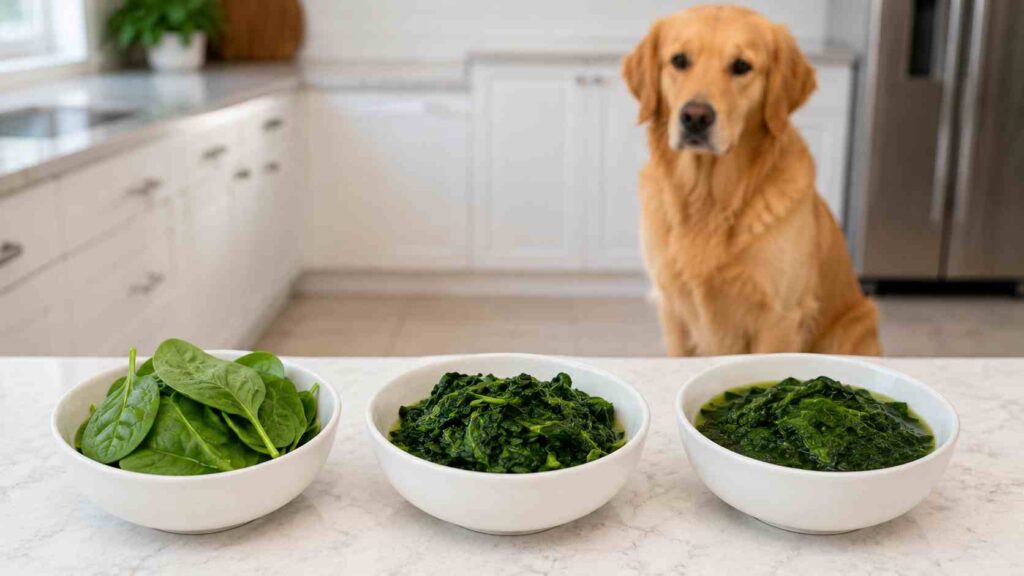
Raw spinach should be washed thoroughly and chopped into pieces appropriate for your dog’s size. Large or tough leaves can be awkward for small dogs or dogs that tend to gulp food, and some dogs simply digest cooked spinach more comfortably than raw leaves.
Lightly cooked spinach — steamed or boiled with nothing added — is softer and easier to portion. Cooking may change the texture and some of the nutrient content, but it does not turn spinach into an unlimited food or remove the need to consider oxalates, portion size, and frequency.
Fresh, frozen, and canned spinach are also an ingredient-label question. Plain frozen spinach can be very different from a seasoned frozen vegetable mix, while canned spinach may contain substantially more sodium than plain fresh or frozen spinach. Check the label rather than assuming all versions are equivalent.
If You Choose to Offer Spinach, Keep the Serving Boring
Wash it, keep it plain, and chop it to a size your dog can comfortably eat. Start with a very small amount, especially if spinach is new to them. Introduce it on its own rather than alongside several new foods so that any vomiting, diarrhea, gas, or other digestive upset is easier to trace.
Treat spinach as an occasional extra, not a nutritional supplement. Treats and table foods should fit within your dog’s overall diet rather than being added on top without thought.
A dog tolerating spinach once also doesn’t mean daily feeding is automatically a good idea. If your dog is on a therapeutic diet — particularly a renal or urinary diet — check with your veterinarian before adding spinach or other extras.
Quick Tips
- Keep spinach plain: no garlic, onion, salt, butter, sauces, or seasoning.
- Start with a small amount rather than a human-sized portion.
- Introduce one new food at a time.
- Stop offering it if it repeatedly causes digestive upset.
- Don’t make spinach a daily habit simply because your dog enjoys it.
- Check with your vet before adding extras to a prescription diet.
Spinach Has Nutrients — But Your Dog Doesn’t Need a Spinach Sales Pitch
Spinach contains fibre, folate, carotenoids, vitamin K, magnesium, potassium, and iron. That’s one reason it has such a strong “healthy food” reputation.
But nutrient content and nutritional necessity are two different things. A dog eating a complete and balanced diet should already be receiving the nutrients they need in appropriate amounts. A little spinach may add variety, but it isn’t filling a nutritional gap that automatically needs fixing.
One point deserves special mention: don’t use spinach to treat anemia. Seeing iron on a nutrition label doesn’t make spinach a treatment for low red blood cell levels. Anemia in dogs has many possible causes and needs proper veterinary diagnosis and treatment.
Bottom line: spinach is optional. Your dog does not need it to stay healthy, and choosing not to feed it is completely reasonable.
Some Dogs Need More Caution Than Others

Puppies
Growing puppies benefit from a carefully balanced diet, so keep extras such as spinach small and infrequent rather than using vegetables to replace part of their regular puppy food.
Senior Dogs
Age alone doesn’t make spinach unsafe, but senior dogs are more likely to have conditions or medications that affect what belongs in their diet. Their health history matters more than their age by itself.
Dogs With Sensitive Stomachs
Introduce any new food gradually and in a small amount. Loose stool or mild digestive upset after a new food may reflect intolerance rather than toxicity, but repeated or worsening symptoms deserve attention.
Dogs With a History of Urinary Stones
Dogs that have previously developed calcium oxalate stones or crystals need individualized dietary guidance. General advice for healthy dogs should not override a urinary diet prescribed to reduce recurrence risk.
Dogs With Kidney Disease
Kidney disease can require carefully controlled nutrition. Don’t add spinach or other “healthy” foods to a renal diet without checking with the veterinarian managing your dog.
Dogs on Prescription Diets
Whether the diet is urinary, renal, gastrointestinal, weight-management, or another therapeutic formula, don’t assume an extra food is harmless simply because it’s nutritious. Therapeutic diets are designed for a specific medical purpose, and unplanned additions can work against that plan.
When Spinach Isn’t Actually the Main Risk
If your dog ate spinach as part of a prepared dish, assess the whole recipe.
Garlic, onion, chives, and leeks create a separate toxicity concern. Butter, cream, cheese, and other rich ingredients can add enough fat to trigger digestive upset in some dogs. Prepared sauces and restaurant dishes may also contain far more salt and seasoning than you would use in plain spinach at home.
That means spinach dip, creamed spinach, spinach curry, and garlic-butter spinach should never be evaluated as though your dog simply ate a vegetable.
Warning Box
After an accidental ingestion:
- Don’t induce vomiting unless a veterinarian specifically instructs you to.
- Don’t give calcium or other supplements in an attempt to “neutralise” oxalates.
- Don’t assume every symptom that follows is caused by spinach.
- Don’t overlook onion or garlic simply because spinach was the main ingredient.
- Don’t panic over a tiny amount of plain spinach in an otherwise healthy dog that remains completely well.
What to Watch for After Your Dog Tries Spinach

Mild digestive signs can include:
- loose stool or diarrhoea
- vomiting
- gas
- reduced appetite
- abdominal discomfort
If these occur after a small new-food exposure, they may be brief. What matters more is whether they persist, worsen, or occur alongside other concerning signs.
Contact your veterinarian sooner if:
- vomiting is repeated
- your dog seems weak, painful, unusually quiet, or otherwise unwell
- you notice changes in urination
- the amount eaten was large or impossible to estimate
- the spinach contained onion, garlic, or other concerning ingredients
- your dog has kidney disease, urinary stone history, or another relevant medical condition
Before you call, have as much of this information ready as possible:
- your dog’s weight
- approximately how much was eaten
- whether it was raw, cooked, canned, frozen, or part of another dish
- the full ingredient list, if known
- when the ingestion happened
- any symptoms you’ve noticed
- relevant medical history
- details of any prescription diet
Those details help your veterinarian judge the actual exposure instead of trying to make a decision from the word “spinach” alone.
If Spinach Appears in Your Dog’s Commercial Food
Seeing spinach on a dog food ingredient list isn’t the same as feeding your dog a bowl of it. In a commercially formulated diet, spinach is included as one ingredient within the food’s overall nutritional profile rather than as a standalone serving.
There’s usually no reason to reject a complete and balanced food simply because spinach appears on the label. If your dog has a condition such as calcium oxalate urinary stones, kidney disease, or is on a therapeutic diet, ask your veterinarian whether that specific food is appropriate rather than judging it from one ingredient alone.
Homemade feeding is different. Copying the ingredients from a commercial food does not recreate its nutrient balance, proportions, or formulation, so a homemade diet should be properly formulated rather than assembled from an ingredient list.
Is Spinach Even the Easiest Vegetable Treat?
| Vegetable | Main Advantage | Main Limitation | Best Use Case |
|---|---|---|---|
| Spinach | Small leafy-green extra | Oxalate considerations | Healthy dogs, occasional use |
| Cucumber | Hydrating and low calorie | Large pieces may be difficult for small dogs or gulpers | Simple crunchy treat |
| Celery | Low calorie and crunchy | Stringy texture in larger pieces | Small, chopped treat |
| Green beans | Easy to serve plain | Avoid salty canned or seasoned versions | Simple low-calorie treat |
| Carrot | Easy to portion | Calories still count; large hard pieces may not suit every dog | Crunchy occasional treat |
| Lettuce | Light and simple | Offers little nutritional value in small servings | Occasional leafy extra |
There’s no reason spinach has to be your dog’s vegetable treat. If your dog enjoys cucumber, green beans, carrots, or another suitable option and you’d rather avoid the extra oxalate considerations, choosing something simpler is perfectly reasonable.
Common Mistakes That Turn a Simple Treat Into a Bad Decision
- Assuming “healthy for humans” means unlimited for dogs.
- Feeding a human-sized portion.
- Giving spinach every day because it’s marketed as a superfood.
- Treating seasoned spinach the same as plain spinach.
- Overlooking onion or garlic in mixed dishes.
- Using canned spinach without checking sodium and other additives.
- Assuming cooking removes every concern.
- Ignoring a history of calcium oxalate stones or urinary disease.
- Giving the same portion to a toy breed and a large dog.
- Letting vegetables replace part of a complete and balanced diet without proper formulation.
- Trying to treat anemia with spinach instead of seeking veterinary care.
- Assuming one well-tolerated serving means daily feeding is automatically appropriate.
Vet Advice — When Your Dog’s Medical History Matters More Than the Vegetable

If your dog has a history of calcium oxalate stones, urinary crystals, kidney disease, recurrent urinary problems, or a prescription diet, speak with your veterinarian before making spinach a regular part of their diet. General feeding advice isn’t designed to replace an individual therapeutic plan.
When you contact your vet, give them the context they actually need:
- your dog’s weight
- approximately how much spinach was eaten
- how often it has been fed
- whether it was raw, cooked, canned, or part of another dish
- any other ingredients involved
- when the ingestion occurred
- any symptoms
- relevant medical history
- details of any prescription diet
If your dog develops vomiting or diarrhoea after eating spinach, don’t automatically assume oxalates are responsible. Digestive signs have many possible causes. What matters is whether the symptoms are mild and brief or persistent, repeated, or accompanied by other signs of illness.
Key Takeaways
- A small amount of plain spinach can be an occasional extra for many healthy dogs.
- Oxalates matter most when a dog has a history of calcium oxalate stones or another relevant medical condition.
- Prepared spinach dishes may be more concerning because of ingredients such as onion, garlic, excessive salt, or rich sauces.
- Spinach is optional; a complete and balanced diet does not need spinach added for nutritional completeness.
- Dogs on prescription diets or with kidney or urinary disease need individualized veterinary advice.
The Bottom Line
Spinach sits somewhere in the middle of dog-safe human foods: it isn’t something most healthy dogs need to avoid completely, but it also isn’t a food they need.
If you choose to offer it, keep it plain, occasional, and modest for your dog’s size. Pay more attention to medical history and the rest of the recipe than to spinach’s “superfood” reputation. And if your dog has urinary stones, kidney disease, or a prescription diet, let your veterinarian make the call.
Frequently Asked Questions
1.Can dogs eat spinach every day?
It’s better treated as an occasional extra rather than a daily addition. Routine feeding adds little nutritional value for a dog already eating a complete diet and makes the oxalate question more relevant, particularly in dogs with urinary or kidney concerns.
2.Does cooking spinach remove all the oxalates?
No. Cooking can change oxalate levels, but it does not make spinach oxalate-free. Portion size, frequency, and your dog’s medical history still matter.
3.Should I worry if my dog ate one spinach leaf off the floor?
For an otherwise healthy dog, one plain spinach leaf is unlikely to cause a problem. Monitor your dog as you would after any unfamiliar food and contact your vet if concerning symptoms develop.
4.Can dogs with kidney disease eat spinach?
This needs an individual answer from the veterinarian managing the kidney disease. Renal diets are often carefully formulated, so adding extra foods without guidance may work against the nutritional plan.
5.Why is spinach sometimes listed in commercial dog food?
Because a small amount can be included as part of a complete formulation. That is different from feeding spinach separately or in large portions at home.
6.Does spinach help with anemia in dogs?
Spinach should not be used as a treatment for canine anemia. Anemia has many possible causes and requires veterinary diagnosis and treatment; the iron in spinach is not a substitute for that care.
7.Is spinach a better treat than cucumber or green beans?
Not necessarily. Cucumber and plain green beans are often simpler choices because they don’t come with the same oxalate considerations. Spinach is just one optional treat, not a superior one.
#. Related Articles: