

If your dog just grabbed a strawberry off the counter, here’s the short version: yes, dogs can eat strawberries, and a small amount of fresh, plain strawberry is usually fine for a healthy dog. But “safe” still depends on what your dog ate, how much they ate, and how it was prepared.
A plain strawberry isn’t the same as strawberry jam. A small sliced piece isn’t the same as several whole berries swallowed in one go. And a healthy adult Labrador isn’t the same as a diabetic dog, an overweight dog, or a puppy that bolts food without chewing.
So before you decide whether to worry, ask yourself four questions: What exactly did your dog eat? How much? Was it fresh or part of another food? And does your dog have any health conditions that change the picture?
The strawberry itself is usually the easy part. Quantity, preparation, additional ingredients, and your individual dog’s health are what matter most.
Can Dogs Eat Strawberries Safely?
The Answer for a Healthy Adult Dog
For most healthy adult dogs, fresh, plain strawberries are safe as an occasional treat. Wash them, remove the green top, cut them into pieces appropriate for your dog’s size and eating habits, and serve them without added sugar, cream, syrup, or other toppings.
“Safe” Doesn’t Mean Unlimited
Strawberries contain natural sugar and fibre. A small serving is unlikely to cause trouble in most healthy dogs, but eating a lot at once can lead to loose stools, vomiting, or general digestive upset.
Strawberries also still contribute calories. Think of them as a treat rather than part of your dog’s nutritionally complete diet, and remember that training treats, chews, table scraps, and other extras all count too.
When the Answer Needs More Thought
Some dogs deserve a more individual approach before strawberries become a regular treat, including:
- Puppies
- Toy and very small breeds
- Dogs that gulp food without chewing
- Dogs with diabetes
- Dogs that are overweight or on calorie restriction
- Dogs with sensitive stomachs or chronic digestive disease
- Dogs eating a veterinary prescription diet
- Dogs with swallowing difficulties
For these dogs, the issue may be portion size, texture, sugar, calories, or whether adding any extra food fits their medical diet.
Your Dog Already Ate Strawberries — Start Here
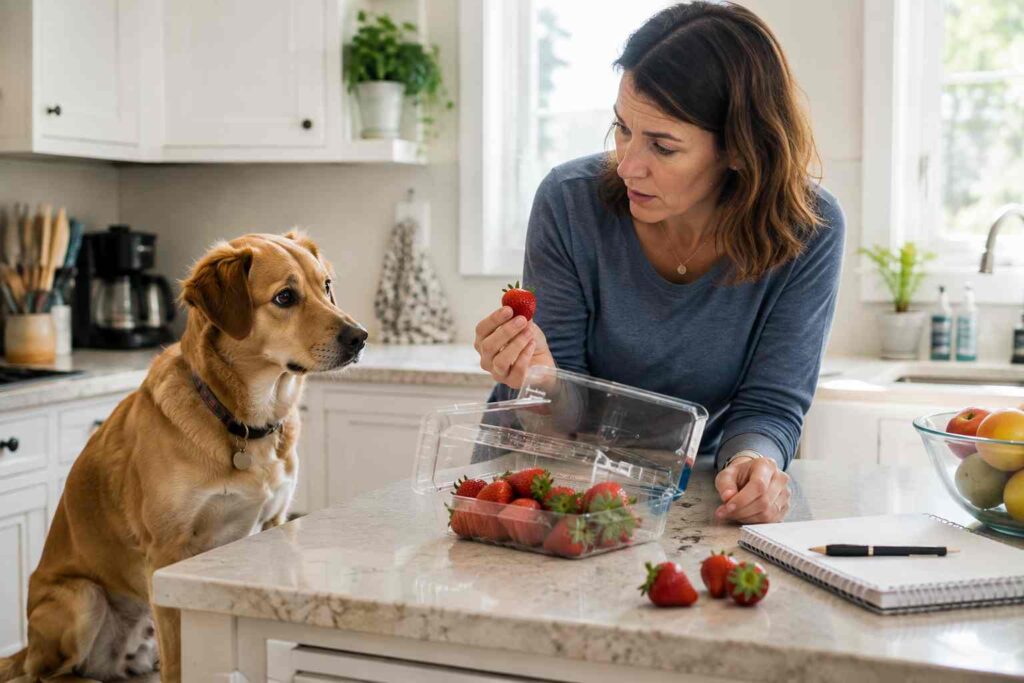
If you’re reading this because your dog has already helped themselves, focus first on what was eaten and how your dog looks now.
What Exactly Was Eaten?
Not all “strawberry incidents” carry the same concern. Work out which situation applies:
- A small amount of plain fresh strawberry
- A whole berry swallowed without chewing
- Several berries at once
- Leaves or stems from a garden plant
- Frozen or dried strawberries
- Strawberry jam, yoghurt, ice cream, cake, or another dessert
- A “sugar-free” strawberry product
Then Check These Four Things
- Amount: roughly how much was eaten?
- Form: was it fresh, frozen, dried, or processed?
- Dog: what is your dog’s size, age, and medical history?
- Symptoms: is your dog behaving normally now?
Context makes a big difference. A healthy Labrador that eats one sliced strawberry would generally be a low-concern situation. A Chihuahua that swallows a large berry whole raises more concern about choking or difficulty swallowing than strawberry toxicity.
A strawberry-containing human food deserves a different assessment again. With jam, yoghurt, ice cream, cakes, and sugar-free products, check the entire ingredient list rather than focusing only on the strawberry.
In particular, look for xylitol in sugar-free products. Xylitol can cause a rapid and potentially severe drop in blood sugar in dogs and, at higher exposures, may cause liver injury. Merck Veterinary Manual advises checking the ingredient list of sugar-free foods for xylitol and seeking veterinary care after a concerning exposure.
Do not try to make your dog vomit after suspected xylitol ingestion unless a veterinarian specifically tells you to do so. Because signs can develop quickly, Merck recommends that vomiting be induced only under veterinary supervision.
Quick Decision Checklist
- Was it plain strawberry or a processed product?
- Roughly how much was eaten?
- Was a large berry swallowed whole?
- Was it fresh, frozen, dried, or prepared in another food?
- Have you checked the ingredient label?
- Could the product contain xylitol or another unsafe ingredient?
- Does your dog have diabetes or another medical condition?
- Is your dog vomiting repeatedly, unusually weak, swollen around the face, choking, collapsing, or struggling to breathe?
If your dog ate only a small amount of plain strawberry and remains completely well, monitoring at home is usually reasonable. If a processed product contains xylitol, the ingredients are unclear, your dog swallowed something that may be obstructing the airway, or concerning symptoms develop, contact a veterinarian promptly rather than waiting for symptoms to worsen.
What Parts of a Strawberry Can Dogs Eat?

Strawberry Flesh
This is the part you actually want to feed. Fresh strawberry flesh is generally safe for dogs in small amounts when it is plain, washed, and cut into appropriately sized pieces. PDSA includes strawberries among dog-friendly fruits and recommends serving fruit plain and in bite-sized pieces.
The Tiny Surface Seeds
Those little seeds dotted across the surface of a strawberry aren’t the same as the hard pits found in fruits such as peaches or plums. They’re tiny and don’t need to be removed before serving.
Green Tops, Stems, and Leaves
The green top, stem, and leaves aren’t considered toxic, but they’re tougher and less digestible than the flesh and may cause stomach upset. Removing them before serving is the simplest option.
Garden-Picked Strawberries
If your dog has helped themselves straight from a strawberry patch, think beyond the fruit itself. Garden berries may have been exposed to pesticides, herbicides, fertilisers, or slug and snail products, and fallen fruit may be mouldy or spoiled.
There’s also a quantity problem: a dog with unrestricted access to a patch can eat far more than you’d intentionally offer. Wash garden-picked berries before feeding them, keep garden chemicals inaccessible, and don’t let your dog graze freely from the plants.
Fresh, Frozen, Dried, or Processed — They’re Not the Same

This is where the risk can change considerably. A plain fresh berry and a strawberry-flavoured dessert may share a name, but they shouldn’t be treated as the same food.
| Strawberry form | General suitability | Main concern | What to check |
|---|---|---|---|
| Fresh, plain | Usually fine in moderation | Portion size, choking | Wash, trim, cut appropriately |
| Frozen, plain | Can be fine | Hard texture, choking | Cut appropriately; consider allowing it to soften |
| Mashed or puréed | Usually fine if plain | Easy to over-serve | No added ingredients |
| Freeze-dried | Depends on the product | Concentrated portion | Added sugar or other ingredients |
| Dried | More caution needed | Concentrated sugar and calories | Full ingredient list |
| Canned | Usually best avoided | Syrup, added sugar, sweeteners | Packaging and ingredient list |
| Jam or jelly | Generally unsuitable | Sugar and other ingredients | Sweeteners, especially xylitol |
| Strawberry yoghurt | Product-dependent | Sugar, sweeteners, dairy | Full ingredient list |
| Strawberry ice cream | Generally unsuitable | Sugar, fat, dairy, additives | Full ingredient list |
| Strawberry cake or dessert | High caution | Other ingredients may be unsafe | The entire recipe |
| “Sugar-free” strawberry product | High caution | Possible toxic sweeteners | Check specifically for xylitol |
Canned strawberries and fruit packed in syrup are best skipped, and processed strawberry foods should always be judged by their complete ingredient list, not by the strawberry content alone.
Warning: If a sugar-free strawberry product contains xylitol, contact a veterinarian promptly. Xylitol can cause profound hypoglycaemia in dogs and, in some cases, serious liver injury. Do not try to make your dog vomit unless a veterinarian specifically directs you to do so.
How to Prepare Strawberries for a Dog
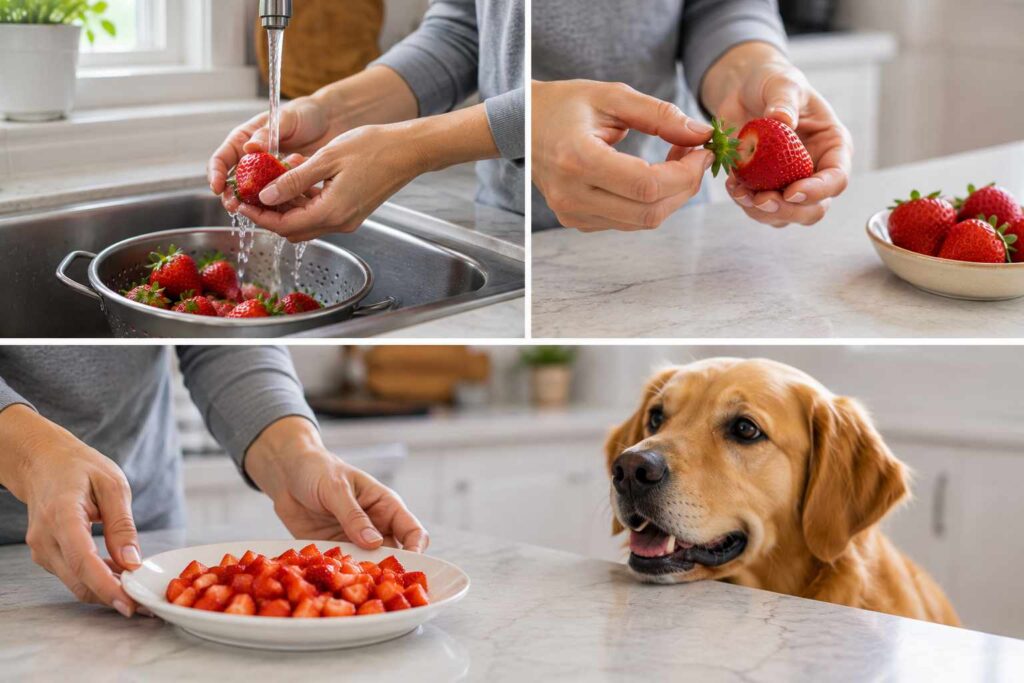
Getting this right takes about thirty seconds:
- Wash them first. Rinse away dirt and surface residue.
- Remove the green top and stem. They offer no useful benefit and are harder to digest.
- Cut for the dog in front of you. A suitable piece for a Labrador may be far too large for a Chihuahua. Mouth size matters, but so does eating style—a large dog that gulps food can still benefit from smaller pieces.
- Start small the first time. Offer one small piece on its own rather than alongside several other new foods, then watch for vomiting, diarrhoea, itching, or other unusual changes.
Quick Tips
- Keep pieces small and easy to chew for puppies and small dogs.
- Don’t hand a food-gulping dog a large, rock-hard frozen strawberry.
- Serve strawberries plain—no sugar, cream, chocolate, syrup, or seasoning.
- If freezing them, cut them before serving rather than assuming frozen automatically means safer.
- Treat strawberries as an occasional extra, not part of the main meal.
How Much Strawberry Makes Sense?
You’ll often see advice such as “one strawberry for a small dog,” but that can be misleading because strawberries vary enormously in size. Dogs do too.
A better approach is to use small pieces relative to your dog’s size and total diet, rather than treating whole berries as a standard unit. A toy dog may need only a small piece or two, while a larger dog can accommodate more. Even then, strawberries should remain a modest treat rather than a bowlful.
Also consider everything else your dog receives that day. Training rewards, chews, table scraps, dental treats, and fruit all contribute to the same overall treat allowance. Veterinary nutrition guidance commonly uses the principle that treats should account for no more than about 10% of daily calories.
There’s no nutritional reason a healthy dog needs strawberries every day. Keeping them as an occasional treat makes portion control easier, especially for small, sedentary, overweight, or diabetic dogs.
What Strawberries Actually Add to a Dog’s Diet

Strawberries contain water, fibre, natural sugars, vitamin C, potassium, folate, and antioxidant compounds such as polyphenols.
That sounds impressive, but it needs context. A dog eating a complete and balanced diet should already be receiving the nutrients they require from their main food. Strawberries are an optional treat, not a nutritional supplement, and your dog isn’t missing anything essential if they never eat them. PDSA similarly treats fruit as an extra rather than a necessary part of a dog’s diet.
You may also see claims that strawberries clean or whiten dogs’ teeth. That isn’t a good reason to feed them. Even where such claims are repeated, strawberries shouldn’t be presented as meaningful dental care and certainly don’t replace tooth brushing, veterinary dental checks, or professional treatment when needed.
Dogs Who Need a More Individual Answer
Puppies
Puppies can have appropriately prepared strawberries, but start with a tiny amount. Their nutritionally complete growth diet should remain the priority, and small pieces are especially important for puppies that gulp food.
Dogs With Diabetes
Strawberries contain natural sugar, so a diabetic dog needs a more individual feeding plan. Don’t rely on a generic strawberry allowance—check with your veterinarian before making them a regular treat.
Overweight Dogs
The occasional small piece may still fit, but “it’s fruit” doesn’t mean “it doesn’t count.” Include strawberries when considering your dog’s total daily calories and other treats.
Dogs With Sensitive Digestion
Extra fruit may trigger loose stools or other digestive upset in some dogs, particularly if they receive too much at once. If your dog has chronic gastrointestinal disease or is already experiencing vomiting or diarrhoea, speak to your veterinarian before introducing new treats.
Dogs on a Veterinary Prescription Diet
Don’t automatically add strawberries—or any other extra food—to a therapeutic diet. These diets may be carefully designed to manage a specific condition, so check with the veterinarian overseeing your dog’s treatment first.
Dogs That Gulp or Have Trouble Swallowing
For these dogs, texture and preparation matter more than body size alone. Cut strawberries into manageable pieces and avoid large, whole, or very hard frozen berries. If your dog has a diagnosed swallowing disorder, ask your veterinarian what food textures are appropriate.
When Strawberries Cause Problems

Eating too many strawberries at once can cause loose stools, diarrhoea, vomiting, or abdominal discomfort. Mild digestive upset often settles once the extra fruit is out of the system, but repeated vomiting, persistent diarrhoea, or worsening symptoms deserve veterinary advice.
Choking is a separate physical risk. A large whole berry or hard frozen strawberry may be difficult to swallow, especially for toy breeds, puppies, dogs with swallowing problems, or dogs that gulp food instead of chewing.
Food sensitivity or allergy is uncommon but possible. After the first few times your dog eats strawberries, watch for itching, hives, facial swelling, vomiting, or diarrhoea. Facial swelling or breathing difficulty should never be treated as a simple upset stomach.
It helps to separate mild digestive trouble from something more serious. A single loose stool in an otherwise bright, comfortable dog is very different from repeated vomiting, marked lethargy, swelling, weakness, or breathing changes.
A Word of Warning: Sometimes the Strawberry Isn’t the Problem
Plain strawberries are generally low-risk. Processed strawberry foods are different because the other ingredients may matter far more than the fruit itself.
Strawberry-flavoured products may contain chocolate, grapes or raisins, large amounts of fat or sugar, or sweeteners that are unsafe for dogs. Xylitol is particularly important: Merck Veterinary Manual states that xylitol-containing products can cause profound hypoglycaemia in dogs and, in some cases, serious liver injury.
If a product says “sugar-free,” check the ingredient list rather than assuming it is safer. If xylitol is listed or you suspect your dog ate it, contact a veterinarian urgently. Do not try to induce vomiting at home unless a veterinarian specifically instructs you to; Merck advises that emesis for xylitol exposure should be attempted under veterinary supervision.
Monitor at Home, Call the Vet, or Seek Urgent Help?

Usually Lower Concern
A small amount of plain strawberry eaten by an otherwise healthy dog that remains bright, comfortable, and symptom-free can usually be monitored at home.
Monitor More Closely
Keep a closer eye on your dog if:
- They ate a much larger amount than you would normally offer
- Mild vomiting or diarrhoea develops
- A large berry was swallowed whole
- A puppy or very small dog was involved
- Your dog has a history of sensitive digestion
If mild symptoms continue, recur, or worsen rather than settling, contact your veterinarian.
Contact Your Vet
Seek veterinary advice if:
- Vomiting or diarrhoea is persistent or repeated
- A very large quantity was eaten
- Your dog has diabetes or another relevant medical condition
- The ingredient list of a processed product is unclear
- Your dog’s behaviour or energy level has changed noticeably
- You are unsure whether another ingredient may be harmful
Seek Urgent Veterinary Help
Get urgent veterinary help if your dog develops:
- Difficulty breathing
- Facial or throat swelling
- Collapse
- Seizures
- Marked weakness or loss of coordination
- Choking or obvious difficulty swallowing
- Suspected xylitol exposure
Xylitol-related hypoglycaemia can develop rapidly, so suspected exposure is not a “wait and see” situation.
Vet Advice: What to Have Ready
Before calling, gather:
- Your dog’s approximate weight
- What was eaten
- Roughly how much was eaten
- Approximately when it happened
- The packaging or ingredient label, if available
- Any symptoms you have noticed
- Relevant medical conditions
- Current medications or prescription diets
Those details can help your veterinarian judge the risk far more accurately than simply knowing that your dog “ate strawberry.”
Common Strawberry Feeding Mistakes

- Giving a small dog a whole large berry instead of cutting it down
- Assuming fruit can be fed freely because it is “healthy”
- Offering a large portion the first time
- Introducing several unfamiliar foods at once
- Forgetting to count strawberries among the day’s other treats
- Giving hard frozen whole berries to a dog that gulps
- Feeding leafy tops unnecessarily
- Skipping the wash, even with organic fruit
- Sharing canned strawberries packed in syrup
- Assuming every strawberry yoghurt is dog-safe
- Assuming “sugar-free” automatically means safer
- Ignoring diabetes, obesity, or a veterinary prescription diet
- Overstating vitamins or antioxidants as a reason to feed strawberries regularly
Key Takeaways
Fresh, plain, washed strawberries are generally safe in small amounts for most healthy dogs. Problems are more likely to come from too much fruit, unsuitable preparation, choking, an individual health condition, or other ingredients in processed strawberry foods.
Keep portions modest, cut berries to suit the dog in front of you, and check ingredient labels carefully—especially on anything labelled sugar-free.
For a healthy dog, sharing a few properly prepared pieces now and then doesn’t need to be complicated. For a dog with diabetes, chronic digestive disease, swallowing problems, or a prescription diet, it is worth checking with your veterinarian before making strawberries a routine treat.
Frequently Asked Questions
1.Can puppies eat strawberries?
Yes, puppies can have small amounts of plain, properly prepared strawberry. Start with a tiny piece, introduce only one new food at a time, and keep a complete and balanced puppy diet as the nutritional priority.
2.Can dogs eat strawberry seeds?
Yes. The tiny seeds on the outside of a strawberry do not need to be removed before feeding.
3.Can dogs eat frozen strawberries?
Plain frozen strawberries can be suitable, but preparation still matters. Cut them into manageable pieces and avoid giving a small dog or food-gulper a large, rock-hard frozen berry because it may pose a choking risk. AKC also recommends cutting strawberries into small pieces before feeding them.
4.Can diabetic dogs eat strawberries?
Possibly, but the natural sugar content and overall diet need to be considered. A diabetic dog should not be given a generic serving allowance; check with the veterinarian managing your dog’s diabetes before making strawberries a regular treat.
5.Can strawberries give dogs diarrhoea?
Yes. Eating too many strawberries can cause digestive upset, including loose stools or diarrhoea. If diarrhoea is severe, persistent, accompanied by repeated vomiting, or your dog seems unwell, contact your veterinarian.
6.What should I do if my dog swallowed a large whole strawberry?
Watch immediately for gagging, coughing, difficulty swallowing, or trouble breathing. If your dog is breathing normally and appears comfortable, continue monitoring for vomiting or other unusual signs. Difficulty breathing or an active choking episode requires urgent veterinary help.
7.Can dogs eat strawberry yoghurt?
It depends on the product. Some plain yoghurt may be tolerated by individual dogs, but strawberry yoghurt can contain added sugar, sweeteners, or other ingredients your dog does not need. Check the full label before offering any, and avoid the product entirely if it contains xylitol.
#. Related Articles: