

Can dogs have watermelon? Yes, most healthy dogs can enjoy a small amount of plain watermelon flesh as an occasional treat, but the rind, seeds, portion size, and your dog’s individual health all matter.
Watermelon season and dog ownership often collide on the same afternoon: you’re halfway through a slice on the patio, and your dog is sitting there with that unmistakable “share it with me” look.
The more useful question isn’t simply whether watermelon is safe. It’s which part can your dog eat, how much makes sense, and what should you do if they’ve already swallowed the rind or seeds?
Watermelon flesh, seeds, rind, and watermelon-flavoured products are not interchangeable. Plain flesh can make an occasional treat, while the rind is difficult to digest and may create a choking or intestinal-obstruction risk. Not poisonous does not automatically mean safe to swallow.
First, Work Out What Your Dog Is Actually About to Eat
Plain Red Flesh
Plain, unseasoned watermelon flesh is the part most dogs can safely have in moderation. It is water-rich and relatively low in calories compared with many conventional treats.
That does not make it nutritionally necessary. Think of watermelon as an occasional extra rather than something your dog needs for a balanced diet.
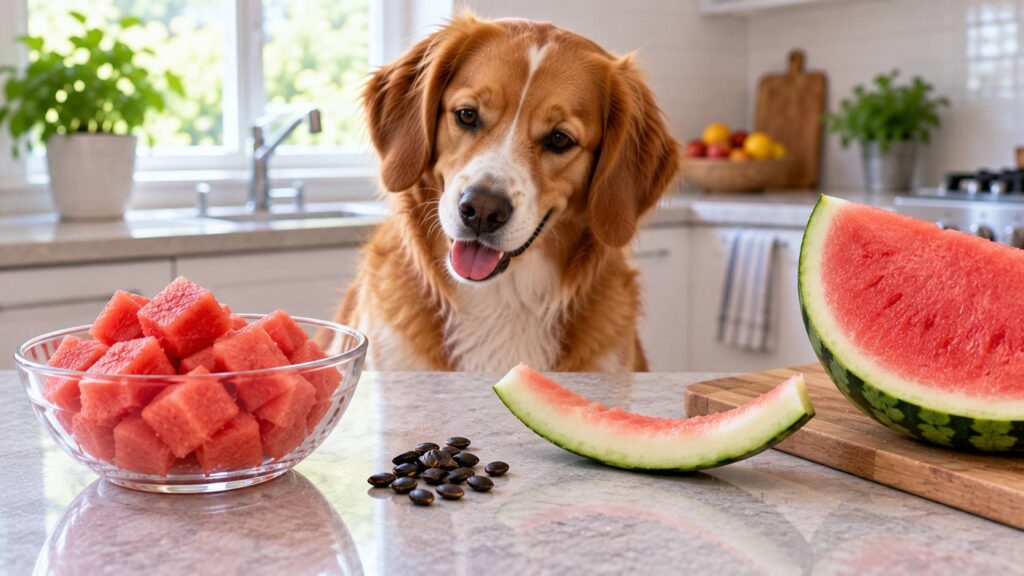
Black Mature Seeds
Remove mature black seeds before serving watermelon deliberately.
A single seed accidentally swallowed by a larger dog is very different from a small dog consuming a substantial number of seeds. The practical concern increases with the number of seeds, the dog’s size, and how much was swallowed, rather than every stray seed automatically being an emergency.
Tiny White Seeds in “Seedless” Watermelon
Seedless watermelon is not always literally seed-free. It can contain small, soft, underdeveloped white seeds.
These are generally less concerning than mature black seeds, but “seedless” still does not mean “no preparation required.” Check the fruit before serving it and remove the rind completely.
White Inner Rind and Hard Green Rind
The rind deserves more attention than the flesh.
It is tough, fibrous, and poorly digested. A dog that swallows a sizable piece may choke or develop a gastrointestinal obstruction further down the digestive tract. Dogs that gulp food instead of chewing it thoroughly deserve extra caution.
The key distinction is that rind is primarily a mechanical hazard, not a classic poisoning problem.
Juice, Sorbet, Popsicles and Flavoured Products
The word “watermelon” on a label does not tell you whether a product is safe for dogs.
Human watermelon products may contain:
- Added sugar
- Sugar substitutes
- Dairy
- Chocolate
- Grapes or raisins in mixed-fruit products
- Other flavourings or additives
- Wooden sticks or skewers
Xylitol is particularly dangerous to dogs and can cause severe poisoning. Always check the complete ingredient list rather than assuming a watermelon-flavoured food is equivalent to plain fruit.
Which Form of Watermelon Is the Better Choice?

| Form | Main Issue | Routine Treat? | Prep Needed | Main Caution |
|---|---|---|---|---|
| Plain fresh flesh | Portion size | Usually | Remove rind and mature seeds | Too much may upset the stomach |
| Seedless flesh | Portion + stray seeds | Usually | Inspect and cut | Rind still needs removing |
| Mature seeds | Mechanical risk | No deliberate feeding | Remove before serving | Quantity and dog size matter |
| Hard rind | Choking / obstruction | No | Remove completely | Poorly digested |
| Frozen flesh | Texture / choking | Sometimes | Use suitable-sized pieces | Extra care with gulpers |
| Plain juice | Easy to overfeed | Usually unnecessary | Check ingredients | Offers little advantage over whole fruit |
| Human popsicle or sorbet | Added ingredients | Usually avoid | Read the label | Sweeteners and additives |
| Fruit salad | Other ingredients | Depends | Identify everything in it | Grapes or raisins may make the dish dangerous |
The Watermelon Decision: Five Things That Matter More Than “Yes or No”
Which part is involved? Flesh, mature seeds, rind, and a mixed dessert each present different concerns.
How much is involved? A lick, two small cubes, a stolen wedge, and a swallowed rind chunk are not the same exposure.
How big is your dog? A piece that is easily manageable for a Labrador may be a substantial mouthful for a Chihuahua. There is no universal “number of cubes” that suits every dog.
How does your dog eat? Dogs that carefully chew food are different from dogs that swallow treats almost whole. Gulpers need smaller pieces and closer supervision.
Does your dog have dietary or medical restrictions? Diabetes, excess weight, gastrointestinal sensitivity, a prescription diet, an elimination diet, or recent vomiting or diarrhoea can all change whether watermelon is a sensible choice.
Before Watermelon Goes in the Bowl

- Use plain watermelon only
- Remove the hard rind completely
- Remove mature black seeds
- Check seedless fruit rather than assuming it contains no seeds
- Keep the portion small
- Cut pieces to suit your dog’s mouth size and eating style
- Supervise while your dog eats
- Start with a particularly small amount the first time
- Count it alongside other treats given that day
- Make sure it does not conflict with a prescription or elimination diet
- Keep fresh drinking water freely available
Safe Doesn’t Mean Necessary
Watermelon provides water, naturally occurring sugars, some fibre, and several vitamins and minerals. Its high water content and relatively low calorie density can make it a lighter choice than many human snacks.
But “contains nutrients” is not the same as “your dog needs these nutrients from watermelon.” A dog eating an appropriate complete and balanced diet should already be receiving the nutrients required from its main food.
The hydration claim also needs perspective. Watermelon can contribute some fluid, but it cannot replace normal access to fresh drinking water, and it should never be used as a treatment for dehydration or heatstroke.
If a dog appears overheated, weak, confused, distressed, or otherwise unwell in hot weather, move them out of the heat and seek veterinary advice rather than relying on fruit to rehydrate them.
How Much Watermelon Makes Sense?

Instead of thinking about a separate “watermelon allowance,” think about your dog’s total treat budget.
WSAVA guidance recommends keeping treats and other extras to no more than about 10% of a healthy dog’s daily calories, with the remaining nutrition coming from a complete and balanced diet. That 10% is not reserved for watermelon—it includes training treats, chews, table scraps, fruit, and other extras combined.
Body weight alone does not determine the right amount. Calorie needs, body condition, activity level, the main diet, other treats, and medical conditions all matter.
For a first taste, offer a genuinely small piece rather than immediately serving a normal treat-sized portion. Introduce watermelon on its own instead of alongside several other unfamiliar foods, then watch for digestive changes such as loose stool, gas, or vomiting.
Be more conservative—or ask your veterinarian first—if your dog is:
- A puppy
- Very small
- Overweight or on a calorie-controlled plan
- Diabetic
- Prone to digestive upset
- On a veterinary prescription or therapeutic diet
Safer Watermelon in 30 Seconds
- Choose plain flesh
- Remove the rind
- Remove mature seeds
- Cut it into manageable pieces
- Start with a small amount
- Watch gulpers closely
- Treat watermelon as an extra, not a staple
- Keep fresh water available
- Skip human watermelon desserts unless every ingredient is confirmed safe
- Stop offering it if it repeatedly causes digestive upset
Fresh, Frozen or Processed? The Form Changes the Answer

Fresh watermelon cubes are the simplest option and the easiest to portion. Frozen pieces can also work, but avoid oversized, rock-hard chunks and take extra care with dogs that gulp rather than chew.
Juice and smoothies are usually unnecessary. They make it easy to consume more fruit quickly, and any added ingredients still need checking. Human popsicles, sorbet, and ice lollies are best avoided because they may contain added sugar, sweeteners, dairy, or other ingredients that are not suitable for dogs. Sticks and skewers create an additional physical hazard.
A product being watermelon-flavoured does not make it dog-safe. Check what is actually in it before sharing.
The Watermelon May Not Be the Dangerous Ingredient
When a watermelon-based product causes a problem, the fruit itself may not be the main concern. More serious risks can come from ingredients or packaging such as:
- Xylitol or other unsuitable sweeteners
- Chocolate
- Grapes or raisins
- Alcohol-containing drinks
- Wooden sticks or skewers
- Rich or high-fat dairy ingredients
- Unknown ingredients in mixed desserts or drinks
If you think your dog may have eaten something toxic, contact your veterinarian or an appropriate pet poison service promptly. Do not try to induce vomiting at home unless a veterinarian specifically tells you to.
Your Dog Already Ate Watermelon? Here’s How to Assess It

Start with the exposure rather than the symptom list.
Work out what was eaten. Plain flesh, seeds, rind, a whole wedge, or a mixed dessert each raise different concerns.
Estimate the amount. A rough idea of the portion, how much rind is missing, and how many seeds may have been swallowed can help a veterinarian assess the situation.
Compare your dog’s size with the piece size. A small dog swallowing a substantial rind chunk is more concerning than a large dog accidentally swallowing one stray seed.
Check how your dog is acting now. Mild loose stool after eating too much flesh is different from repeated vomiting, abdominal pain, marked lethargy, loss of appetite, difficulty passing stool, or breathing problems.
Know when to call. Contact your vet if your dog swallowed a large or uncertain amount of rind, develops repeated vomiting, appears painful, becomes unusually lethargic, has trouble breathing, cannot keep food or water down, or is getting worse.
Too Much Flesh or Something More Concerning?
| Observation | Simple Overindulgence | More Concerning After Rind |
|---|---|---|
| Mild loose stool | Possible | Possible; consider the full context |
| Mild gas | Possible | Non-specific |
| One isolated vomit | Possible | Needs context |
| Repeated vomiting | More concerning | Important warning sign |
| Loss of appetite | Less typical | Concerning |
| Abdominal pain | Needs assessment | Concerning |
| Marked lethargy | Not typical of simple overfeeding | Concerning |
| Difficulty passing stool | Less typical | Possible obstruction concern |
| Breathing or choking problem | Emergency | Emergency |
This table is a guide to risk recognition, not diagnosis. If symptoms are significant, persistent, or worsening, veterinary assessment is the safer option.

Why Rind Deserves the Most Caution
Watermelon rind is not mainly a poisoning problem. The concern is mechanical: a large piece can cause choking before it reaches the stomach or become lodged farther along the gastrointestinal tract.
A dog may also look completely normal soon after swallowing rind. That is why “she seems fine right now” should not be treated as a guaranteed all-clear, particularly when a sizeable piece is missing.
Dog size and swallowed-piece size matter together. A small rind fragment and a large swallowed strip do not carry the same level of concern, and there is no single rule that fits every dog.
What About Watermelon Seeds, Specifically?
Mature black seeds are best removed before intentionally feeding watermelon.
One accidentally swallowed seed in an otherwise well dog is not the same situation as a small dog swallowing many seeds. The practical concern rises with the number swallowed, the dog’s size, and any symptoms that follow.
The soft, pale seeds sometimes found in seedless watermelon are different from mature black seeds and are generally less concerning. Even so, giving the fruit a quick check before serving is sensible.
Avoid alarmist claims that every watermelon seed causes a blockage. Risk depends on context rather than a single seed being automatically dangerous.
Some Dogs Need a Different Answer

Diabetic Dogs
Watermelon contains naturally occurring sugar, so it should not be added casually to a diabetic dog’s diet. Ask your veterinarian whether it fits your dog’s individual feeding plan.
Overweight or Calorie-Restricted Dogs
Watermelon still counts as a treat. It should come from the same overall treat allowance as training rewards, chews, table scraps, and other extras rather than being treated as a “free” food.
Dogs With Sensitive Digestion
A new fruit can trigger loose stool, gas, or vomiting in some dogs, especially if too much is offered at once. Start with a very small amount or skip it if your dog regularly reacts poorly to dietary changes.
Dogs on Prescription or Elimination Diets
Do not add watermelon simply because it seems healthy. Prescription and elimination diets often depend on tight control over ingredients, so check before introducing extras.
Puppies
Offer only a tiny first portion, keep pieces appropriately sized, and do not let treats displace nutritionally complete puppy food. Puppies that gulp food should be supervised particularly closely.
Dogs That Swallow Treats Whole
For these dogs, shape, texture, and piece size matter as much as the ingredient itself. Avoid large pieces and be especially cautious with firm frozen chunks.
Common Mistakes That Turn a Safe Treat Into a Problem

- Handing over a whole wedge with the rind still attached
- Assuming “seedless” means no preparation is needed
- Treating high water content as permission to feed a large portion
- Letting watermelon become a substantial part of the day’s food instead of a small treat
- Giving large frozen chunks to a dog that gulps
- Sharing human watermelon desserts without checking every ingredient
- Using watermelon as a substitute for fresh drinking water or proper care for heat illness
- Assuming a dog that looks fine immediately after swallowing rind cannot develop a problem later
Contact a Vet Rather Than Guessing When…
Contact your veterinarian promptly if:
- A large or unknown amount of rind has been swallowed
- Your dog is choking or struggling to breathe
- Vomiting is repeated or persistent
- There is significant abdominal pain or swelling
- Your dog seems unusually or markedly lethargic
- They refuse food after a concerning ingestion
- They are straining or having difficulty passing stool
- Symptoms are worsening rather than improving
- Your dog has a medical condition that could affect the situation
- A watermelon-based product contains a potentially toxic ingredient
- You cannot confidently determine what or how much your dog ate
Breathing difficulty or active choking is an emergency. For other concerning exposures, don’t wait for severe symptoms before asking for veterinary advice, particularly if a substantial piece of rind is missing.
Do not try to induce vomiting unless a veterinarian specifically instructs you to. It is not appropriate for every ingestion, and attempting it without professional guidance can cause additional harm.
Watermelon vs Other Common Dog-Safe Fruits

| Food | Main Advantage | Main Limitation |
|---|---|---|
| Watermelon | Water-rich and relatively low in calories | Rind and mature seeds need removing |
| Cucumber | Water-rich and easy to prepare | Still needs sensible portioning and cutting |
| Blueberries | Naturally small and convenient | Quantity still matters |
| Banana | Easy to portion and serve | More calorie- and sugar-dense |
| Pumpkin | May be useful in certain digestive situations | Type, amount, and preparation matter |
None of these fruits is nutritionally necessary for a dog eating an appropriate complete and balanced diet. The best choice depends on the individual dog, the portion, and how the food is prepared.
The Bottom Line
Dogs can eat watermelon, provided you’re talking about small amounts of plain flesh rather than rind or a watermelon-flavoured human product.
Remove the hard rind and mature seeds, cut the flesh into manageable pieces, and keep it within your dog’s overall treat allowance. The rind deserves the most caution because swallowed pieces can become a choking or gastrointestinal-obstruction hazard.
Watermelon can contribute some fluid, but it should not be treated as a substitute for fresh drinking water or as a remedy for dehydration or heat illness.
Most importantly, feed the dog in front of you. A healthy adult that chews carefully, a tiny puppy that gulps, and a dog on a prescription diet do not necessarily need the same approach.
Frequently Asked Questions
1.Can dogs eat watermelon safely?
Yes. Most healthy dogs can have small amounts of plain watermelon flesh as an occasional treat. Remove the hard rind and mature seeds first, and introduce it gradually if your dog has never eaten it before.
2.Can dogs eat watermelon rind?
Watermelon rind should not be intentionally fed to dogs. It is tough and poorly digested, and swallowed pieces can create a choking or intestinal-obstruction risk.
If your dog has swallowed a substantial piece—especially if they’re small, the amount is unknown, or symptoms develop—contact your veterinarian for advice.
3.My dog ate watermelon rind but seems fine. What should I watch for?
Don’t use normal behaviour immediately after the incident as a guaranteed all-clear. Watch for repeated vomiting, loss of appetite, abdominal pain or swelling, unusual lethargy, or difficulty passing stool.
If a large piece is missing, you’re unsure how much was swallowed, or any concerning symptoms develop, contact your vet rather than waiting to see whether the rind passes.
4.Can dogs eat watermelon seeds?
Mature black seeds are best removed before serving watermelon. Accidentally swallowing one stray seed is very different from consuming many seeds, particularly for a small dog.
Risk depends on the amount swallowed, the dog’s size, and any symptoms, so avoid claims that every individual seed will cause a blockage.
5.Are the white seeds in seedless watermelon safe?
The small, soft, underdeveloped white seeds commonly found in seedless watermelon are generally less concerning than mature black seeds.
You should still inspect the fruit before serving it. “Seedless” does not mean the rind can be left on or that no preparation is required.
6.Can diabetic dogs eat watermelon?
Watermelon contains naturally occurring sugar, so it should not automatically be added to a diabetic dog’s diet simply because it is fruit.
Whether a small amount fits depends on the dog’s individual diet and diabetes management plan. Check with the veterinarian managing your dog’s condition before introducing it.
7.Can puppies eat watermelon?
Most puppies can try a very small amount of plain, properly prepared watermelon flesh once they are eating solid food, but treats should not displace their complete and balanced puppy diet.
Remove the rind and mature seeds, cut the flesh into appropriately sized pieces, and supervise puppies that tend to gulp rather than chew.
8.Can dogs eat frozen watermelon?
Plain frozen watermelon flesh can be offered in moderation, but piece size and texture matter. Avoid large, very hard chunks, particularly for small dogs and dogs that swallow treats whole.
9.Can watermelon cause diarrhoea in dogs?
Yes. Eating too much watermelon—or introducing an unfamiliar food too quickly—can cause loose stool or other digestive upset in some dogs.
Stop offering it if your dog reacts poorly. Persistent diarrhoea, repeated vomiting, marked lethargy, pain, or other concerning symptoms warrant veterinary advice.
10.Can dogs eat watermelon every day?
Watermelon does not become toxic simply because it is offered frequently, but there is usually no need to give it every day. It should remain a small extra within the dog’s total treat allowance rather than displacing nutritionally complete food.
11.Can watermelon replace water on a hot day?
No. Watermelon contains plenty of water, but fresh drinking water should remain freely available.
A dog showing signs of overheating or dehydration needs appropriate cooling and veterinary guidance when indicated—not watermelon as a substitute for water or medical care.
Interested in Checking Another Food?
Before sharing another snack, explore the related guides on cucumber, blueberries, bananas, and pumpkin. Different foods come with different preparation and portion considerations, so checking first is safer than assuming one dog-safe fruit makes another safe too.
If your dog has already eaten something you’re concerned about, particularly a potentially toxic ingredient or a large indigestible piece, contact your veterinarian rather than relying on general feeding guidance.