
You’ve cracked an egg into the pan, your dog’s already sitting by your feet looking hopeful, and you’re wondering whether it’s actually fine to slide a bit into their bowl.
Can dogs eat eggs? Yes—most healthy dogs can eat plain, fully cooked eggs in sensible amounts. But that answer changes depending on four things: how the egg was prepared, what was added to it, how much your dog ate, and your dog’s size and health.
Get those details right, and egg can be a useful occasional treat or topper. Get them wrong, and the issue may be anything from extra calories and an upset stomach to exposure to harmful ingredients.
If your dog has already eaten an egg and you’re here because you’re worried rather than curious, start with the next section.
Your Dog Already Ate Egg? Start With These Four Details
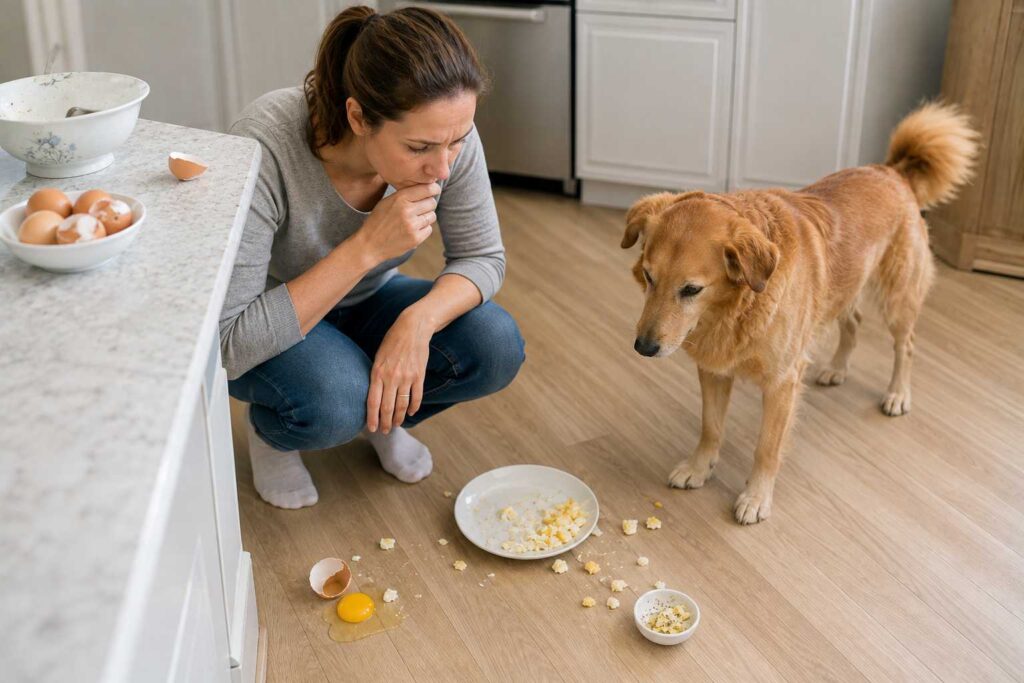
Before deciding whether there’s a problem, work out exactly what happened.
Was it fully cooked, runny, or raw?
A fully cooked egg and a raw egg don’t carry the same food-safety considerations. Raw and undercooked eggs can contain bacteria such as Salmonella, which is why veterinary guidance generally favors serving eggs fully cooked.
What was added to it?
Plain egg is one thing. Egg cooked with a generous amount of butter, folded into a cheese omelette, or seasoned with onion or garlic is another. Onion and garlic can damage dogs’ red blood cells when enough is consumed, so sometimes the ingredients around the egg matter more than the egg itself.
How much did your dog eat?
A stolen bite and a whole breakfast plate aren’t comparable. Quantity affects the calorie and fat load, and it also matters when you’re deciding whether simple monitoring is reasonable or veterinary advice is warranted.
Which dog ate it?
One egg represents a much larger portion of a small dog’s daily intake than a large dog’s. Health history matters too. A healthy adult dog and a dog on a prescription diet, calorie restriction, or low-fat feeding plan may need different advice.
Quick exposure checklist
- Was the egg raw, undercooked, or fully cooked?
- Was onion or garlic included anywhere in the dish?
- Was it cooked in a lot of butter, oil, or other fat?
- Roughly how much did your dog eat?
- Did they swallow shell as well?
- How long ago did it happen?
- Is your dog behaving normally?
- Any repeated vomiting, diarrhoea, unusual lethargy, or other concerning changes?
- Does your dog have an existing medical condition or prescription diet?
If it was a modest amount of plain, fully cooked egg and your otherwise healthy dog is acting normally, the egg itself is unlikely to be a major concern. If the dish contained potentially toxic ingredients, your dog ate a large amount, or symptoms are developing, contact your veterinarian for advice.
Not All Eggs Create the Same Situation
“Can dogs eat eggs?” is really shorthand for several different scenarios, and they don’t all deserve the same answer.
| Egg form | Main concern | Better choice? | What to check |
|---|---|---|---|
| Plain hard-boiled | Portion and calories | Yes | Amount fed |
| Plain scrambled | Portion and calories | Yes | No butter, seasoning, or other additions |
| Plain poached | Cooking completeness | Usually | White and yolk fully cooked |
| Fried | Added fat | Less ideal | Amount of oil or butter |
| Soft-boiled or runny | Undercooking | Avoid as a routine choice | Whether any part remains undercooked |
| Raw | Bacterial exposure | Not preferred | Amount eaten and any symptoms |
| Omelette | Added ingredients | Depends | Onion, garlic, cheese, seasoning, fat |
| Breakfast leftovers | Multiple ingredients | Depends | Everything else on the plate |
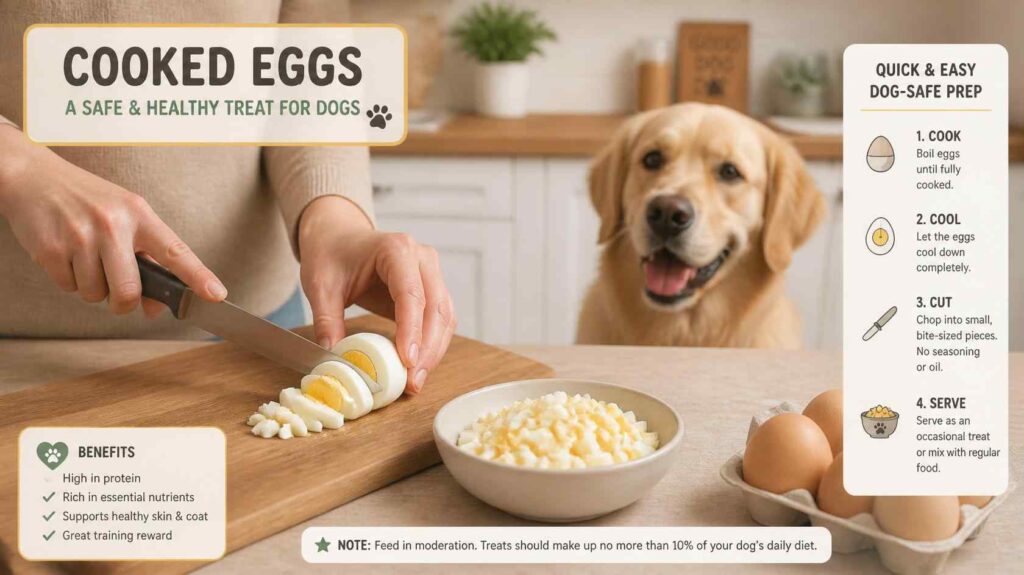
A “scrambled egg” isn’t one single food. Plain scrambled egg cooked through without butter, oil, salt, or seasoning can be a straightforward option. The version made for your own breakfast may contain ingredients your dog doesn’t need—and dairy can also cause digestive upset in some dogs.
The same principle applies to poached and boiled eggs: fully cooked is the safer choice. Raw or undercooked egg doesn’t offer a clear nutritional advantage that justifies routinely taking on the additional food-safety risk.
Eggs Are Nutritious — But Does Your Dog Actually Need Them?

Eggs provide high-quality protein along with fat and several vitamins and minerals. That’s useful nutrition, but it doesn’t make egg an essential addition to every dog’s bowl.
Eggs can contribute:
- High-quality protein and essential amino acids
- Fat and fatty acids
- Choline
- Selenium
- Riboflavin and vitamin B12
- Vitamin A and other micronutrients
The important distinction is nutritious versus necessary. If your dog already eats a complete and balanced diet appropriate for their life stage, that food is designed to provide the nutrients they need. Egg can be an occasional extra; it doesn’t need to “fix” the base diet.
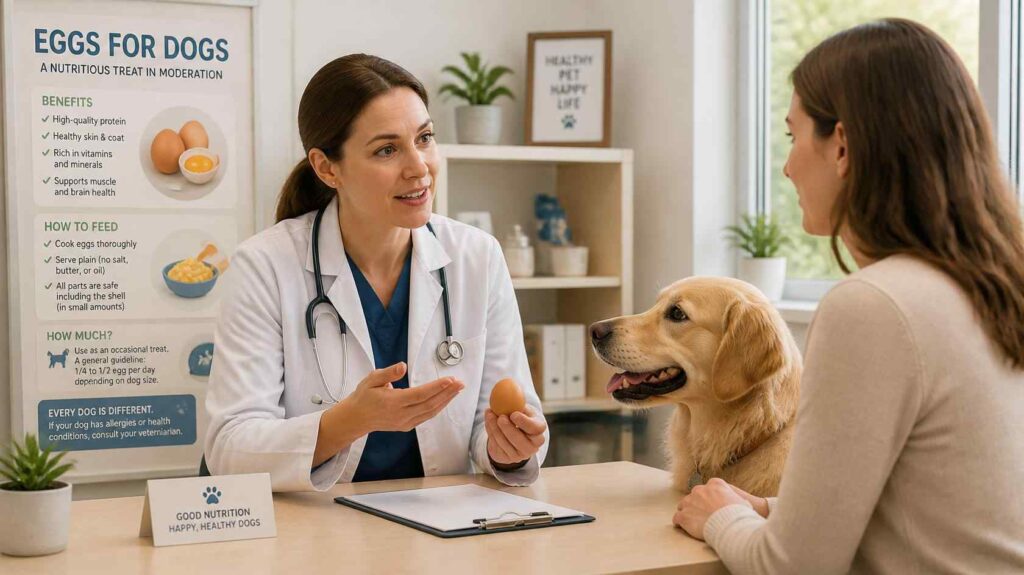
That matters because extras still count. Feeding eggs regularly on top of a dog’s normal ration adds calories, and repeatedly overdoing treats and toppers can contribute to weight gain. The right amount therefore depends on the dog’s size, activity, body condition, health, and what else they’re eating—not on a universal “one egg a day” rule.
Quick tip: Keep your dog’s complete diet as the foundation. Think of plain cooked egg as an optional treat or topper, not a nutritional shortcut or a “superfood” your dog needs every day.
How Much Egg Actually Makes Sense

Portion size is where well-meaning owners can easily overdo it, mostly because “one egg” means very different things depending on the dog.
WSAVA recommends keeping treats and extras to no more than about 10% of a healthy dog’s daily calories. For context, its guidance allows roughly 47 treat calories a day for an average 10 kg dog in ideal body condition, compared with about 108 calories for a 30 kg dog. That means a whole egg can use up most—or even more than—the daily treat allowance of a small dog, while taking up a much smaller share for a large dog.
A better way to think about portions is:
- Small dogs: start with a small piece rather than automatically offering a whole egg.
- Medium dogs: a partial or whole egg may fit occasionally, depending on their calorie needs and other treats.
- Large dogs: a whole egg may be easier to accommodate, but it still counts toward the day’s extras.
These aren’t fixed serving rules. Age, activity, body condition, normal diet, other treats, and medical needs all affect what makes sense.
If egg becomes a regular topper, don’t treat it as calorie-free. For a dog that needs tight weight control, the overall ration may need adjusting rather than simply piling egg on top of the usual meal.
A daily egg isn’t automatically harmful, but it shouldn’t become the default just because egg is nutritious. Frequency matters less than whether it fits the dog’s complete diet and calorie needs.
Raw Eggs Need a Different Conversation

Raw egg deserves more caution, but it’s useful to separate a genuine hazard from unnecessary panic.
The bacterial concern. Raw and undercooked animal foods can carry disease-causing bacteria, including Salmonella. The British Veterinary Association warns that uncooked foods bring a higher risk of bacterial spread that can affect pets as well as people in the household.
One accidental raw egg isn’t the same as routinely feeding raw eggs. If your dog steals one raw egg, don’t assume serious illness is inevitable. Work out how much was eaten, whether anything else was involved, and monitor your dog. If vomiting, diarrhoea, marked lethargy, loss of appetite, or other concerning signs develop, contact your veterinarian.
What about avidin and biotin? Raw egg white contains avidin, a protein that binds biotin. The mechanism is real, but the internet often strips away the context: a single accidental raw egg isn’t the same as repeatedly feeding substantial amounts of raw egg white. Cooking also makes the avidin issue far less relevant, while avoiding the unnecessary food-safety gamble of routinely feeding raw egg.
Your kitchen is part of the equation too. Handle raw egg as a potential source of contamination: wash your hands, clean bowls and utensils, and disinfect surfaces that came into contact with it. Raw-food bacteria can spread around the home even when the dog appears perfectly well.
If your dog is fed a professionally formulated raw diet that includes egg, the wider diet may have been planned differently—but raw ingredients still require careful handling. “Part of a raw diet” doesn’t make foodborne pathogens disappear.
A note on egg origin: labels such as free-range, organic, farm-fresh, or locally produced shouldn’t be used as a reason to assume a raw egg is risk-free. From a dog-safety standpoint, fully cooking the egg remains the simpler choice.
Warning: Raw Eggs, Toxic Add-Ins, and Medical Exceptions
- Avoid making raw or undercooked egg a routine treat.
- Check omelettes and breakfast dishes for onion, garlic, or other unsafe ingredients.
- Large amounts of butter, oil, bacon grease, or other fatty additions can be especially inappropriate for dogs that require fat restriction.
- Dogs with pancreatitis may be prescribed low-fat diets, so don’t add egg—particularly fatty preparations—without considering their veterinary diet plan.
- Dogs on veterinary therapeutic diets shouldn’t automatically receive extra toppers; WSAVA recommends checking with the veterinary team when a dog has a medical condition or is eating a prescribed diet.
- Contact your veterinarian if symptoms develop, the amount eaten was unusually large, or the egg dish contained a potentially toxic ingredient.
Egg White, Yolk, and Shell Aren’t Interchangeable
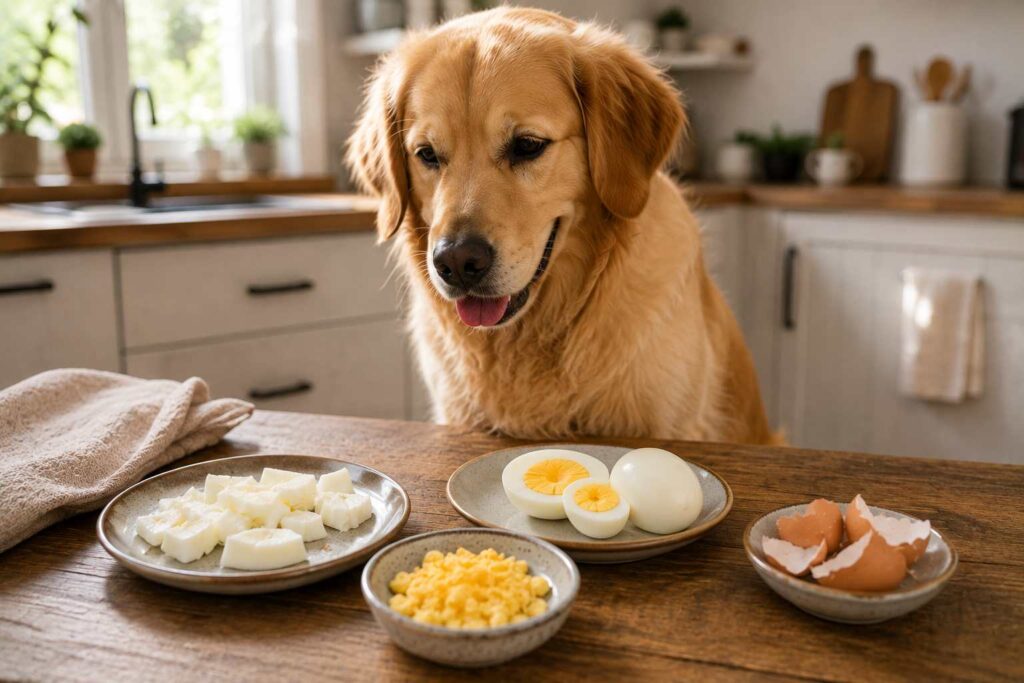
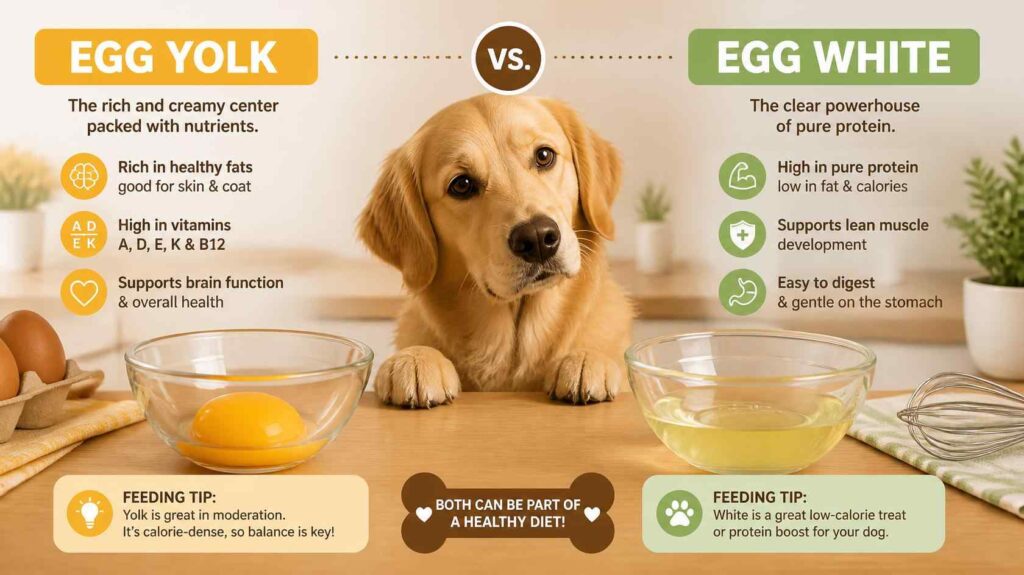
Egg white supplies protein with very little fat. Cooked egg white can be part of an occasional serving, but there’s usually no reason to separate it from the yolk unless you’re working within a specific feeding plan.
Egg yolk contains most of the egg’s fat along with several micronutrients. That doesn’t make yolk “bad,” but its calories and fat deserve more attention in dogs whose weight or dietary fat needs to be tightly controlled.
Eggshell contains calcium, but that doesn’t mean a dog eating complete food needs calcium added to their bowl. Merck Veterinary Manual advises against indiscriminate mineral supplementation because excess minerals can upset nutritional balance. Growing large- and giant-breed puppies are particularly sensitive to excessive calcium intake.
If you’re feeding a home-prepared diet that requires a calcium source, don’t guess the amount from an online eggshell recipe. The whole recipe—including its calcium-to-phosphorus balance—should be formulated appropriately for your dog. Merck notes that homemade diets can be nutritionally unbalanced and recommends properly formulated diets, particularly where mineral balance is concerned.
Eggshell membrane supplements sold for specific purposes are also different from simply grinding kitchen eggshells into a dog’s dinner.
| Part | Main Feature | Main Caution | Best Context |
|---|---|---|---|
| White | Protein, little fat | Raw egg concerns | Plain and cooked |
| Yolk | Fat and micronutrients | Calories and fat load | Moderate portions |
| Whole egg | Combined nutrition | Total calories | Plain, fully cooked |
| Shell | Calcium | Unnecessary mineral supplementation | Only when diet formulation calls for it |
Some Dogs Need a Different Answer
Puppies should get the overwhelming majority of their nutrition from a complete food formulated for growth. Adding calcium “for stronger bones” can backfire, especially in large- and giant-breed puppies, because calcium and phosphorus need to stay appropriately balanced during development.
Overweight dogs have less room in their calorie budget for extras. A whole egg may represent a substantial treat for a small dog, so portion size matters more than whether egg has a healthy reputation.
Dogs with pancreatitis or those prescribed a low-fat diet need more individualized advice. Merck Veterinary Manual notes that low-fat feeding is an important part of managing pancreatitis in dogs, so don’t assume a whole egg or buttery egg dish fits their plan.
Dogs on a prescription or therapeutic diet may have very specific nutrient targets. Even an otherwise safe topper can interfere with the purpose of that diet, so check with the veterinary team before making egg a routine addition.
Dogs with sensitive stomachs are best introduced to egg in a small, plain, fully cooked portion. And if your dog already has vomiting, diarrhoea, or another gastrointestinal problem, don’t assume scrambled egg is automatically the right “bland food” treatment—the cause of those signs matters.
Is It an Allergy, an Intolerance, or Just an Upset Stomach?

One loose stool after an egg-topped dinner doesn’t prove your dog has an egg allergy. A sudden change in food, a larger-than-usual portion, added fat, or another ingredient on the plate may be responsible.
Dogs can develop food allergies to egg proteins, but true food allergy usually shows a repeatable pattern rather than a single digestive wobble. Possible signs include persistent or recurring itching, paw or ear irritation, recurrent skin or ear infections, and gastrointestinal problems such as vomiting or diarrhoea. Merck Veterinary Manual notes that food allergy cannot be reliably diagnosed from symptoms alone. (merckvetmanual.com)
If egg repeatedly seems to trigger problems, don’t keep testing larger or smaller amounts at home. A veterinarian-supervised elimination diet followed by a controlled food challenge is the reliable way to investigate a suspected food allergy. During a proper diet trial, even treats, flavoured medications, chews, and table scraps can affect the result. (merckvetmanual.com)
Egg Myths That Sound Healthier Than the Evidence
“Raw eggs build stronger muscles.” The useful protein comes from the egg, not from serving it raw. Cooking makes egg the safer choice without removing its value as a protein source.
“Eggs boost immunity.” Eggs contribute useful nutrients as part of an overall balanced diet, but that isn’t the same as providing a special therapeutic “immune boost.”
“Eggs cure diarrhoea.” They don’t. A dog with diarrhoea may need anything from simple dietary management to veterinary treatment depending on the cause, severity, duration, and other symptoms.
“Eggs guarantee a shiny coat.” Adequate nutrition supports healthy skin and coat, but no single ingredient can guarantee a visible improvement.
“Eggshells strengthen every dog’s bones.” More calcium isn’t automatically better. Mineral balance is particularly important during growth, so eggshell shouldn’t be added to a complete diet simply as an insurance policy.
Common Mistakes Dog Owners Make With Eggs
- Sharing the seasoned, buttery breakfast version instead of a plain portion
- Giving a whole egg without considering the dog’s size or calorie needs
- Adding egg on top of the normal ration without accounting for the extra calories
- Choosing raw egg simply because it seems more “natural”
- Treating egg as a remedy for ongoing diarrhoea
- Adding eggshell to an already complete diet without a nutritional reason
- Assuming “organic,” “free-range,” or “farm fresh” means raw egg is risk-free
- Replacing a complete puppy diet with egg-heavy home-prepared meals
- Assuming one episode of itching proves an egg allergy
- Sharing an omelette without checking every ingredient first
A Simple Way to Introduce Egg for the First Time
Keep the first serving deliberately boring: plain, fully cooked, and small. Skip seasoning, heavy butter, oil, and other new foods at the same meal. If your dog does react, having changed only one thing makes it much easier to work out what may have caused the problem.
Quick tips:
- Cook the egg fully
- Serve it plain
- Start with a small portion
- Let it cool before serving
- Cut or crumble it appropriately for your dog’s size
- Count it within the day’s treats and extras
- Watch for vomiting, diarrhoea, itching, or other unusual changes
- Don’t make it a daily habit automatically
When Egg Stops Being a Food Question and Becomes a Vet Question
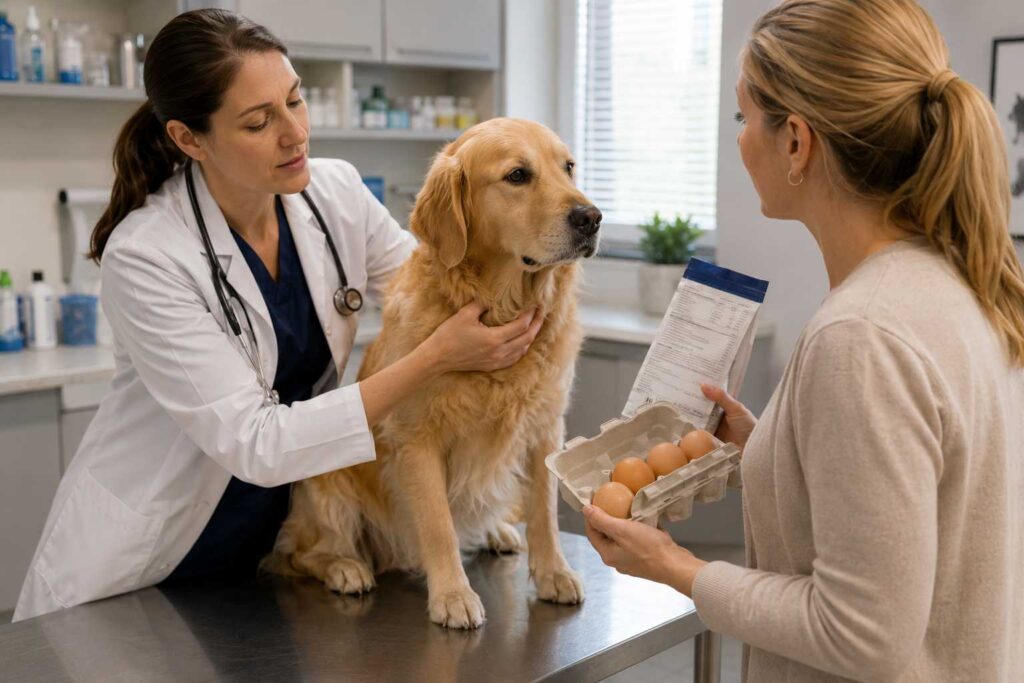
Contact your veterinarian if the egg dish contained a potentially toxic ingredient such as onion or garlic, your dog ate an unusually large amount, your dog has a medical condition that makes dietary changes more important, or concerning symptoms develop.
Symptoms that matter more than the egg itself:
- Repeated vomiting
- Significant or persistent diarrhoea
- Marked lethargy or weakness
- Signs of dehydration
- Loss of appetite alongside other symptoms
- Symptoms that are worsening rather than settling
- Collapse or any severe change in your dog’s condition
Have this ready when you call:
- Your dog’s approximate weight
- Roughly how much egg was eaten
- Whether it was raw, undercooked, or fully cooked
- Whether shell was swallowed
- Every other ingredient in the dish
- Roughly when it happened
- Any symptoms and when they started
- Relevant medical conditions, medications, or prescription diets
Vet Guidance Box
Don’t judge the situation from the word “egg” alone. The useful questions are: How was it prepared? What else was in it? How much was eaten? Which dog ate it?
A small amount of plain cooked egg in a healthy dog is very different from a fatty omelette containing onion eaten by a dog with pancreatitis. Persistent, severe, or worsening symptoms deserve veterinary assessment rather than repeated home remedies.
Final Egg Decision Checklist
- Is it fully cooked?
- Is it plain, without seasoning or lots of added fat?
- Are onion, garlic, and other unsafe ingredients absent?
- Is the portion appropriate for this dog’s size and calorie needs?
- Does it fit within the dog’s overall diet rather than simply adding extra calories?
- Does your dog have a medical condition or prescription diet that changes the decision?
- Are you avoiding unnecessary eggshell supplementation?
- Has your dog tolerated egg previously?
- Are you offering egg as food rather than trying to treat a health problem?
If the answers are reassuring, a modest amount of plain, fully cooked egg can be a reasonable occasional treat for many healthy dogs.
The Bottom Line
Eggs aren’t quite a simple yes-or-no food. For most healthy dogs, the easiest rule is plain, fully cooked, and appropriately portioned.
Raw or undercooked eggs add avoidable food-safety concerns, while butter, seasoning, onion, garlic, and other breakfast ingredients can change an otherwise harmless snack into something worth a closer look.
Start small, keep the rest of the meal familiar, and judge egg in the context of your dog’s complete diet and health—not by its reputation as a “healthy” human food.
Frequently Asked Questions
1.Can dogs eat eggs every day?
Some dogs could fit egg into their diet regularly, but daily feeding isn’t necessary and shouldn’t be the automatic rule. What matters is whether the egg fits within the dog’s total calorie and nutrient intake without crowding out a complete, balanced diet. Smaller dogs have much less room for extra calories than larger dogs.
2.Can dogs eat eggs cooked in butter or oil?
A small accidental amount isn’t necessarily a problem for a healthy dog, but plain egg is the better routine choice. Extra butter or oil adds unnecessary calories and fat and may be particularly inappropriate for dogs that need a low-fat diet.
3.My dog ate a raw egg by accident—should I be worried?
One accidental raw egg does not mean your dog will become ill, but raw eggs can carry harmful bacteria. Note how much was eaten, clean any contaminated surfaces, and monitor your dog. Contact your veterinarian if vomiting, diarrhoea, marked lethargy, loss of appetite, or other concerning signs develop, or if your dog is medically vulnerable.
4.Can dogs eat eggs and rice together?
Plain, fully cooked egg and plain cooked rice are not inherently toxic to dogs, but that doesn’t make the combination a treatment for diarrhoea or an appropriate long-term diet. If your dog is already unwell, ask your veterinarian what to feed rather than assuming a homemade “bland diet” is the right answer.
5.Do quail or duck eggs work the same way as chicken eggs?
The same basic safety principles apply: cook them fully, serve them plain, and account for their size and calorie content. Different types of eggs aren’t interchangeable portion-for-portion.
6.Can dogs be allergic to eggs?
Yes. Egg proteins can trigger food allergy in some dogs. Recurrent itching, ear or skin problems, vomiting, or diarrhoea associated with food deserves veterinary investigation. Merck Veterinary Manual identifies an elimination diet followed by controlled rechallenge as the reliable way to confirm a food allergy rather than diagnosing it from symptoms alone. (merckvetmanual.com)
7.Are eggs a good option for a dog with an upset stomach?
Not automatically. Some dogs tolerate plain cooked egg well, while others may find a dietary change or the yolk’s fat content unhelpful. If vomiting or diarrhoea is persistent, recurring, severe, accompanied by lethargy or other symptoms, or affects a puppy or medically vulnerable dog, veterinary advice is more useful than experimenting with home remedies.
#. Related Articles: