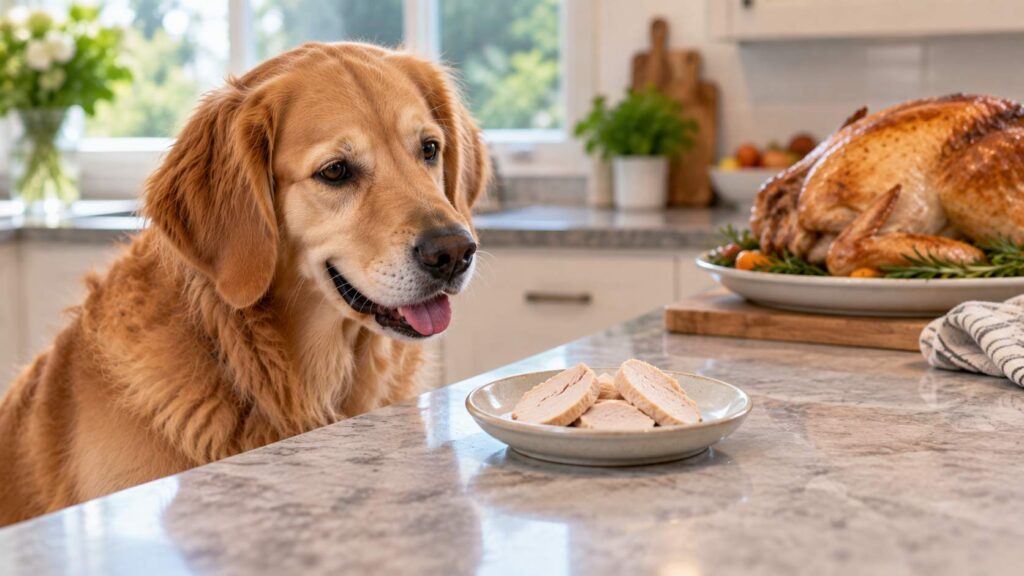
Can dogs eat turkey? Yes, most healthy dogs can have a small amount of plain, fully cooked, skinless, boneless turkey meat. The problem is that “turkey” in a real kitchen is rarely just plain meat. It might be a slice of breast, a piece of greasy skin, a spoonful of gravy-soaked stuffing, or a carcass with a pile of cooked bones. Those aren’t the same food, and they don’t carry the same risk.
So instead of asking only whether turkey is safe, ask five smaller questions: Which part is it? How was it cooked? What was added? How much is your dog getting? And does your dog have any dietary or medical restrictions?
If your dog has already grabbed something off the counter or plate, jump straight to “Your Dog Already Ate Turkey: Change the Question.”
Start With the Turkey in Front of You
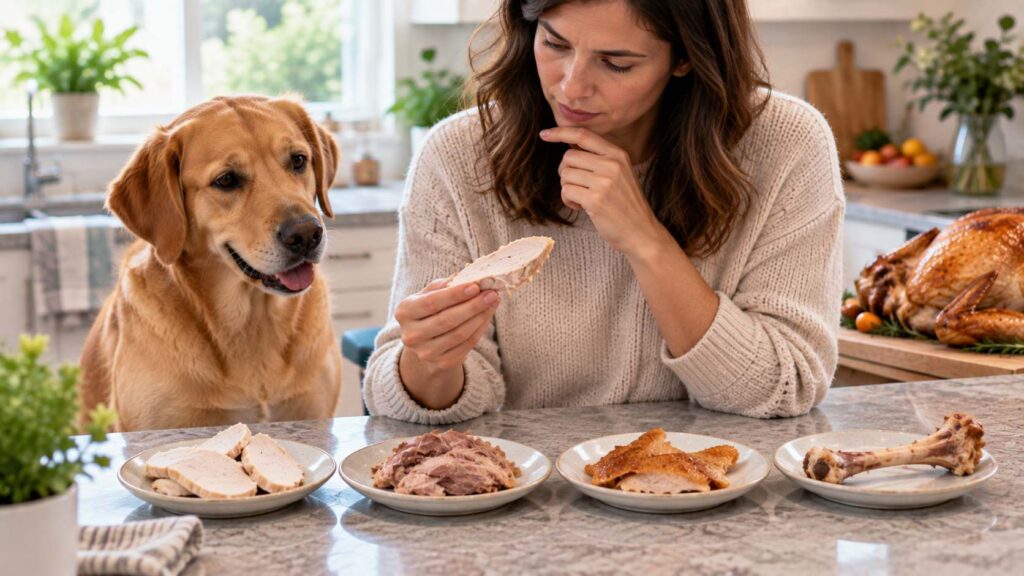
Plain Meat Is a Different Question From a Turkey Dinner
When people say turkey is fine for dogs, they generally mean meat that is plain, fully cooked, skinless, boneless and unseasoned. That version can be an occasional extra for many healthy dogs.
Once butter, gravy, stuffing, brine, marinades or heavy seasoning enter the picture, the question changes. Now you need to assess everything that came with the turkey, not just the meat itself.
Five Details That Can Change the Answer
Run through these before you hand anything over:
- Part: breast, dark meat, skin, giblets or bone
- Preparation: plain roasted or baked, fried, smoked, brined or raw
- Added ingredients: onion, garlic, butter, oil, salt, gravy or seasoning
- Amount: one small piece or a plateful
- Dog: a healthy adult, a puppy, or a dog with a medical or dietary restriction
Breast, Dark Meat, Skin and Bones Aren’t Interchangeable
Skinless breast is typically the leaner choice. Dark meat from the thigh or leg contains more fat, so portion and preparation matter more. Skin is fatty and often carries much of the seasoning, while bones introduce an entirely different physical hazard.
The useful question isn’t simply “Is this turkey?” It’s “What part of the turkey am I actually offering?”
The Turkey Safety Sort: Which Version Do You Have?
This table is a general guide for healthy dogs, not a ruling on your individual pet.
| Turkey form | Main issue | General direction | What to check |
|---|---|---|---|
| Plain cooked breast | Portion size | Lower concern | Skinless, boneless, unseasoned |
| Plain dark meat | Fat and portion | More caution | Skin removed; keep the portion small |
| Ground or minced turkey | Added ingredients and cooking | Depends | Plain and thoroughly cooked |
| Turkey skin | Fat and seasoning | Avoid | How much was eaten |
| Cooked bones | Choking or digestive-tract injury | Avoid | Whether any were swallowed |
| Deli turkey | Salt and additives | Poor choice | Ingredient label |
| Smoked turkey | Salt, brine and seasoning | Poor choice | Added ingredients |
| Brined turkey | Added salt solution and seasonings | Caution | Recipe or packaging |
| Fried or butter-basted turkey | High fat | Avoid sharing | Cooking method and added fat |
| Raw turkey | Microbial contamination | Avoid as a casual treat | Handling and exposure |
| Turkey with stuffing or gravy | Mixed ingredients | Usually avoid | Onion, garlic, fat and other ingredients |
If You’re Planning to Give Your Dog Turkey, Use This Checklist
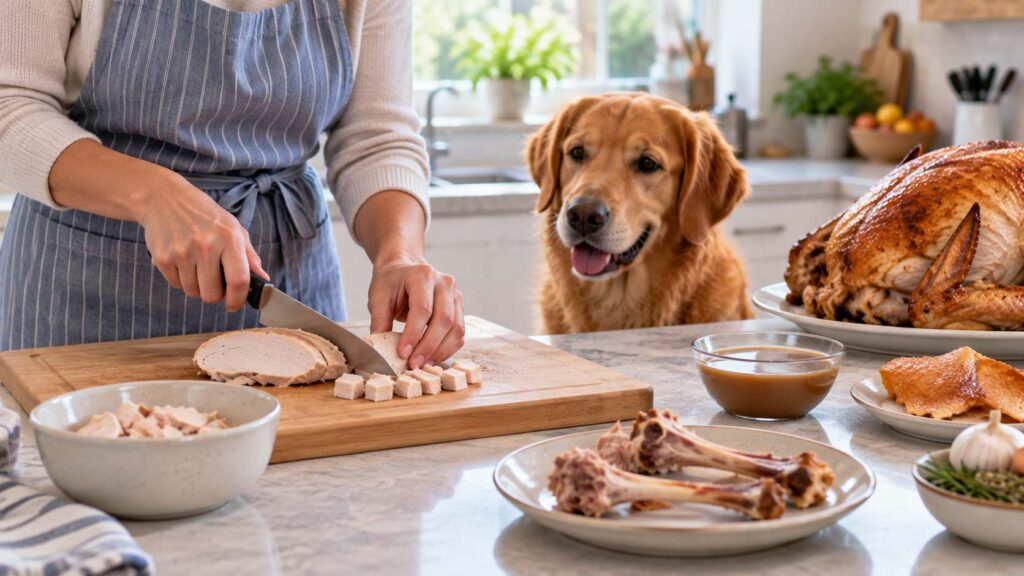
Before offering turkey on purpose, check that it is:
- Fully cooked to a safe internal temperature
- Free of bones, including small fragments hiding in shredded meat
- Free of skin
- Free of onion and garlic
- Free of gravy, stuffing and heavy seasoning
- Not coated in butter, oil or fatty drippings
- Not smoked, brined or highly processed
- A small extra rather than a human-sized serving
- Compatible with your dog’s regular diet and any veterinary dietary restrictions
For food safety, don’t rely on colour or clear juices alone. The USDA recommends cooking poultry to a minimum internal temperature of 165°F (73.9°C) measured with a food thermometer.
Set Aside the Dog’s Piece Before You Season Dinner
This is one of the easiest ways to avoid mistakes. If you’re cooking turkey anyway, set aside a small piece of boneless, skinless meat before adding butter, gravy, marinades or seasoning.
Cooking the dog’s portion plain means you don’t have to guess later whether a seasoned piece is safe enough after wiping or scraping something off.
Turkey Should Stay an Extra, Not Quietly Become the Meal
A complete and balanced dog food is formulated to supply nutrients in appropriate proportions. A few pieces of turkey added on top are an extra, not a replacement for that diet.
A useful rule of thumb is to keep treats and toppers collectively below about 10% of daily calories. That doesn’t mean 10% of your dog’s diet should be turkey; it is an overall ceiling for extras, and some dogs need stricter limits. VCA also notes that treats may be unsuitable for dogs on certain therapeutic diets or with conditions such as chronic pancreatitis.
If you want turkey to become a substantial part of a homemade diet rather than an occasional treat, ask your veterinarian about an appropriately qualified veterinary nutrition professional who can formulate a complete and balanced recipe.
Quick tips for sharing turkey:
- Choose plain, fully cooked meat.
- Remove skin and bones before serving.
- Keep the first portion small.
- Skip gravy and stuffing.
- Count turkey with the day’s other treats.
- Don’t add turkey to a prescription diet without checking first.
- If your dog hasn’t eaten turkey before, introduce only a small amount.
Your Dog Already Ate Turkey: Change the Question
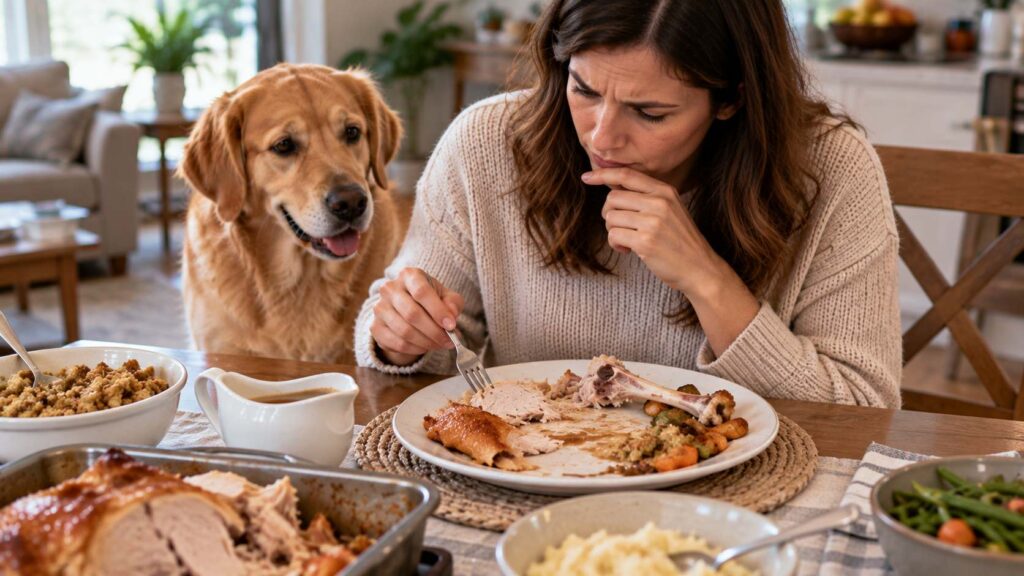
If the turkey has already disappeared, “Can dogs eat turkey?” stops being the most useful question.
Now you need to work out what your dog ate, what was attached or mixed with it, roughly how much disappeared, and whether anything other than food may have been swallowed.
First Work Out Exactly What Disappeared
Was it:
- Plain meat?
- Skin?
- A cooked bone?
- Stuffing?
- Gravy?
- Fatty drippings?
- A mixed plate of leftovers?
- Part of the carcass?
If you weren’t watching, look at what’s missing and what’s left. Check for broken bones, torn packaging, missing foil, skewers or cooking twine. That information can be much more useful to a veterinarian than simply saying, “My dog ate turkey.”
Then Check What Was Added
Look at the recipe, packaging or ingredient list if you have it. Check for onion, garlic, seasoning mixes, butter, oil, stock, marinades and brines.
Onion and garlic deserve particular attention. They belong to the Allium family and can cause oxidative damage to red blood cells in dogs. Importantly, clinical signs of resulting anaemia may not appear until several days after exposure, so a dog appearing normal immediately after eating an onion-containing dish doesn’t rule out a problem.
If you know or suspect your dog ate a meaningful amount of onion, garlic or a concentrated form such as onion or garlic powder, contact your veterinarian or an appropriate animal poison service rather than waiting for symptoms.
Amount and Dog Size Change the Context
There isn’t one universal “safe amount” that fits every situation.
A bite of plain, boneless breast eaten by a healthy Labrador is very different from a small dog eating a plate of buttery skin, stuffing and gravy. The ingredients, amount, dog’s size, health history and symptoms all change the assessment.
If you’re calling a vet, try to have the dog’s weight, food or recipe involved, estimated amount and time of ingestion ready.
One Stolen Bite Isn’t the Same as Raiding the Carcass
A small piece of plain, boneless turkey in an otherwise well dog is generally a much lower-concern situation than a carcass raid.
A dog that gets into a carcass may swallow several hazards at once: cooked bones, fatty skin, seasoned scraps and even non-food material. If bones or foreign objects may have been swallowed, contact your veterinarian promptly for advice rather than relying on home remedies.
The Holiday Plate Has Risks That Aren’t Really About Turkey
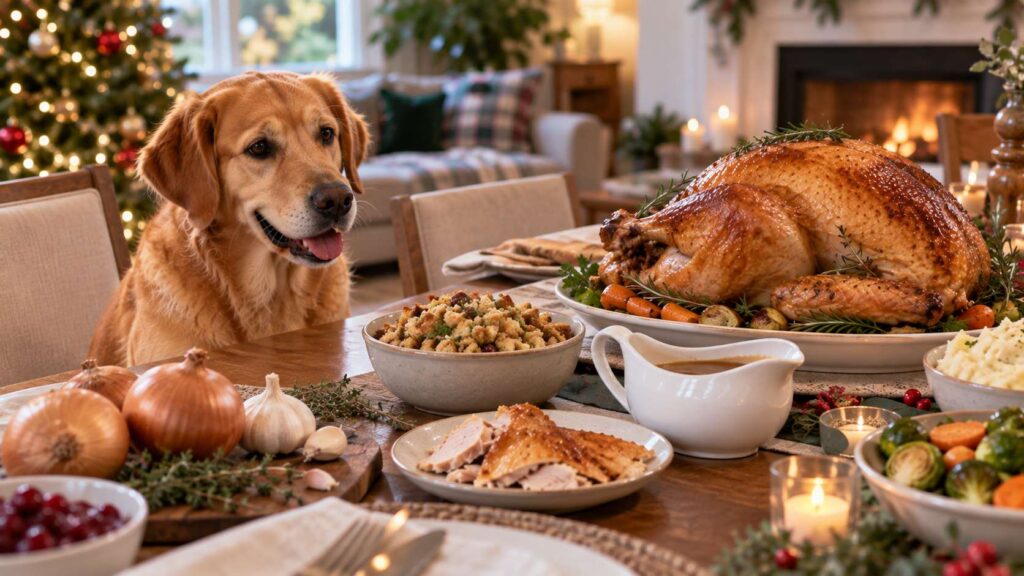
Whether it’s Christmas, Thanksgiving in the United States, or Canadian Thanksgiving in October, the turkey meat itself may be only one part of the problem.
Stuffing and Gravy Can Change the Risk
Stuffing may contain onion or garlic, while gravy can contain onion, garlic, stock, butter, fat and substantial seasoning. You often can’t tell what is in a mixed dish just by looking at it.
That’s why a piece of plain turkey breast and a piece taken from a gravy-covered holiday plate shouldn’t automatically get the same answer.
If onion is the concern, see our guide on whether dogs can eat onions for a closer look at the risk.
Skin, Drippings and Rich Leftovers Add a Different Problem
Turkey skin, drippings, buttery gravy and other rich leftovers can deliver a sudden high-fat meal. At minimum, that can lead to digestive upset in some dogs.
Fatty meals are also associated with pancreatitis in dogs, although it’s too simplistic to say that one piece of turkey skin automatically causes pancreatitis. The underlying cause of pancreatitis is often unknown, but recent consumption of a fatty meal can be a contributing factor, and dogs being managed for pancreatitis commonly require careful attention to dietary fat.
Watch particularly carefully if your dog has a history of pancreatitis or is already on a veterinary low-fat diet.
The Carcass Can Be More Dangerous Than the Meat
A turkey carcass combines several problems in one tempting package: multiple cooked bones, skin, fat, scraps and seasoning.
Cooked bones are not merely a nutritional concern. They can cause choking or digestive-tract obstruction and injury. If you think your dog swallowed a cooked turkey bone, don’t assume that being able to eat or drink normally right now means the risk has passed.
Keep the carcass in a secure container or bin that your dog cannot reach, especially during cleanup when counters and rubbish are easy to forget.
Don’t Forget the Things That Aren’t Food
Some holiday hazards only smell like dinner:
- Cooking twine or string
- Foil coated with meat juices or fat
- Skewers and toothpicks
- The giblet bag and other packaging
- Absorbent pads from supermarket meat trays
- Rubbish bags containing the carcass and scraps
RSPCA Australia specifically advises keeping dogs away from string used around roasts and absorbent pads found under packaged meat, as well as avoiding cooked bones and fatty foods.
String and other foreign objects can cause intestinal obstruction, while sharp objects such as skewers can cause internal injury. If you think your dog swallowed any of these, contact a veterinarian promptly.
Warning: Don’t Treat Bone or Foreign-Object Ingestion Like an Ordinary Upset Stomach
Contact a veterinarian promptly if your dog swallowed—or may have swallowed—a cooked bone, cooking string, foil, a skewer, packaging or another foreign object.
Seek urgent veterinary care for choking or breathing difficulty, repeated vomiting, marked lethargy, significant abdominal pain, collapse, or other rapidly worsening signs.
Don’t induce vomiting or give a home remedy unless a veterinarian or animal poison professional specifically tells you to do so. What is appropriate depends on what was swallowed and the individual dog.
Why Bones, Fat and Seasoning Deserve Separate Attention

Cooked Bones Are More Than a Choking Problem
Cooked turkey bones can break or splinter into sharp pieces, creating risks that go well beyond choking. WSAVA advises against feeding bones—cooked or raw—because they can cause significant injury if chewed or swallowed.
Possible problems include:
- Choking or a bone becoming lodged in the throat or oesophagus
- Cuts to the mouth or throat
- Gastrointestinal obstruction
- Injury to the stomach or intestines
- Pain or difficulty passing bone fragments
If your dog has swallowed a cooked turkey bone, don’t deliberately make them vomit or rely on a home remedy. Contact your vet for advice based on the dog’s size, the type and amount of bone swallowed, when it happened, and whether symptoms are present.
Fatty Turkey Can Be Harder on Some Dogs
Turkey skin, drippings, buttery gravy and other rich preparations can cause digestive upset, particularly when a dog suddenly eats a large amount.
They deserve extra caution in dogs with a history of pancreatitis or those prescribed a low-fat diet. Merck notes that eating large amounts of table scraps or other inappropriate foods is considered a risk factor for pancreatitis, although in many cases no specific cause can be identified. Miniature Schnauzers are among the breeds reported to have a higher prevalence of the disease.
That doesn’t mean one bite of turkey skin automatically causes pancreatitis. The practical point is simpler: don’t turn a generally lean food into a high-fat meal by adding skin, drippings, butter or gravy.
Onion and Garlic May Be Hidden Rather Than Visible
Onion and garlic can turn up in stuffing, gravy, stock, marinades and seasoning blends, so removing obvious pieces doesn’t necessarily remove the concern.
Both belong to the Allium family and are unsafe for dogs. According to the Merck Veterinary Manual, onion and garlic can cause oxidative damage to red blood cells in dogs, potentially leading to haemolytic anaemia.
Check the actual recipe or ingredient label rather than relying on appearance. If your dog has eaten turkey containing onion or garlic and you’re unsure whether the amount is concerning, contact your vet or an appropriate animal poison service for case-specific advice.
Raw Turkey Adds a Different Type of Risk
Raw turkey introduces a food-safety issue that properly cooked turkey does not. Raw animal products can transmit pathogens, which is one reason WSAVA identifies unprocessed raw animal-based treats as a pathogen-transmission risk.
There is also a household hygiene issue: raw meat, bowls, utensils and preparation surfaces can spread contamination. This matters especially in homes with people who are more vulnerable to foodborne illness.
If you’re considering a raw diet rather than dealing with an accidental bite of raw turkey, discuss the diet and its risks with your veterinary team rather than improvising with raw kitchen scraps.
Important: Don’t treat bone or foreign-object ingestion like an ordinary new-food upset.
Contact a vet or emergency clinic promptly if you suspect your dog swallowed a cooked bone, twine, foil, packaging or another foreign object.
Seek urgent veterinary care if you see:
- Choking or difficulty breathing
- Repeated vomiting
- Marked weakness or lethargy
- Significant abdominal pain
- Collapse or rapidly worsening symptoms
- Signs suggesting a possible obstruction
If onion or garlic was involved, contact your vet or an animal poison service for advice even if your dog currently appears well.
Don’t try to make your dog vomit unless a veterinary professional or poison service specifically tells you to. With sharp or obstructive objects, bringing material back up may create additional injury.
How Much Turkey Makes Sense Without Inventing a Magic Portion?
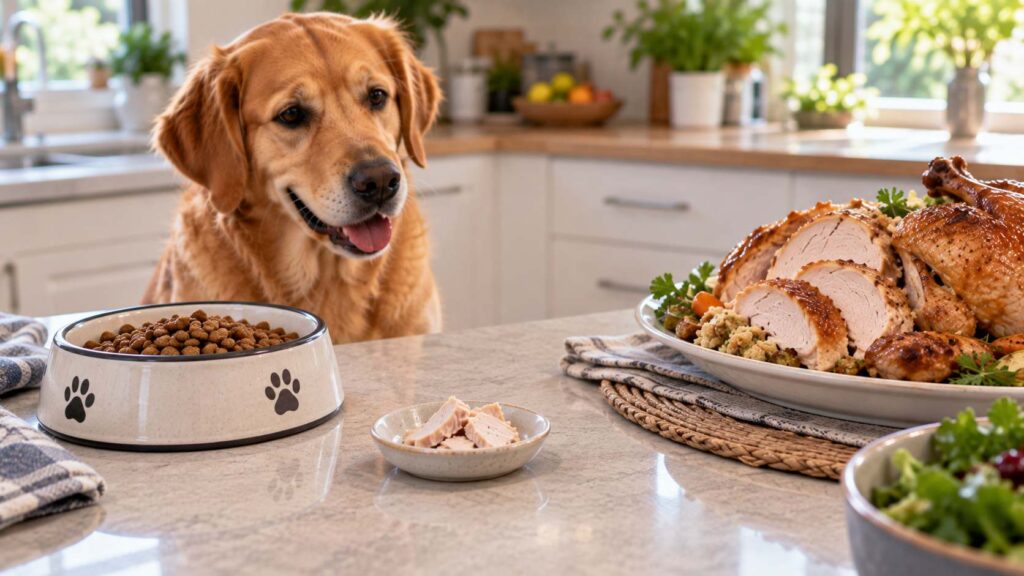
Think in Terms of Extras, Not a Second Dinner
Your dog’s regular complete diet should provide the bulk of their nutrition. Turkey belongs in the same allowance as treats, chews, toppers and training rewards—not in a separate “free food” category.
Why a Universal Spoonful-by-Dog-Weight Chart Can Mislead
A chart that says every dog of a certain weight can have a fixed number of tablespoons sounds convenient, but it ignores individual calorie needs, body condition, activity, other treats, medical conditions and how the turkey was prepared.
Two dogs of the same weight can have different energy requirements, so a fixed serving chart can create false precision.
The 10% Concept Needs One Important Qualification
WSAVA recommends that treats provide no more than 10% of a dog’s daily calorie intake, with the remaining calories coming from a complete and balanced diet. It also notes that individual energy needs vary and dogs with medical conditions or veterinary-prescribed diets may need different advice.
That 10% covers all treats and extras combined. It doesn’t mean turkey should make up 10% of the diet, and it isn’t a target you need to reach.
In practice, offer only a small amount, count it with the day’s other extras, and stop if it doesn’t agree with your dog.
Some Dogs Need a Different Answer Even When the Turkey Is Plain
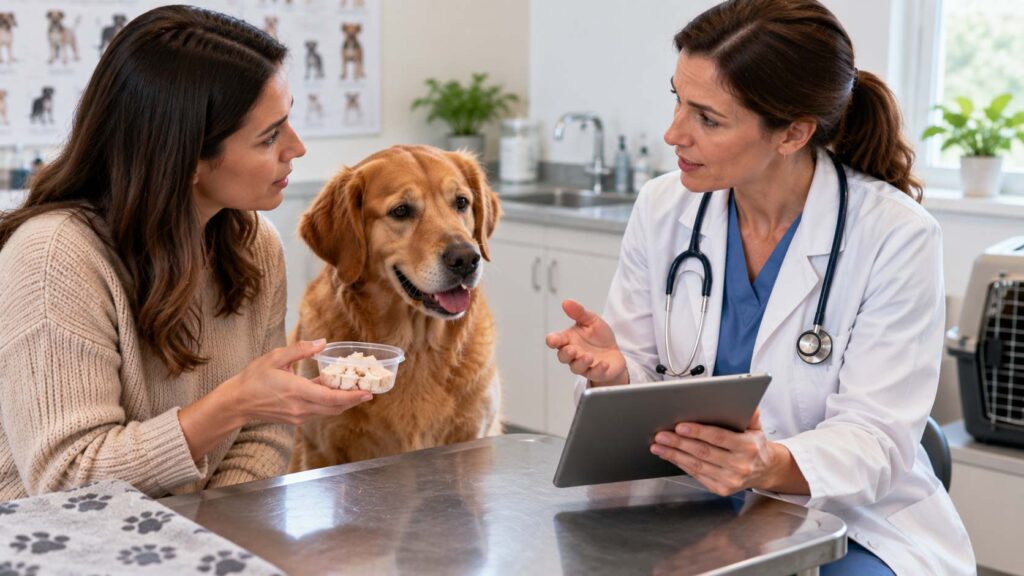
Dogs With a History of Pancreatitis or Low-Fat Diets
A dog being managed for pancreatitis or another condition requiring dietary fat restriction shouldn’t receive extra turkey simply because it’s plain.
Merck notes that dietary fat restriction is an important part of managing canine pancreatitis. If your vet has prescribed a specific diet, follow that plan rather than adding table foods without checking first.
Dogs on Elimination or Prescription Diets
Elimination diets only provide useful information when they’re followed strictly. Even a small piece of turkey can introduce another protein and interfere with the trial.
Merck advises that dogs undergoing an elimination diet eat only the foods and treats recommended by their veterinarian; table food, flavoured medications and other extras can compromise the process.
Dogs With Suspected Food Allergies or Intolerances
A true food allergy involves an immune response; other adverse food reactions can have different mechanisms. A single episode of loose stool after eating turkey doesn’t prove an allergy.
Food allergy can cause persistent itching, recurring skin or ear problems and, in some dogs, gastrointestinal signs. The reliable diagnostic approach is a properly controlled elimination diet followed by a dietary challenge—not guessing from symptoms or repeatedly switching proteins.
If your dog is already undergoing a food-allergy investigation, don’t introduce turkey unless it is part of the veterinary plan.
Puppies, Seniors and Dogs With Other Restrictions
Age alone doesn’t automatically make plain turkey unsafe, but nutritional needs and medical restrictions can change what makes sense for an individual dog.
Puppies need a complete diet formulated for growth, while older dogs may be managing conditions that require specific nutrient or calorie targets. Dogs with kidney, heart, gastrointestinal or other chronic disease may also have individually prescribed diets.
If your dog is on a therapeutic diet, the prescription takes priority over general human-food advice.
Is Turkey Actually “Good” for Dogs, or Simply Something They Can Eat?
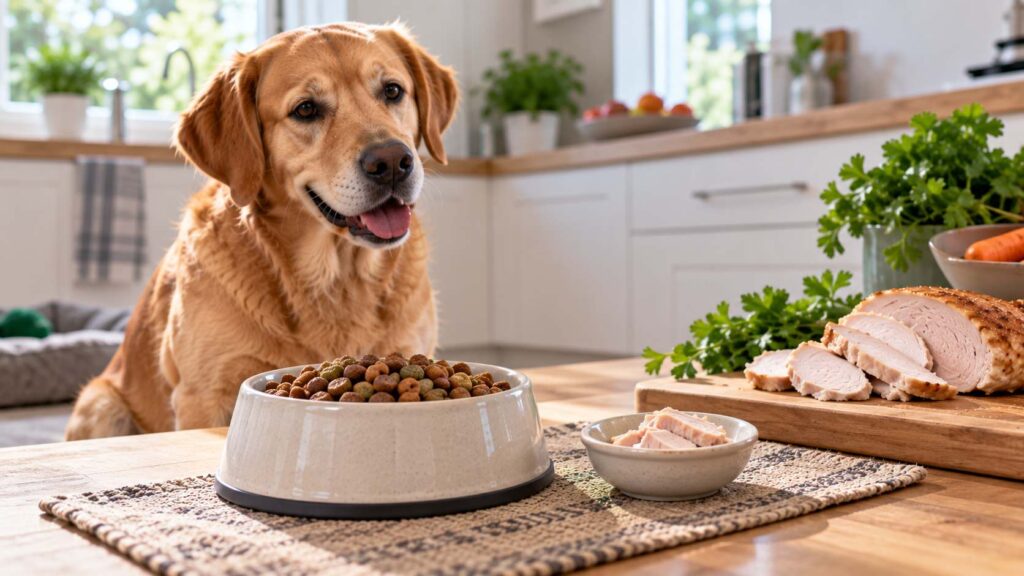
Protein and Nutrients: Keep the Benefit in Perspective
Turkey provides protein and several nutrients, but that doesn’t make a few pieces a nutritional necessity.
For a dog already eating an appropriate complete and balanced diet, turkey is best thought of as an optional food or treat rather than something needed to prevent a nutritional deficiency.
Safe Doesn’t Mean Nutritionally Necessary
A food can be suitable in small amounts without adding anything essential to the diet.
That’s the right perspective for turkey: it can be an occasional extra for many dogs, but dogs don’t need table turkey to be healthy.
Turkey Treat vs Turkey-Based Dog Food vs Homemade Turkey Diet
- An occasional turkey treat is an extra.
- A complete turkey-based dog food is formulated to meet defined nutritional requirements for its intended life stage.
- A homemade turkey-heavy diet isn’t automatically complete or balanced simply because turkey is nutritious.
Merck notes that pet-food nutritional adequacy statements indicate whether a product provides all required nutrients and the life stage for which it is intended. Plain turkey meat doesn’t come with that nutritional balance.
So a dog doing well on a complete turkey-based food doesn’t automatically mean roast leftovers will suit them. The fat, ingredients, portion and nutritional purpose are different.
Is Turkey Better Than Chicken?
There’s no universal winner. The better choice depends on your dog’s individual tolerance, the cut and preparation, their normal diet and any veterinary restrictions.
Turkey may be considered when a dog cannot eat a particular protein, but don’t assume it’s automatically “hypoallergenic” or an appropriate replacement during a food-allergy investigation. Novel-protein choices need to account for what the dog has previously eaten, and possible cross-reactivity can complicate selection.
Common Turkey Mistakes That Sound Reasonable
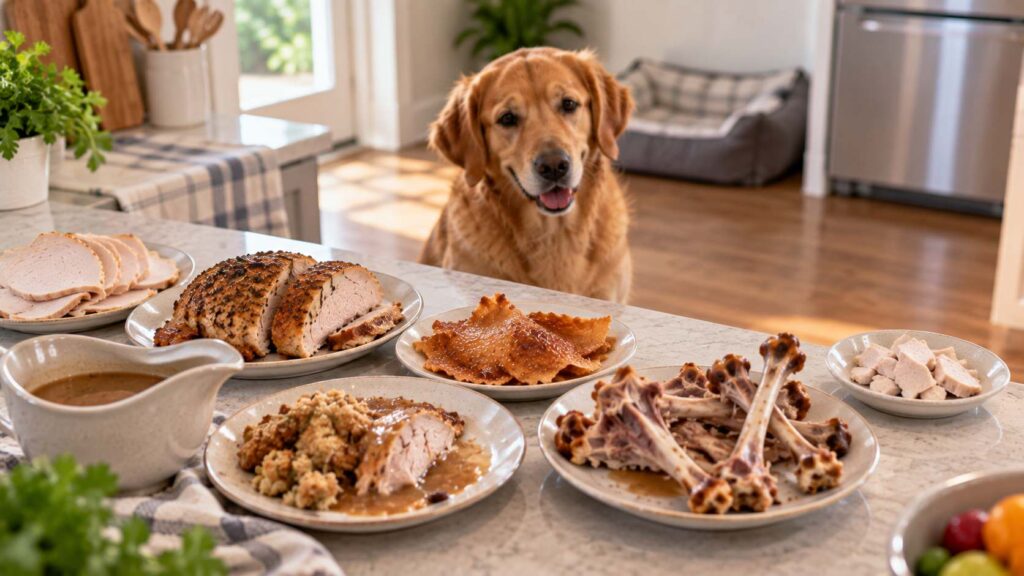
“It’s turkey breast, so deli slices must be the same.”
They’re not. Deli turkey is processed and may contain substantial salt, seasonings or other added ingredients. Check the label rather than judging it by the name.
“I removed the bone, so the leftovers are safe.”
Bones are only one concern. Skin, fat, gravy, stuffing and seasoning still matter.
“I took the skin off after it was cooked in gravy.”
Removing the skin doesn’t undo ingredients or fat that may already be on the meat. If you want to share turkey, set aside a plain portion before seasoning.
“Turkey is lean, so the amount doesn’t matter.”
Skinless breast may be relatively lean, but portion still matters. Too many extras add calories and a sudden large serving of unfamiliar food can upset the digestive system.
“My dog has diarrhoea, so plain turkey must help.”
Turkey isn’t a treatment for diarrhoea. Dietary management depends on the cause and the individual dog. Persistent, recurrent, bloody or otherwise concerning diarrhoea warrants veterinary advice rather than repeated experimentation with table food.
“The 10% rule means 10% of the diet can be turkey.”
The guideline applies to all treats and extras combined, not turkey alone.
“A cooked bone is safe because cooking killed the bacteria.”
Microbial risk and physical safety are separate issues. Cooking doesn’t make a bone safe to chew or swallow; WSAVA advises against both cooked and raw bones because they can cause significant injury.
“I can’t see any onion, so there probably isn’t any.”
Onion and garlic can be blended into gravy, stuffing, stock or seasoning. Check the ingredients rather than relying on what you can see.
Five Turkey Situations That Look Similar but Aren’t
A healthy dog is offered a small piece of plain, skinless breast. This is the lower-concern scenario. Keep the portion small, remove every bone, and count it with the day’s other treats rather than treating it as part of the regular meal.
Your dog steals gravy-covered turkey at dinner. Check what was in the gravy and roughly how much disappeared. Onion, garlic and a large amount of fat change the situation; if either allium was present or you can’t estimate the exposure, contact your vet or an animal poison service for advice.
Your dog swallows part of a cooked turkey bone. Contact your vet promptly, even if your dog currently seems comfortable. WSAVA advises against both cooked and raw bones because chewing or swallowing them can cause significant injury.
You want to use leftover plain turkey as daily training treats. Small pieces can be used as treats for an otherwise healthy dog, but include them in the total treat allowance. WSAVA recommends keeping all treats combined to no more than about 10% of a healthy dog’s daily calories.
A dog on a prescription low-fat or elimination diet is offered plain turkey. Check with your vet first. “Plain” doesn’t necessarily mean compatible. During an elimination diet, even table food or an otherwise suitable treat can interfere with the trial.
When Turkey Stops Being a Food Question and Becomes a Vet Question
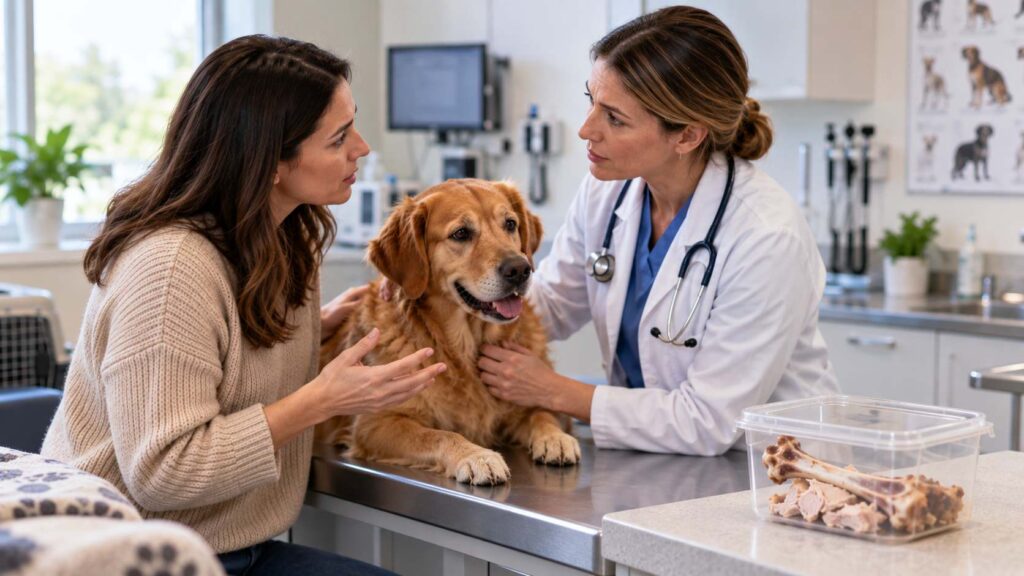
Symptoms That Matter After Eating Turkey
Contact your vet promptly if your dog develops:
- Repeated vomiting
- Diarrhoea that persists, worsens or is accompanied by other signs of illness
- Marked weakness or lethargy
- Loss of appetite
- A painful or swollen abdomen, or an unusual hunched posture
- Repeated retching
- Difficulty passing stool after eating bones
- Signs that a bone or other object may be stuck
Choking, difficulty breathing, collapse or rapidly worsening symptoms are emergencies. Seek urgent veterinary care rather than waiting to see whether they improve.
If your dog swallowed a cooked bone, twine, foil, packaging or another foreign object, contact your vet even if symptoms haven’t appeared yet.
What Information to Have Ready When You Call
Have these details ready if possible:
- Your dog’s approximate weight
- Exactly what was eaten
- Roughly how much disappeared
- The ingredient list or recipe, if available
- When it happened
- Whether bones, twine, foil or other foreign material may have been swallowed
- Any symptoms you’ve noticed
- Existing medical conditions
- Prescription or restricted diets
Don’t induce vomiting or give a home remedy unless a veterinary professional or animal poison service specifically directs you to do so.
Vet advice: Online guidance can help you identify the likely concern, but it can’t assess your dog’s individual exposure or examine them for an obstruction, abdominal pain or other complications. When bones, foreign objects, toxic ingredients or significant symptoms are involved, getting case-specific veterinary advice early is the safer approach.
Key Takeaways
- Plain, fully cooked, skinless, boneless and unseasoned turkey can be a small occasional treat for many healthy dogs.
- Skin, rich gravy, stuffing, smoked or heavily seasoned turkey and other fatty leftovers are better left off the dog’s plate.
- Cooked turkey bones should not be fed. WSAVA advises against both cooked and raw bones because of the potential for significant injury.
- There’s no universal turkey portion. Keep extras small and remember that the treat allowance covers all treats combined, not turkey alone.
- Dogs on prescription or elimination diets need individual guidance before extra foods are added.
The Bottom Line
Turkey itself isn’t the main problem for most healthy dogs. The part of the bird, preparation, added ingredients, portion and individual dog’s health are what change the answer.
If you want to share some, set aside a small piece of plain, boneless, skinless turkey before seasoning the family meal. Keep the carcass, bones and food waste securely out of reach.
If your dog helps themselves instead, don’t focus only on the word “turkey.” Work out what was eaten, what was mixed with it, how much disappeared and whether bones or non-food items were involved. Those details tell you whether you’re dealing with a simple stolen snack or something that needs veterinary attention.
Frequently asked questions
1. Can dogs eat turkey giblets?
Plain, thoroughly cooked turkey heart and gizzard can be offered in small amounts to an otherwise healthy dog. Liver is nutrient-dense, so it doesn’t need to be given in large or frequent portions.
Avoid giblets cooked with onion, garlic, rich gravy or heavy seasoning. Around holiday meals, also check that the giblet bag itself hasn’t disappeared.
2. Can dogs eat turkey necks?
Cooked turkey necks shouldn’t be fed because they contain bones. Raw necks aren’t risk-free either: WSAVA advises that both cooked and raw bones can cause significant injury, while raw animal products can also present a pathogen-transmission risk.
If you’re considering raw bones as part of a feeding plan, discuss the risks with your veterinary team rather than assuming raw means safe.
3. Can dogs eat turkey every day?
A small amount of plain turkey used within the overall treat allowance is different from making turkey the dog’s main food.
Plain turkey meat by itself isn’t a complete diet. A food intended for long-term feeding needs to provide the required nutrients in appropriate proportions for the dog’s life stage.
If you want to feed a home-prepared diet regularly, have it formulated appropriately rather than building meals around turkey alone.
4. Can puppies eat turkey?
A small piece of plain, thoroughly cooked, boneless and skinless turkey can generally be used as an occasional treat for a healthy puppy.
Keep it small because the puppy’s main diet needs to supply the nutrition required for growth. Avoid letting treats and table foods displace a properly balanced puppy diet.
5. Does turkey make dogs sleepy?
There’s no good reason to expect a few bites of turkey to act like a sedative.
If your dog becomes unusually lethargic after raiding a large holiday meal—especially alongside vomiting, abdominal discomfort, weakness or other symptoms—don’t dismiss it as “the turkey making them sleepy.” Consider what else was eaten and contact your vet if your dog seems unwell.
6. Can turkey upset a dog’s stomach?
Yes. A large portion, fatty skin, gravy, seasoning or simply introducing an unfamiliar food can be followed by digestive upset.
A single mild episode in an otherwise bright dog is different from repeated vomiting, persistent or worsening diarrhoea, abdominal pain, loss of appetite or marked lethargy. Those signs deserve veterinary advice.
7. Can dogs eat ground turkey?
Yes, plain ground or minced turkey can be suitable when it is thoroughly cooked and served without onion, garlic, seasoning or rich sauces.
Check packaged products for added ingredients rather than assuming all ground turkey is plain. Keep the serving modest and count it with the dog’s other treats and extras; WSAVA recommends that treats collectively stay within about 10% of daily calories for the average healthy dog.
If your dog is on a veterinary-prescribed diet or an elimination trial, check before adding it. During a food-allergy elimination trial, table foods and unapproved treats can undermine the diagnostic process.
#. Related Articles: