If you’ve got a spay booked for your dog, you’ve probably wondered, “How long does it take to spay a dog?” It’s a fair question—but there isn’t just one answer, because there isn’t just one clock running.
The operation itself may be relatively short. But the time your dog spends at the clinic, the time she needs to wake safely from anaesthesia, and the time her body needs to heal are completely different timelines. Mixing them up can lead owners to expect an immediate pickup—or let an energetic dog return to normal activity before she’s ready.
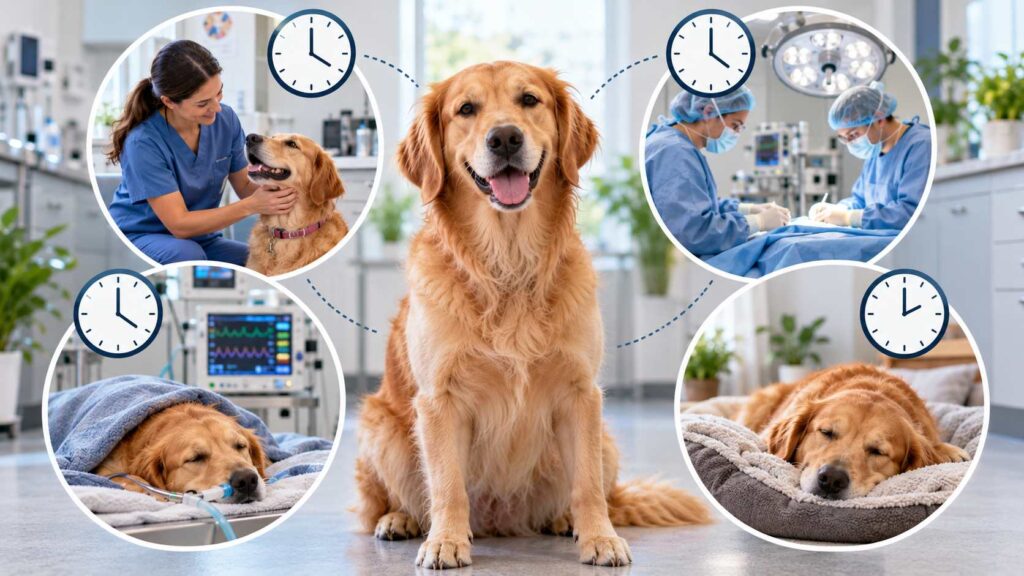
So it helps to look at spay day as four separate clocks: the operation, preparation and anaesthesia, monitored recovery, and healing at home.
The Four Clocks Behind a Dog Spay
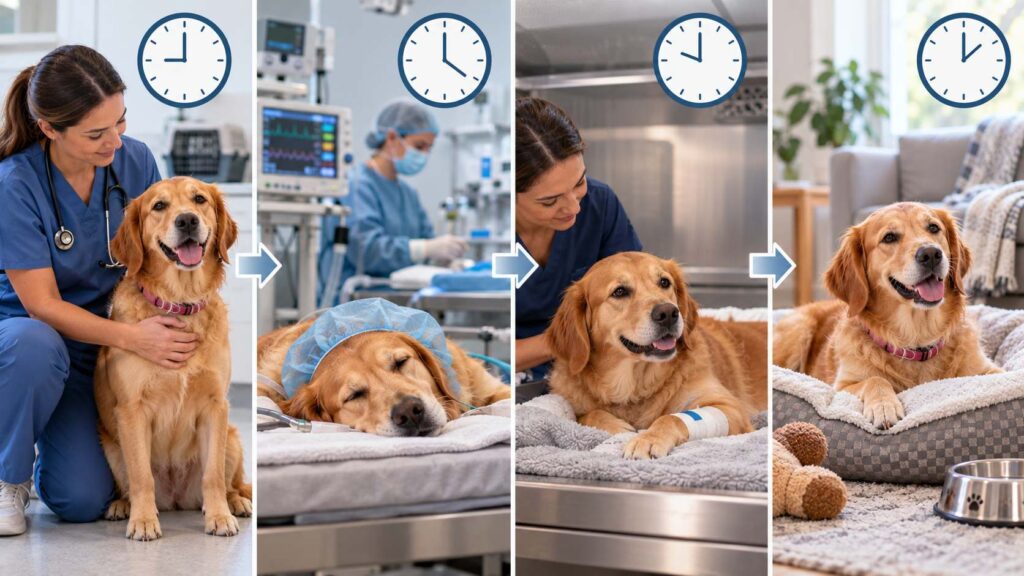
This is usually what owners mean when they ask how long a spay takes. For an uncomplicated routine spay, the procedure itself may be completed relatively quickly, but there isn’t one reliable time range that applies to every dog.
Body size and condition, anatomy, reproductive status, the surgical technique being used and unexpected findings can all affect how long the operation takes.
Your vet may be able to give you an estimate for your dog, but an exact time shouldn’t be treated as a target. Safe surgery matters more than speed.
Clock 2: Preparation and Anaesthesia
Before surgery begins, there’s important groundwork to do. Depending on your dog and the clinic, this may include:
- an admission check and physical examination
- review of medications and recent health changes
- pre-anaesthetic blood tests when recommended
- placement of an IV catheter
- premedication and pain relief
- induction of general anaesthesia
- clipping and preparing the surgical site
- positioning and connecting your dog to monitoring equipment
This is one reason a dog can spend much longer at the clinic than she spends in the operating room.
Clock 3: Waking Up and Going Home
Once the operation is finished, your dog doesn’t simply get handed back to you.
She needs supervised recovery as the anaesthetic wears off. The veterinary team will monitor things such as her breathing, temperature, comfort, alertness and overall stability, as well as checking the surgical site.
She’ll be discharged when the team is satisfied that she’s ready—not simply because a certain number of minutes have passed.
Clock 4: Healing at Home
This is the clock owners can easily underestimate.
Being awake, walking and interested in playing does not mean your dog is healed. She may start behaving much more like herself before the incision and deeper tissues have finished recovering.
That’s why the activity restrictions and wound-care instructions your veterinary team gives you still matter even when your dog appears completely normal.
Which Spay Timeline Do You Mean?
| Timeline | Starts When | Ends When | What It Tells You |
|---|---|---|---|
| Surgical time | Operation begins | Operation finishes | Length of the surgery itself |
| Perioperative time | Preparation begins | Dog is stable after surgery | The wider medical process around the operation |
| Clinic stay | Drop-off | Discharge | How long your dog is actually away from home |
| Healing time | After surgery | Recovery milestones are met | When restrictions can safely be eased |
Follow Your Dog Through Spay Day
Check-In: Before She Goes to Surgery
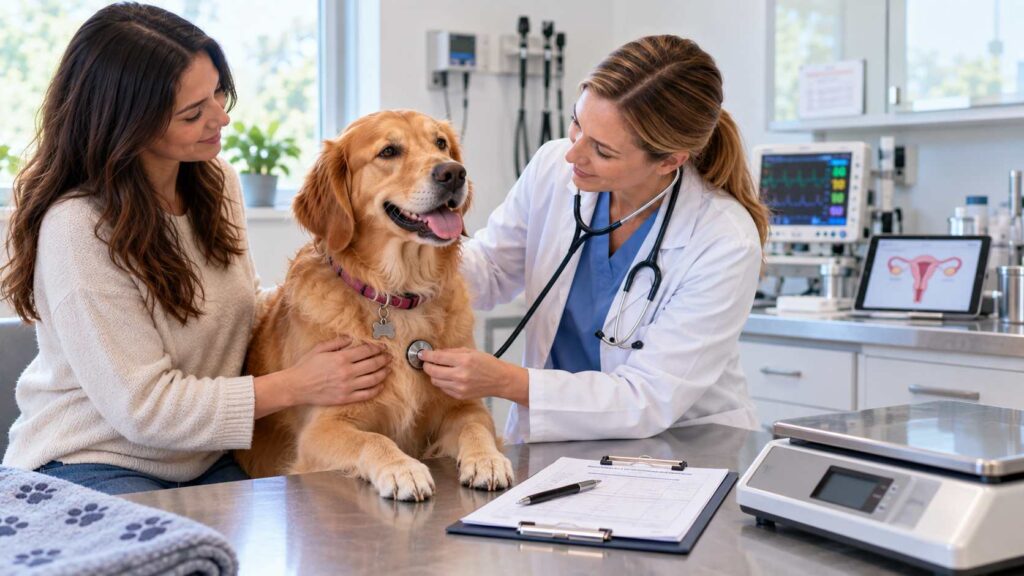
When you drop your dog off, the veterinary team will review her health and medical history and perform the checks needed before anaesthesia.
Tell them about any medications or supplements she receives and anything that has changed since the appointment was booked—even if it seems minor. Vomiting, diarrhoea, coughing, reduced appetite or unusual lethargy may be relevant.
It’s also important to tell the clinic if your dog is in season or there is any possibility she could be pregnant.
Follow your clinic’s specific instructions about food, water and regular medications before surgery. Don’t substitute a generic fasting schedule found online; instructions can vary according to the patient and anaesthetic plan.
Why Surgery Doesn’t Start the Moment You Leave

Dropping your dog off in the morning doesn’t necessarily mean surgery starts immediately.
Clinics work through surgical lists, and each patient also needs to be admitted and prepared safely. Placing a catheter, administering medications, inducing anaesthesia and preparing the surgical site all happen before the operation itself.
So if your dog has been at the clinic for several hours, that doesn’t mean she’s been undergoing surgery for several hours.
If you’re arranging work, transport or childcare around the appointment, ask the clinic for an estimated collection window rather than trying to calculate pickup time from the expected length of surgery.
During Surgery: What’s Actually Happening
Your dog is under general anaesthesia during the operation.
The exact procedure can differ. An ovariectomy removes the ovaries, while an ovariohysterectomy removes the ovaries and uterus. Some veterinary practices also offer laparoscopic techniques.
The surgical site is then closed in layers. Depending on the technique, your dog may have visible external sutures or internal dissolvable stitches.
You don’t need to know every surgical detail before consenting, but it is reasonable to ask which procedure your vet plans to perform and what the expected recovery will involve.
After Surgery: Why She Isn’t Sent Home Straight Away
Coming round from general anaesthesia isn’t instant.
Your dog will be monitored during recovery while the veterinary team assesses her breathing, temperature, alertness and comfort. They’ll also check the incision and provide additional pain management if needed.
This isn’t unnecessary waiting time. Safe recovery from anaesthesia is part of the procedure.
Pickup: Same Day or Overnight?
Many dogs having an uncomplicated routine spay can go home the same day once they’re recovering appropriately.
However, same-day discharge isn’t guaranteed. A dog may need longer monitoring because of her individual health, how she responds to anaesthesia, the procedure performed or something that happened during surgery. Clinic protocols also differ.
An overnight stay therefore doesn’t automatically mean something has gone wrong.
The most useful question to ask isn’t “What time will the operation finish?” but “When should I expect an update, and what does my dog need to do before she’s ready to come home?”
What Can Make a Spay Take Longer Than Expected?
Several factors can affect the operation itself, the anaesthetic plan, or how long your dog needs to be monitored afterwards:
- In season: Blood flow to the reproductive tissues increases during heat, which can make surgery more technically challenging and increase bleeding risk. Tell your clinic if your dog is in season or has recently finished one. Whether to proceed or postpone is a decision for your veterinarian based on your dog’s circumstances.
- Pregnancy or reproductive changes: Pregnancy can change the complexity of the procedure. A phantom pregnancy may also affect the preferred timing of a routine spay, so mention any nesting, mammary enlargement, milk production or other changes to your vet.
- Body size and condition: Size, anatomy and body condition can affect surgical access and planning. However, there’s no reliable formula where a larger dog simply means a certain number of extra minutes.
- Age and health conditions: Dogs with existing medical problems may need additional testing, anaesthetic planning or postoperative monitoring. Age alone doesn’t tell the whole story; your dog’s overall health matters.
- Surgical technique: Traditional open surgery, laparoscopic surgery, ovariectomy and ovariohysterectomy aren’t identical procedures. Technique can affect surgical and recovery considerations, but one approach isn’t automatically best for every dog.
- Unexpected findings or complications: Occasionally the surgical plan has to change because of something discovered before or during the procedure. If that happens, additional treatment or monitoring may be necessary.
One distinction matters particularly: a routine elective spay in a healthy dog isn’t comparable to emergency reproductive surgery. Pyometra, for example, is a potentially life-threatening uterine infection and can require more intensive treatment and monitoring. Don’t use an emergency case to estimate how long a routine spay should take.
Traditional vs Laparoscopic Spay — Does the Timeline Change?
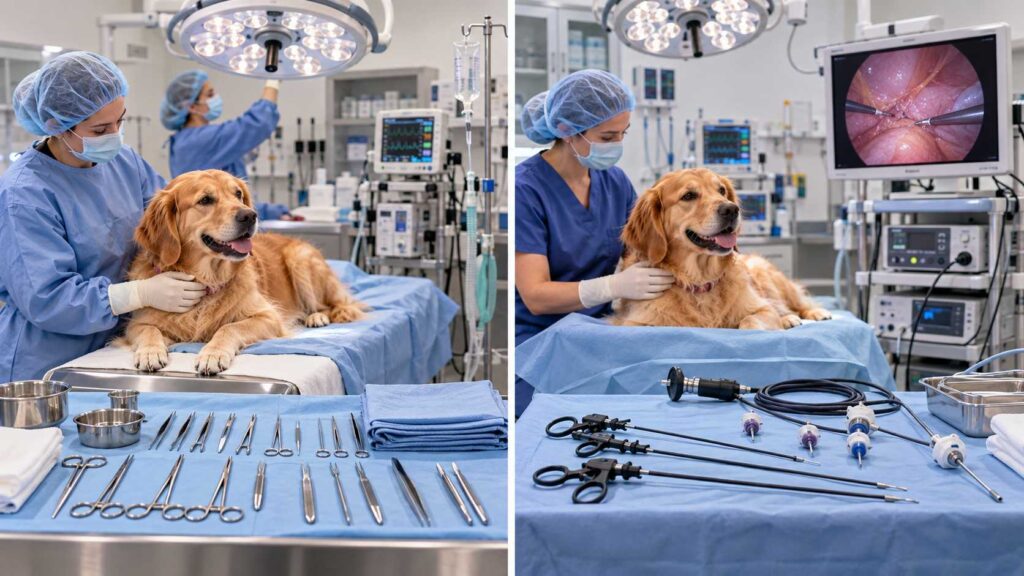
The techniques differ, but procedure length alone isn’t a useful way to choose between them.
| Traditional (Open) Spay | Laparoscopic Spay | |
|---|---|---|
| Surgical access | Conventional abdominal incision | Small abdominal ports for a camera and specialised instruments |
| Procedure performed | May be ovariectomy or ovariohysterectomy | Commonly ovariectomy, depending on the surgeon and case |
| Equipment | Standard surgical equipment | Requires specialised equipment and training |
| Availability | Widely available | Availability varies between veterinary practices |
| Recovery | Follow the surgeon’s individual recovery plan | May offer recovery advantages in suitable cases, but activity and wound-care instructions still matter |
Neither technique is a universal “winner.” Ask your veterinarian which procedure they recommend for your dog, why they recommend it, and what the expected recovery will involve rather than choosing solely on incision size or anticipated surgical time.
Home Doesn’t Mean Healed — The Recovery Milestones That Matter
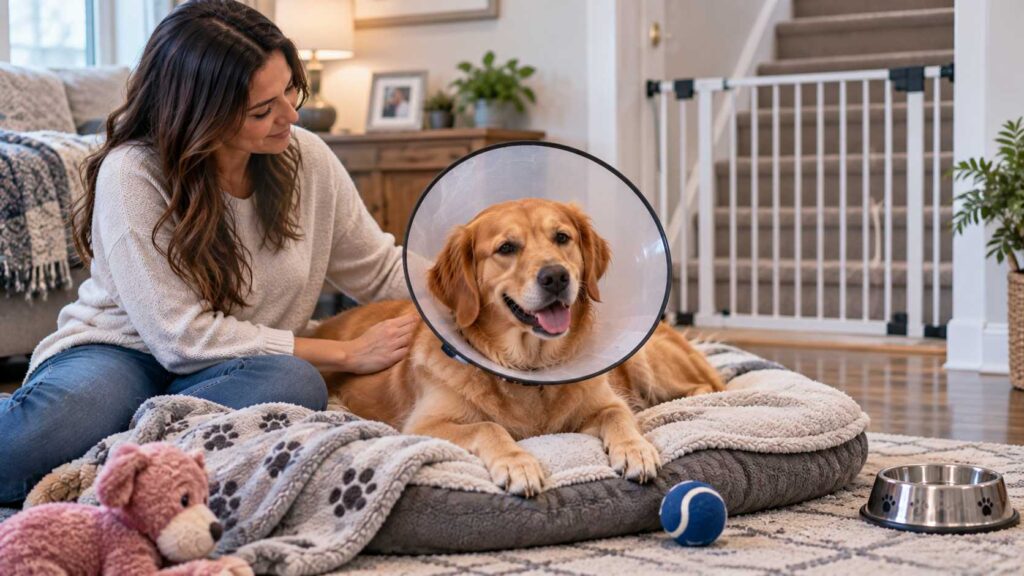
A day-by-day countdown can be misleading because dogs don’t all recover at exactly the same pace. These milestones are more useful.
Awake and stable: Some drowsiness or disorientation can occur after anaesthesia. Give your dog a quiet, comfortable place to rest and follow the discharge instructions you were given.
Eating, drinking and toileting: Follow your clinic’s instructions about the first meal and water. Monitor appetite, drinking, urination and bowel movements, and contact the clinic if your dog isn’t progressing as expected or develops vomiting or other concerning symptoms.
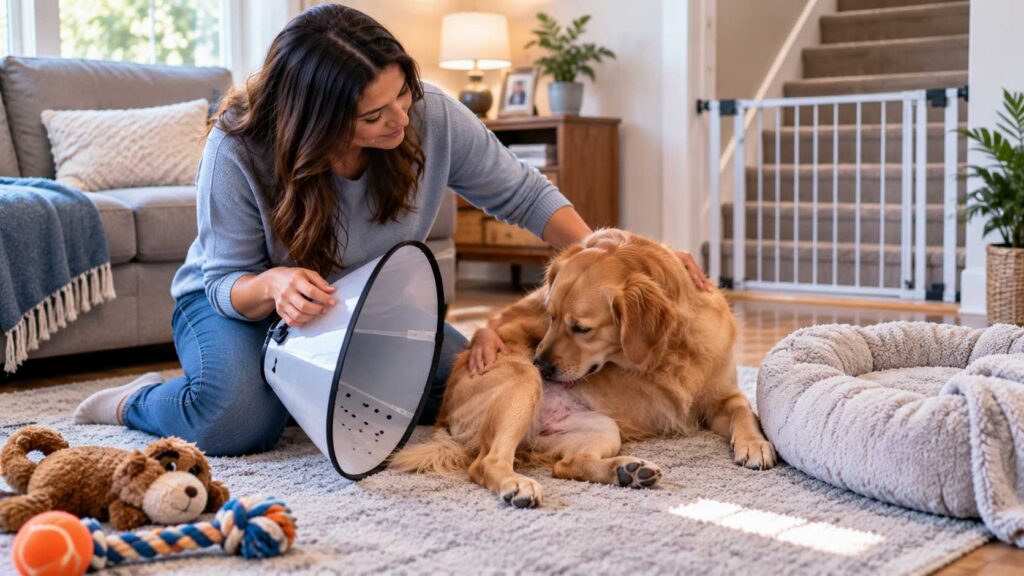
Incision staying clean and protected: Prevent licking and chewing with the protection recommended by your vet, such as an e-collar or appropriately fitted recovery suit. Don’t apply creams, antiseptics or other products unless your veterinary team tells you to.
Energy returning: This is an easy point to misread. Your dog may feel ready to run or jump before the surgical tissues are ready for that strain. Feeling normal isn’t the same as being healed.
Return to normal activity: Running, jumping, rough play, stairs, bathing and swimming should be managed according to your veterinarian’s instructions. Don’t shorten the restriction period simply because your dog seems bored or energetic.
Call your vet sooner rather than waiting for a recovery milestone if your dog becomes significantly unwell, has worsening pain, repeated vomiting, difficulty breathing, trouble urinating, increasing redness or swelling around the incision, bleeding, discharge, missing stitches or an opening wound.
Spay-Day Checklist for Dog Owners
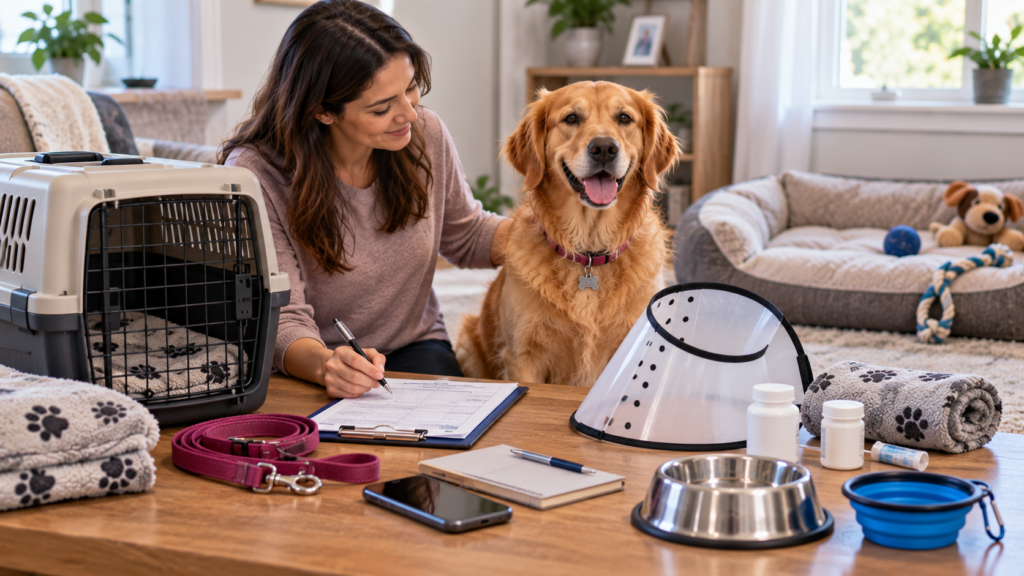
Before You Leave Home
- Follow your clinic’s specific fasting and water instructions
- Confirm whether regular medications should be given
- Mention any new illness or symptoms
- Tell the clinic if your dog may be in heat or pregnant
- Bring any records or medications the clinic requested
- Make sure the clinic has your correct contact number
Before She Comes Home
- Set up a quiet, comfortable recovery area
- Block unnecessary access to stairs if advised
- Prevent jumping onto or off furniture
- Separate boisterous pets if necessary
- Have prescribed medications ready
- Have the recommended cone or recovery protection available
Before You Leave the Clinic
- Ask exactly which procedure was performed
- Ask whether the stitches are dissolvable or need removal
- Confirm medication doses and timing
- Confirm food and water instructions
- Ask exactly what exercise is allowed
- Confirm incision-care instructions
- Confirm the follow-up date, if one is needed
- Save the clinic’s daytime and after-hours contact details
Common Mistakes That Can Turn a Routine Recovery Into a Problem
Treating discharge as full recovery. Being well enough to leave the clinic doesn’t mean the incision and deeper tissues have finished healing. Keep following the discharge instructions after your dog starts acting normal.
Letting an energetic dog run or jump too soon. Energy often returns before healing is complete. Running, jumping, rough play and other strenuous activity can put unnecessary strain on the surgical site.
Removing the cone too soon. Licking and chewing can irritate the incision, introduce bacteria or damage stitches. Keep the e-collar or other protection in place for as long as your veterinary team recommends.
Following a generic internet fasting schedule. Fasting and medication instructions can vary. Before surgery, follow the instructions from the clinic performing your dog’s procedure rather than a timetable found online.
Giving human pain medication. Never give human painkillers unless your veterinarian specifically instructs you to. If your dog’s prescribed pain relief doesn’t seem adequate, call the clinic rather than adding another medication yourself.
Cleaning the incision with household products. Don’t apply peroxide, antiseptics, creams or ointments unless your vet has specifically recommended them. In most routine recoveries, the goal is to keep the surgical site clean, dry and protected.
Comparing her recovery with another dog’s. Surgical technique, health, reproductive status and individual healing all vary. Another dog’s timeline isn’t a reliable benchmark for yours.
Assuming routine and emergency surgery follow the same timeline. A healthy dog having a planned elective spay is very different from a dog needing emergency reproductive surgery, such as treatment for pyometra. Recovery and monitoring needs shouldn’t be compared directly.
Call Your Vet Rather Than Waiting for the Timeline
Contact your veterinary clinic promptly if you notice:
- significant or worsening lethargy
- collapse or difficulty breathing
- repeated vomiting
- pain that appears severe or is getting worse
- concerning or persistent bleeding
- increasing redness, swelling or discharge around the incision
- missing stitches or the wound beginning to open
- difficulty urinating or other concerning toileting problems
- refusal to eat beyond the timeframe your clinic told you to expect
- any warning sign specifically listed in your discharge instructions
Collapse, difficulty breathing or rapid deterioration needs urgent veterinary attention.
If something about your dog’s recovery worries you, don’t wait for an online timeline to tell you whether enough time has passed. Your veterinary team knows what procedure was performed and is better placed to decide whether your dog needs to be examined.
Questions Worth Asking Before You Leave the Clinic
- Which spay procedure did my dog have, and did everything go as expected?
- What anaesthetic effects should I expect tonight?
- When should I become concerned if she’s still very sleepy?
- How long should activity be restricted?
- When can she use stairs, run, jump and play again?
- How long should the cone or recovery suit stay on?
- What should the incision normally look like?
- Are the stitches dissolvable, or will they need removing?
- When is the follow-up appointment, if one is needed?
- Which signs mean I should call the clinic today, and which require emergency care?
- Who should I contact outside normal clinic hours?
The Bottom Line
Spaying doesn’t have one single timeline. There’s the operation itself, preparation and anaesthesia, monitored recovery at the clinic, and then healing at home.
That’s why “the operation is finished” and “my dog is fully recovered” can be very different points in time.
Keep your discharge instructions and after-hours contact number somewhere easy to find, prepare a quiet recovery area before surgery day, and follow your vet’s instructions for wound protection and activity. Let healing—not your dog’s returning energy—determine when normal activity resumes
Frequently Asked Questions
1. How long does the actual spay surgery take?
There isn’t one reliable time range for every dog. Surgical technique, body size and condition, anatomy, reproductive status and unexpected findings can all affect the duration. Your clinic can give you a more useful estimate for your individual dog.
2. Why does my dog have to stay at the vet longer than the surgery itself takes?
Because the operation is only one part of the visit. Admission, preparation, anaesthesia, surgery, supervised recovery and discharge checks all take time. A dog spending several hours at the clinic doesn’t mean she spent several hours in surgery.
3. Can my dog come home the same day after being spayed?
Many dogs having an uncomplicated routine spay can go home the same day once they’re recovering appropriately. Some need longer monitoring or an overnight stay. Your veterinary team will decide when your dog is safe to discharge.
4. Does spaying take longer if my dog is in heat?
It can be more technically challenging because blood flow to the reproductive tissues increases during heat. Tell your clinic if your dog is in season or has recently finished one. Your veterinarian can advise whether to proceed or postpone based on her circumstances.
5. Is a laparoscopic spay quicker than a traditional one?
Not necessarily. Operating time depends on the technique, surgeon and individual dog, and speed alone isn’t a useful way to choose between procedures. Ask your vet about the expected recovery, risks and suitability of each option for your dog.
6. How long does it take for a spay incision to heal?
Many routine surgical wounds require roughly 10–14 days of careful protection and restricted activity, but healing varies with the dog and procedure, and deeper tissues continue recovering beyond what you can see on the surface. Follow your vet’s specific instructions rather than judging recovery by the appearance of the incision alone.
7. My dog seems completely normal the next day. Does that mean she’s healed?
No. Alertness and energy can return well before the surgical tissues have finished healing. Continue the prescribed activity restrictions and incision protection even if your dog seems ready to get back to normal.
#. Related Articles:
1. How Long Are Dogs Pregnant?