The Number on the Bag Is Only the Starting Point
How much food should a puppy eat? There isn’t one universal cup or gram amount that works for every puppy. The right daily amount depends on your puppy’s age, current weight, expected adult size, growth rate, body condition, activity level, and the calorie density of the specific food you’re feeding.
That’s why a generic internet chart can only take you so far. The feeding guide on your puppy food is a useful starting point, but it still needs to be adjusted to the puppy in front of you. Two Labrador puppies of the same age and similar weight, for example, may need different portions because their growth rate, activity and body condition are not identical.
A better approach is simple: start with the correct feeding guide, measure the food accurately, include treats and extras, then monitor your puppy’s growth and body condition and adjust when necessary.
First, Find Your Puppy’s Starting Daily Amount
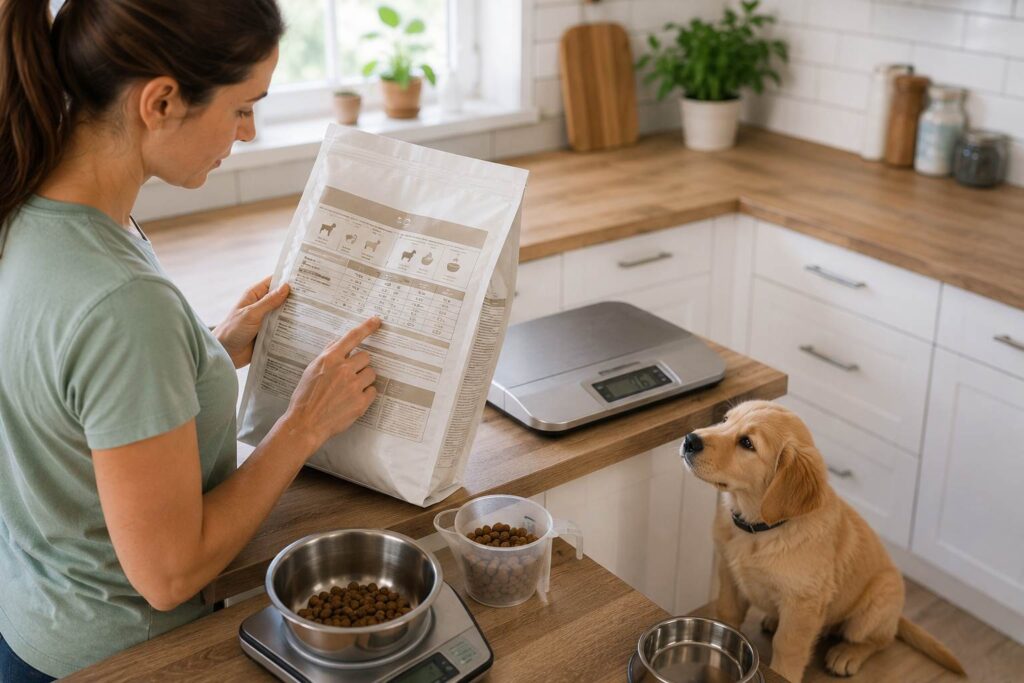
Check Which Feeding Guide Your Food Uses
Turn the puppy food package over and read the feeding table carefully. Depending on the manufacturer, recommendations may be based on:
- your puppy’s current weight
- age
- expected adult weight
- or a combination of these
Don’t assume a number such as “20 kg” automatically means your puppy’s current weight. Some puppy foods use expected adult weight instead. Follow the instructions for that specific product.
If you have a mixed-breed puppy and don’t know their likely adult size, your veterinarian can help you make a reasonable estimate and then refine the portion as your puppy grows.
Make Sure the Number Means “Per Day,” Not “Per Meal”
This is an easy mistake to make.
If the feeding guide recommends 150 g per day and your puppy eats three meals, that 150 g should normally be divided across all three meals. It does not mean 150 g at breakfast, lunch and dinner.
Always check the wording on the package before portioning meals.
Don’t Copy the Same Cups From Another Brand
When you switch foods, don’t automatically keep feeding the same number of cups or scoops.
Different puppy foods can contain very different amounts of energy in the same volume. Kibble size and density also vary, so one cup of Food A is not nutritionally equivalent to one cup of Food B.
Check the new product’s feeding guide and calorie information, then calculate the portion from that food rather than copying the old measurement.
Measure the Daily Ration More Accurately
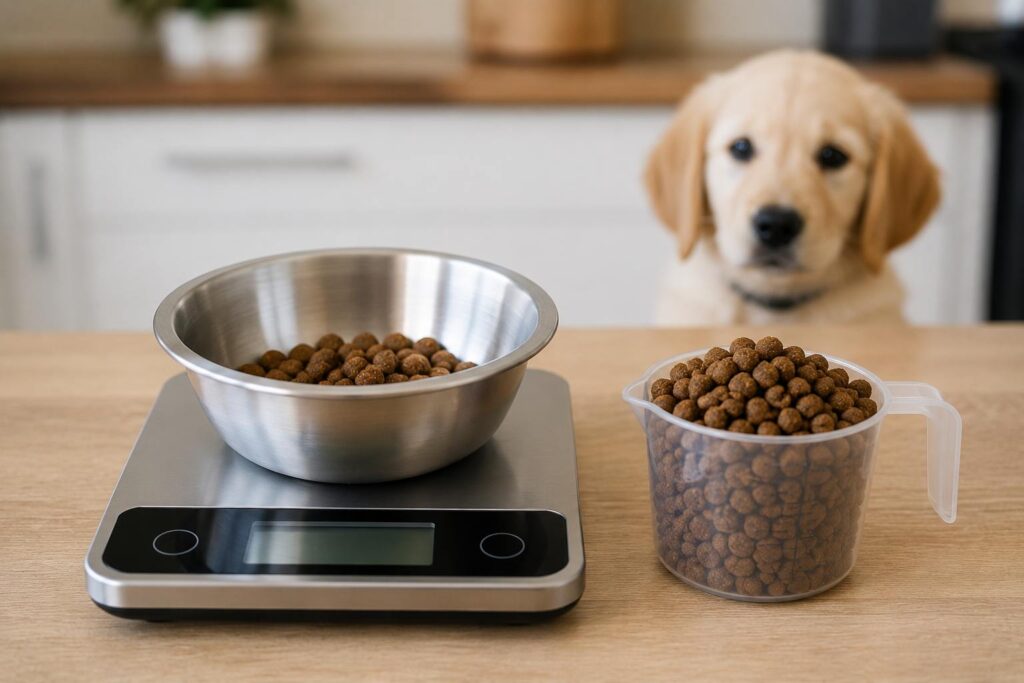
Grams vs Cups – Which Is Better?
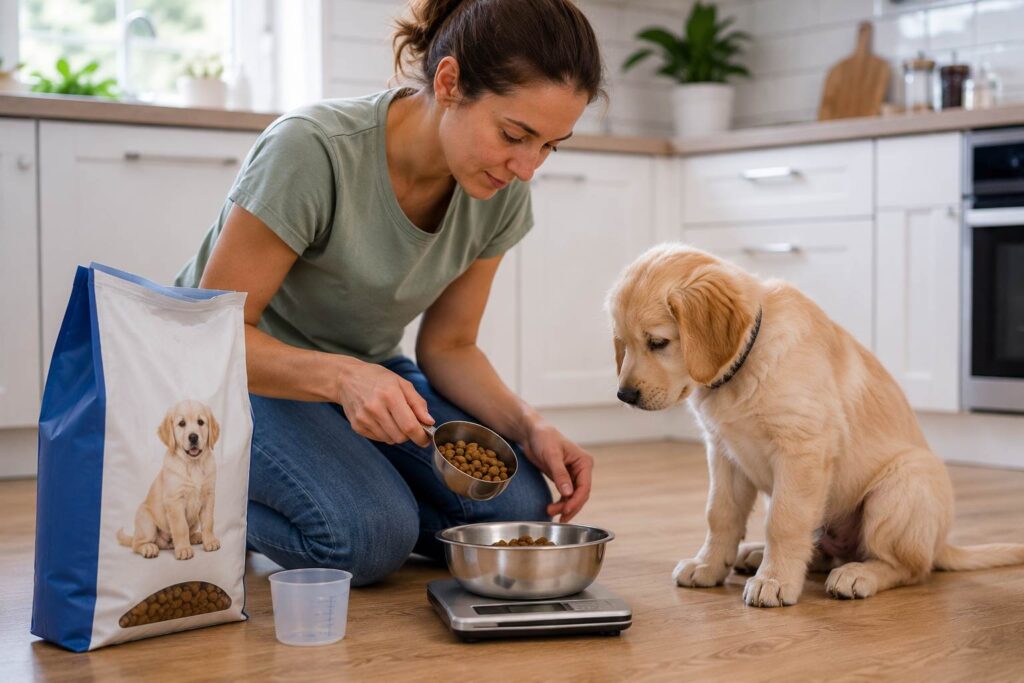
For dry food, a digital kitchen scale is usually the most consistent way to measure a puppy’s ration.
Measuring cups can vary depending on the cup used, kibble shape, how full it is and whether the food is levelled or heaped. PDSA recommends weighing puppy food with digital scales rather than relying on a measuring cup, as this provides a more accurate way to measure the daily allowance. PDSA puppy feeding guide
A practical routine is to place the bowl on the scale, reset it to zero and weigh the required number of grams.
Divide the Daily Total Across Meals
Once you know the daily allowance, divide it across the number of meals your puppy currently needs.
The meals do not have to be identical down to the final gram, but the total amount eaten across the day should stay reasonably consistent.
For example, if some of the morning ration is used during training, that food still counts toward the day’s total.
Keep Treats, Chews and Toppers Inside the Daily Intake
Training rewards, chews, toppers and table-food extras all contribute calories.
This matters particularly during puppyhood because owners often do a lot of reward-based training. A puppy can receive carefully measured meals and still take in considerably more food than intended through rewards throughout the day.
Using some of the puppy’s normal kibble for training is an easy way to keep those extras under control. If you use higher-value treats, keep portions small and factor them into the overall diet.
Quick Tips
- Pre-weigh the day’s food so everyone in the household knows what is available.
- Use part of the measured ration for training when practical.
- Recalculate portions whenever you change foods rather than carrying over the old cup measurement.
- Avoid estimating portions with heaped household cups.
- Make sure everyone who feeds or trains the puppy is working from the same daily allowance.
- Keep fresh drinking water available at all times.
How Feeding Changes as a Puppy Grows
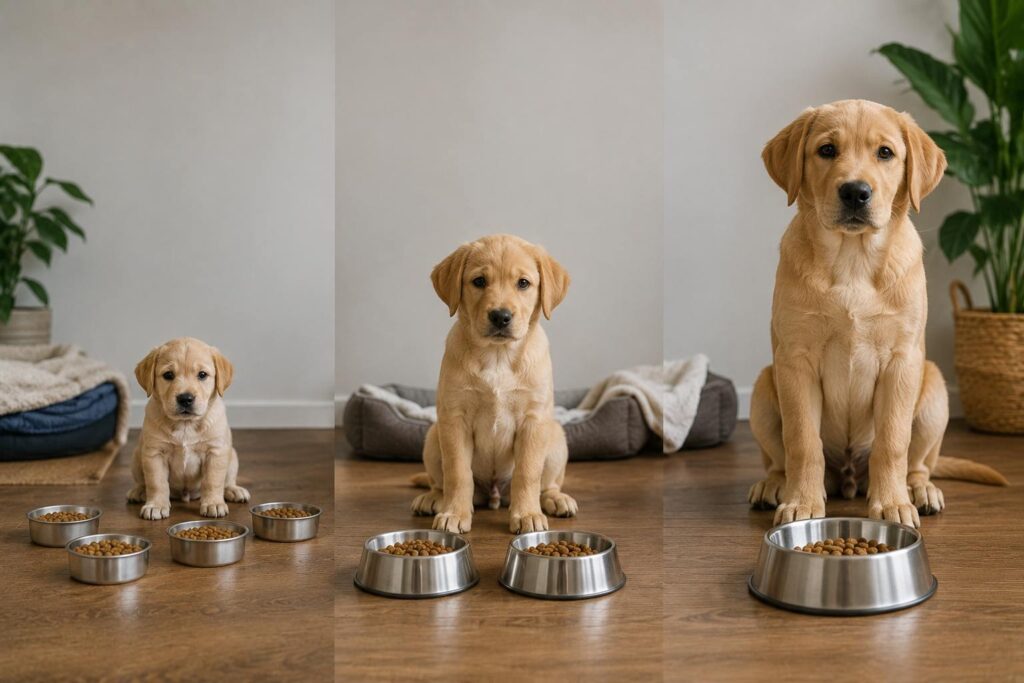
Very Young Puppies Need Smaller, More Frequent Meals
Young puppies usually cope better with several smaller meals than one or two large ones.
Meal timing deserves particular attention in very young toy and small-breed puppies. Some are more vulnerable to low blood sugar, especially if they are not eating normally, so unusually long gaps between meals should not be created simply to force a new feeding schedule.
Weakness, trembling, unusual sleepiness, poor coordination, collapse or refusal to eat in a very young puppy should prompt veterinary advice rather than simply waiting for the next scheduled meal.
Meal Frequency Usually Falls With Age
Puppies generally move from more frequent meals when very young to fewer meals as they mature.
There isn’t one date on which every puppy must change schedules. Breed size, age, health, routine and veterinary advice all matter. Rather than changing meal frequency simply because a puppy reaches a particular birthday, make the transition gradually and keep the total daily ration in mind.
Bigger Does Not Always Mean “Keep Adding More Food”
A growing puppy gets heavier, but that doesn’t mean the food portion should simply keep increasing indefinitely.
Growth is fastest during the earlier stages of puppyhood and gradually slows as adulthood approaches. The goal is steady, appropriate development rather than maximum possible growth, which is especially important for large and giant breeds.
If your puppy suddenly looks bigger, check their current feeding guide, weight trend and body condition before automatically adding another scoop.
When to Recheck the Portion
Reassess the ration whenever something important changes, including:
- a noticeable change in growth or body condition
- switching to a different puppy food
- a major change in activity
- frequent training with food rewards
- moving toward adulthood
- veterinary recommendations
- changes around neutering or another medical procedure
Don’t make major portion changes based on one unusually hungry day. Look at the trend in weight, body condition, appetite and growth instead.
| Situation | What Usually Changes | What to Recheck |
|---|---|---|
| Young puppy | Meal frequency | Daily amount and meal division |
| Rapid growth phase | Energy requirement | Weight trend and body condition |
| Food brand change | Calorie density | New product’s daily feeding amount |
| Treat-heavy training | Calories outside meals | Main-meal allowance and treat intake |
| Large or giant breed | Growth management | Food formulation, growth rate and body condition |
| Nearing adulthood | Growth slows | Portion size and timing of the adult-food transition |
Size Matters – But Breed Alone Doesn’t Set the Portion
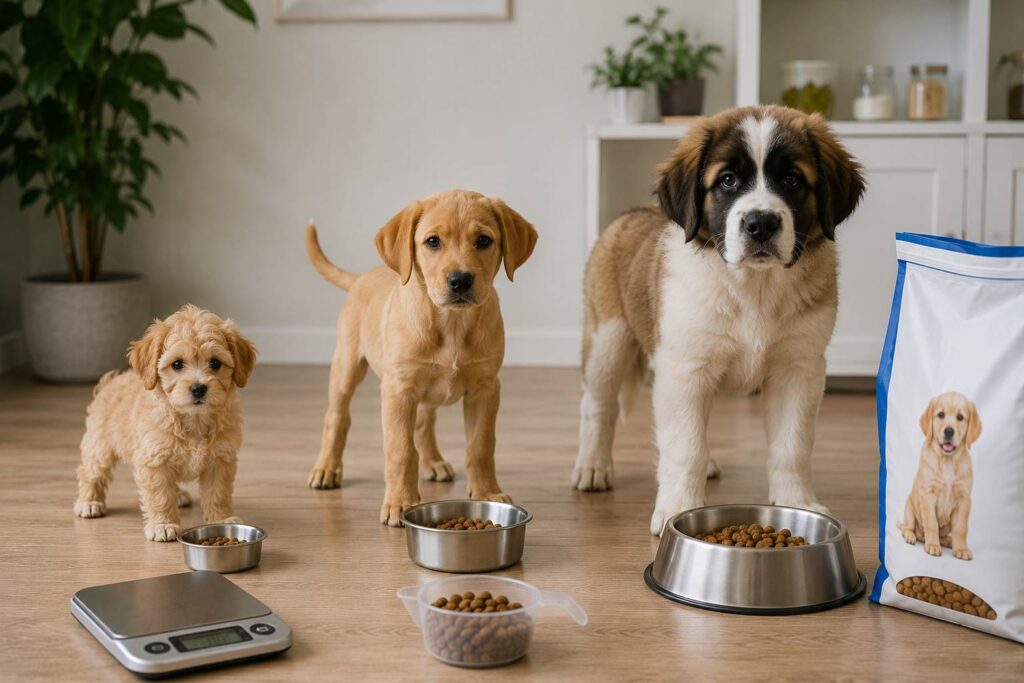
Toy and small puppies may need smaller, more frequent meals for longer than larger puppies. Very young toy breeds deserve particular attention because they can be more vulnerable to low blood sugar if they are not eating normally. Keep a close eye on appetite, energy and meal consistency rather than simply stretching the time between meals.
Medium-sized puppies often have fewer special feeding considerations, but their portions still need to follow growth and body condition rather than appetite alone. A puppy that eagerly finishes every meal does not necessarily need more food.
Large and giant puppies need especially careful growth management. The aim is steady, controlled development rather than rapid weight gain. Foods formulated for the growth of large-breed puppies are designed with their energy and mineral requirements in mind. Avoid deliberately “bulking up” a large puppy or adding calcium or mineral supplements unless your veterinarian specifically recommends them.
If you don’t know a mixed-breed puppy’s likely adult size, ask the breeder or rescue whether they have information about the parents or expected mature size. Your veterinarian can also help estimate an appropriate size range using the puppy’s breed background, current weight and growth pattern. Treat any estimate as a starting point and refine the feeding plan as your puppy develops.
Is the Starting Amount Actually Right for Your Puppy?
Watch Growth, Not Just the Empty Bowl
An empty bowl tells you that your puppy finished the meal. It doesn’t tell you whether the portion was appropriate.
A more useful picture comes from weight trend, growth rate and body condition over time. Check these regularly rather than judging the ration from a single meal or a particularly hungry-looking day.
Begging Does Not Automatically Mean Underfeeding
Puppies quickly learn that begging can lead to food, attention or another trip to the treat cupboard. Some are naturally more food-motivated than others.
Before increasing the ration because your puppy seems hungry, check whether their weight and body condition are progressing appropriately and remember to count treats, chews and training rewards.
Leaving Food Does Not Automatically Mean Something Is Wrong
A puppy occasionally leaving part of a meal may not be a problem, particularly if they remain bright, active and otherwise normal.
A persistent or sudden loss of appetite deserves more attention, especially if it comes with vomiting, diarrhoea, lethargy, weakness, abdominal swelling or poor weight gain. In those situations, don’t simply keep changing the portion—contact your veterinary team.
Use a Feed → Monitor → Adjust Loop
Use the food label to establish a starting ration, measure it accurately, then monitor your puppy’s weight, growth and body condition. If the trend suggests the portion needs changing, make a modest adjustment and reassess rather than making a dramatic change overnight.
Useful signs to monitor include:
- steady, appropriate growth
- ribs that can be felt without pressing hard
- a visible waist when viewed from above
- normal energy and activity
- a consistent appetite
- normally formed stools
The important point is that the right portion is something you confirm over time, not a number you calculate once and never revisit.

Dry, Wet or Mixed Feeding – Don’t Compare Them by Volume Alone
Dry Food
Dry food is relatively calorie-dense, so seemingly small differences in portion size can matter when repeated every day.
For the most consistent measurement, weigh kibble in grams rather than relying on a scoop or household cup. Always use the calorie and feeding information for the specific product you are feeding.
Wet Food
Wet puppy food contains substantially more moisture than dry kibble, so the portion can look much larger even when it provides a similar amount of energy.
Don’t compare wet and dry foods by bowl volume alone. Check the feeding guide and calorie information on the package.
Mixed Feeding
When feeding wet and dry food together, avoid giving the full recommended daily ration of both. That can unintentionally turn one complete day’s allowance into considerably more food than intended.
Instead, reduce each component so the combined intake makes up the appropriate daily ration. If the manufacturer’s mixed-feeding instructions are available, use those as your starting point.
| Feeding Style | Best Measurement | Main Portion Risk | Key Check |
|---|---|---|---|
| Dry | Grams | Inconsistent cup measurements | Calorie density and feeding guide |
| Wet | Grams or can/pouch portion | Comparing it with dry food by volume | Label calorie content and daily allowance |
| Mixed | Measure both components | Adding a full ration of each | Combined daily intake |
What Can Quietly Push a Puppy Over Its Daily Intake?
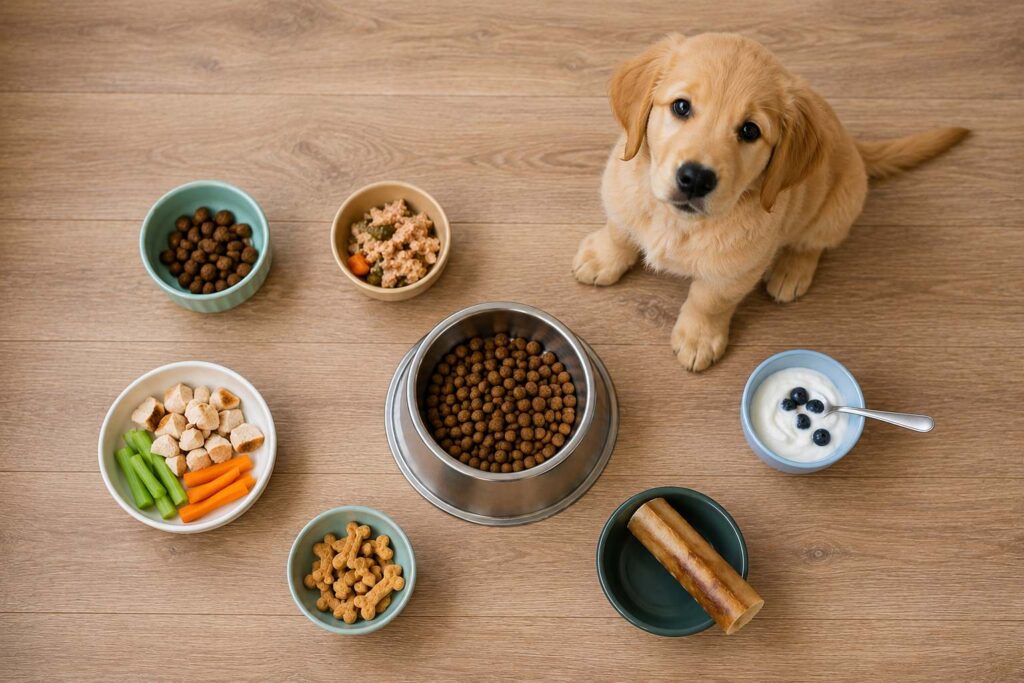
A puppy’s meals may be perfectly measured while a surprising amount of extra food arrives elsewhere during the day:
- Training rewards, especially during frequent puppy-training sessions
- Dental chews and edible chews
- Toppers added to encourage eating
- Table food and leftovers
- Treats from visitors or family members
- Several people feeding the puppy without knowing what others have already given
Quick Tip: Keep one daily treat container that everyone in the household uses. When practical, use part of the puppy’s measured kibble for training, and account separately for larger chews or higher-calorie treats.
Common Puppy Feeding Mistakes
- Treating the total daily allowance as the amount for each meal
- Copying another puppy’s ration without considering the individual puppy or food
- Measuring kibble inconsistently with household cups
- Assuming different foods contain roughly the same calories
- Increasing portions every time the puppy begs
- Forgetting treats, chews and toppers when considering total intake
- Free-feeding without knowing how much the puppy actually eats
- Switching foods while continuing the old portion measurement
- Trying to make a puppy grow faster by deliberately overfeeding
- Adding calcium, minerals or other supplements to a complete puppy diet without veterinary advice
- Making a large ration change because of one unusual day
When “Just Feed More” Is the Wrong Response
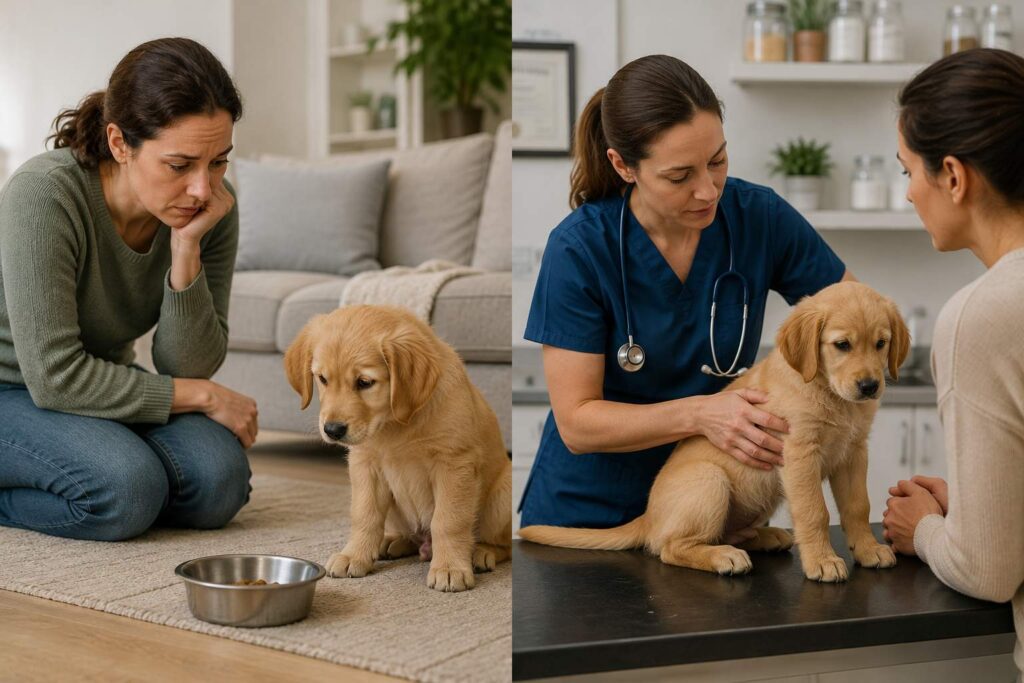
Seek veterinary advice rather than simply increasing your puppy’s food if you notice:
- Poor or stalled growth
- Persistent vomiting
- Persistent diarrhoea
- Marked lethargy or weakness
- Repeatedly refusing food
- A noticeably distended abdomen
- Unexplained weight loss
- A concerning change in body condition
- A sudden or persistent change in appetite
Very young puppies can become unwell quickly, so don’t wait for several symptoms to appear if your puppy seems weak, unusually sleepy, repeatedly vomits, cannot keep food or water down, or otherwise seems seriously unwell.
Possible Reasons Feeding Amount Isn’t the Whole Story
Sometimes the problem isn’t portion size at all. Parasites, gastrointestinal disease, poor nutrient absorption, an unsuitable diet, underlying illness, or competition with other pets at mealtimes can all affect how a puppy eats and grows.
For example, a puppy that isn’t gaining weight despite apparently eating enough needs a different approach from a healthy puppy that simply begs after dinner. Persistent digestive symptoms, poor appetite or abnormal growth warrant veterinary assessment rather than repeatedly increasing the ration at home.
Special Nutrition Warnings During Growth
Faster Growth Is Not Better Growth
This is especially important for large and giant breeds. The goal is controlled, steady development rather than making a puppy grow as quickly or as heavily as possible.
Overfeeding during growth can promote excessive weight gain and an unnecessarily rapid growth rate. The Merck Veterinary Manual notes that overfeeding during growth increases growth rate, which is undesirable for proper skeletal development. Large and giant puppies are particularly sensitive to nutritional excesses while their skeleton is developing, so deliberately trying to “bulk up” a puppy is not beneficial
Don’t Add Calcium “For Stronger Bones”
A complete puppy food formulated for growth should already provide calcium, phosphorus and other essential nutrients in appropriate amounts and proportions.
Adding calcium, mineral powders or vitamin supplements “just in case” can upset that nutritional balance rather than improve it, particularly in large and giant-breed puppies. Only supplement a growing puppy’s diet when your veterinarian has identified a reason to do so.
Avoid Unbalanced DIY Diets
Puppies have specific nutritional requirements for growth, making homemade and raw diets particularly difficult to formulate correctly.
If you want to feed a home-prepared diet, don’t rely on an internet recipe or simply combine meat, vegetables and supplements yourself. Ask your veterinarian about working with a suitably qualified veterinary nutrition professional who can formulate a complete diet for your individual puppy.
Change Foods Gradually
When possible, transition between foods gradually rather than replacing the old diet overnight. A transition over roughly 7–10 days is commonly used, with the proportion of new food increasing while the old food decreases.
Monitor appetite and stool during the change. If your puppy develops persistent vomiting, diarrhoea, refuses food or seems unwell, contact your veterinarian rather than assuming the food transition is the only cause.
How to Know When It’s Time to Adjust the Amount
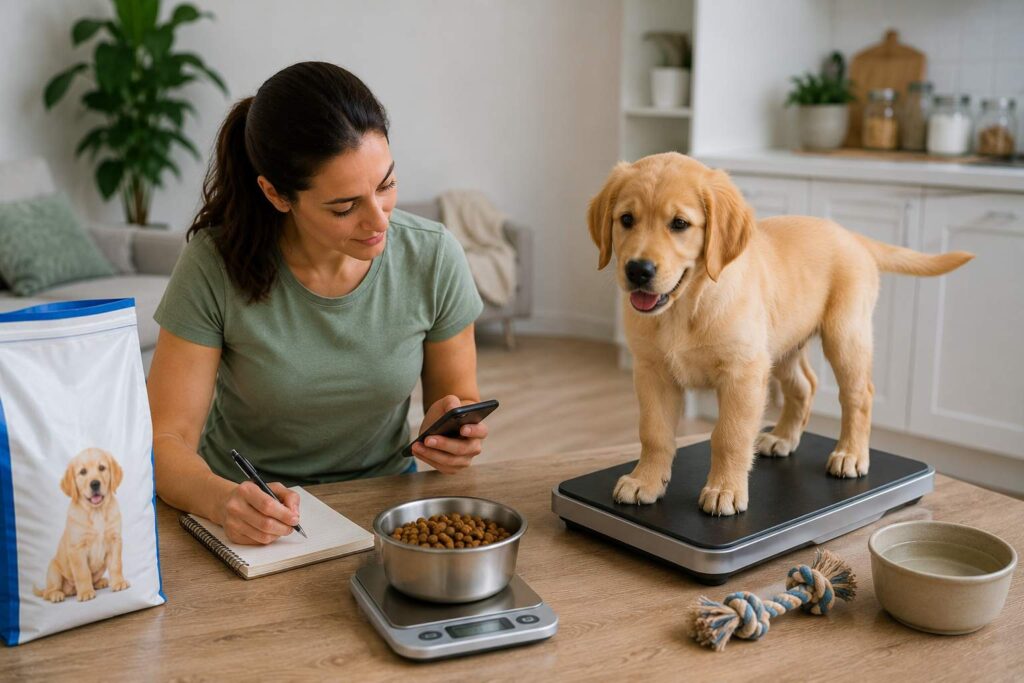
Recheck the ration when something meaningful changes: a new food, a new growth stage, a shift in weight or body condition, substantially more or fewer treats, or a significant change in activity.
If your puppy is growing appropriately, maintaining a healthy body condition, eating normally and producing normal stools, there is usually no reason to increase the ration simply because they beg for more.
For abnormal growth, repeated digestive problems, medical conditions, or concerns about feeding a large or giant-breed puppy, let your veterinary team guide the next adjustment.
Vet Advice: What to Ask at Your Puppy’s Next Check-Up
- Is my puppy growing at an appropriate rate?
- Is their current body condition appropriate?
- Is this food nutritionally complete and suitable for growth?
- Does my puppy need a food formulated for large-breed growth?
- Is my estimate of their expected adult size reasonable?
- Is it time to change their meal frequency?
- Should their calorie intake be reassessed after neutering?
- Are treats, chews or toppers affecting their overall diet?
- When should we begin transitioning from puppy to adult food?
- Does my puppy actually need any supplements?
A Natural Conclusion
There isn’t one perfect number that will suit every puppy throughout growth. Start with the feeding guide for the specific food you’re using, measure the daily ration accurately, account for treats, chews and toppers, and then watch what matters most: your puppy’s growth and body condition.
Some puppies are extremely food-motivated and will ask for another meal five minutes after finishing one. Others occasionally leave food behind. Neither behaviour, on its own, tells you whether the ration is right.
Don’t chase a perfect cup number. Feed the puppy in front of you: start with an appropriate amount, measure it consistently, monitor growth and adjust when the evidence says you should. If appetite, weight, growth, energy or digestion changes unexpectedly, involve your veterinarian rather than trying to solve everything by changing the portion.
Frequently Asked Questions
1.Should I feed by my puppy’s current weight or their expected adult weight?
It depends on the food. Puppy feeding guides may use current weight, age, expected adult weight, or a combination of these. Read the headings and instructions on your specific product rather than assuming what a weight column means.
2.Are grams really more accurate than cups?
Yes. A digital kitchen scale gives you a consistent measurement, whereas the amount of kibble in a cup can change depending on kibble size, shape, how the cup is filled and whether it is level or heaped.
For dry food, weighing the ration in grams is usually the simplest way to improve portion consistency.
3.Why does my puppy still seem hungry right after eating?
Begging isn’t a reliable measure of calorie requirements. Puppies may ask for food because they are food-motivated, have learned that begging works, or simply enjoy eating.
Check your puppy’s growth, weight trend, body condition and total daily intake—including treats—before automatically increasing the portion. A persistent or sudden increase in appetite accompanied by weight loss or other changes deserves veterinary advice.
4.Can two puppies of the same breed need different daily amounts?
Yes. Breed and size provide useful context, but they don’t determine an exact ration. Puppies of the same breed can differ in current weight, expected adult size, activity, body condition, growth rate and individual energy requirements.
5.Can I free-feed my puppy, leaving food out all day?
Measured meals are usually more useful during puppyhood because they let you see how much your puppy actually eats and make changes in appetite easier to notice.
Leaving unlimited food available can make portion control difficult, particularly for puppies that readily overeat. Your veterinarian may recommend a different approach in specific circumstances.
6.Can I mix wet and dry puppy food?
Yes, provided the overall diet remains nutritionally appropriate for growth. Don’t give the full recommended daily amount of dry food plus the full recommended amount of wet food.
Use the manufacturers’ mixed-feeding guidance when available, or calculate the contribution from each food so the combined ration—not each food separately—meets the intended daily intake.
7.Should puppies get calcium or vitamin supplements?
Not routinely. If your puppy eats a complete and balanced diet formulated for growth, additional calcium, minerals or vitamins should not be added unless your veterinarian recommends them for a specific reason.
Extra supplementation is not automatically beneficial and can be particularly problematic during skeletal development in large and giant-breed puppies.
#. Related Articles: