
Roast dinner is in the oven, the kitchen smells incredible, and your dog is sitting at your feet with that familiar “I know you’re holding something good” look. Perhaps you still have a few sage leaves in your hand, or your dog has already helped himself to some stuffing from the counter. Either way, you are now wondering: can dogs have sage, or is this something to worry about?
The answer depends on what your dog encountered. A fresh garden leaf, dried seasoning, sage essential oil, and sage-and-onion stuffing are four very different exposures with very different levels of risk.
Common culinary sage is generally considered non-toxic to dogs, but that does not make every sage product safe. The form, amount, added ingredients, and your dog’s size and health all matter.
Start Here: What Exactly Did Your Dog Get Into?
Before deciding what to do, identify which situation applies:
- Fresh culinary sage: One or two leaves, a handful, or part of the plant, including stems or soil.
- Dried or ground sage: A pinch used in cooking or a larger spill from a seasoning container.
- Sage-containing food: Stuffing, dressing, sausage, gravy, poultry seasoning, roast chicken, or turkey.
- Sage oil, extract, or supplement: Essential oil, tincture, capsule, herbal drops, or diffuser liquid.
- Smoke exposure: Smoke produced by burning or smudging sage indoors.
- An unidentified “sage” plant: An ornamental or wild plant that may not be common culinary sage.
These exposures should not be treated as interchangeable. A dog eating one fresh leaf is very different from a dog swallowing concentrated essential oil or eating stuffing made with onion and garlic.

The Core Safety Answer
Common culinary sage, botanically known as Salvia officinalis, is classified by the ASPCA as non-toxic to dogs. However, “non-toxic” does not mean that unlimited amounts are harmless, that sage has proven medicinal benefits, or that concentrated sage products are safe.
Eating a small amount of plain culinary sage is unlikely to cause a serious problem in an otherwise healthy dog. A larger amount of leaves or dried herb may irritate the digestive system and lead to vomiting, loose stools, drooling, reduced appetite, or abdominal discomfort.
It is also important to confirm which plant your dog ate. “Sage” is a common name used for several plants, including white sage, clary sage, Russian sage, Texas sage, and sagebrush. These are not all the same species and should not automatically be given the same safety assessment as Salvia officinalis. If the plant is unfamiliar, photograph it and retain any label or packaging before contacting your veterinarian.
There is also a clear difference between accidental exposure and intentional supplementation. A dog stealing one fresh leaf is usually a low-concern event. Giving sage tea, capsules, tinctures, or essential oil as a natural remedy is different because concentrations vary, human doses do not translate safely to dogs, and herbal products may interact with medication. There is no widely accepted veterinary serving dose for routine sage supplementation in dogs.
Quick-Answer Box
One plain fresh leaf: Usually low risk. Monitor for mild digestive upset.
Several leaves or part of the plant: Stomach irritation is possible, especially in a small dog.
Dried sage: More concentrated by volume; the amount consumed matters.
Sage essential oil: Do not give orally or apply to the skin without direct veterinary instruction.
Sage stuffing, sausage, or gravy: Check for onion, garlic, fat, salt, nutmeg, raisins, alcohol, or xylitol.
Burning sage: Treat coughing or breathing problems as smoke exposure, not as food poisoning.
An unfamiliar plant called sage: Do not assume it is culinary sage.
Sage Risk at a Glance
| Form of sage | Concentration | Main concern | Feed on purpose? | What to do |
|---|---|---|---|---|
| One fresh culinary leaf | Low | Mild stomach irritation is possible but uncommon | Unnecessary | Observe your dog |
| Several fresh leaves | Low to moderate | Vomiting, diarrhoea, drooling, or reduced appetite | Not recommended | Monitor closely |
| Small pinch of dried sage | Moderate | More concentrated than a fresh leaf | Unnecessary | Estimate the amount and observe |
| Large amount of dried sage | Moderate to high | Gastrointestinal irritation | No | Contact your vet for advice |
| Sage tea | Variable | Uncertain strength and possible added ingredients | Avoid as a remedy | Check the full ingredient list |
| Capsule, extract, or tincture | High or uncertain | Dosing errors, additives, and medication interactions | Veterinary guidance only | Call your vet |
| Sage essential oil | Very high | Mouth, skin, neurologic, and respiratory effects | Never without veterinary direction | Seek prompt veterinary advice |
| Sage smoke | Inhaled exposure | Eye and airway irritation | Avoid around dogs | Move the dog to fresh air and ventilate |
| Stuffing, sausage, or gravy | Mixed exposure | Onion, garlic, fat, salt, and other ingredients | Usually unsuitable | Check the entire recipe |
When Sage Is Not Actually the Danger

This is often the most important part of assessing a sage-related exposure. In many dishes, the sage itself is not the ingredient most likely to harm your dog.
Onion, Garlic, Leeks, and Chives
Stuffing, sausage, gravy, stock, and seasoning blends commonly contain members of the allium family, including onion, garlic, leeks, and chives. According to the Merck Veterinary Manual, onion and garlic can damage a dog’s red blood cells, and cooking or drying them does not make them safe. Onion or garlic powder can also be easy to miss because it may appear far down the ingredient list.
A dog that eats sage-and-onion stuffing therefore needs to be assessed for the amount of onion or garlic consumed, not just the sage.
Fat and Pancreatitis Risk
Sage sausage, buttery stuffing, meat drippings, fatty roast skin, and rich gravy can contain enough fat to trigger significant digestive upset. In susceptible dogs, a high-fat meal may contribute to pancreatitis.
The risk may be greater in dogs with:
- A previous episode of pancreatitis
- Obesity
- Diabetes
- Certain hormonal conditions
- A history of reacting badly to rich foods
Repeated vomiting, loss of appetite, marked lethargy, a hunched posture, or abdominal pain after eating a rich meal warrants veterinary advice.
Salt and Seasoning Blends
Packaged stuffing, sausage, gravy, stock cubes, and poultry seasoning can contain substantial amounts of salt. Mixed seasonings may also include garlic powder, onion powder, nutmeg, chilli, or other ingredients that are unsuitable for dogs.
Never judge a seasoning blend by the word “sage” on the front of the packet. Read the complete ingredient list.
Other Hidden Ingredients
Depending on the recipe, sage-containing food may also include:
- Nutmeg
- Raisins or sultanas
- Alcohol
- Xylitol
- Large quantities of butter
- Cooked bones
- Highly concentrated stock
- Preservatives or flavouring blends
These ingredients may change a low-risk sage exposure into a situation that requires prompt veterinary advice.
Garden Contaminants
Even correctly identified culinary sage may be unsafe if the plant has been exposed to:
- Pesticides
- Herbicides
- Fertiliser
- Slug or snail bait
- Mould
- Compost
- Treated soil
- Toxic plants growing in the same pot
If your dog dug up the plant, also consider whether soil, stones, plant labels, plastic, or pieces of the pot were swallowed.
Safety warning: If your dog ate an unidentified plant, swallowed sage essential oil, consumed food containing onion or garlic, or develops repeated vomiting, weakness, tremors, breathing difficulty, collapse, or severe lethargy, contact a veterinarian promptly. Do not induce vomiting unless a veterinary professional specifically tells you to do so.
So, when your dog eats something sage-flavoured, the first question should not be only, “How much sage did he eat?” It should be, “What exactly was in the food, how much was eaten, and is my dog showing any symptoms?”
If Your Dog Ate Sage: Five Things to Do Right Now

- Remove the remaining sage or food so your dog cannot eat any more.
- Identify exactly what was eaten. Was it a culinary sage leaf, dried seasoning, an unknown garden plant, essential oil, a supplement, or a prepared dish? Check the label or recipe where possible.
- Estimate the amount and timing. A rough estimate is still useful. Note when the exposure happened and whether your dog may have swallowed packaging, soil, stems, or other ingredients.
- Consider your dog’s individual risk. Size, age, existing health conditions, current medication, and the concentration of the product can all affect how urgently you should respond.
- Watch for symptoms and contact your veterinarian when needed. Keep the packaging, photograph the plant, or save a sample of the food in case your vet needs help identifying the exposure.
Do not induce vomiting unless a veterinarian specifically instructs you to. Avoid giving milk, oil, salt, or other home remedies “just in case.” These do not neutralise the exposure and may make the situation harder to manage.
Should You Call the Vet?
Monitor at Home If:
- The plant is confidently identified as common culinary sage
- Only a small amount was eaten
- Your dog is a healthy adult
- No essential oil or concentrated product was involved
- The food contained no unsafe co-ingredients
- Your dog remains comfortable and symptom-free
Continue observing your dog over the next several hours. Mild digestive signs can develop after eating a larger amount of plant material.
Call for Same-Day Veterinary Advice If:
- You cannot estimate how much was eaten
- Your dog is a puppy, toy breed, senior, pregnant, or medically vulnerable
- Several leaves or a substantial amount of dried sage were consumed
- Vomiting, diarrhoea, drooling, reduced appetite, or lethargy develops
- The plant may have been treated with pesticides or fertiliser
- A supplement, tincture, tea, or multi-ingredient product was involved
Seek Urgent Veterinary Care If:
- Sage essential oil was swallowed or spilled onto the coat
- Your dog is trembling, weak, disoriented, or unsteady
- Breathing becomes fast, noisy, or difficult
- Vomiting is repeated or your dog cannot keep water down
- Your dog collapses or becomes unusually unresponsive
- The plant cannot be identified
- Onion, garlic, xylitol, raisins, alcohol, or another toxin may also have been eaten
Symptoms by Type of Exposure
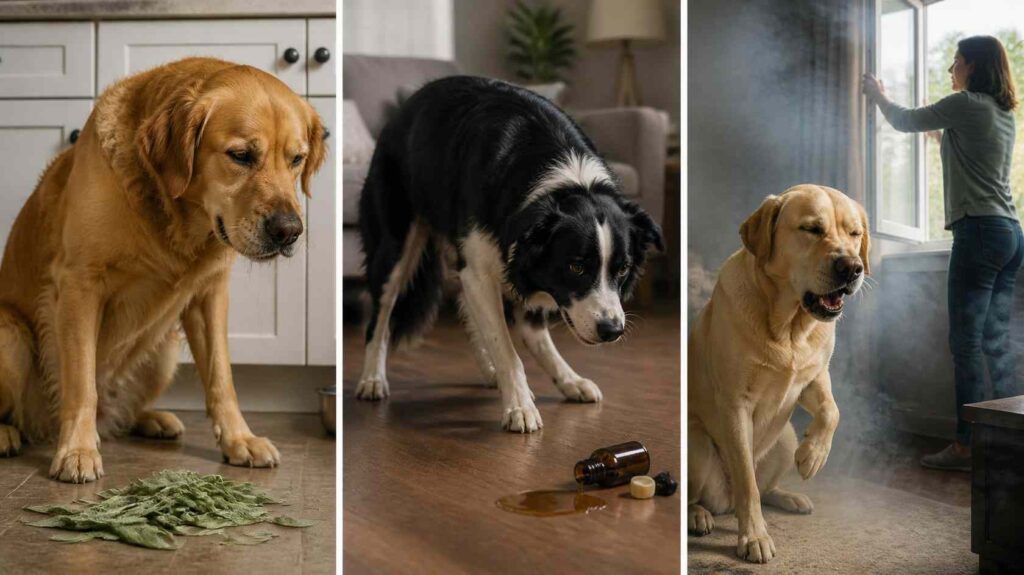
Too Much Sage Plant
Possible signs include:
- Vomiting
- Diarrhoea
- Drooling
- Reduced appetite
- Abdominal discomfort
- Lethargy
These signs are more likely after a dog eats a large amount of leaves, tough stems, or other plant material.
Essential Oil Exposure
Concentrated sage oil is not equivalent to the fresh herb. Possible signs include:
- Mouth irritation
- Heavy drooling
- Vomiting
- Weakness
- Wobbliness
- Tremors
- Red or irritated skin
- Watery eyes
- Coughing or breathing irritation
Oil on the coat also creates a licking risk. Prevent further contact and call your veterinarian rather than trying to wash or treat the area with another product unless advised.
Smoke Exposure
Smoke from burning sage may cause:
- Coughing
- Sneezing
- Watery eyes
- Wheezing
- Rapid breathing
- Restlessness
- Breathing difficulty
Move your dog into clean, fresh air immediately. Persistent coughing, wheezing, or laboured breathing needs veterinary attention.
Sage-Containing Human Food
Possible signs include:
- Vomiting or diarrhoea
- Abdominal pain
- Marked lethargy
- Repeated vomiting
- Weakness
- Pale gums
In these cases, onion, garlic, excess fat, salt, or another ingredient may be more important than the sage itself. Some effects from allium ingredients can be delayed, so do not wait for symptoms before calling if a meaningful amount may have been eaten.
Does Sage Actually Do Anything Good for Dogs?

Sage contains biologically active compounds, including rosmarinic acid, and laboratory research has explored antioxidant and antimicrobial properties. Online claims often extend this to digestive support, fresher breath, reduced inflammation, or calmer behaviour.
The evidence gap matters. Laboratory findings, traditional herbal use, and human research do not prove that sage produces the same benefits in dogs. There is no well-established veterinary dose for using sage as a canine supplement, and the tiny amount found in food is unlikely to have a meaningful therapeutic effect.
That does not make ordinary culinary sage harmful. It simply means it should not be treated as medicine.
Persistent bad breath may indicate dental disease or another health problem. Repeated vomiting, diarrhoea, abdominal discomfort, or anxiety also deserves proper assessment rather than an herbal home remedy.
Sage in Different Forms
Fresh Leaves
A small accidental nibble of correctly identified common sage is usually low risk. Wash culinary herbs before using them around food, and prevent your dog from eating large amounts or chewing tough stems.
There is no nutritional need to add sage routinely to a complete and balanced canine diet.
Dried or Ground Sage
Dried sage is more concentrated by volume than fresh leaves. A light trace in otherwise plain food is different from eating a spilled jar or a spoonful of seasoning.
Mixed seasoning products may also contain onion powder, garlic powder, salt, nutmeg, or other unsuitable ingredients.
Cooked Sage
Cooking does not make unsafe co-ingredients harmless. Sage in plain cooked meat presents a different situation from sage in buttery stuffing, sausage, gravy, or seasoned skin.
Always assess the entire recipe.
Sage Tea
Do not use sage tea as a treatment for digestive problems, anxiety, infection, or bad breath. Its strength can vary, and blends may contain additional herbs, sweeteners, caffeine, or flavourings.
Supplements and Capsules
Human herbal products may contain concentrated extracts, alcohol, sweeteners, or other active ingredients. Their dosing is not designed for dogs, and they may interact with medication.
Use them only under direct veterinary guidance.
Essential Oil
Do not give sage essential oil by mouth, apply it to your dog’s skin or fur, or use it as a flea, wound, or infection treatment without veterinary direction.
Store bottles securely and clean spills before your dog can walk through or lick them.
Burning Sage and Diffusers Around Dogs

Smoke from smudging can irritate a dog’s eyes and airways, particularly in a poorly ventilated room. Flat-faced breeds, senior dogs, and dogs with heart or respiratory disease may be less tolerant of smoke than healthy dogs with normal airways.
Keep your dog away from the area while sage is burned, ventilate the room thoroughly, and never burn it beside a crate, bed, or enclosed resting space.
Essential oil diffusers create a different exposure. They release concentrated compounds into the air and may leave droplets or residue on nearby surfaces. Stop using the diffuser and contact your veterinarian if your dog develops drooling, vomiting, coughing, weakness, wobbliness, skin irritation, or breathing changes.
Who Needs Extra Caution?
Use a lower threshold for veterinary advice when exposure involves:
- Puppies
- Toy and small breeds
- Senior dogs
- Pregnant or nursing dogs
- Dogs with seizure disorders
- Dogs with liver or kidney disease
- Dogs with pancreatitis or chronic digestive disease
- Dogs with respiratory or heart conditions
- Dogs with known food allergies
- Dogs taking prescription medication
These dogs may be affected by a smaller amount, become dehydrated more quickly, or be more vulnerable to concentrated herbal products and unsafe co-ingredients.
Common Mistakes Owners Make

- Assuming every plant called “sage” is common culinary sage
- Treating essential oil like a stronger version of the fresh leaf
- Believing “non-toxic” means there is no limit
- Following an unsupported online dosage chart
- Feeding stuffing because sage itself appears low risk
- Overlooking onion or garlic powder in seasoning blends
- Applying sage oil directly to the skin or coat
- Using sage tea to manage vomiting or diarrhoea
- Burning sage beside the dog’s bed or crate
- Giving human herbal supplements without veterinary advice
- Inducing vomiting without professional instruction
- Waiting for severe symptoms after an oil or unknown-plant exposure
The Bottom Line
Can dogs have sage? A small accidental amount of correctly identified common culinary sage is generally unlikely to cause serious harm in a healthy adult dog. Larger amounts may still cause digestive upset.
The more important risks involve concentrated essential oil, unknown plants, herbal supplements, smoke exposure, and sage-containing dishes made with onion, garlic, excess fat, salt, or other unsafe ingredients.
When you are unsure, focus on five details: what was eaten, how much, when it happened, your dog’s size and health, and whether symptoms are developing. A prompt call to your veterinarian is safer than waiting when the product is concentrated, the plant is unidentified, toxic co-ingredients are possible, or your dog appears unwell.
Frequently Asked Questions
1. Can Dogs Eat Fresh Sage Leaves?
A small accidental amount of correctly identified common sage is usually low risk for a healthy adult dog. Eating several leaves, stems, or a large part of the plant may cause vomiting, diarrhoea, or abdominal discomfort.
Sage is not necessary in a dog’s diet, so there is little reason to feed it routinely.
2. How Much Sage Is Too Much for a Dog?
There is no established veterinary serving limit for sage. Risk depends on the form, amount, concentration, and the dog’s size and health.
One fresh leaf and a spoonful of dried seasoning are not equivalent exposures. Contact your veterinarian if a small dog eats a substantial amount, the quantity is uncertain, or symptoms develop.
3. Is Sage Essential Oil Safe to Use Around My Dog?
Sage essential oil is highly concentrated and should not be swallowed, applied to the skin, or used near a dog without veterinary guidance.
Contact your veterinarian after ingestion, a significant spill onto the coat, or symptoms such as drooling, vomiting, weakness, wobbliness, coughing, or breathing difficulty.
4. Can Dogs Eat Sage-and-Onion Stuffing?
No. Stuffing commonly contains onion, garlic, butter, salt, stock, and other ingredients that may be harmful to dogs.
If your dog eats stuffing, check the recipe or packaging and call your veterinarian with the ingredients, amount eaten, time of exposure, and your dog’s weight.
5. Is It Safe to Burn Sage Around My Dog?
It is best to keep your dog away while sage is burned. Smoke can irritate the eyes and airways, particularly in flat-faced dogs and those with heart or respiratory disease.
Use good ventilation and move your dog into fresh air if coughing, wheezing, watery eyes, restlessness, or breathing changes develop.
6. Should I Make My Dog Vomit After Eating Sage?
No. Do not induce vomiting unless a veterinarian specifically instructs you to do so.
Vomiting is usually unnecessary after a small amount of plain culinary sage and may be unsafe after oil exposure or in a dog that is weak, unsteady, or having breathing problems.
7. What Should I Do If My Dog Chewed an Unidentified “Sage” Plant?
Remove access, photograph the plant, save any label, and note how much may have been eaten. Do not rely on the common name alone because several unrelated plants are called sage.
Contact your veterinarian or an animal poison service if the plant cannot be confidently identified, chemicals may have been used on it, or your dog develops symptoms.
#. Related Articles: