
Can dogs eat sweet potato? Yes—plain, cooked sweet potato can generally be offered to healthy dogs in small amounts. But what happened to the sweet potato before it reached your dog matters.
A chunk of plain roasted sweet potato that falls from the kitchen counter is very different from a serving of casserole, restaurant fries or buttery mash. In prepared dishes, the bigger concern may be added ingredients such as onion, garlic, excess salt or a lot of fat rather than the sweet potato itself.
This guide covers both situations: how to serve sweet potato if you’re planning to, and what to check if your dog has already helped themselves. One thing is worth knowing up front: safe to eat doesn’t mean your dog needs it. If your dog already eats an appropriate complete and balanced diet, sweet potato is an optional extra.
Start With the Sweet Potato in Front of You

“Sweet potato” can mean very different things once it’s been through a kitchen. Work out which version you’re dealing with first.
Plain and Cooked
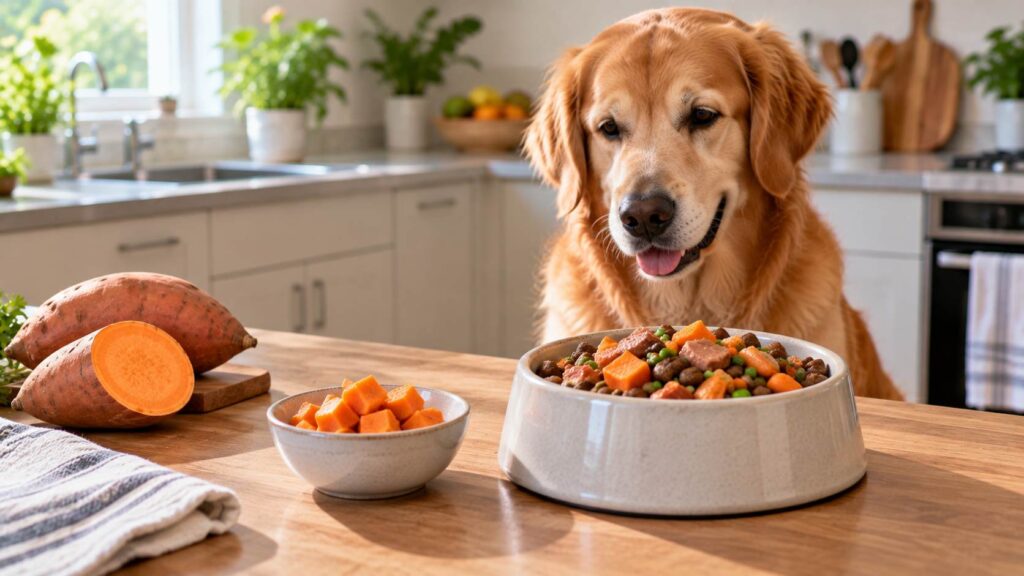
Boiled, steamed or baked sweet potato with nothing added is the simplest option. Let it cool, then cut or mash it into pieces appropriate for your dog’s size and eating style.
Avoid offering a large chunk that an enthusiastic dog could swallow without chewing. Small dogs and dogs that tend to gulp food need especially manageable pieces.
Raw or Firm Pieces
Raw sweet potato shouldn’t be confused with raw white potato. Sweet potatoes and white potatoes belong to different plant families, so concerns associated with raw or green white potatoes shouldn’t automatically be applied to sweet potatoes.
The more practical concerns are the hard texture and digestibility. A large, firm piece may be difficult to chew or swallow, particularly for a small dog or one that gulps food. Cooking softens sweet potato and makes it a more sensible way to offer it.
If your dog has already swallowed a large raw piece, don’t try to make them vomit unless a veterinarian specifically tells you to. Contact your vet if the piece was concerning for your dog’s size or your dog develops symptoms.
Skin-On Sweet Potato
Sweet potato skin isn’t inherently poisonous, but it is tougher and more fibrous than the flesh.
If you leave the skin on, wash the potato thoroughly and cook it until soft. Peeling is a reasonable choice for a first serving, a small dog, or a dog that doesn’t handle fibrous foods well.
Mashed Sweet Potato
Plain cooked sweet potato can be mashed before serving, which also makes portioning easy.
Human-style mash is another matter. Check for butter, cream, excess salt and seasonings before sharing it. Onion or garlic in any form changes the situation because both are toxic to dogs.
Fries, Chips and Restaurant Sweet Potato

Sweet potato fries and chips are poor choices for dogs because they usually come with extra fat, salt and seasonings. Restaurant versions can be harder to assess because you may not know exactly what was used, and onion or garlic powder can be hidden in seasoning blends.
One stolen fry isn’t automatically an emergency in an otherwise healthy dog, but fries shouldn’t become a planned treat. Rich, fatty table foods can also be a concern for dogs prone to pancreatitis. Plain baked sweet potato is a much simpler option.
Casseroles and Holiday Dishes
This is where you need to look beyond the sweet potato.
Depending on the recipe, a casserole may contain:
- Onion or garlic
- Butter or cream
- Stock or gravy
- Brown sugar or syrup
- Marshmallows
- Raisins, currants or sultanas
- Nuts
- Spice blends
- Sugar-free ingredients containing xylitol
Don’t share a dish just because sweet potato is its main ingredient. If your dog has already eaten some, check the entire recipe rather than guessing from how the food looks.
Dried or Dehydrated Sweet Potato
Dehydrated sweet potato can be an occasional treat, but drying removes water, making each piece more concentrated than fresh cooked sweet potato.
Check commercial products for added ingredients and consider the size and texture of the chew. Tough strips can be a poor match for dogs that tend to swallow treats in large pieces rather than chewing them properly.
Your Dog Already Ate Sweet Potato: Change the Question

If it’s already happened, “is sweet potato safe?” matters less than “what exactly did my dog eat?”
First, Work Out What Was Eaten
Try to pin down:
- Whether it was raw or cooked
- Whether it was plain or part of a prepared dish
- Whether the skin was on
- Roughly how much was eaten
- What other ingredients were present
- When your dog ate it
- Your dog’s approximate size
- Whether your dog has an existing medical condition or special diet
If you need to call your vet, having this information ready makes the situation much easier to assess.
Check the Rest of the Recipe
The sweet potato may be the least concerning ingredient on the plate.
Check the recipe, packaging or restaurant ingredient information for onion, garlic, leeks, chives, raisins, currants, macadamia nuts or xylitol. Also note large amounts of rich or fatty ingredients such as butter and cream.
If you identify a potentially toxic ingredient, contact your veterinarian or an appropriate animal poison service promptly rather than waiting for symptoms. Some toxic effects can be delayed. Keep the packaging, ingredient list or recipe available when you call.
Look at Your Dog, Not Just the Food
Watch for:
- Repeated vomiting
- Significant or persistent diarrhoea
- Abdominal discomfort
- Restlessness, hunching or unusual whining
- Marked tiredness or weakness
- Loss of appetite
- Difficulty keeping food or water down
A large amount of an unfamiliar food can upset a dog’s digestive system even when the food itself isn’t toxic. Don’t assume, however, that persistent vomiting or diarrhoea is simply “too much fibre.”
When the Situation Needs Veterinary Advice
Contact your vet if your dog ate a potentially toxic ingredient, swallowed a concerningly large or hard piece, ate an unusually large amount for their size, or develops significant symptoms.
Seek individual advice sooner if your dog has a diet-sensitive medical condition or is eating a veterinary-prescribed diet.
Warning: The Sweet Potato May Not Be the Main Problem
Onion, garlic and other toxic co-ingredients can turn an otherwise straightforward sweet potato incident into a different situation. Rich foods can create additional concerns too.
Check the entire recipe, not just the ingredient your dog was aiming for. Don’t induce vomiting or give a home remedy unless a veterinarian or animal poison professional specifically instructs you to do so.
If You’re Choosing to Feed It, Use This Checklist

Before putting sweet potato in your dog’s bowl, check that:
- It’s cooked and soft.
- It’s served plain.
- It contains no onion, garlic, sauce or gravy.
- It isn’t loaded with butter, cream or other rich additions.
- There’s no unnecessary added salt.
- Pieces are appropriate for your dog’s size and eating style.
- You’re starting with a small amount if it’s new to them.
- You’re introducing one new food at a time.
- You’re counting it as a treat or extra rather than a replacement for the main diet.
- You’ve considered any existing health conditions.
- You’ve checked with your veterinary team before adding it to a prescription or elimination diet.
- You’ll watch for digestive changes afterwards.
How Much Matters More Than the “Healthy” Label
Treat Calories Still Count
“Healthy” doesn’t mean unlimited. Sweet potato contributes calories, and those calories count alongside biscuits, training rewards, chews and table scraps.
A useful veterinary nutrition principle is to keep all treats and extras combined to no more than about 10% of daily calories, unless your veterinary team has advised otherwise. Your dog’s complete diet should provide the vast majority of their nutrition.
That doesn’t mean 10% of the diet should be sweet potato. It’s a limit for all extras combined.
Why I Won’t Give You a Tablespoon Chart
You’ll find charts online matching spoonfuls of sweet potato to body weight. They look precise, but they can create a false impression that there’s one medically correct serving for every dog of a particular size.
The appropriate amount depends on more than weight:
- Daily calorie needs
- Body condition
- Activity level
- Regular diet
- Other treats
- Life stage
- Medical conditions
Two dogs that both weigh 10 kg can have different energy and dietary needs.
A better starting point is a small amount that fits within your dog’s overall treat allowance, rather than turning sweet potato into a prescribed daily dose.
First-Time Feeding Is Different From Established Tolerance
If your dog has never eaten sweet potato before, offer only a small amount and avoid introducing several unfamiliar foods at the same time.
Then watch their appetite, stool and general comfort. If everything stays normal, sweet potato can remain an occasional option if your dog enjoys it.
Don’t keep increasing the serving simply because your dog would happily eat more. Most dogs aren’t known for setting their own sensible treat limits.
What Sweet Potato Actually Adds to a Dog’s Diet
Fibre and Carbohydrate
Sweet potato provides dietary fibre and digestible carbohydrate, which dogs can use for energy. Fibre can affect stool consistency and digestive function, but that doesn’t make sweet potato a treatment for diarrhoea, constipation or other gut problems.
More isn’t necessarily better, either. The effect depends on the amount, the rest of the diet and the individual dog.
Beta-Carotene and Micronutrients
Sweet potato contains beta-carotene, which dogs can convert to vitamin A, along with nutrients such as vitamin C, several B vitamins, potassium and manganese.
It’s easy to turn “contains a nutrient” into claims that sweet potato improves eyesight, immunity, skin or other aspects of health. That’s a bigger claim than the evidence supports. A few cubes of sweet potato shouldn’t be treated as a supplement or a way to correct nutritional deficiencies.
Nutritious Doesn’t Mean Necessary
If your dog already eats an appropriate complete and balanced food, their essential nutritional needs should be covered. Sweet potato can be an occasional extra, but it shouldn’t crowd out the food providing that balanced nutrition.
The Digestion Question Is More Complicated Than “Fibre Is Good”
Why Some Dogs May Tolerate It Well
Many healthy dogs handle a small amount of plain cooked sweet potato without trouble. Others may be more sensitive to a sudden change in food.
That’s why a small first serving is more useful than trying to find a supposedly perfect portion online: you can see how your individual dog responds without giving them a large amount at once.
Why Too Much Can Backfire
A large serving—especially when your dog isn’t used to it—can lead to loose stools, gas, abdominal discomfort or vomiting.
If mild digestive signs appear after introducing sweet potato, stop offering it and monitor your dog. Significant, persistent or worsening symptoms need veterinary advice rather than repeated attempts with smaller portions.
Sweet Potato Is Not a Diagnosis for Diarrhoea or Constipation
Changing your dog’s stool by adding fibre doesn’t tell you why the stool changed in the first place.
Diarrhoea and constipation have many possible causes, ranging from dietary changes to underlying illness. If either problem persists, keeps returning, is accompanied by vomiting, blood, pain or lethargy, or your dog otherwise seems unwell, veterinary assessment matters more than another food experiment.
Some Dogs Need a More Individual Answer

Puppies
Puppies need an appropriately balanced diet for growth, so complete puppy food should take priority over extras.
Once a puppy is comfortably eating solid food, a tiny amount of plain, soft sweet potato may be offered occasionally. Keep pieces easy to eat and treats small enough that they don’t displace the puppy’s main diet.
Dogs With Diabetes
Sweet potato contains carbohydrate, but that doesn’t make it automatically forbidden for every diabetic dog.
Diabetes management depends on consistency across the whole diet, calorie intake, feeding schedule and treatment plan. If your dog has diabetes, check with the veterinary team managing the condition before making sweet potato a regular extra.
Overweight Dogs
Add up all the extras, not just this one.
If your dog needs to lose weight, sweet potato still has to fit within the daily calorie budget alongside training treats, chews and table scraps. A food doesn’t become calorie-free because it’s a vegetable.
Dogs With Sensitive Stomachs or Chronic Digestive Problems
Don’t assume sweet potato will automatically soothe a sensitive stomach. Some dogs tolerate it well; others don’t.
If your dog has a diagnosed gastrointestinal condition or is already eating a carefully selected diet, check with your vet before adding another ingredient. Otherwise, it can become difficult to tell whether the diet is helping or what’s triggering symptoms.
Dogs With a History of Pancreatitis
Plain sweet potato contains very little fat, but sweet potato fries, oil-roasted pieces and butter- or cream-heavy mash are a different proposition.
Dogs with a history of pancreatitis may have specific dietary requirements, including fat restriction in some cases. Follow the diet recommended for your dog rather than assuming a plain-food rule applies to every preparation.
Dogs With Urinary Problems
Sweet potato contains oxalate, but that doesn’t mean an occasional piece causes urinary stones.
For a dog with a history of calcium oxalate stones or one eating a therapeutic urinary diet, the overall diet matters more than judging one ingredient in isolation. Ask the veterinary team managing the condition before adding regular extras.
Dogs on Prescription or Elimination Diets
Don’t add sweet potato simply because it’s generally safe for healthy dogs.
Extras can interfere with the purpose of a therapeutic diet. A strict elimination diet trial is particularly easy to undermine: an unapproved treat or table scrap introduces another ingredient and can make the results harder to interpret.
Allergy vs Food Intolerance
They’re not the same thing. A food allergy involves an immune response, while an intolerance doesn’t. Both can potentially cause digestive signs, and food allergies may also be associated with skin problems such as itching.
If the same food repeatedly seems to trigger symptoms, stop offering it and discuss the pattern with your vet rather than trying to diagnose an allergy at home.
Facial swelling, widespread hives, collapse or difficulty breathing after eating require urgent veterinary attention.
One Sweet Potato, Very Different Feeding Situations

| Form / Situation | What to Evaluate | Main Concern |
|---|---|---|
| Plain cooked | Amount and tolerance | Overfeeding, digestive upset |
| Raw piece | Size, amount and texture | Chewing, swallowing, digestibility |
| Skin-on | Preparation and texture | Tolerance, chewing |
| Plain mash | Amount | Overfeeding |
| Human-prepared mash | Full recipe | Added ingredients |
| Fries / chips | Cooking method and seasoning | Fat, salt, seasonings |
| Casserole | Entire recipe | Potentially unsafe co-ingredients |
| Dehydrated chew | Size, ingredients and calories | Chewing, portion |
| Homemade topper | Total amount | Displacing balanced food |
| Commercial complete food | Overall formulation | Diet-level nutrition |
Sweet Potato Isn’t Automatically the Best Choice for Every Goal

There’s no universal winner. The useful comparison depends on why you’re considering the food in the first place.
| Question | Sweet Potato | Pumpkin | Rice | White Potato |
|---|---|---|---|---|
| How owners usually offer it | Cooked cubes or mash | Plain cooked or pure pumpkin | Plain cooked rice | Plain boiled or baked |
| Fibre context | Contains fibre and starch | Contains fibre with a high water content | White rice is relatively low in fibre | Primarily a starchy food |
| Does preparation matter? | Yes—plain and cooked | Yes—plain pumpkin, not pie filling | Yes—plain and cooked | Yes—fully cooked; avoid green or sprouted potato |
| Common human-food issue | Butter, salt, seasonings | Sugar and spices in pie filling | Oil, salt and sauces | Butter, cream, frying oil |
| Suitable as an occasional extra? | Yes, when appropriate | Yes, when appropriate | Yes, when appropriate | Yes, when appropriately prepared |
| Key practical point | Portion still matters | Not a universal GI remedy | Sometimes used in vet-directed short-term diets | Different safety considerations from sweet potato |
Sweet Potato vs Pumpkin for Stool Concerns
Both contain fibre, but neither is a universal treatment for loose stool or constipation.
Pumpkin is commonly discussed as a source of fibre for dogs, but the right approach depends on what’s causing the stool problem. If diarrhoea or constipation persists, keeps returning or comes with other signs of illness, finding the cause matters more than choosing between pumpkin and sweet potato.
Sweet Potato vs Rice When a Dog Has an Upset Stomach

Plain rice is sometimes included in short-term feeding plans for dogs with mild digestive upset, but homemade “bland diets” aren’t appropriate for every dog and aren’t nutritionally complete for long-term feeding.
If your dog is repeatedly vomiting, has significant diarrhoea, seems painful or lethargic, can’t keep water down, or isn’t improving, contact your veterinarian rather than cycling through different foods at home. Puppies, elderly dogs and dogs with existing medical conditions may need advice sooner.
Sweet Potato vs White Potato
Sweet potato and white potato are different plants, so their safety considerations shouldn’t be treated as interchangeable.
Plain, fully cooked white potato can be offered in small amounts, but green or sprouted white potatoes are a different concern because they can contain higher concentrations of glycoalkaloids such as solanine. That isn’t a reason to label raw sweet potato the same way.
Neither potato is automatically “healthier” for every dog, and neither is essential to a dog eating an appropriate complete diet.
Common Sweet Potato Feeding Mistakes
- Assuming “natural” means unlimited. Count sweet potato as a treat, along with every other extra your dog gets.
- Starting with a large portion. Begin with a small amount and see how your dog tolerates it.
- Treating it as a balanced meal. It isn’t. Complete and balanced dog food should remain the nutritional base.
- Sharing seasoned human food. Set aside your dog’s portion before adding butter, salt, sauces or seasonings.
- Checking the sweet potato but ignoring the rest of the recipe. Onion, garlic and other ingredients may matter far more than the sweet potato itself.
- Offering big or hard pieces. Cook it until soft and use pieces appropriate for your dog’s size and eating style.
- Using it repeatedly to self-treat diarrhoea or constipation. Recurring digestive problems need a cause, not another food experiment.
- Assuming every form is equivalent. A raw chunk, restaurant fry, casserole and plain cooked cube present different concerns.
- Ignoring calories from dehydrated chews. Removing water makes them more concentrated than fresh sweet potato.
- Adding it to a prescription or elimination diet without checking. An otherwise safe extra can interfere with the purpose of a carefully controlled diet.
- Assuming a nutrient guarantees a health benefit. Containing beta-carotene or fibre doesn’t make sweet potato a treatment or supplement.
- Panicking over one ingredient. Look at the form, amount, complete recipe, your dog’s health and any symptoms before deciding what matters.

What About Sweet Potato in Commercial Dog Food?
A Treat and a Major Diet Ingredient Are Different Questions
A few pieces of cooked sweet potato as an occasional treat and sweet potato used as a prominent ingredient in a dog’s regular food are different nutrition questions.
The safety of one ingredient doesn’t tell you whether an entire diet is appropriate. Overall formulation, nutritional adequacy, calorie intake and your individual dog’s needs matter more.
Grain-Free Doesn’t Automatically Mean Better or Worse
“Grain-free” is a label, not a guarantee of nutritional quality.
WSAVA advises owners not to judge a pet food from its ingredient list alone because the list doesn’t reveal important information such as ingredient quality or the expertise behind the formulation.
If you’re choosing your dog’s main food, look at the complete diet rather than deciding that one ingredient—whether sweet potato, rice, peas or something else—makes it inherently good or bad.
Where the DCM Question Actually Fits
You may have seen reports linking certain diets with non-hereditary dilated cardiomyopathy (DCM), a serious disease of the heart muscle.
The FDA investigated reports involving diets in which ingredients such as peas, lentils, other pulses and/or potatoes—including sweet potatoes—were used prominently. However, its current guidance says the specific relationship between diet and reported cases remains unclear. Reports have involved both grain-free and grain-containing diets, and the FDA says there is no evidence that legumes or pulses are inherently dangerous.
Most importantly, this is a whole-diet question. It is not evidence that occasionally giving a healthy dog a small piece of plain sweet potato causes DCM.
If you’re concerned about your dog’s regular food or heart health, discuss the complete diet with your veterinarian rather than removing one ingredient based on a headline.
Sweet Potato in 30 Seconds
- Plain beats seasoned.
- Cooked and soft is the practical choice.
- Start with a small amount.
- Check the entire recipe.
- Keep all treats and extras within your dog’s calorie allowance.
- Sweet potato doesn’t replace complete and balanced food.
- Don’t use it to diagnose or repeatedly treat digestive problems.
- Prescription diets and diet-sensitive medical conditions need individual advice.
Vet Advice: When Food Advice Stops Being Enough
Contact your veterinarian if your dog has:
- Repeated or persistent vomiting
- Significant or persistent diarrhoea
- Abdominal pain or a swollen or tense abdomen
- Marked lethargy, weakness or collapse
- Difficulty keeping food or water down
- Eaten onion, garlic, xylitol, raisins/currants or another potentially toxic ingredient
- Swallowed a concerningly large or hard piece
- Eaten an unusually large amount for their size
- A medical condition that makes diet changes more important, such as diabetes or chronic digestive disease
- A prescription or elimination diet and you’re unsure whether sweet potato fits
When you call, have the food package or recipe nearby if possible. Your vet will usually want to know what was eaten, approximately how much, when it happened, your dog’s size and whether any symptoms have appeared.
What happens next depends on the exposure and your dog’s condition. Your vet may advise home monitoring, arrange an examination or recommend treatment or testing. If a potentially toxic ingredient was involved, don’t wait for symptoms simply because your dog currently looks well.
Don’t induce vomiting or give a home remedy unless a veterinarian or animal poison professional specifically instructs you to do so.
Frequently Asked Questions
1. Can dogs eat canned sweet potato?
Check the ingredient list rather than relying on the front of the can.
Plain canned sweet potato without added salt, sweeteners or seasonings may be suitable in a small amount. Avoid versions packed in syrup or prepared with unnecessary additives.
2. Can dogs eat sweet potato baby food?
Only after checking every ingredient. A product made solely from sweet potato may be suitable in a small amount, but some prepared foods contain additional ingredients.
There’s no particular advantage to baby food for a healthy dog that can eat ordinary plain cooked sweet potato.
3. Can dogs eat purple sweet potato?
Yes, the same basic rules apply: cook it, serve it plain and keep the portion modest.
Be more careful with prepared purple sweet potato or ube-flavoured desserts and products, which may contain sugar, dairy, fat or other ingredients you wouldn’t want to share with your dog.
4. Can dogs eat sweet potato with cinnamon?
There’s no need to add cinnamon or other seasoning for your dog. Plain sweet potato is easier to assess and avoids the risk of sharing a spice blend or recipe containing other ingredients.
If your dog has eaten a prepared dish rather than a tiny amount of cinnamon on plain sweet potato, check the entire ingredient list before deciding whether there’s a concern.
5. Can dogs eat sweet potato every day?
A healthy dog may tolerate a small regular amount, but there’s usually no nutritional reason sweet potato needs to be fed every day.
If you offer it regularly, it needs to fit within the dog’s total treat allowance without displacing complete food. WSAVA recommends that treats and extras provide no more than about 10% of a healthy dog’s daily calorie intake.
6. How should I store cooked sweet potato for my dog?
Cool leftovers promptly and store them covered in the refrigerator, following normal food-safety practices. You can also freeze small plain portions for later use.
Discard sweet potato that has spoiled or been left out long enough that you wouldn’t consider it safe to eat yourself.
7. Can I mix sweet potato into my dog’s regular food?
For many healthy dogs, a small amount of plain cooked sweet potato can be used as an occasional topper.
Count it among the day’s treats and extras rather than simply adding it on top of the dog’s normal calorie intake. If your dog is overweight, has a medical condition or eats a veterinary-prescribed diet, check with your veterinary team before making it a regular addition.
A Better Question Before You Share
Instead of stopping at “Is sweet potato safe?”, ask four questions:
- What form is it in?
- How much will my dog eat—or how much did they already eat?
- What else is in it?
- Does this particular dog have a health or dietary reason to be more cautious?
Those answers tell you far more than the ingredient name alone.
If your dog is already unwell, skip the food experiments and contact your veterinarian. If everything is fine and you’re checking before sharing, explore our other guides to safe human foods for dogs.
# Related Articles: