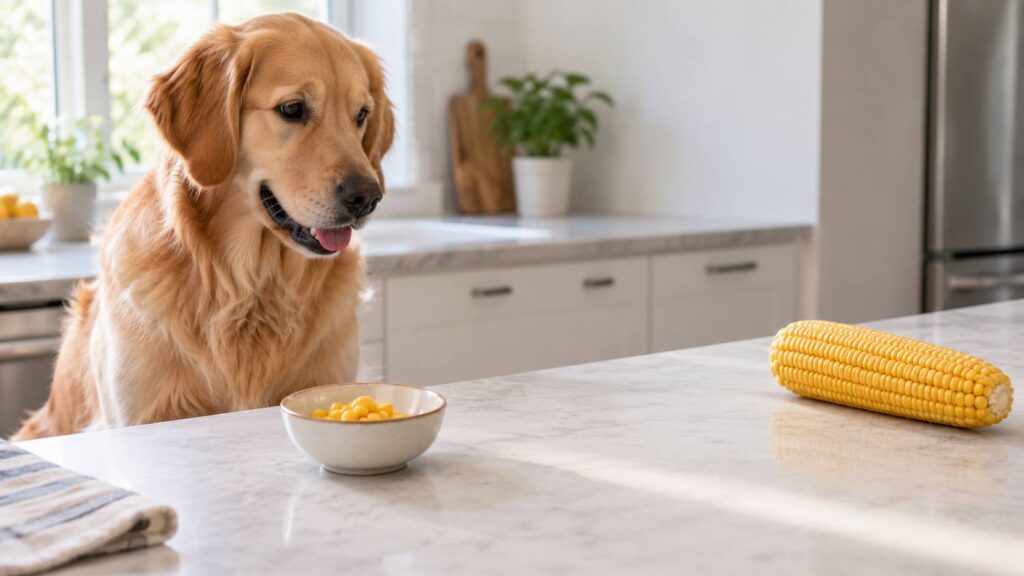
Can dogs eat sweetcorn? Yes — plain sweetcorn kernels are generally safe for most healthy dogs in small amounts. But that answer changes completely if the corn cob is involved.
If you’re standing in the kitchen wondering whether to share a few kernels, this is mainly a portion and preparation question. If your dog has swallowed part of a cob or raided the bin after a barbecue, it’s no longer a feeding question — a corn cob can cause a potentially serious blockage in the digestive tract, and you should contact your vet promptly.
The first step, then, isn’t deciding whether sweetcorn is “good” or “bad.” It’s working out exactly what your dog ate.
Before You Decide, Identify What Your Dog Actually Has

“Sweetcorn” can describe several very different exposures. The form matters because plain kernels, seasoned leftovers, and a swallowed cob do not carry the same risks.
Loose Sweetcorn Kernels
This includes kernels already removed from the cob — whether cooked, fresh, frozen, or tinned/canned.
Plain, appropriately prepared kernels are the lowest-risk form and are generally suitable as an occasional treat for most healthy dogs. The main considerations are portion size, how the corn was prepared, and whether your dog tolerates it well.
Sweetcorn Still Attached to the Cob
A whole cob, half a cob, a chewed cob, or even a missing fragment belongs in a completely different category.
Corn cobs are not digestible. A swallowed piece can become lodged in the stomach or intestines and cause a foreign-body obstruction. Chewing the cob into smaller pieces does not make it reliably safe.
If you know or strongly suspect that your dog swallowed part of a cob, contact your vet rather than waiting for symptoms to appear.
Sweetcorn From a Human Meal
Buttered corn, salted corn, barbecue corn, garlic-butter corn, creamed corn, and sweetcorn mixed into other dishes need to be assessed by their full ingredient list, not just by the corn.
The kernels may not be the main concern. Onion and garlic are harmful to dogs, while rich or fatty toppings can cause digestive upset and may be unsuitable for dogs that need a low-fat diet or have a history of pancreatitis. Heavily salted foods are also best avoided.
Quick Checklist: What Exactly Did Your Dog Eat?
Before deciding what to do next, work through these questions:
- Was it kernels only, or could part of the cob have been swallowed?
- Roughly how much was eaten?
- Was it raw, cooked, frozen, or tinned/canned?
- Was it plain or mixed with other ingredients?
- Did it contain onion, garlic, butter, heavy seasoning, or a salty sauce?
- How large is your dog?
- When did the exposure happen?
- Is your dog vomiting, uncomfortable, unusually quiet, refusing food, or showing other symptoms?
- Does your dog have a medical condition or follow a veterinary-prescribed diet?
If you need to call your vet, having these details ready can make the initial assessment more useful.
The Three Sweetcorn Problems Are Not the Same
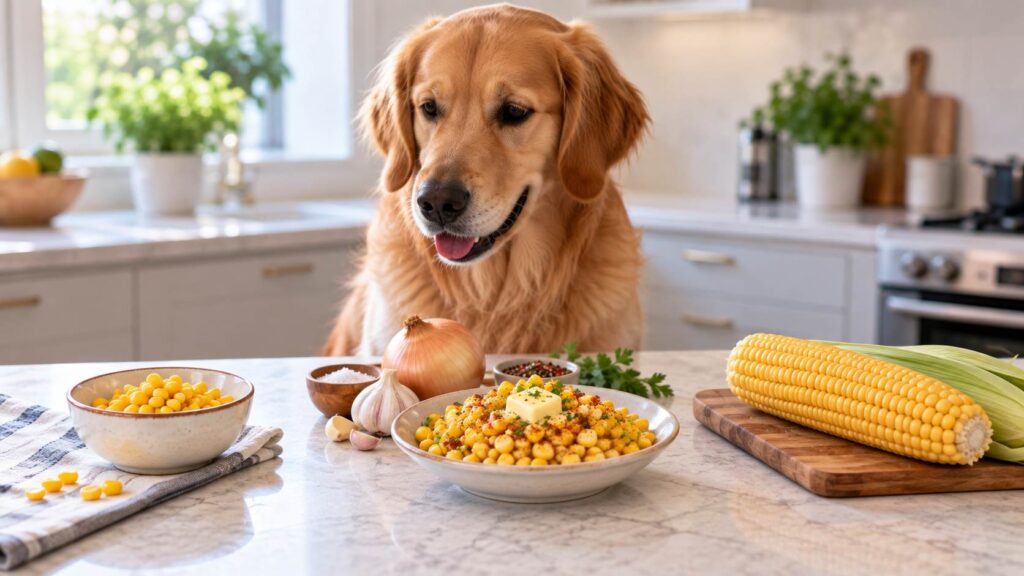
The easiest way to think about sweetcorn is to separate it into three different situations: plain kernels, added ingredients, and the cob itself.
Plain Kernels — Mostly a Portion and Tolerance Question
Plain cooked sweetcorn kernels are not considered toxic to dogs. For most healthy dogs, a small amount can be offered occasionally.
Too much may cause digestive upset, particularly if sweetcorn is new to your dog. It also adds extra calories, so it should be treated as an occasional extra rather than a regular addition to an already complete and balanced diet.
There is no need to give sweetcorn specifically for its nutrients. A properly formulated dog food should already provide the nutrition your dog needs.
Toppings and Recipes — The Ingredients Change Everything
Once sweetcorn comes from a human meal, check what else is on the plate.
Garlic and onion change the safety assessment because they are harmful to dogs. Butter, cream, cheese, oils, and rich sauces can substantially increase the fat and calorie content, while salty seasonings make the food less suitable as a dog treat.
This is why a spoonful of plain kernels and a piece of garlic-butter barbecue corn should not receive the same answer.
Corn Cob — A Foreign-Body Problem, Not a Toxicity Problem
The cob is dangerous for a completely different reason.
It isn’t poisonous. Instead, it is dense, fibrous, and poorly digestible, which means a swallowed piece can become stuck in the gastrointestinal tract. The resulting blockage may be partial or complete and can become a veterinary emergency.
Dog size does not make cob ingestion automatically safe, and there is no dependable rule that a “small piece” will pass on its own.
Warning: If your dog has swallowed, or may have swallowed, part of a corn cob, contact your veterinarian promptly. Do not try to make your dog vomit or use food to “push” the cob through unless a veterinarian specifically instructs you to do so.
What Form of Sweetcorn Is It? A Quick Comparison
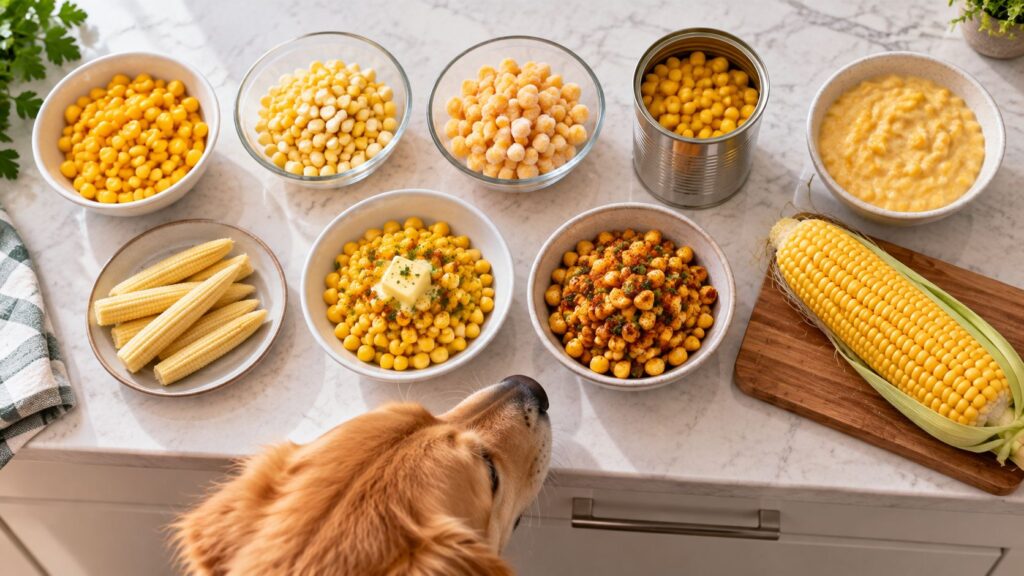
| Form | Feed Intentionally? | Main Concern | Best Decision |
|---|---|---|---|
| Plain cooked kernels | Yes, in small amounts | Portion size, digestive upset | Occasional treat |
| Fresh raw kernels | Better prepared first | Tougher to digest | Cook and serve plain |
| Frozen kernels | Yes, once appropriately prepared | Hard texture, portion size | Thaw or cook before serving |
| Tinned/canned sweetcorn | Depends on ingredients | Added salt or sauces | Check the label; choose plain |
| Corn cob, any size | No | Choking or gastrointestinal obstruction | Never offer as food or a chew |
| Swallowed cob fragment | No | Foreign-body obstruction | Contact your vet promptly |
| Buttered corn | Better avoided | Fat and calories | Choose plain kernels instead |
| Garlic- or onion-seasoned corn | No | Harmful ingredients | Assess the exposure and seek veterinary advice if needed |
| BBQ corn | Usually unsuitable | Cob plus butter, salt, or seasoning | Avoid sharing |
| Creamed corn | Usually a poor choice | Fat, salt, dairy, sugar, or additives | Check ingredients; plain kernels are safer |
| Baby corn | Context-dependent | Portion, texture, preparation | Serve plain and appropriately sized |
Your Dog Already Ate Sweetcorn — What To Do Depends on What They Ate

If your dog has already helped themselves, the right response depends on what they ate, how much, what else was in the food, and whether any cob was involved. A few plain kernels and a swallowed piece of corn cob are very different situations.
Only a Few Plain Kernels
If your dog ate a small amount of plain sweetcorn kernels, there’s usually little cause for concern in an otherwise healthy dog. Keep an eye on them and avoid piling on extra treats or unfamiliar foods for the rest of the day.
A little temporary gas or softer stool can happen after a new food. If your dog remains bright, comfortable, and interested in food and water, monitoring is usually reasonable.
A Large Amount of Kernels
A large serving can cause vomiting, diarrhoea, gas, or abdominal discomfort, particularly in a small dog or one with a sensitive stomach.
Keep fresh water available and monitor your dog. Contact your vet if vomiting is repeated, your dog cannot keep water down, refuses food, becomes unusually quiet or uncomfortable, or the digestive upset is persistent or worsening.
Corn From Dinner, a Barbecue, or a Takeaway
Try to identify everything that was in the dish, not just the sweetcorn.
Onion and garlic are harmful to dogs and warrant veterinary advice if they were eaten. Rich butter, cream, cheese, oils, or fatty sauces may cause digestive upset and are more concerning for dogs with a history of pancreatitis or those prescribed a low-fat diet. Heavily salted or strongly seasoned foods are also best treated more cautiously than plain kernels.
If you still have the packaging, recipe, or ingredient list, keep it handy when speaking to your vet.
Any Chance the Cob Was Swallowed
Treat this completely differently from kernel ingestion.
A corn cob is not toxic, but it is poorly digestible foreign material that can become lodged in the stomach or intestines. A dog may appear completely normal soon after swallowing it, so lack of symptoms is not proof that the cob will pass safely.
If you know or reasonably suspect that part of a cob was swallowed, contact your veterinarian promptly rather than waiting for signs of obstruction to appear.
⚠️ Suspected Corn Cob Ingestion — What to Do Right Now
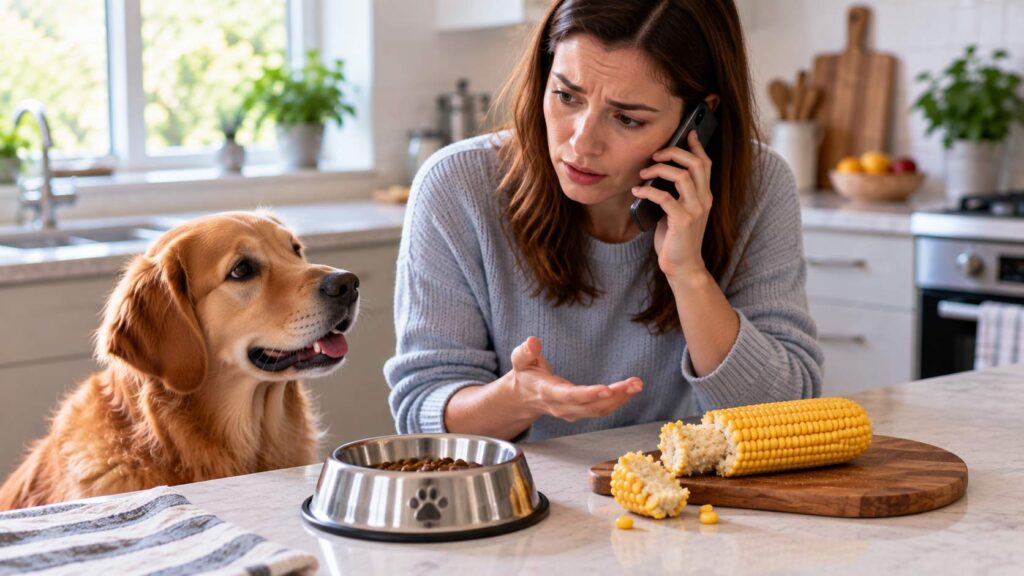
- Contact your vet promptly if you know or suspect that your dog swallowed any part of a mature corn cob.
- Don’t wait for vomiting before asking for advice.
- Don’t assume a small fragment will automatically pass.
- Don’t assume a large or giant-breed dog is automatically safe; dog size alone cannot rule out obstruction.
- Don’t try to make your dog vomit unless a veterinarian specifically instructs you to.
- Don’t give bread, large meals, or other bulky foods in an attempt to “push” the cob through.
- Keep any remaining cob, food packaging, ingredient list, or a photo of what was eaten.
- Note approximately when it happened and how much may be missing so you can give your vet useful information.
Why a Corn Cob Can Become Dangerous After the Meal Is Over
A mature corn cob behaves very differently from the kernels. Once swallowed, a piece can remain in the stomach or move into the intestine and cause a gastrointestinal obstruction.
An obstruction may be partial or complete, and the signs are not always identical. A partial blockage can produce intermittent vomiting, reduced appetite, or vague abdominal discomfort, while a complete obstruction may cause more rapidly worsening signs. This is one reason a dog looking well shortly after eating a cob should not be used as reassurance.
Normal toileting doesn’t necessarily rule out a blockage either. Stool that was already farther along the digestive tract may still be passed after an obstruction develops.
If your vet suspects a foreign body, the assessment may include your dog’s history, a physical examination, and diagnostic imaging. Depending on where the object is located and what the vet finds, removal may sometimes be possible with an endoscope; other cases require surgery.
Signs That Turn a Sweetcorn Incident Into a Veterinary Concern
Seek veterinary advice promptly if your dog develops:
- Repeated vomiting or unproductive retching
- Difficulty keeping water down
- Loss of appetite
- Marked lethargy or unusual restlessness
- Abdominal discomfort, tenderness, or a tense-looking abdomen
- Weakness or signs of dehydration
- Straining or producing noticeably less stool
- Symptoms that are becoming more frequent or severe rather than settling
These signs matter particularly if any part of a corn cob may have been swallowed. Don’t wait for the full list to appear before contacting your vet.
If You Do Want to Feed Sweetcorn, Preparation Matters
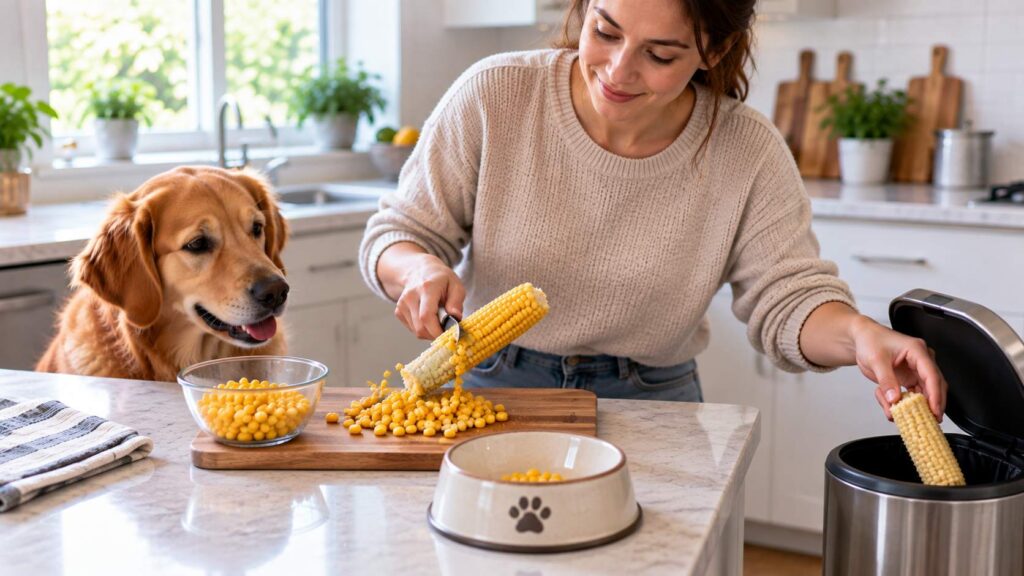
If no accidental ingestion has occurred and you’re simply deciding whether to share some, keep it simple:
- Serve it plain. Skip butter, heavy salt, onion, garlic, and rich sauces.
- Remove the kernels completely from a mature cob. Never offer the cob as a chew.
- Start small. Introduce sweetcorn as you would any unfamiliar treat and see how your dog tolerates it.
- Count it as a treat. Sweetcorn is an optional extra; your dog’s complete and balanced food should remain the main source of nutrition.
Fresh, Frozen and Tinned Sweetcorn Aren’t Quite the Same
Fresh sweetcorn: Remove the kernels fully from the mature cob before offering any, then put the discarded cob somewhere your dog cannot raid later.
Frozen sweetcorn: Plain frozen kernels are not inherently toxic, but thawing or cooking them makes them easier to serve and avoids giving very cold, hard pieces to dogs that gulp food.
Tinned or canned sweetcorn: Check the label for added salt, sauces, or seasonings. Plain varieties are preferable; draining and rinsing can remove some surface brine.
Creamed corn: Recipes vary and may contain added salt, sugar, dairy, fat, or seasonings. Because there is little benefit to sharing it, plain kernels are the simpler choice.
Baby corn: Baby corn is harvested young and is softer than a mature corn cob, but it should still be served plain and cut into an appropriate size for your dog rather than handed over as a large piece.
How Much Sweetcorn Actually Makes Sense?
There’s no single “safe number of kernels” that works for every dog. A sensible portion depends on your dog’s size, daily calorie needs, usual diet, and how many other treats they’re getting.
As a general nutrition guideline, treats — including sweetcorn — should make up no more than about 10% of a dog’s daily calories, with the remaining calories coming from a complete and balanced diet.
Some dogs need a more individual approach. Check with your vet before adding sweetcorn if your dog is on a weight-loss, prescription, or elimination diet, or has diabetes, chronic digestive problems, pancreatitis, or another condition that affects what they should eat. Puppies also have specific nutritional needs, so treats shouldn’t displace the food they need for healthy growth.
Is Sweetcorn Actually Good for Dogs?
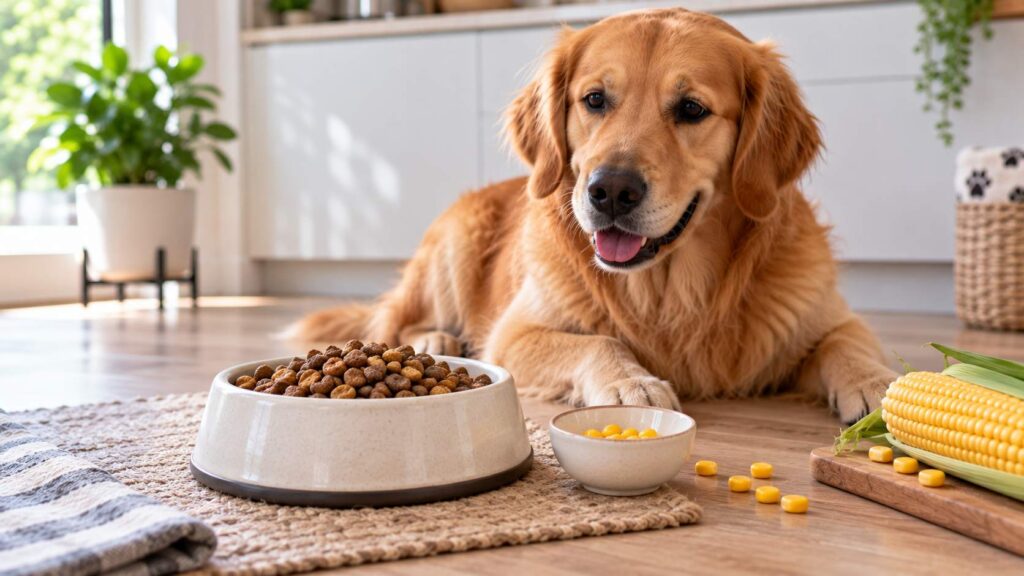
Sweetcorn provides carbohydrate, fibre, and small amounts of vitamins and minerals. It isn’t simply an “empty filler,” but that doesn’t make it a food your dog needs.
A few kernels aren’t going to transform your dog’s nutrition. If your dog already eats a complete and balanced food, sweetcorn is best viewed as an occasional extra rather than a health supplement.
It’s also important not to confuse corn used as an ingredient in commercial dog food with a mature corn cob. Properly processed corn can be a digestible component of a formulated diet; the cob is tough foreign material that can cause an obstruction if swallowed.
And if you occasionally notice pieces of the kernel’s outer covering in your dog’s stool, that doesn’t mean the entire kernel passed through unused. Tough plant material can remain visible even when other components have been digested.
Corn Allergy, Sensitivity, and Ordinary Overfeeding Are Different Things
Loose stools after sweetcorn don’t automatically mean your dog is allergic to corn.
A new food or an overly generous portion can cause temporary digestive upset. Individual dogs can also react poorly to particular ingredients, and food allergy is another possibility — but symptoms alone aren’t enough to identify corn as the cause.
If digestive or skin problems repeatedly appear after particular foods, speak to your vet rather than trying to diagnose an allergy by repeatedly removing and reintroducing ingredients yourself.
If your dog is already on a veterinary elimination diet, don’t add sweetcorn without checking first. Even seemingly harmless extras can interfere with a carefully controlled food trial.
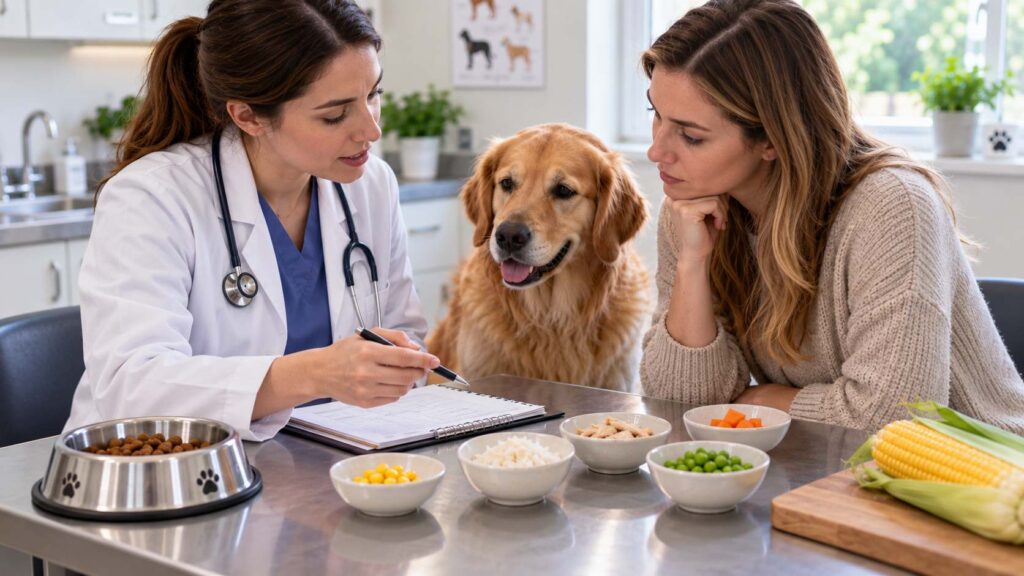
Common Mistakes Dog Owners Make With Sweetcorn
- Offering the cob itself as something to chew
- Assuming a natural food must be harmless
- Waiting for symptoms after a known or suspected cob ingestion
- Assuming a chewed cob is easier to digest
- Believing a large dog will automatically pass cob pieces safely
- Sharing seasoned barbecue leftovers instead of plain kernels
- Overlooking onion or garlic in a corn-based dish
- Feeding generous portions simply because kernels aren’t toxic
- Treating sweetcorn as a health supplement rather than an occasional treat
- Forgetting that treats still contribute calories
- Assuming tinned, frozen, and creamed corn are interchangeable
- Trying to induce vomiting without veterinary instruction
- Feeding bread or bulky food in an attempt to “push” a swallowed cob through
Quick Tips for Safer Sweetcorn Decisions
- Kernels and cob carry completely different risks.
- Plain is a better choice than seasoned.
- Keep portions small.
- Remove kernels completely from a mature cob before serving.
- Put discarded cobs into a secure bin immediately.
- Check tinned/canned sweetcorn for added salt, sauces, or seasonings.
- Introduce unfamiliar foods gradually.
- Count sweetcorn within your dog’s normal treat allowance.
- Check with your vet before adding extras to a medical or therapeutic diet.
- Cob ingestion is a veterinary question, not a feeding question.
BBQ and Picnic Season Needs a Bit of Extra Vigilance
Corn cobs are particularly easy for dogs to steal after barbecues and picnics: from unattended plates, barbecue trays, rubbish bags, compost heaps, or food dropped on the ground.
Use a secure-lidded bin, clear plates promptly, keep cooked cobs well out of reach, and ask guests not to give them to your dog. Before letting your dog roam around after a meal outdoors, check for discarded cobs and other leftovers.
When Your Vet Should Be Part of the Decision
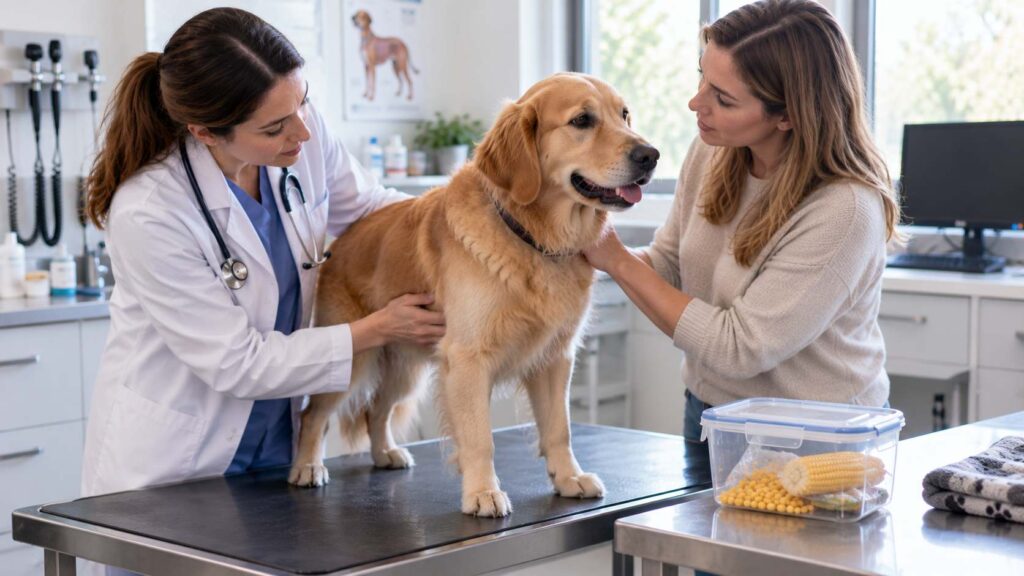
Contact your vet promptly after any known or suspected mature corn-cob ingestion. Veterinary advice is also appropriate if your dog develops persistent or worsening vomiting, abdominal discomfort, loss of appetite, lethargy, difficulty keeping water down, or other concerning signs.
For routine feeding, your vet should also be part of the decision if your dog has a medical condition or follows a therapeutic diet that adding treats could complicate.
When you call about an accidental exposure, have these details ready if possible:
- Your dog’s approximate weight
- What was eaten
- Roughly how much
- Whether any cob was involved
- When it happened
- Other ingredients or toppings
- Any symptoms you’ve noticed
- Packaging, ingredient lists, or a photo of the remaining food
Key Takeaways
- Plain sweetcorn kernels can be an occasional treat for most healthy dogs when served in small amounts.
- Seasoned or recipe-based corn needs an ingredient check, particularly for onion, garlic, rich fats, and excess salt.
- A mature corn cob is a foreign-body hazard, regardless of your dog’s size.
- A dog appearing well after swallowing a cob does not prove that it will pass safely.
- If you know or suspect that a cob was swallowed, contact your vet rather than waiting for symptoms.
The Bottom Line
Sweetcorn kernels and corn cobs deserve two very different answers.
A few plain, appropriately prepared kernels can be an occasional treat for most healthy dogs. The cob, however, should never be offered as food or a chew because swallowed pieces can cause a serious gastrointestinal obstruction.
So before deciding what to do, identify what your dog actually ate. If it was plain kernels, think portion and preparation. If a mature cob may have been swallowed, contact your vet promptly rather than taking a wait-and-see approach.
Frequently Asked Questions
1. Can dogs eat sweetcorn straight from a tin?
Plain tinned or canned sweetcorn can be offered in small amounts, but check the label first. Choose varieties without sauces or seasonings and preferably with little or no added salt. Draining and rinsing sweetcorn packed in brine can remove some of the salt on the surface.
2. Is it safe to give a dog sweetcorn on the cob if it’s cut into small pieces?
No. Cutting a mature cob into smaller pieces doesn’t make it digestible. A swallowed fragment can still lodge in the digestive tract and cause an obstruction. Remove the kernels and keep the cob away from your dog.
3. Why does my dog seem completely normal after eating a corn cob?
A dog can appear normal before signs of a gastrointestinal obstruction develop. Lack of immediate vomiting or pain doesn’t prove that the cob will pass safely.
If you know or suspect that your dog swallowed part of a mature corn cob, contact your vet promptly rather than waiting for symptoms.
4. Can dogs eat sweetcorn if they’re on a weight-loss plan?
Possibly, but it needs to fit within the calorie-controlled diet your vet has recommended. Even small extras add calories, so don’t automatically add sweetcorn on top of the dog’s existing allowance.
5. Is popcorn the same as sweetcorn for dogs?
No. Popcorn is a different preparation and brings different practical concerns. Plain, fully popped popcorn is very different from buttered, salted, caramel-coated, or otherwise flavoured popcorn, while hard unpopped kernels should not be offered.
6. How long after eating a corn cob should I worry if my dog hasn’t shown symptoms?
There isn’t a reliable symptom-free period you can use at home to declare a swallowed cob safe. The timing and severity of signs can vary depending on where a piece becomes lodged and whether an obstruction develops.
Don’t wait for a particular number of hours to pass. If you know or suspect that your dog swallowed part of a mature corn cob, contact your veterinarian promptly.
7. Can dogs with sensitive stomachs have sweetcorn?
Some can tolerate a small amount of plain sweetcorn, while others may develop gas, loose stools, or other digestive upset.
If your dog has recurrent digestive problems, a diagnosed gastrointestinal condition, or a veterinary-prescribed diet, check with your vet before introducing sweetcorn rather than experimenting with new treats.
#. Related Articles: