
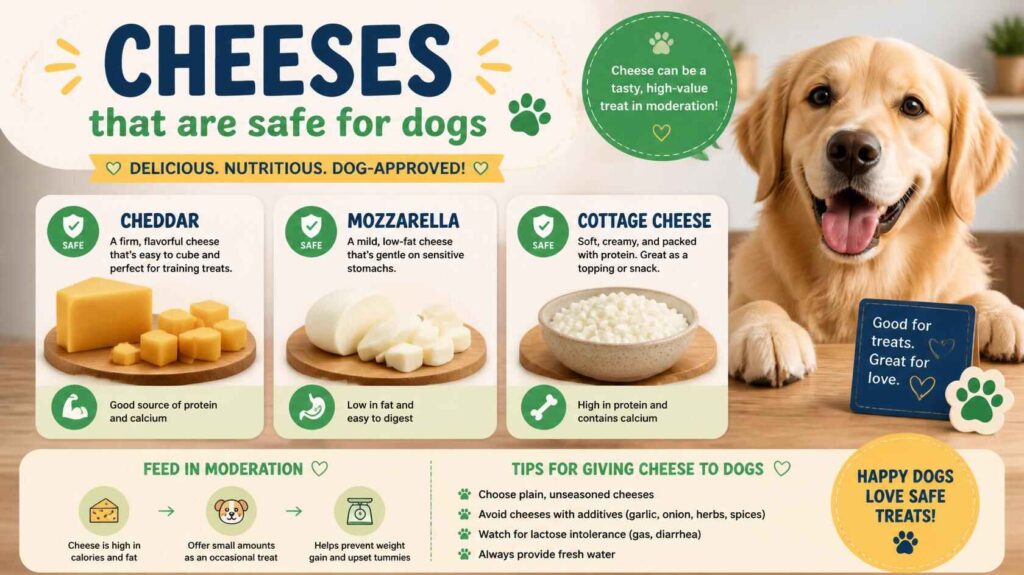
Can dogs eat cheese? Yes — most dogs can eat small amounts of plain cheese, but whether it’s a good choice for your dog depends on the type of cheese, the portion, and your dog’s individual health. A sliver of mild cheddar used as a training reward is very different from a wedge of blue cheese picked off the floor or a slice of cheese-topped pizza containing onion or garlic.
Before you decide, consider five things together: the exact cheese or product, how much your dog will eat, what else is in it, your dog’s size and health, and how your dog has handled dairy before. Most plain cheeses are not inherently toxic, but that does not make every type, portion, or situation equally safe.
If your dog has already eaten cheese and you are trying to work out whether to worry, skip ahead to the accidental-ingestion section further down and check the product, amount, ingredients, timing, and any symptoms.
Before You Give Cheese, Run This Five-Point Check

What Exact Cheese or Product Is It?
Plain cheddar, mozzarella, or cottage cheese is one thing. Flavoured cheese, cheese spread, cheese sauce, processed cheese slices, and blue or mould-ripened cheese are different products with different concerns.
Do not judge safety by the cheese name alone. Check the ingredient list and nutrition label, especially with flavoured or processed products.
How Much Will Your Dog Actually Eat?
“A little bit of cheese” can mean a crumb, a cube, a slice, or half a block.
Portion also needs to make sense for the dog. A piece that looks small to a person may represent a much larger calorie load for a 5 kg terrier than for a 40 kg Labrador. And if cheese has already been used during training that day, those pieces count too.
WSAVA advises that treats collectively should provide no more than about 10% of an average healthy dog’s daily calories. That is an allowance for all treats and extras combined, not 10% specifically for cheese.
What Else Is in the Product?
This is where owners can easily overlook a more important risk.
Flavoured cheeses, dips, spreads, pizzas, and other cheese-containing foods may contain ingredients such as:
- onion
- garlic
- chives
- sauces
- seasonings
- other potentially unsuitable additions
Onion, garlic, chives, leeks, and shallots are among the foods WSAVA identifies as unsafe for dogs.
A plain piece of mozzarella and a piece of garlic cheese bread should therefore not be treated as the same exposure.
Does Your Dog Have Any Dietary or Medical Restrictions?
A dog with a history of pancreatitis, a prescribed low-fat diet, a weight-loss plan, an elimination diet, or another therapeutic diet needs a different answer from a healthy dog with no digestive history.
For example, Merck notes that dietary indiscretion is considered a common risk factor for pancreatitis in dogs, and low-fat feeding is important in dogs being managed for the condition.
If your vet has prescribed a particular diet, do not assume a small piece of cheese is automatically compatible with it.
Has Your Dog Tolerated Dairy Before?
Previous tolerance is useful context, but it is not a green light for a much larger portion.
Some dogs can eat a tiny amount of cheese without obvious problems, while others develop digestive signs. If cheese is new to your dog and there is no medical reason to avoid it, keep any first taste very small.
Checklist — Cheese Before the Bowl
- Plain rather than flavoured
- No onion, garlic, or chives in the ingredients
- Not blue or mould-ripened cheese
- Portion is genuinely small for your dog
- Fits within the day’s total treat allowance
- No relevant dietary or medical restrictions
- Piece is small enough to swallow safely
- Stop offering it if digestive problems repeatedly occur
Cheese Has More Than One Risk Factor

Lactose and Digestive Upset
Dogs produce the enzyme lactase to digest lactose, the sugar found in milk. Lactase levels tend to decrease as dogs mature, so some adult dogs do not digest dairy particularly well.
Possible signs of poor dairy tolerance include:
- gas
- bloating
- loose stools or diarrhoea
- vomiting
- abdominal discomfort
Tolerance varies considerably between dogs. One dog may manage a tiny amount with no obvious problem while another develops digestive upset.
Some aged cheeses contain less lactose than fresher dairy products, but lower lactose does not automatically make a cheese a better dog treat. Fat, calories, sodium, ingredients, and portion size still matter.
Fat and Calories
Cheese is often calorie-dense and can contain substantial amounts of fat. That matters for dogs that are overweight, receive lots of training treats, or need dietary fat restriction.
It is also important not to oversimplify pancreatitis. Cheese does not have a known universal dose at which it suddenly “causes pancreatitis,” and many cases have no single identifiable cause. However, Merck identifies dietary indiscretion as a common risk factor in dogs, and high-fat foods are generally inappropriate for dogs already being managed for pancreatitis.
If your dog has had pancreatitis before or has been prescribed a low-fat diet, cheese is something to discuss with your vet rather than manage with a generic serving guide.
Sodium
Cheese products vary considerably in sodium content. Parmesan, feta, halloumi, and many processed cheese products can be especially salty.
For most healthy dogs, the concern with a tiny occasional piece is usually the overall treat load rather than one isolated nutrient. But if your dog has been prescribed a sodium-restricted diet, the actual product label matters.
Do not assume that “low fat” also means “low sodium.” They are separate nutritional characteristics.
Lactose Intolerance Isn’t the Same as a Dairy Allergy

These terms are often used interchangeably, but they describe different problems.
Lactose intolerance is primarily a digestive issue caused by difficulty breaking down lactose. Signs may include gas, bloating, loose stools, vomiting, or diarrhoea.
A food allergy or adverse food reaction involves a response to dietary components such as proteins and may present differently, including recurring skin, ear, or gastrointestinal problems.
One episode of loose stool after cheese does not diagnose either condition. The portion, fat content, added ingredients, and other foods eaten that day may also be relevant.
What Actually Matters More Than the Cheese Name
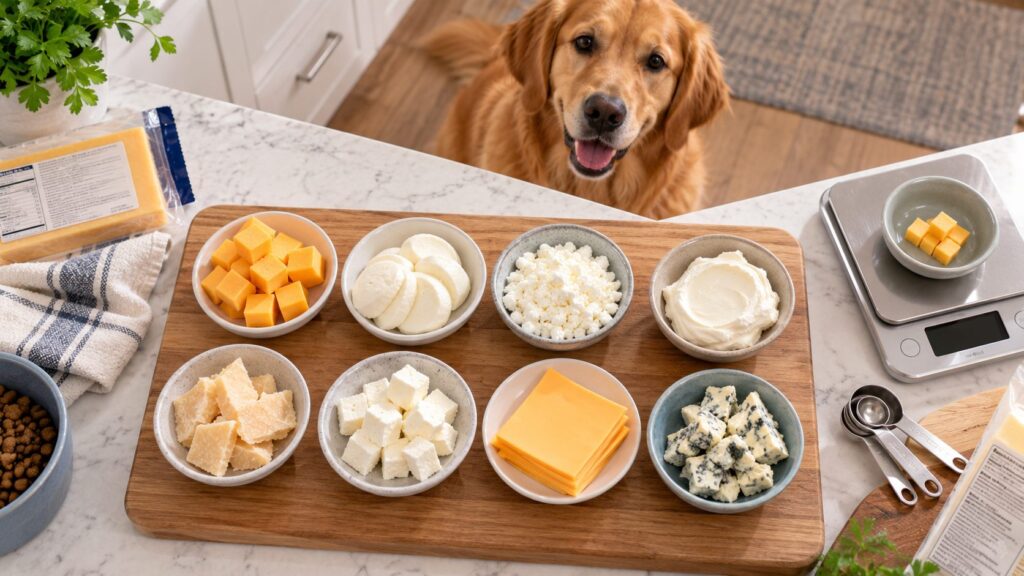
| Cheese/Product Type | Lactose Consideration | Fat/Calories | Sodium | Added Ingredient Risk | Main Consideration |
|---|---|---|---|---|---|
| Cheddar | Usually lower than fresh dairy, but varies | Can be calorie-dense | Varies | Usually low if plain | Keep portions small |
| Mozzarella | Product-dependent | Varies | Varies | Usually low if plain | Check the actual product |
| Cottage cheese | Varies | Product-dependent | Can vary considerably | Usually low if plain | Read the nutrition label |
| Cream cheese | Varies | Often calorie- and fat-dense | Varies | Flavoured versions may contain unsafe additions | Check ingredients carefully |
| Parmesan | Often relatively low in lactose | Concentrated, calorie-dense food | Often high | Usually low if plain | Sodium and portion size |
| Feta/Halloumi | Product-specific | Varies | Often high | Usually low if plain | Salt content |
| Processed cheese slices | Product-dependent | Varies | Often higher | More additives may be present | Check both ingredients and nutrition |
| Blue cheese/Stilton/Roquefort | Lactose is not the main concern | Variable | Variable | Mould-toxin concern | Avoid as a routine dog treat |
| Garlic or herb cheese | Not the main issue | Variable | Variable | High ingredient concern | Avoid products containing unsafe flavourings |
The Cheese That Needs a Different Conversation
Blue cheese — including Stilton, Roquefort, Gorgonzola, and similar mould-ripened varieties — isn’t just “another fatty cheese.” Certain moulds used in these cheeses can produce tremorgenic compounds, including roquefortine C. Veterinary sources associate exposure to tremorgenic mycotoxins with signs such as vomiting, poor coordination, tremors, and seizures.
That is a different concern from ordinary lactose intolerance or eating too much fatty food, which is why blue cheese deserves its own warning rather than being treated like an ordinary cheese variety.
Warning: Blue Cheese and Neurological Signs
Don’t intentionally offer blue cheese to your dog. If your dog has eaten blue cheese, especially more than a tiny taste, contact your vet or an animal poison service for advice based on the product, amount, timing, and your dog’s size.
Tremors, twitching, loss of coordination, seizures, collapse, or severe weakness require urgent veterinary attention. Do not wait for neurological signs to improve on their own, and never try to make your dog vomit unless a veterinary professional specifically instructs you to do so.
“Safe” Doesn’t Automatically Mean “Good for Your Dog”
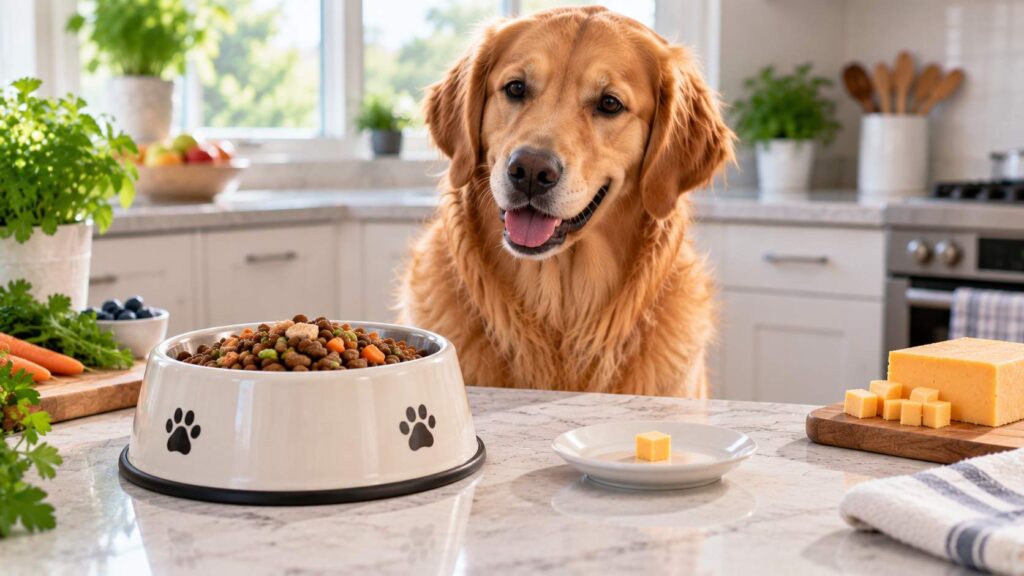
Cheese does provide protein, calcium, fat, and calories, but dogs do not need cheese to obtain these nutrients. A complete and balanced dog food should already meet their nutritional requirements, so cheese is better viewed as an optional treat, not a supplement.
The more useful question isn’t “Is cheddar healthy for dogs?” It’s “Does this amount of cheese make sense for this particular dog?” Consider their size, calorie needs, health history, dietary restrictions, and how much they’ve already had that day.
Portion Control Without the “One Cube” Rule
Cube-counting advice sounds precise, but it isn’t. Cubes vary in size, cheeses vary in calorie density, and one cube represents a very different portion for a Chihuahua than for a Bernese Mountain Dog.
A better approach is to count cheese within your dog’s total daily treat allowance, rather than giving it a separate allowance of its own. Training rewards, biscuits, table scraps, and cheese all contribute to the same total.
For high-value training rewards, smaller is usually better. Dogs do not need a mouthful every time they succeed. A crumb- or pea-sized piece can still be highly motivating while making it easier to control calories over a long training session.
Quick Tips: Less Cheese, Same Reward Value
- Cut cheese into tiny pieces before training starts
- Use the smallest piece that still motivates your dog
- Count repeated rewards toward the day’s total treats
- Resist gradually making each reward bigger
- For long or frequent training sessions, use some of your dog’s regular food or another lower-calorie reward where appropriate
My Dog Already Ate Cheese — What to Check First

If this is why you’re here, don’t focus only on the word “cheese.” The exact product and circumstances usually matter more.
Identify what was eaten. Check the cheese type, brand if available, ingredient list, whether it was plain or flavoured, whether it was fresh or mouldy/spoiled, and whether it was eaten by itself or as part of another food.
Estimate the amount and timing. Work out roughly how much is missing, your dog’s approximate weight, and when the ingestion happened. You do not need a perfect measurement — an honest estimate is more useful than guessing confidently.
Check whether anything else disappeared. Wrappers, wax coatings, foil, plastic, or other packaging create a separate foreign-body risk. PDSA advises contacting a vet promptly when a dog may have swallowed something harmful or capable of causing an intestinal blockage.
Look at the whole meal, not just the cheese. A slice of pizza may contain onion or garlic. A cheeseburger may add sauces, onion, and a large fat load. A cheese board may also contain grapes, raisins, nuts, or blue cheese. Garlic bread with melted cheese may be more concerning because of the garlic than the dairy itself.
Checklist: Information to Have Ready for Your Vet
- Dog’s approximate weight
- Exact cheese or food product involved
- Ingredient list or packaging, if available
- Approximate amount eaten
- Time of ingestion
- Any symptoms so far
- Relevant health conditions, especially previous pancreatitis
- Current medication or prescribed diet
- Whether any wrapper, foil, wax, or plastic was swallowed
What Your Dog’s Reaction Can Tell You — and What It Can’t

Mild digestive signs such as gas, bloating, a loose stool, or isolated vomiting can occur after dairy or a rich meal. If your dog otherwise seems well, keep a close eye on them and make sure fresh water is available. Avoid adding more rich foods while you monitor them.
Contact your vet if vomiting or diarrhoea is repeated or persistent, your dog becomes markedly lethargic, refuses food or water, appears painful around the abdomen, or simply seems significantly unwell. A history of pancreatitis, a very small dog eating a large quantity, or an unidentified mixed food lowers the threshold for seeking advice.
Tremors, seizures, loss of coordination, collapse, or severe weakness are not ordinary lactose-intolerance signs. If blue or mouldy food may have been eaten, these can indicate tremorgenic toxin exposure and require urgent veterinary care. Merck Veterinary Manual notes that tremorgenic mycotoxicosis can progress to significant neurological signs and may require hospital treatment.
One bad stomach episode does not confirm lactose intolerance. The quantity eaten, fat content, added ingredients, sudden dietary change, and unrelated gastrointestinal illness can produce similar symptoms.
| What You Notice | Possible Context | Next Question to Ask |
|---|---|---|
| Gas or bloating | Dairy intolerance or unfamiliar food | Was this a new cheese or a larger amount than usual? |
| Loose stool | Lactose, fat, portion size, or other ingredients | What exactly was eaten, and how much? |
| Repeated vomiting | Larger ingestion, rich food, or another ingredient | What was the full product or meal? |
| Abdominal pain or marked lethargy | More significant gastrointestinal concern | Any history of pancreatitis or dietary restriction? |
| Tremors, twitching, poor coordination | Possible tremorgenic toxin exposure | Was blue cheese or mouldy food involved? |
| Missing wrapper or packaging | Possible foreign-body risk | What material was swallowed, and approximately how much? |
Some Dogs Need a Different Answer
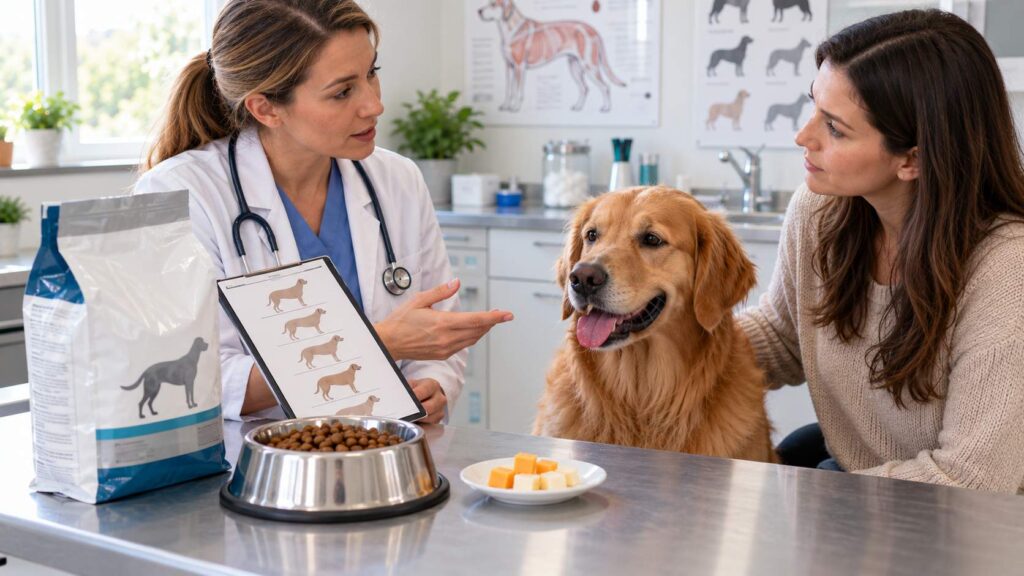
Dogs with a history of pancreatitis, or those prescribed a low-fat diet, should not be treated according to the usual “small amount is fine” advice. Cheese can be high in fat and calories, and your vet’s dietary instructions should take priority. The same applies to dogs on weight-loss plans, where frequent cheese rewards can make calorie control harder.
If your dog is on an elimination or hydrolysed diet, even a small piece of cheese may interfere with the purpose of the trial by introducing an unplanned food protein. Dogs on other veterinary diets — including diets prescribed for kidney, heart, gastrointestinal, or metabolic disease — should also follow the specific restrictions set by their vet rather than general feeding advice.
Puppies do not need cheese for growth if they are eating a complete and balanced puppy food. If cheese is used as a treat, keep portions very small so it does not displace nutritionally balanced food. With senior dogs, health conditions and prescribed diets matter more than age alone.
When Generic Advice Isn’t Enough
Contact your vet for individual advice if your dog:
- has a history of pancreatitis or requires a low-fat diet
- is on a strict prescription or elimination diet
- repeatedly develops vomiting, diarrhoea, itching, or other signs after dairy
- may have eaten a significant amount of blue or mouldy cheese
- has abdominal pain, marked lethargy, tremors, seizures, or other neurological signs
- swallowed cheese packaging, foil, wax, or plastic
- ate a substantial amount and you cannot identify the product or ingredients
Cheese as a Training and Medication Tool

Cheese can work well as a high-value training reward because it is strongly scented, palatable, and easy to divide into tiny pieces. The key is reward size, not reward volume: a dog usually does not need a large cube each time they get something right.
Cheese is also commonly used to hide tablets, but do not assume it is suitable for every medication. Some medicines have specific instructions about food or dairy, so follow the label and your vet or pharmacist’s guidance.
If cheese is not appropriate because of weight, digestive sensitivity, pancreatitis risk, or a prescribed diet, alternatives may include:
- part of your dog’s normal kibble allowance
- a lower-calorie dog treat
- a veterinary-approved treat compatible with a prescribed diet
- a small amount of plain cooked food only if it is appropriate for your dog’s dietary plan
Common Cheese-Feeding Mistakes
Assuming past tolerance means unlimited tolerance.
A dog that handled one small piece well may still develop problems after a much larger amount.
Judging cheese by lactose alone.
Fat, calories, sodium, and added ingredients can matter just as much.
Treating cottage cheese as automatically healthy.
Fat and sodium vary between products, so check the label.
Giving human-sized cubes.
A portion that looks small to you may be a large treat for a small dog.
Forgetting training treats count.
Cheese used during training contributes to the same daily treat allowance as biscuits, chews, and table scraps.
Using cheese during an elimination diet.
Even a small amount can introduce a new protein and make the diet trial harder to interpret.
Assuming a cheesy dish is only a cheese problem.
Pizza, garlic bread, cheeseburgers, sauces, and spreads may contain ingredients that are more concerning than the cheese itself.
Feeding spoiled or accidentally mouldy cheese.
Do not treat spoiled food as equivalent to fresh cheese or deliberately mould-ripened cheese.
Quick Decision Guide
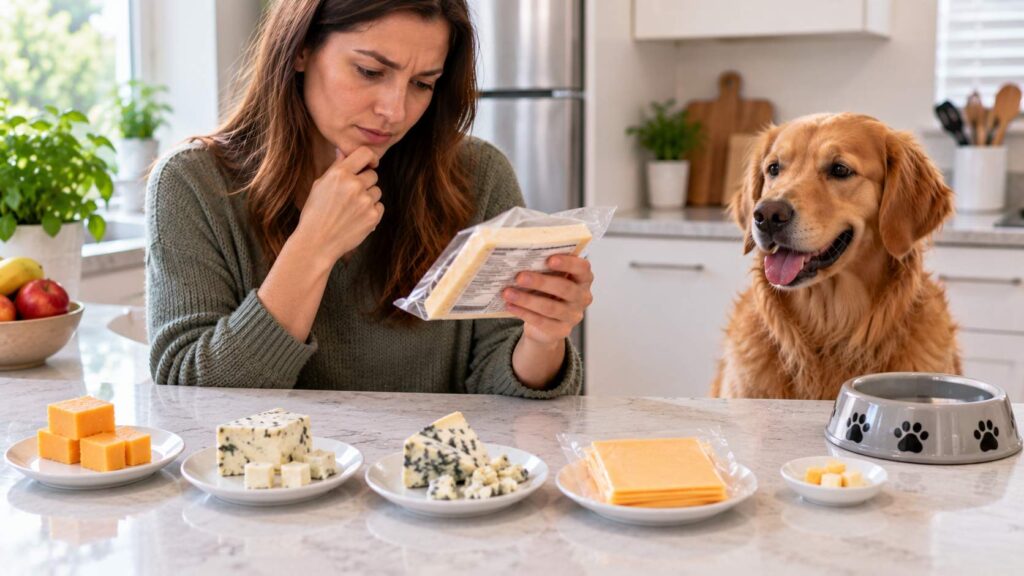
Plain cheese + healthy dog + tiny portion + no risky ingredients
→ May be reasonable as an occasional treat.
Flavoured cheese
→ Check the complete ingredient list first.
Blue, Stilton, Roquefort, Gorgonzola, or mouldy cheese
→ Treat as a higher-risk exposure rather than an ordinary snack.
A larger amount eaten
→ Consider the quantity, dog’s size, exact product, health history, and symptoms together.
History of pancreatitis or a therapeutic diet
→ Follow your vet’s specific dietary advice rather than generic serving guidance.
Wrapper, foil, wax, or plastic swallowed
→ Assess this separately as a possible foreign-body problem.
The Bottom Line
Cheese is not automatically dangerous for dogs, but “Can dogs eat cheese?” does not have one answer for every dog.
For a healthy dog, a tiny amount of plain, unflavoured cheese may be an occasional treat if it fits within the day’s overall treat allowance. The answer changes when the cheese is very fatty or salty, contains unsafe ingredients, is blue or mouldy, or the dog has a medical condition or prescribed diet.
The most useful question is: What exact cheese did my dog eat, how much, and does it suit this particular dog?
Frequently Asked Questions
1. Can dogs eat cheese every day?
Cheese is better treated as an occasional extra than a routine part of the diet. Daily cheese can add significant calories over time, especially when combined with other treats. If you use rewards every day, part of your dog’s normal food allowance or a lower-calorie treat may be easier to manage.
2. Is low-fat cheese automatically the safer choice?
No. Lower fat may reduce calories and make a product more suitable in some situations, but it does not tell you how much sodium, lactose, or added flavouring the cheese contains. Check the whole label rather than relying on “low-fat” alone.
3. Can dogs eat cheese rind?
It depends on the rind. Some are edible cheese surfaces, while others may include wax or other coatings that are not intended to be eaten. Rinds can also be tough or difficult for a dog to swallow. The simplest option is to remove the rind before offering a small piece of cheese.
4. My dog ate cheese but seems completely normal — should I still watch for anything?
If it was a small amount of plain cheese and your dog has no relevant health problems, monitor for digestive signs such as vomiting, diarrhoea, bloating, or discomfort.
If the cheese was blue or mouldy, contained potentially harmful ingredients, was eaten in a large amount, or your dog swallowed packaging, contact your vet for advice even if your dog currently appears well.
5. Can dogs on a prescription diet ever have cheese?
Sometimes, but only if it fits the purpose of that particular diet. Cheese may be inappropriate for low-fat, elimination, hydrolysed, sodium-restricted, weight-management, or other therapeutic diets. Ask the vet managing your dog’s diet before adding it.
6. Why do dogs seem to love cheese so much?
Cheese has a strong smell, rich taste, and soft texture that many dogs find highly rewarding. That makes it useful for training, but it also makes it easy to overfeed if each reward is larger than necessary.
7. Is cheese better than a standard dog treat?
Not necessarily. Cheese can be especially motivating during training, but it is often more calorie-dense than purpose-made treats. For frequent everyday rewards, your dog’s regular kibble or a lower-calorie treat may be easier to fit into the diet.
#. Related Articles: