
Are Milk-Bone treats good for your dog? For many healthy dogs, they can be an occasional treat when you choose the right product and keep the portion appropriate.
Picture two dogs receiving “one Milk-Bone” after dinner. The first is a 9 kg Shih Tzu who spends most of the day on the sofa. The second is a 30 kg Labrador who runs several kilometres each day. If both receive the same large biscuit, that single treat may have a very different effect on their daily calorie intake.
That is the problem with asking whether Milk-Bones are simply “good” or “bad.” Milk-Bone is a range of biscuits, chews, and soft treats with different ingredients, textures, sizes, and calorie counts. A fair assessment must consider the exact product rather than judging the entire brand as one food.
The practical answer: Milk-Bone treats can be suitable for many healthy adult dogs when the product is appropriately sized and the portion is controlled. They are not a superfood, but they are not automatically harmful either. Whether they are a sensible choice for your dog depends on four factors: the product, the portion, the dog, and the purpose.
The Milk-Bone Suitability Test
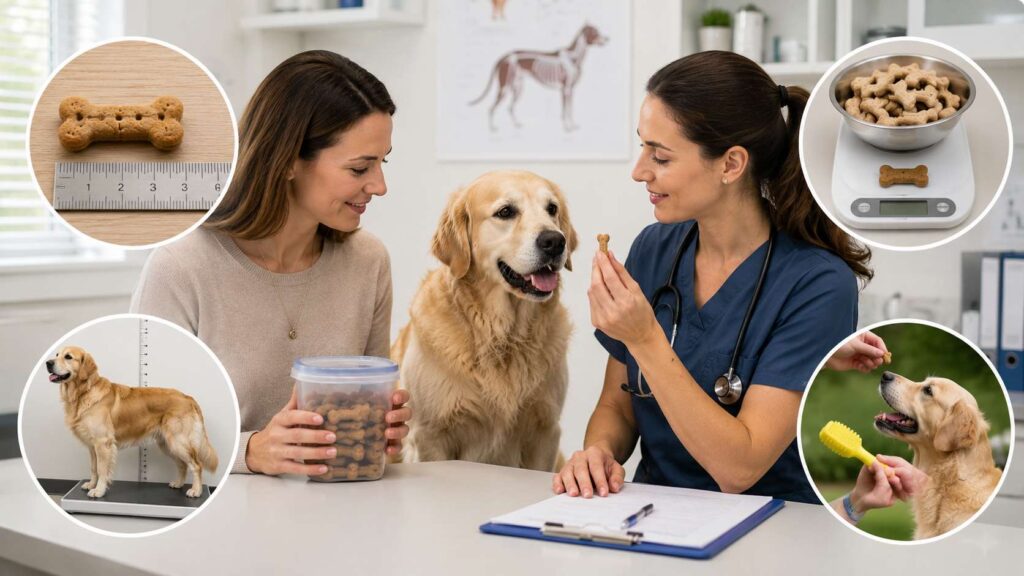
Before offering a Milk-Bone, work through these four checks.
Check the Exact Product
Milk-Bone products include Original biscuits in Mini, Medium, and Large sizes, as well as Soft & Chewy treats, MaroSnacks, and Brushing Chews. These products do not necessarily contain the same ingredients or provide the same number of calories.
Check the current packaging for:
- Calories per treat
- Intended dog size
- Feeding instructions
- Texture and chew type
- Ingredient list
- Any supplemental-feeding statement
Formulas and nutritional information can change, so the package in your hand should take priority over an older product listing online.
Check the Portion
Consider how many treats your dog receives, the calories in each one, and everything else your dog has eaten that day.
One appropriately sized biscuit is unlikely to cause a problem for most healthy dogs. The more common issue is treat stacking—a Milk-Bone after breakfast, training rewards during a walk, a dental chew in the afternoon, and table scraps at dinner.
Check the Dog
A suitable portion depends on more than body weight. Consider your dog’s:
- Body condition
- Age
- Activity level
- Chewing style
- Dental health
- Digestive tolerance
- Existing medical conditions
- Current feeding or weight-management plan
A treat that works well for a healthy, active adult may be inappropriate for an overweight dog, a dog with pancreatitis, or a senior with painful teeth.
Check the Purpose
Ask what you want the treat to achieve.
- An occasional reward
- Frequent training reinforcement
- Enrichment
- Medication delivery
- A dental-care benefit
- Part of a daily routine
A large crunchy biscuit may work as an occasional reward for a suitable dog, but it is usually a poor choice for repetitive training. Likewise, an ordinary biscuit should not be treated as equivalent to a purpose-designed dental chew.
After these checks, most dogs fall into one of four categories:
- Usually suitable in a measured amount
- Suitable after reducing the portion
- Suitable only with close monitoring
- Best discussed with a veterinarian first
Safe, Healthy, and Necessary Are Not the Same Thing
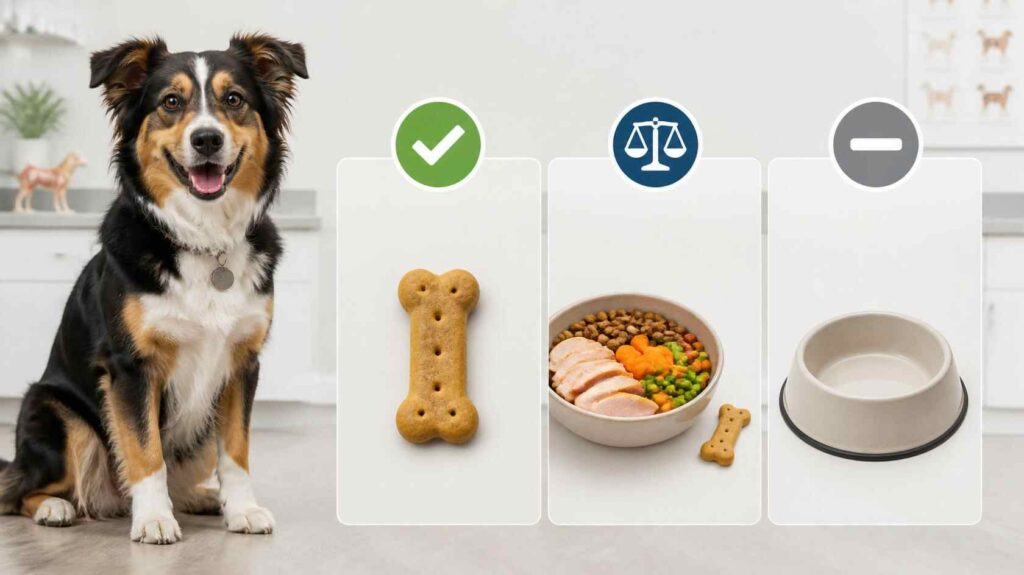
These terms are often used interchangeably, but they mean different things.
Safe means the treat is not expected to harm an appropriate dog when it is correctly sized and fed in moderation. It does not mean every dog will tolerate it.
Healthy means the treat fits within the dog’s overall diet without contributing excessive calories, displacing balanced food, or interfering with a medical feeding plan.
Necessary is a separate question. Milk-Bones are supplemental treats, not a nutritional requirement. Added vitamins and minerals do not turn a biscuit into a complete meal or make it essential to your dog’s health.
Their most realistic benefits are:
- Convenience
- Palatability
- Shelf stability
- Reward value
- Easy portioning, particularly with smaller products
Those benefits can make them useful, but they should not be mistaken for nutrition your dog cannot obtain from a complete and balanced diet.
Milk-Bone Products Aren’t Interchangeable
Comparison Table: Milk-Bone Formats at a Glance
| Product format | Typical texture | Portion-control ease | Likely best use | Main concern |
|---|---|---|---|---|
| Original Minis | Small and crunchy | High | Training and frequent rewards | Several pieces can add up quickly |
| Original Medium | Crunchy | Moderate | Occasional reward | May use a large share of a small dog’s treat allowance |
| Original Large | Large and crunchy | Low | Larger dogs and infrequent use | High calories per piece and possible gulping risk |
| Soft & Chewy | Softer | Depends on product | Seniors or dogs that struggle with hard biscuits | Different recipe and calorie profile |
| MaroSnacks | Filled or layered | Depends on product | Occasional high-value reward | Easy to overfeed |
| Brushing Chews | Purpose-designed chew | Depends on size | Dental-support routine | Must match the dog’s size and chewing behaviour |
Always confirm the calorie value, ingredient list, and feeding guidance on the current package. Do not assume that information for one Milk-Bone variety applies to every other product in the range.
The Calorie Question Matters More Than the Biscuit Count
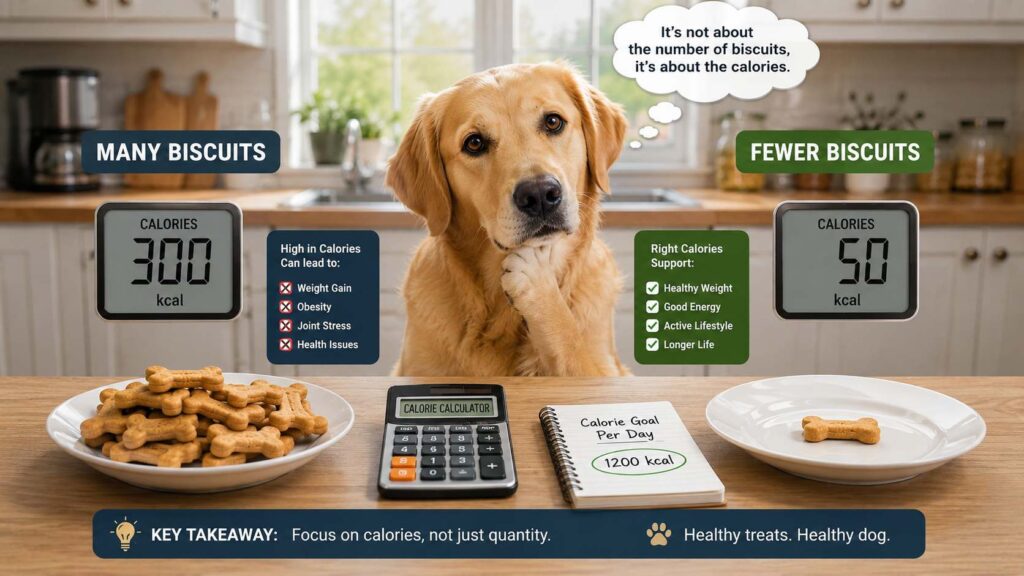
“How many Milk-Bones can my dog have?” is not the best starting question because one Mini and one Large biscuit are not nutritionally equivalent.
The more useful question is:
How many calories does this treat contain, and how does that fit into my dog’s total daily intake?
A commonly used veterinary nutrition guideline is that treats should account for no more than about 10% of a dog’s daily calories, as outlined in the WSAVA Global Nutrition Guidelines. The remaining calories should come from a complete and balanced diet. This is a general guideline rather than a personalised feeding recommendation, and dogs with medical conditions may require stricter limits.
Remember that “treats” include more than biscuits:
- Dental chews
- Training rewards
- Table scraps
- Food used to hide medication
- Stuffed toys
- Lick mats
- Chews
- Snacks given by children, visitors, or other family members
A Simple Household Treat System
Place your dog’s entire daily treat allowance in one container each morning. Everyone in the household must use treats only from that container.
When it is empty, switch to:
- Praise
- Play
- A favourite toy
- A walk or sniffing break
- A measured portion of the dog’s regular kibble
This simple method prevents one of the most common feeding mistakes: several people each giving “just one” treat without knowing what the dog has already received.
Accidental overfeeding is rarely caused by one dramatic decision. More often, it results from several small extras that no one counted.
What the Ingredient List Can — and Can’t — Tell You
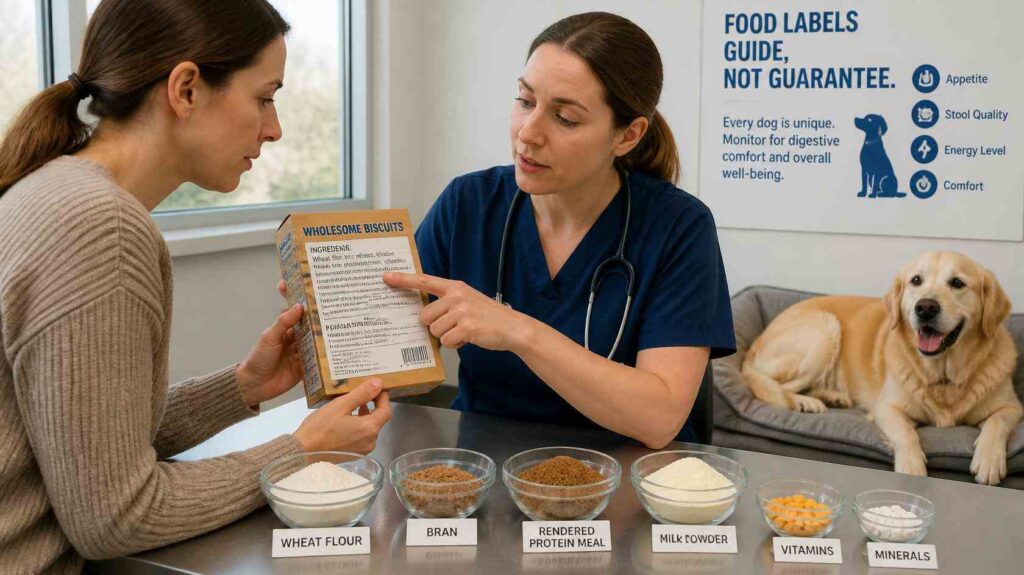
Wheat flour and wheat bran are common ingredients in dry dog biscuits. They are not automatically harmful, and many dogs tolerate wheat without difficulty. However, they may be unsuitable for a dog with a confirmed wheat sensitivity or a veterinarian-directed elimination diet.
Meat and bone meal may sound unappealing, but it is a rendered protein and mineral ingredient used in many pet foods. It is generally less expensive than fresh meat, but the name alone does not prove that it is unsafe or nutritionally poor.
The word “Milk-Bone” also does not tell you how much lactose a product contains. Dogs with known dairy sensitivity should be introduced cautiously and monitored for gas, loose stools, vomiting, or abdominal discomfort.
Fat, salt, and preservatives such as BHA serve practical functions in commercial pet food. They should not be described as automatically dangerous or completely irrelevant. Their importance depends on the amount fed, the dog’s total diet, and any medical restrictions. This matters particularly for dogs on low-fat, sodium-controlled, kidney, heart, or prescription diets.
Added vitamins and minerals may contribute small amounts of nutrients, but they do not turn a supplemental treat into complete and balanced food.
The ingredient list can help you identify known problem ingredients. It cannot, by itself, tell you whether the treat will cause an allergy, whether it suits a medical condition, or how easily your individual dog will digest it.
Which Dogs Need Extra Caution?
Small dogs can use a large share of their daily treat calories on a single oversized biscuit. A treat that is too large may also be difficult to chew safely. Minis or carefully broken pieces usually offer better portion control.
Puppies need age-appropriate, correctly sized treats that do not displace the calories and nutrients provided by complete puppy food. Very small rewards are usually more practical for training, particularly while the teeth and jaws are still developing.
Senior dogs may have missing teeth, periodontal disease, or oral pain that makes hard biscuits uncomfortable. Watch for:
- Chewing on one side
- Dropping food
- Pawing at the mouth
- Taking longer to eat
- Refusing hard treats
A softer alternative may be more comfortable, but persistent chewing difficulty deserves a veterinary dental examination.
Overweight or inactive dogs should receive treats as part of a defined calorie plan rather than according to the package’s maximum feeding guide. A dog that begs frequently is not necessarily hungry or underfed.
Dogs that gulp food need close supervision and smaller portions. Do not give an oversized biscuit whole to a dog that tends to swallow treats without chewing.
Dogs with sensitive digestion should be introduced to one new treat at a time. Start with a small amount and monitor stool quality, appetite, vomiting, gas, and energy levels before increasing the portion.
When a Medical Condition Changes the Answer
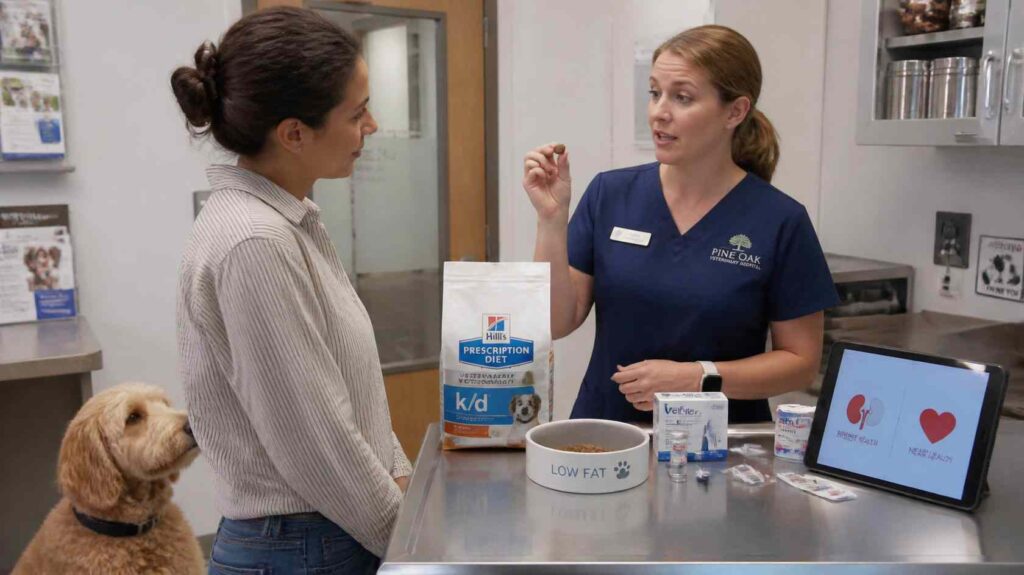
Some dogs should not receive Milk-Bones—or any new commercial treat—without veterinary approval.
This includes dogs with:
- Pancreatitis or fat-sensitive conditions: Suitability depends on the fat content of the entire diet, previous episodes, and the veterinarian’s feeding plan.
- Diabetes: Unplanned treats can affect calorie consistency, meal timing, and insulin management.
- Kidney, heart, or sodium-restricted conditions: Standard treats may conflict with limits on sodium, phosphorus, protein, or other nutrients.
- Prescription diets: Renal, urinary, gastrointestinal, weight-loss, hydrolysed, and novel-protein diets can all be undermined by additional treats.
- Elimination diet trials: Even a small flavoured biscuit can interfere with weeks of careful testing.
- Significant obesity: Treat calories may slow or prevent safe weight loss.
- Recurring dietary reactions: Repeated digestive, skin, or ear symptoms need proper investigation rather than continued trial-and-error feeding.
Vet Advice: If your dog has pancreatitis, diabetes, kidney disease, a prescribed therapeutic diet, significant obesity, or a history of food-related reactions, ask your veterinarian before adding Milk-Bones. The useful question is not whether Milk-Bones are safe in general, but whether that exact product fits your dog’s medical nutrition plan.
Allergy, Intolerance, or Simple Overeating?
Loose stool, gas, vomiting, or reduced appetite after eating a treat may result from overeating, a sudden dietary change, or digestive intolerance. These signs do not automatically mean the dog has a food allergy.
Possible signs of a food-responsive skin condition include:
- Persistent itching
- Paw licking or chewing
- Recurrent ear inflammation
- Repeated bacterial or yeast skin infections
- Hair loss caused by scratching
However, these symptoms can have many other causes, including parasites, environmental allergies, infection, and unrelated gastrointestinal disease.
One reaction after one treat does not identify the responsible ingredient. The timing may be coincidental, the portion may have been too large, or the treat may have been introduced too quickly.
A true food allergy cannot be diagnosed from the ingredient list alone. Veterinary-supervised elimination and dietary challenge testing remain the most reliable way to investigate a suspected dietary reaction. Randomly switching between treats can make the pattern harder to understand.
Do Milk-Bones Actually Clean Teeth?
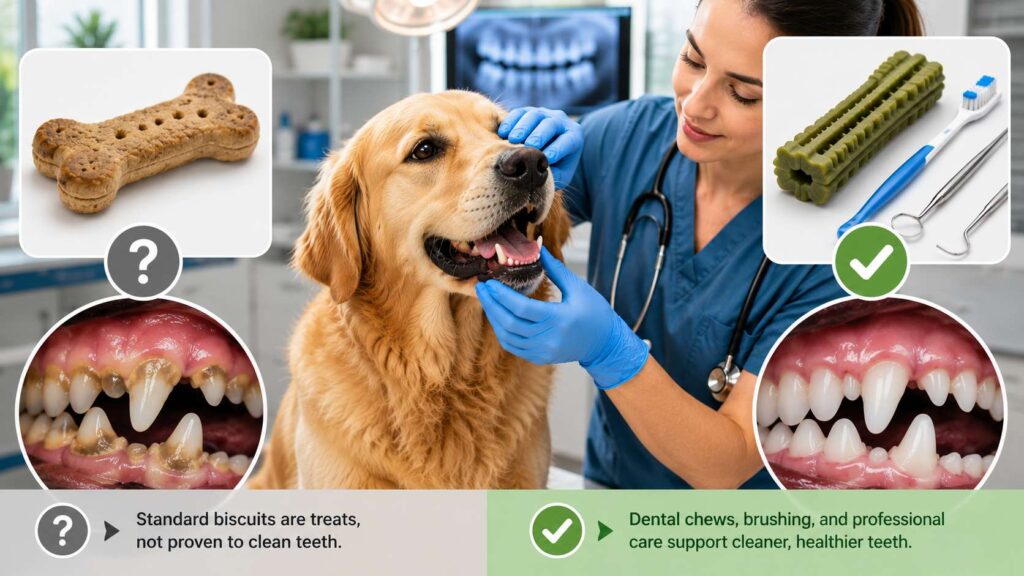
A crunchy biscuit may create some mechanical contact with the tooth surface, but crunchiness alone does not prove meaningful plaque or tartar control.
Original Milk-Bone biscuits and Milk-Bone Brushing Chews are designed for different purposes. Milk-Bone Brushing Chews are included among the products accepted by the Veterinary Oral Health Council (VOHC) for helping reduce tartar when used as directed, but those findings should not be applied to every Milk-Bone product. Original Milk-Bone biscuits are different products and should not be assumed to provide the same dental benefits.
Ordinary biscuits should not replace:
- Regular tooth brushing
- Veterinary dental examinations
- Professional dental treatment when needed
- Appropriately sized dental products with evidence for a specific oral-health benefit
If dental care is your main goal, choose a purpose-designed product that matches your dog’s size and chewing behaviour. Even dental chews work best as part of a broader oral-care routine rather than as the only form of dental care.
How to Introduce Milk-Bones Safely
Start with a small partial portion. If your dog remains well, you can repeat it the next day and gradually work towards the planned serving.
Avoid introducing several new foods or treats at the same time. Otherwise, it becomes difficult to identify what caused a reaction.
During the first few servings:
- Supervise your dog
- Keep fresh water available
- Match the treat to the dog’s size
- Watch for gulping or difficulty chewing
- Monitor stool, appetite, vomiting, itching, and ear symptoms
- Stop feeding the treat if symptoms repeatedly return
For training, use Minis or break larger biscuits into small pieces before the session begins. Mix food rewards with praise, toys, or play so that every successful behaviour does not add extra calories.
Common Mistakes Owners Make
- Treating every Milk-Bone product as identical when recipes, textures, sizes, and calories differ.
- Counting biscuits instead of calories—one Large biscuit is not equivalent to one Mini.
- Treating the package’s maximum feeding guide as the ideal amount for every dog.
- Assuming added vitamins make a supplemental treat a health food.
- Believing that “crunchy” automatically means proven dental benefit.
- Blaming wheat after one reaction without considering portion size, intolerance, or unrelated illness.
- Forgetting treats given by children, visitors, dog walkers, or other family members.
- Continuing to offer the treat after repeated diarrhoea, vomiting, itching, or ear flare-ups.
- Giving hard biscuits to a dog with dental pain, fractured teeth, or poor chewing ability.
- Adding ordinary treats to a prescription or elimination diet without veterinary approval.
If Your Dog Eats Too Many Milk-Bones
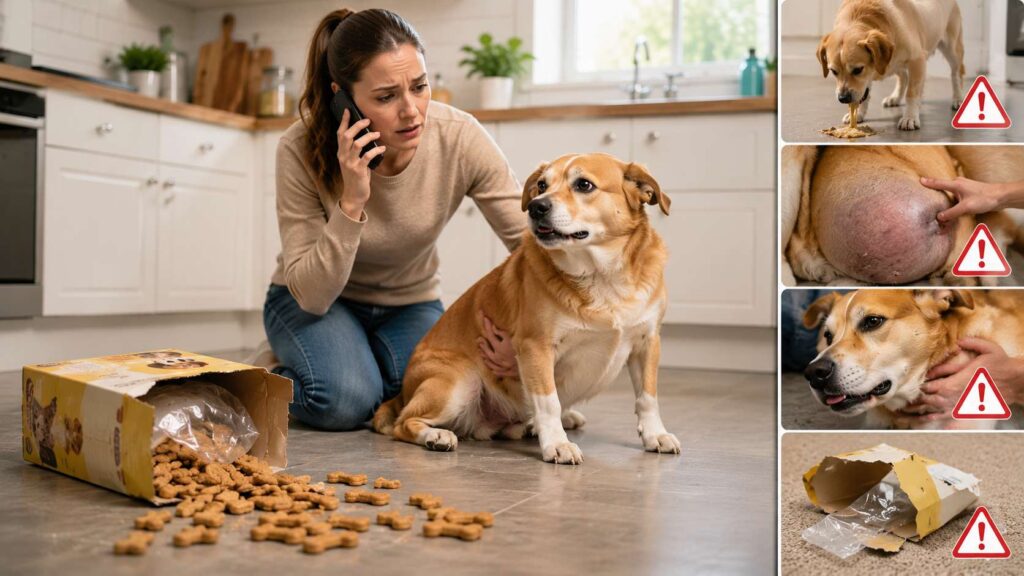
Warning: Do not induce vomiting unless a veterinarian or animal poison-control professional specifically instructs you to do so.
Gather the following information before calling your veterinary clinic:
- Exact product name
- Biscuit size
- Estimated number eaten
- Dog’s weight
- Approximate time of ingestion
- Whether plastic, cardboard, or other packaging was swallowed
- Current symptoms
- Existing medical conditions
- Current medications
Contact your veterinarian promptly if:
- A small dog ate a large quantity
- Vomiting or diarrhoea is repeated or persistent
- The abdomen appears swollen or painful
- Your dog becomes markedly lethargic
- Packaging was swallowed
- Your dog has pancreatitis, diabetes, kidney disease, or another diet-sensitive condition
Treat the situation as an emergency if your dog has:
- Difficulty breathing
- Pale, grey, or blue-tinged gums
- Collapse
- Facial swelling
- An inability to swallow
- Signs of choking
A dog that has eaten too many biscuits may develop temporary digestive upset, but the expected course depends on the amount consumed, the dog’s size, the exact product, and whether packaging was involved. Veterinary advice is the safest way to judge the risk.
Better Alternatives, Depending on the Job
For frequent training, measured kibble or very small low-calorie treats provide better calorie control.
For weight management, veterinarian-approved low-calorie treats or suitable dog-safe vegetables may be more practical than larger biscuits. Portions still need to be counted.
For sensitive digestion, a limited-ingredient treat can reduce the number of dietary variables, although it does not guarantee tolerance.
For dogs on a prescription or elimination diet, use only treats approved by the veterinary team.
For senior dogs with chewing difficulty, choose small, softer treats that are easy to portion.
For dental support, use a correctly sized purpose-designed dental product alongside regular brushing and veterinary dental care.
No alternative is automatically better simply because it is natural, grain-free, or made from one ingredient. Calorie content, hardness, digestibility, and the dog’s individual needs still matter.
The Final Decision Tool
Usually fine:
- Healthy adult dog
- Good body condition
- Correctly sized product
- Measured portion
- No recurring digestive or skin reactions
- Normal chewing ability
- No conflicting medical diet
Use with caution:
- Small dog
- Senior dog
- Fast eater
- Sensitive stomach
- Weight-gain tendency
- Frequent training schedule
- Mild dental limitations
Ask your vet first:
- Pancreatitis
- Diabetes
- Kidney or heart disease
- Prescription diet
- Active elimination trial
- Significant obesity
- Recurrent skin or ear disease
- Severe dental disease
- Previous serious dietary reaction
Check Your Dog’s Treat Budget Today
Before reaching for the box, check the exact Milk-Bone product, calories per piece, and everything else your dog has received as a snack today.
If treats are taking up too much of the daily calorie allowance, switch to smaller pieces, Minis, measured kibble, or a reward that better suits the job.
For dogs with medical conditions, prescription diets, recurring reactions, or dental pain, discuss the treat with your veterinarian rather than relying on a general brand-level answer.
Frequently Asked Questions
1. Are Milk-Bones bad for dogs?
Not inherently. For many healthy adult dogs, Milk-Bones can be an acceptable occasional treat when the product size and portion suit the dog.
Problems are more likely to result from overfeeding, choosing an unsuitable biscuit size, ignoring other daily snacks, or giving the treat to a dog with a medical or dietary restriction. They should be treated as supplemental rewards rather than an important source of nutrition.
2. Can dogs eat Milk-Bones every day?
A small, measured portion may fit into the daily routine of a healthy dog, provided all treats combined remain within an appropriate share of the dog’s daily calories.
Daily feeding becomes less appropriate when the dog is overweight, receives several other snacks, has recurring digestive or skin symptoms, or follows a veterinary diet. Count dental chews, table scraps, training rewards, and medication foods as part of the same treat allowance.
3. Can one large Milk-Bone be too much for a small dog?
Yes. A biscuit designed for a larger dog may use a substantial part of a small dog’s daily treat allowance in one serving.
It may also be awkward to chew or easier to swallow whole. Select the size intended for your dog, use Minis, or break a larger biscuit into appropriately small pieces while accounting for the total calories.
4. Are Milk-Bones too hard for senior dogs?
They can be. Older dogs commonly develop periodontal disease, missing teeth, fractured teeth, or oral pain that makes crunchy biscuits uncomfortable.
Choose a softer reward if your dog hesitates, drops the biscuit, chews on one side, or avoids hard food. Briefly softening a biscuit may help some dogs, but ongoing chewing difficulty should be assessed by a veterinarian rather than managed only by changing the treat.
5. Do Milk-Bones actually clean my dog’s teeth?
Original crunchy biscuits may provide limited mechanical contact, but they should not be considered a substitute for tooth brushing or evidence-supported dental care.
Milk-Bone Brushing Chews are a separate product designed for a different purpose. Choose dental products according to their specific evidence, correct size, and your dog’s chewing style, and continue regular veterinary dental checks.
6. Can dogs with pancreatitis or diabetes have Milk-Bones?
Only with veterinary guidance. Dogs with pancreatitis may need strict control of dietary fat and total calories, while diabetic dogs often require consistent meals, treats, and medication timing.
An ordinary commercial biscuit may not fit the dog’s prescribed plan even if a single ingredient appears harmless. Ask the veterinarian managing the condition which treats, portions, and feeding times are appropriate.
7. What should I do if my dog ate an entire box of Milk-Bones?
Collect the package and note the product, estimated quantity, time eaten, and your dog’s weight. Check whether any plastic or cardboard was swallowed, then contact your veterinarian promptly.
Watch for repeated vomiting, diarrhoea, lethargy, abdominal pain, bloating, retching, or reduced appetite. Small dogs and dogs with pancreatitis, diabetes, kidney disease, or other dietary conditions may need faster assessment. Difficulty breathing, collapse, choking, or pale or blue gums is an emergency.
#. Related Articles: