
You’ve just switched off the lamp and settled in when you hear it — that steady, heavy huffing coming from the dog bed in the corner. If you’re wondering, “Why is my dog panting at night?” you’re probably trying to work out whether this is normal or a sign that something isn’t right. No walk just happened, no excitement, and no obvious reason explains it.
Most owners land on one of two conclusions: either “he’s fine, dogs pant” or “something’s seriously wrong.” The truth often sits somewhere in between. What matters is not simply that your dog is panting, but what the breathing looks like, what else is happening, and whether this is different from your dog’s normal behaviour.
This isn’t a list of possible causes to scroll through and guess at. It’s a way to work through what you’re seeing tonight: what normal panting looks like, what changes when breathing becomes concerning, and how to decide whether to monitor your dog, arrange a vet visit, or seek emergency care.
Start Here: What Does Your Dog’s Breathing Actually Look Like?
Before worrying about causes, look closely at the breathing itself. This distinction can be more useful than trying to diagnose the reason for panting at home.
Normal panting usually means an open mouth, visible tongue, and breathing that looks relatively effortless. Your dog can still settle, change position, respond normally to you, and otherwise seems comfortable.
Fast breathing at rest is different. The mouth may be closed, and the chest may simply rise and fall more quickly than usual. If you want to assess resting breathing, observe your dog when they’re genuinely relaxed or asleep — not while they’re actively panting.
Laboured breathing is more concerning. Look for obvious effort from the abdomen with each breath, the head or neck stretched forward, unusual wheezing or other strained breathing sounds, weakness, or a dog that cannot find a comfortable position. Cornell University’s College of Veterinary Medicine also lists blue-tinged gums, increased abdominal effort, neck extension, and collapse among signs of respiratory distress.
| Feature | Normal Panting | Fast Resting Breathing | Possible Breathing Distress |
|---|---|---|---|
| Mouth | Usually open | Often closed | Open or closed |
| Effort | Low | May remain easy | Increased or visibly strained |
| Belly movement | Mild | Variable | Pronounced |
| Can settle? | Usually yes | Often yes | May struggle to get comfortable |
| Other signs | Usually none | Depends on cause | Noisy breathing, weakness, abnormal gum colour or collapse |
| What to do | Watch for the trigger and recovery | Note the pattern and associated signs | Seek veterinary help promptly |
If your dog appears to be struggling for air rather than simply panting, treat that as an emergency rather than waiting to see whether it settles. Difficulty breathing at rest, especially with blue or grey gums, marked abdominal effort, neck extension, or collapse, needs immediate veterinary attention.
Why Panting Feels So Much Louder at Night
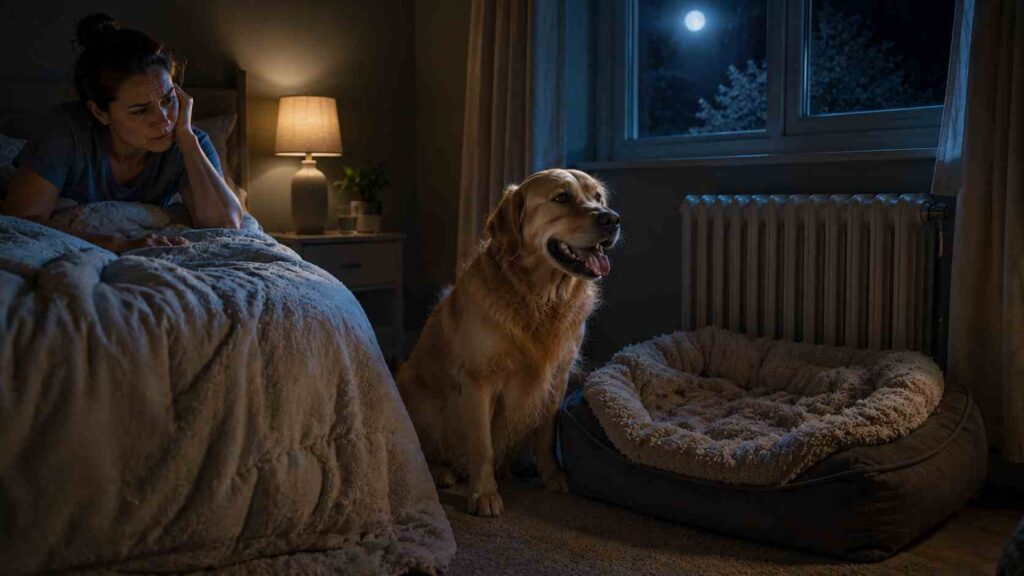
Nothing about your dog’s biology automatically makes panting abnormal after dark, but nighttime can make certain problems easier to notice.
The house goes quiet. No TV, conversations, traffic, or daytime activity. Breathing that might disappear into the background at 3 p.m. can become impossible to ignore at 3 a.m.
Bedding and room conditions matter. Thick beds, enclosed crates, warm bedrooms, radiators, poor ventilation, and humid air can make it harder for a dog to cool down. Dogs rely heavily on panting for heat loss, so persistent heavy panting in a warm environment deserves more attention, particularly if drooling, weakness, confusion, vomiting, or collapse develops. Heatstroke can progress rapidly and is a veterinary emergency.
Pain may become easier to spot at rest. A dog with arthritis or another painful condition may repeatedly change position, hesitate before lying down, seem stiff after getting up, or simply fail to settle. Panting can accompany discomfort even when a dog isn’t crying or obviously limping.
Evening anxiety triggers can linger. Thunderstorms, fireworks, being left alone, visitors, travel, a new sleeping place, or a disrupted routine can cause panting and restlessness. Anxiety is more convincing when it fits a clear trigger and appears alongside other stress behaviours, rather than being assumed simply because no physical cause is obvious.
Medication timing can offer a clue. If nighttime panting began soon after a new prescription or dose change, make a note of it. Corticosteroids such as prednisone or prednisolone can cause panting and may also increase thirst, urination, and appetite. Don’t stop prescribed steroids on your own; contact the prescribing veterinarian if the side effects are new, severe, or troublesome.
Senior dogs deserve a broader look. Older age itself isn’t a diagnosis. New nighttime panting may be related to pain, cognitive changes, heart or lung disease, endocrine disorders, medication effects, or reduced ability to cope with heat. A repeated change from your senior dog’s usual nighttime routine is worth discussing with a veterinarian rather than writing it off as “just getting old.”
Flat-faced breeds also deserve extra caution. Bulldogs, French Bulldogs, Pugs, and other brachycephalic dogs can have airway obstruction that causes noisy breathing, open-mouth breathing, exercise intolerance, laboured breathing, blue gums, or collapse. Poor breathing shouldn’t automatically be considered normal simply because of the dog’s breed.
Follow the Other Clues, Not Just the Panting
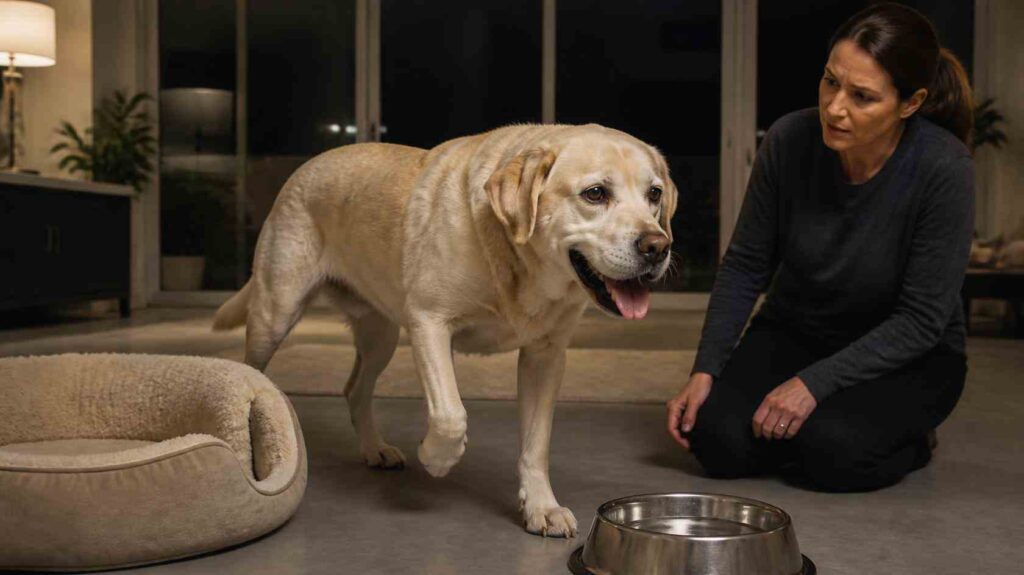
Panting on its own can have many explanations. Panting alongside another new symptom is often much more useful when deciding what to do next. The goal isn’t to diagnose your dog at home, but to notice patterns that may raise or lower the level of concern.
Panting plus pacing or restlessness — can occur with anxiety, pain, overheating, or abdominal discomfort.
Panting plus coughing — deserves veterinary attention because heart, lung, or airway disease may be involved.
Panting plus noisy, wheezy, or raspy breathing — raises concern for an airway or respiratory problem, especially if breathing also looks more difficult than usual.
Panting plus stiffness or trouble lying down — may point toward arthritis, spinal or musculoskeletal pain, or an injury. Some dogs in pain never cry out; repeatedly getting up and changing position may be the more obvious clue.
Panting plus increased thirst or urination — can occur with certain medications, particularly corticosteroids, or with conditions such as Cushing’s disease. Corticosteroids are known to cause panting as well as increased thirst, urination, and appetite.
Panting plus a swollen abdomen or repeated dry retching — treat this as a possible emergency, discussed in more detail below.
Panting plus weakness, collapse, blue-tinged gums, or obvious breathing effort — needs urgent veterinary care. Cornell lists abdominal breathing effort, neck extension, increased breathing sounds, blue-tinged gums, weakness, and collapse among signs of respiratory distress.
| What You’re Seeing Alongside Panting | Worth Considering | General Level of Concern |
|---|---|---|
| Pacing | Anxiety, pain, overheating, abdominal discomfort | Depends on context |
| Coughing | Heart, lung, or airway disease | Vet assessment |
| Increased thirst | Medication effect or endocrine disease | Vet assessment |
| Stiffness or difficulty settling | Pain, arthritis, injury | Vet assessment |
| Noisy or laboured breathing | Airway or respiratory problem | Higher concern |
| Swollen abdomen or dry retching | Possible GDV/bloat | Emergency |
| Weakness, collapse, or blue/grey gums | Respiratory, circulatory, heat-related, or other serious problem | Emergency |
The Emergency Owners Often Miss: Panting With Bloat Signs
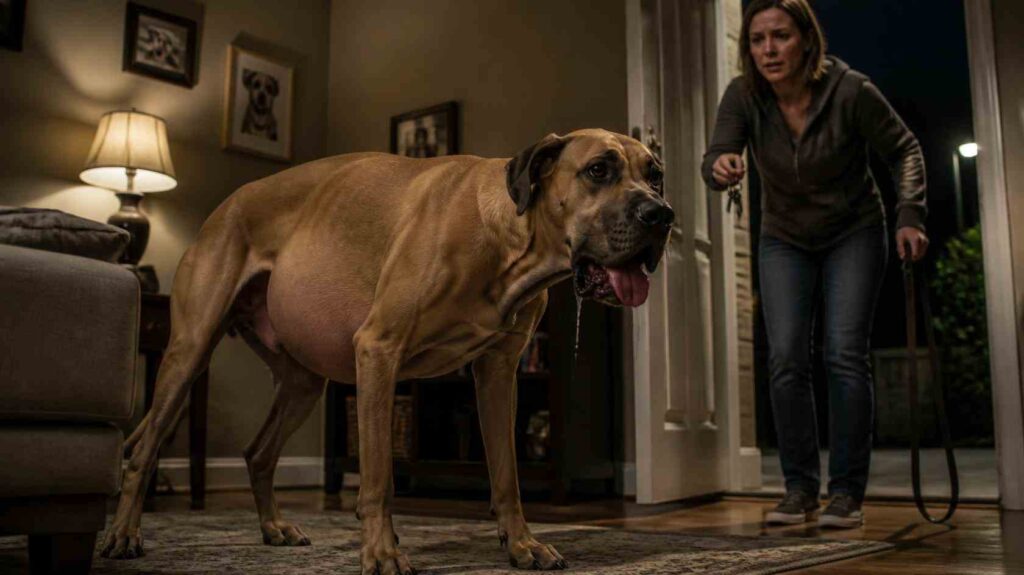
One combination deserves its own section because it is genuinely time-critical: gastric dilatation-volvulus (GDV), often called bloat.
Watch for sudden restlessness or pacing together with a swollen or painful abdomen, excessive drooling, and repeated attempts to vomit that bring little or nothing up. Weakness, pale gums, or collapse may develop as the condition worsens. Merck Veterinary Manual lists restlessness, rapid breathing, abdominal swelling and pain, dry retching, and excessive drooling among signs of bloat.
It’s easy to think, “He just can’t settle tonight,” especially when panting and pacing are the first things you notice. But panting plus abdominal swelling or repeated unsuccessful retching is not a wait-and-see situation. GDV requires immediate veterinary treatment.
Seek Emergency Care If You See These Signs
Some combinations need action now rather than monitoring overnight.
Seek emergency veterinary care if your dog’s panting comes with:
- obvious difficulty or increased effort when breathing
- blue, grey, or very pale gums
- collapse or severe weakness
- breathing that is rapidly worsening
- pronounced abdominal effort with each breath
- an extended head or neck as the dog tries to breathe
- inability to settle because breathing is difficult
- a swollen or painful abdomen
- repeated unsuccessful retching
- severe overheating with weakness or altered responsiveness
- seizures
Cornell classifies respiratory distress, a distended abdomen, pale gums, sudden collapse, and seizures among situations requiring emergency care.
Monitor, Book a Vet Visit, or Go to Emergency? A Simple Way to Decide
| Situation | Suggested Action |
|---|---|
| Brief panting after an obvious trigger such as exercise, excitement, or warmth, followed by a full return to normal | Monitor |
| Nighttime panting keeps returning without an obvious explanation | Book a vet appointment |
| Panting occurs with persistent coughing, stiffness, increased thirst, or other new changes | Book a vet appointment |
| Breathing becomes visibly laboured or strained | Emergency |
| Panting occurs with a swollen abdomen or repeated dry retching | Emergency |
| Panting occurs with collapse, severe weakness, or blue/grey gums | Emergency |
The key question is whether your dog returns fully to their normal baseline. One short episode after an obvious trigger is very different from a new pattern that appears every night or comes with additional symptoms.
Checklist: What to Notice Before You Call the Vet
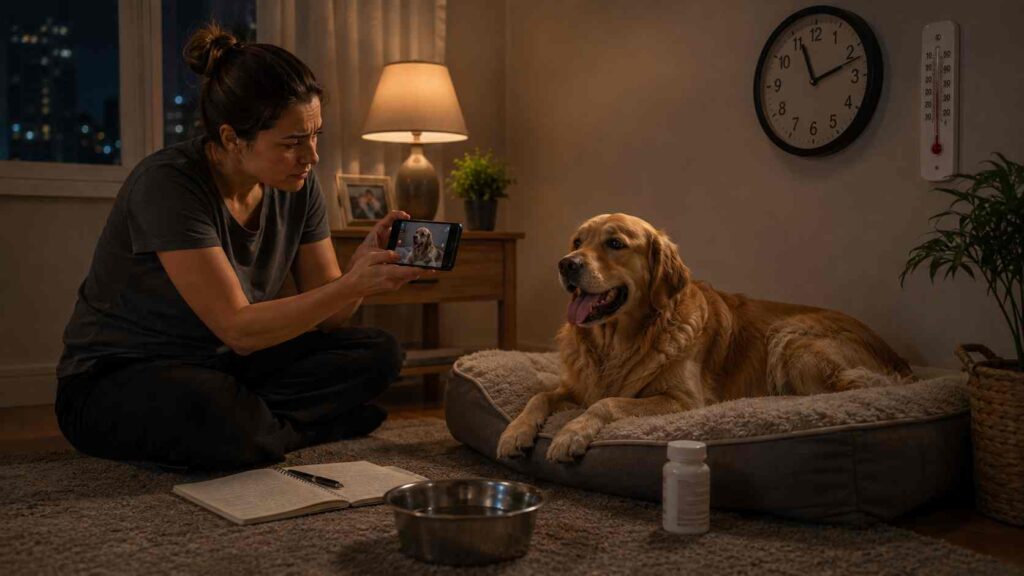
A little detail can make a veterinary phone call or appointment much more useful.
- When did the panting start, and was the change sudden or gradual?
- How long does each episode last?
- Is it happening repeatedly or every night?
- Was there exercise, excitement, stress, or heat exposure beforehand?
- Is the room warm, humid, enclosed, or poorly ventilated?
- Can your dog lie down and settle normally?
- Is there pacing, coughing, wheezing, or another unusual breathing sound?
- Does the belly seem to work unusually hard with each breath?
- Is there vomiting, dry retching, drooling, or abdominal swelling?
- Has drinking, urination, or appetite changed?
- Is your dog stiff, limping, reluctant to move, or repeatedly changing position?
- Was a medication recently started or changed?
- What time was the medication given relative to the panting?
- Do the gums look their usual healthy colour?
- Can you safely record a short video showing the breathing, posture, and sounds?
A short video and a simple note of when the episode happened, what came before it, and what other signs you noticed can give your veterinarian much more useful information than “my dog has been panting at night.”
Common Medical and Non-Medical Causes Worth Knowing About
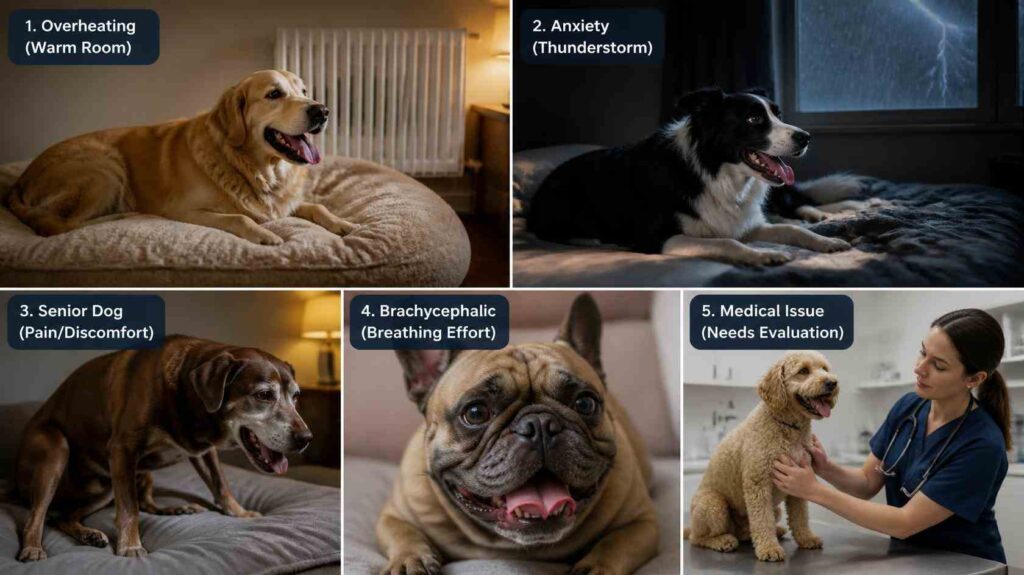
Heat, humidity, and recent activity. Thick coats, heavy bedding, warm rooms, poor ventilation, excess weight, and flat-faced anatomy can all make it harder for a dog to cool down. Panting that settles after rest in a comfortably cool environment is different from relentless panting accompanied by drooling, weakness, confusion, vomiting, or collapse — signs that can occur with heatstroke and need urgent veterinary attention.
Anxiety and nighttime stress. Noise sensitivity, thunderstorms, fireworks, separation, an unfamiliar environment, or a disrupted routine can leave a dog panting and restless. Anxiety is more likely when there is a recognizable trigger and other stress behaviours such as pacing, trembling, hiding, or repeatedly seeking reassurance. Don’t assume anxiety is the cause simply because the room isn’t hot.
Pain and physical discomfort. Arthritis, dental pain, an injury, abdominal discomfort, spinal or muscular pain, and recovery from surgery can all make it difficult for a dog to settle. Pain isn’t always accompanied by whining. Repeatedly getting up, changing position, stiffness, guarding, or reluctance to move may be the only clues.
Heart and lung problems. Panting or unusually fast breathing may occur alongside coughing, reduced stamina, lethargy, weakness, fainting, or increased breathing effort. A dog that is visibly struggling to breathe needs urgent veterinary care rather than home monitoring.
Airway disease in flat-faced breeds. French Bulldogs, Bulldogs, Pugs, and other brachycephalic dogs are at greater risk of obstructed breathing. Heavy panting at rest, persistent noisy breathing, disturbed sleep, or obvious breathing effort shouldn’t be dismissed as “just how the breed is.”
Cushing’s disease and other endocrine conditions. Panting can occur with Cushing’s disease, but panting alone isn’t enough to diagnose it. Increased thirst and urination, increased appetite, skin or coat changes, muscle weakness, and changes in body shape provide more useful context for your vet.
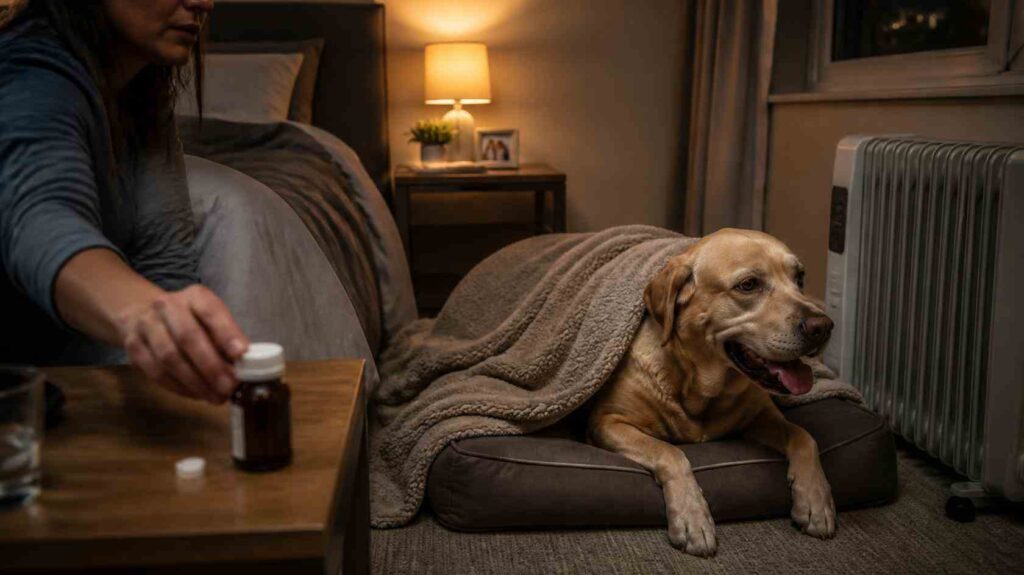
Medication side effects. Corticosteroids such as prednisone, prednisolone, and dexamethasone can cause panting and may also increase thirst, urination, and appetite. If the timing of the panting matches a new prescription or dose change, tell the prescribing veterinarian. Never stop a prescribed corticosteroid abruptly unless your vet tells you to do so.
Cognitive dysfunction in senior dogs. Cognitive decline can disrupt the sleep-wake cycle and cause nighttime pacing, disorientation, altered interactions, or difficulty settling. However, don’t assume an older dog has dementia based on panting alone; pain and medical problems should also be considered.
Common Mistakes Owners Make
A few understandable assumptions can delay the right care:
- Assuming every panting dog is simply too hot.
- Blaming unexplained panting on anxiety without considering pain or illness.
- Dismissing a new symptom because a dog is “just getting old.”
- Treating noisy or difficult breathing as normal for a flat-faced breed.
- Counting respiratory rate while the dog is actively panting instead of when they’re calm or asleep.
- Waiting for coughing before taking abnormal breathing seriously.
- Missing subtle pain signs such as repeated repositioning or difficulty lying down.
- Stopping prescribed medication without speaking to the veterinarian.
- Giving human painkillers, sedatives, or sleeping medication.
- Waiting until morning despite obvious emergency warning signs.
What Your Vet Will Likely Want to Know
Come prepared with when the panting started, how long episodes last, how often they happen, and what your dog was doing beforehand. Mention recent exercise or heat exposure, changes in the sleeping environment, medications and their timing, and any changes in appetite, thirst, urination, mobility, coughing, or behaviour.
Depending on what your vet finds, the examination may include your dog’s breathing effort, heart and lung sounds, gum colour, temperature, body condition, airway, and abdomen. Further testing depends on the suspected cause rather than panting alone.
A short video is genuinely useful because intermittent symptoms have an unhelpful habit of disappearing the moment you’re in the exam room. Try to capture your dog’s breathing, posture, and any unusual sounds without disturbing them.
Most importantly, panting is a symptom, not a diagnosis. Cushing’s disease, heart or lung disease, anxiety, pain, and cognitive dysfunction all require the wider pattern — and sometimes diagnostic testing — to work out what is actually happening.
What Not to Do
Don’t give human painkillers, sedatives, or sleeping tablets. Don’t use leftover veterinary medication prescribed for another problem or another dog. Don’t abruptly stop prescribed corticosteroids.
Don’t force large amounts of water on a distressed dog or exercise a heavily panting dog to “tire them out.” Normal-looking gums are reassuring but don’t rule out every serious problem.
And if your dog is already struggling to breathe, collapsing, developing blue or grey gums, or showing a swollen abdomen with repeated unsuccessful retching, don’t wait to see whether things get worse — seek emergency veterinary care.
The Bottom Line
Nighttime panting is a symptom, not a diagnosis. Sometimes the explanation is straightforward — a warm sleeping area, recent activity, or a stressful evening. But new, persistent, recurrent, or unexplained panting deserves more attention, particularly when it appears with coughing, pain, excessive thirst, abdominal swelling, weakness, or changes in breathing effort.
Rather than guessing at a disease, watch the pattern: when the panting starts, how long it lasts, what happens alongside it, and whether your dog returns fully to normal afterward. Those clues help separate something you can monitor from something that deserves a vet appointment — or emergency care tonight.
Frequently Asked Questions
1.Why is my dog panting at night when the room is cool?
A cool room makes environmental heat less likely, but it doesn’t rule out thick bedding, poor ventilation, recent activity, pain, anxiety, medication effects, or an underlying medical problem. Repeated panting without an obvious trigger is worth discussing with your vet.
2.Is it normal for a dog to pant while lying down?
Occasional panting while resting can be normal after activity, excitement, stress, or warmth. Frequent or prolonged panting while lying quietly — especially if it is new or has no obvious trigger — deserves closer attention.
3.Can arthritis cause nighttime panting without any whining?
Yes. Dogs in pain don’t always vocalize. With arthritis or other musculoskeletal pain, clues may include stiffness after getting up, difficulty lying down, reluctance to use stairs, or repeatedly changing sleeping positions.
4.Why does my dog only pant when trying to settle down for the night?
Discomfort may become more noticeable once a dog stops moving, so joint or other pain is one possibility. Bedtime-related anxiety, a warm sleeping area, and other medical causes can produce a similar pattern. Recurrent episodes shouldn’t automatically be blamed on behaviour.
5.Should I count my dog’s breathing rate while they’re panting?
No. Panting isn’t the right time to assess a resting respiratory rate. Wait until your dog is comfortably resting or asleep. Count each rise-and-fall cycle of the chest as one breath. If you’re monitoring breathing because of a known heart or respiratory condition, follow the target and measurement method your veterinarian has given you.
6.Can a new medication really cause my dog to pant more at night?
Yes. Corticosteroids such as prednisone are particularly well known for causing panting and may also increase thirst, urination, and appetite. Note when the medication was given and when the panting occurred, then discuss the pattern with the prescribing veterinarian rather than changing the treatment yourself.
7.My dog is panting but seems completely normal otherwise — should I still be concerned?
A brief episode after an obvious trigger that resolves completely may only need monitoring. If the panting is new, keeps returning, happens without an obvious reason, or becomes more intense, arrange a veterinary assessment even if your dog appears normal between episodes.
#. Related Articles: