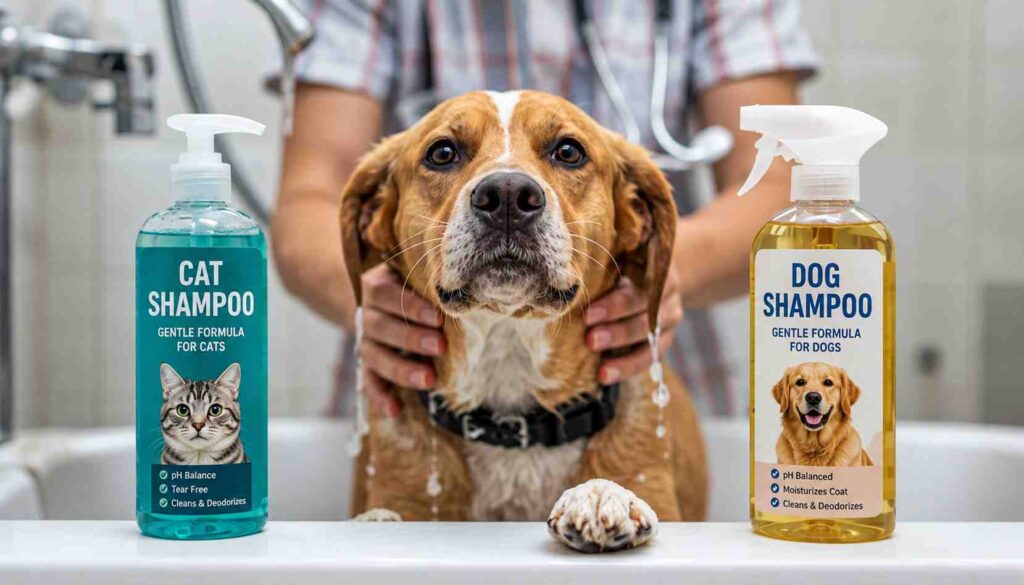
You’re standing at the bathtub, your dog is already wet, and the dog shampoo bottle is empty. Sitting right there on the shelf is the cat’s shampoo. Can I use cat shampoo on my dog?
The answer depends on what’s actually in the bottle. Not every product sold as cat shampoo carries the same risk. A plain grooming shampoo is a very different product from a medicated shampoo or a flea-and-tick treatment. The ASPCA recommends choosing shampoo specifically formulated for the species you’re bathing because ingredients that are suitable for one type of pet may not be appropriate for another.
Before you pour anything on your dog, check three things: what species the label lists, what type of shampoo it is, and whether you’ve already used it.
If you’ve already bathed your dog with the shampoo and you’re here because you’re worried, skip ahead to the section on what to do next. You don’t need to read the whole article first.
Before You Pour It, Turn the Bottle Around
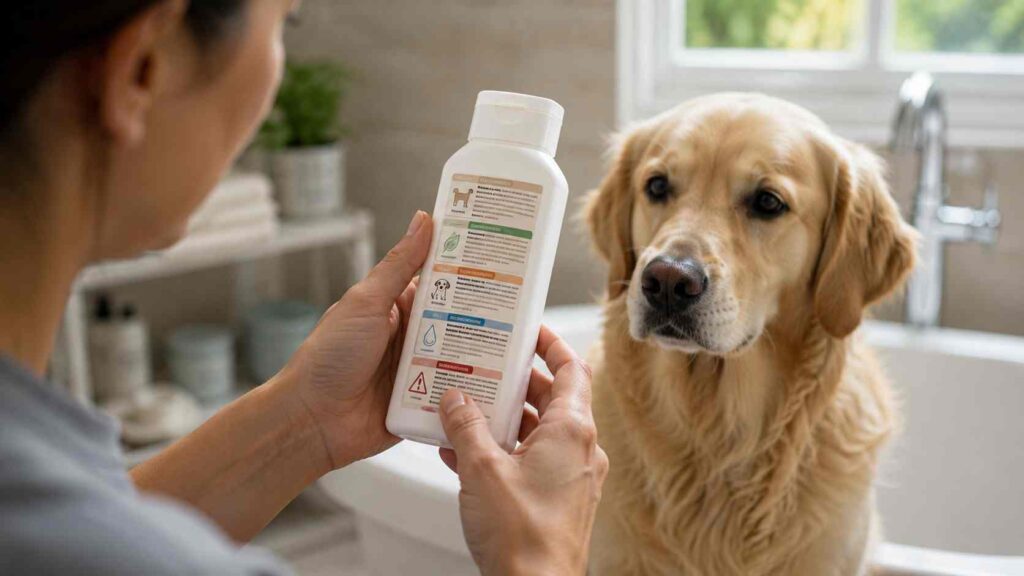
Most guides jump straight into dog-versus-cat skin differences. That’s not the most useful place to start. When you’re holding the bottle in your hand, the quickest practical check is the product label.
Does It Say “Cats Only,” “Dogs Only,” or “Dogs and Cats”?
This is one of the most useful pieces of information on the bottle.
If a shampoo is labelled only for cats, don’t assume that being safe for one pet species automatically makes it suitable for another. For routine bathing, choose a product intended for dogs.
If the label explicitly says the shampoo is suitable for both dogs and cats, that’s different. Dual-species shampoos do exist, including some veterinary medicated products. In that situation, follow the manufacturer’s directions, including any age, dilution, contact-time, or frequency restrictions.
Don’t judge safety by the packaging. Words such as “gentle,” “natural,” or “hypoallergenic” do not replace the species and usage instructions on the label.
What Kind of Shampoo Is Actually in the Bottle?
Not all cat shampoos do the same job. Broadly, you’re looking at one of these:
- Ordinary grooming shampoo — primarily cleans the coat and skin
- Hypoallergenic or cosmetic shampoo — designed or marketed for gentler cleansing, but still needs appropriate species labelling
- Medicated shampoo — intended to help manage a specific skin problem
- Flea or tick shampoo — contains active ingredients intended to control parasites
- Unknown or unreadable formula — doesn’t give you enough information to make a sensible safety decision
The type of shampoo often matters more than the brand name.
Check More Than the Product Name
Before using any pet shampoo on your dog, look for:
- The animal species listed on the label
- Active ingredients
- Minimum age for use
- Dilution instructions
- Frequency or contact-time directions
- Any weight restrictions
- Safety warnings
- Full directions for use
This becomes particularly important with flea-and-tick products. The U.S. Environmental Protection Agency advises using these products only on the species and, where specified, the size or weight shown on the label.
Six Things to Check Before Using Any Pet Shampoo
- Species listed on the label
- Type of shampoo: grooming, medicated, or flea/tick
- Active ingredients
- Minimum age requirement
- Dilution and use directions
- Warnings or restrictions
If you can answer all six, you’re making an informed decision rather than guessing.
Not All Cat Shampoos Carry the Same Risk
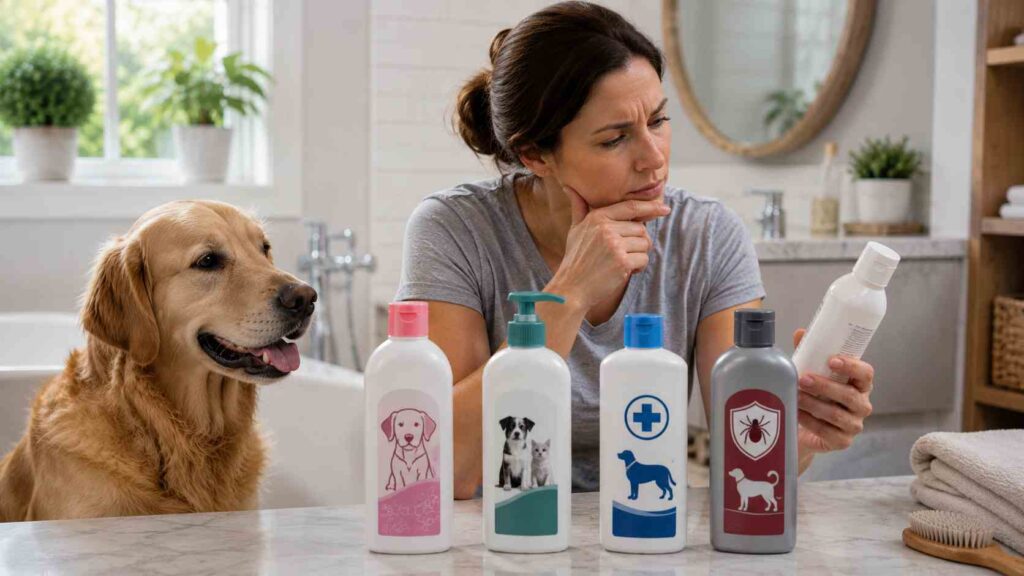
| Product in Your Hand | Suitable Direction | Main Thing to Check | Extra Caution |
|---|---|---|---|
| Ordinary cat-only grooming shampoo | Prefer a dog-specific product | Species and formula | Dogs with sensitive or damaged skin |
| Shampoo labelled “for dogs and cats” | Follow the product directions | Age and use restrictions | Individual sensitivity |
| Medicated cat shampoo | Don’t substitute casually | Active ingredients and intended condition | Existing skin disease or prescribed treatment |
| Cat flea or tick shampoo | Don’t use unless the label includes dogs | Species, age, weight and pesticide directions | Puppies and medically vulnerable dogs |
| Unknown or unlabelled shampoo | Don’t guess | Ingredients cannot be confirmed | Applies to every dog |
Why “For Dogs and Cats” Changes the Answer
If the bottle specifically states that it is formulated or approved for both dogs and cats, you’re no longer making a cross-species guess.
That doesn’t mean every dog will tolerate every dual-species shampoo perfectly. You still need to follow the instructions for dilution, application, rinsing, age restrictions, and how often the product can be used.
A dog with inflamed, infected, broken, or unusually sensitive skin may also need a product chosen for the underlying problem rather than whichever pet shampoo happens to be nearby.
Why Medicated Shampoo Is a Different Question
Medicated shampoo isn’t simply stronger soap. It is used to manage particular skin problems, and the correct product depends on what is actually causing those problems.
Veterinary shampoos may contain ingredients such as chlorhexidine, ketoconazole, miconazole, benzoyl peroxide, sulfur, or salicylic acid. For example, VCA describes chlorhexidine-plus-ketoconazole products as treatments used for superficial bacterial and fungal skin conditions in dogs and cats, while medicated shampoos more broadly are selected according to the dog’s specific skin condition.
Those ingredients are not automatically dangerous to dogs. In fact, several are routinely used in canine dermatology. The issue is whether the particular formula, concentration, application method, and intended use are appropriate for your dog.
If your dog is already using a vet-prescribed shampoo, don’t replace it with the cat’s medicated shampoo simply because the active ingredients look similar. Veterinary shampoos can have specific dilution, contact-time, and treatment-frequency instructions.
That’s a treatment decision, not a bathroom shortcut.
Why Flea and Tick Shampoo Deserves Extra Caution
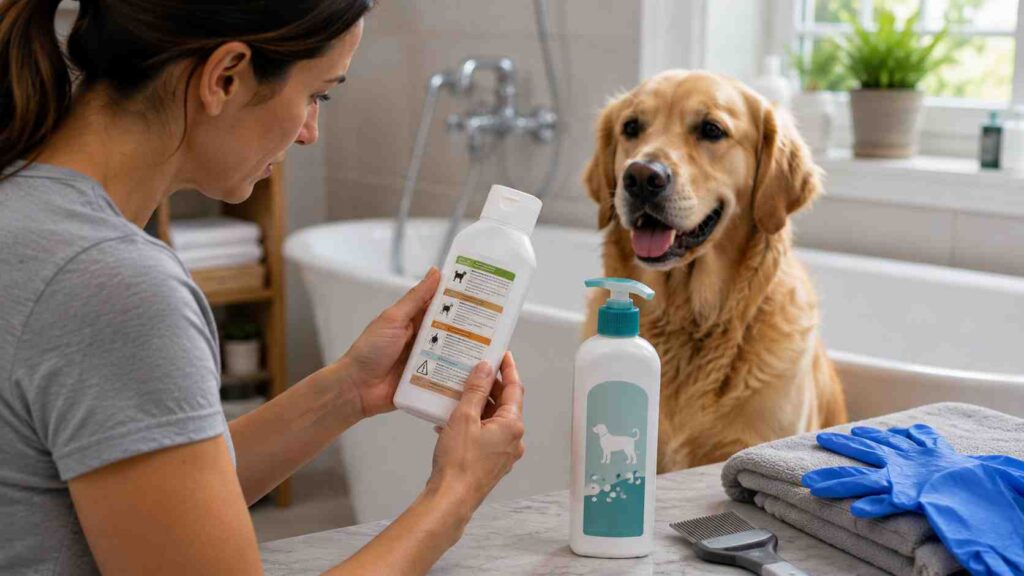
This is genuinely different from ordinary cleansing shampoo. Flea and tick shampoos contain active ingredients intended to kill or control parasites, so their species, age, dose, and sometimes weight restrictions matter.
The U.S. Environmental Protection Agency advises using flea and tick products only on the animal species and size or weight specified on the label, because some pesticides are tolerated differently by dogs and cats.
One important example is permethrin. It’s used in some flea and tick products for dogs but can be highly toxic to cats. Merck Veterinary Manual specifically identifies cats as particularly susceptible to permethrin and other pyrethroid toxicity. That’s why you shouldn’t assume a flea product can safely move from one species to another—even when the bottles look similar.
Flea and Tick Products Are Not Ordinary Shampoo
Never assume a flea or tick product is interchangeable across species. Don’t estimate how much to use based on your dog’s size unless the label specifically tells you to dose that way. Check the intended species, age, weight, and application instructions before use, with extra care for puppies.
Already Used It? Start With What Your Dog Looks Like Now
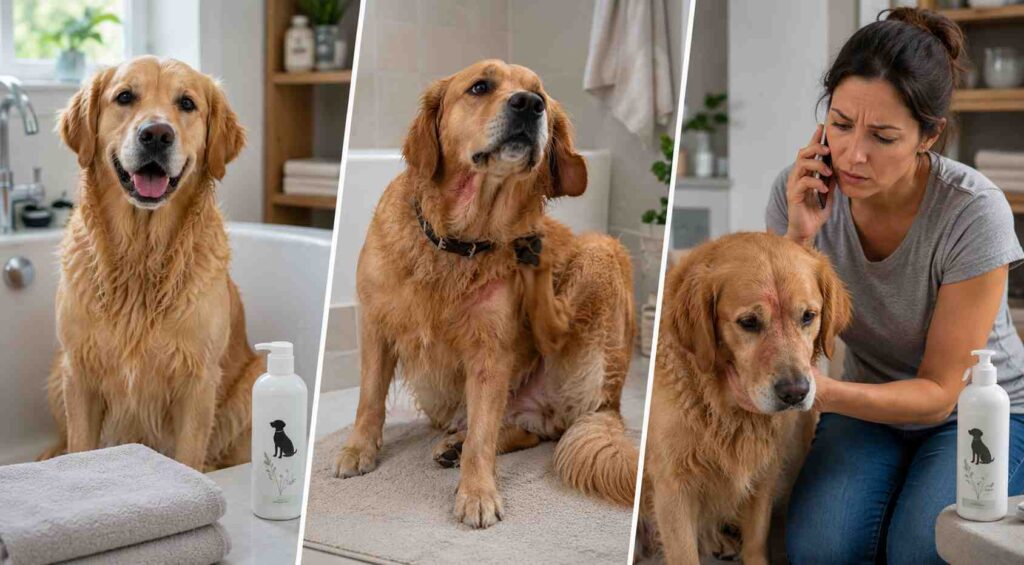
If you’re past the “should I?” stage and have already washed your dog with cat shampoo, what you do next depends on the product you used and how your dog is behaving now.
Keep the bottle or packaging nearby. If you need veterinary advice, the exact product name, active ingredients, and concentration can be far more useful than simply saying “cat shampoo.”
Your Dog Seems Completely Normal
If it was an ordinary grooming shampoo, your dog was rinsed thoroughly, and they’re behaving normally, don’t automatically assume you’ve caused poisoning.
Make sure there’s no obvious shampoo residue left in the coat and keep an eye out for irritation or unusual behavior. Avoid immediately giving another full shampoo bath “just in case,” since repeated washing can add further skin irritation.
If the product was medicated, flea/tick, or contains an active ingredient you’re unsure about, check the label and contact your veterinarian for product-specific advice rather than relying only on the fact that your dog currently looks fine.
Your Dog Is Itchy, Red, Flaky, or Uncomfortable
Milder skin reactions may show up as:
- Increased scratching
- Repeated licking
- Red or irritated skin
- Dry or flaky skin
- Localized discomfort
If there’s still product in the coat, rinse it away thoroughly with lukewarm water and stop using the shampoo. If the irritation persists, spreads, or becomes more uncomfortable, contact your veterinarian.
Persistent itching shouldn’t automatically be blamed on the shampoo, either. Dogs with allergies, yeast or bacterial skin disease, or another underlying problem may already have compromised skin that becomes more noticeable after bathing.
Your Dog Has More Serious Symptoms
Seek prompt veterinary attention if your dog develops signs such as:
- Significant facial swelling
- Widespread hives
- Difficulty breathing
- Repeated vomiting
- Tremors
- Marked weakness
- Collapse
- Seizures or other serious neurological abnormalities
These signs move the situation beyond simple post-bath skin irritation.
When This Stops Being a Grooming Question
If your dog is having a severe or rapidly worsening reaction, contact your veterinarian or an emergency veterinary clinic promptly.
If a flea/tick or medicated product was involved, have the packaging with you so the veterinary team can identify the active ingredients.
If your dog swallowed a significant amount of shampoo, contact your veterinarian rather than trying a home remedy. Do not induce vomiting unless a veterinary professional specifically instructs you to do so.
One Accidental Bath and Routine Use Aren’t the Same Decision
Why a Single Accidental Exposure Needs Context
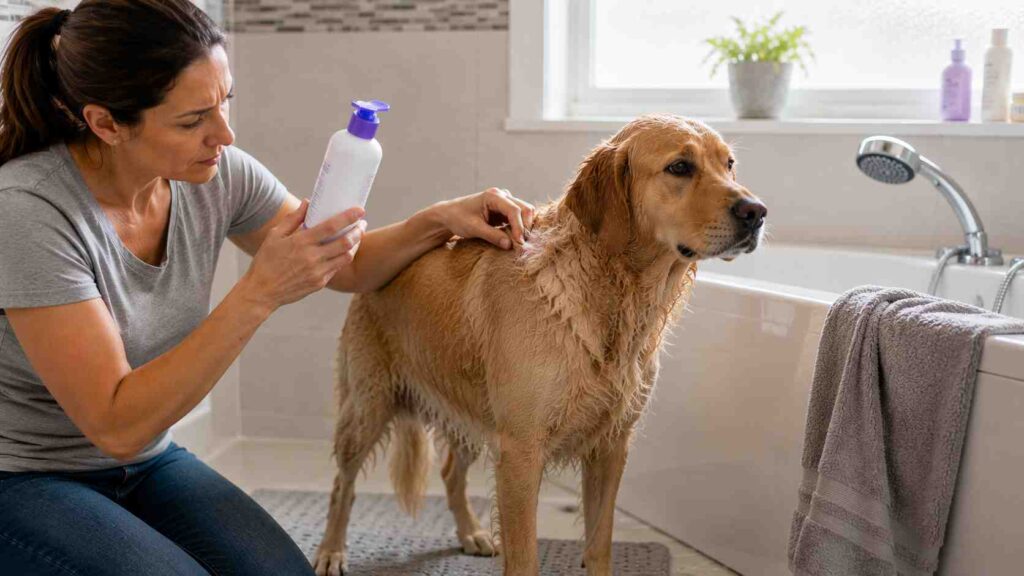
One accidental bath isn’t automatically harmless or automatically dangerous. The important questions are:
- What type of shampoo was it?
- Was it labelled for dogs as well as cats?
- Did it contain medication or a pesticide?
- How much was used?
- Was it rinsed thoroughly?
- Is your dog showing any symptoms?
- Did your dog lick or swallow the product?
- Does your dog already have sensitive or damaged skin?
A healthy adult dog accidentally washed once with a plain grooming shampoo is a very different situation from a puppy exposed to a cat-only flea treatment.
Why Repeated Use Is Harder to Justify
Accidentally grabbing the wrong bottle once is one thing. Making cat-only shampoo your dog’s regular bathing product is another.
For routine bathing, the ASPCA recommends choosing a shampoo formulated for the species you’re bathing. A dog-specific or properly labelled dual-species shampoo removes the uncertainty about whether the formulation was intended for canine use.
Why Your Dog’s Health Changes the Answer
Extra caution makes sense for:
- Puppies
- Dogs with known allergies or very sensitive skin
- Dogs with active dermatitis or hot spots
- Dogs with open, raw, or inflamed skin
- Dogs with recurring bacterial or yeast skin problems
- Dogs already using a veterinarian-prescribed shampoo or dermatological treatment
If your dog is being treated for a skin condition, don’t substitute another medicated shampoo simply because some of the ingredients look familiar. The formulation, concentration, contact time, and treatment schedule can all matter.
Cat Skin vs Dog Skin — Don’t Let the pH Explanation Mislead You
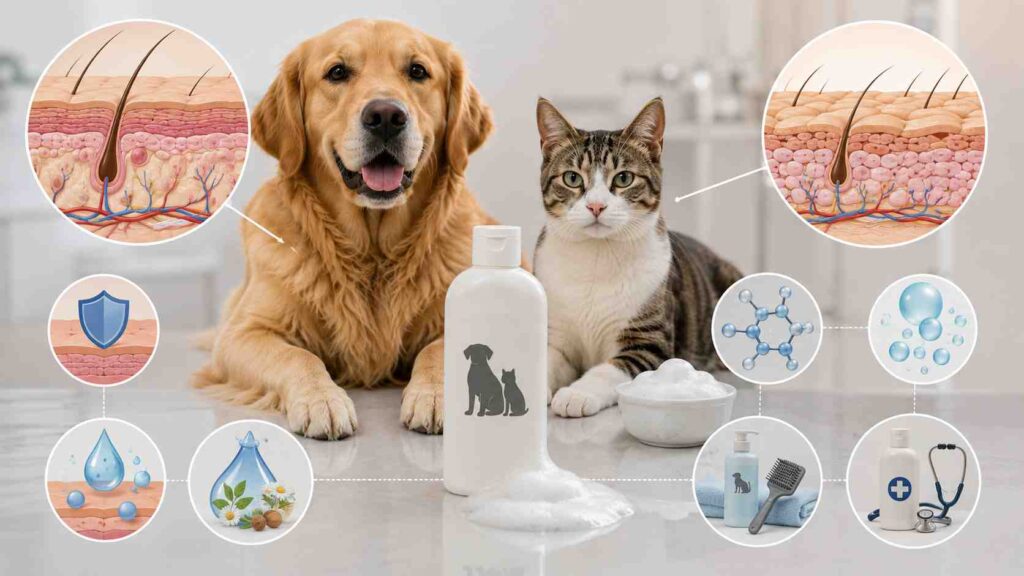
pH Is Only One Piece of the Formula
You’ll often see shampoo advice reduced to one claim: “dogs and cats have different skin pH.”
That’s too simple to tell you whether the bottle in your hand is appropriate.
A shampoo’s full formulation, active ingredients, intended species, purpose, and your dog’s skin condition are more useful for making the decision than relying on a single pH number.
So instead of trying to compare pH values in the bathroom, read the product label.
Cosmetic Shampoo and Therapeutic Shampoo Have Different Jobs
A regular grooming shampoo primarily cleans the skin and coat.
A medicated shampoo is designed to help manage a particular dermatological problem.
A flea or tick shampoo contains active ingredients intended to control parasites.
They may all come in similar-looking bottles, but they aren’t interchangeable products.
“Natural” and “Hypoallergenic” Don’t Override the Label
Words such as “natural,” “gentle,” “organic,” or “hypoallergenic” shouldn’t be treated as proof that a shampoo is appropriate for dogs.
Essential oils deserve particular caution. VCA notes that several concentrated essential oils—including tea tree, peppermint, pine, pennyroyal, wintergreen, and others—can cause poisoning in dogs through ingestion or skin exposure.
That doesn’t mean every pet shampoo containing a botanical ingredient is automatically dangerous; formulation and concentration matter. It does mean you shouldn’t add concentrated essential oils to a homemade shampoo or assume “natural” equals harmless.
No Dog Shampoo at Home? Don’t Turn the Bathroom Into a Chemistry Experiment
When Waiting May Be the Better Option
If the mess isn’t urgent, waiting until you have an appropriate dog shampoo is often simpler than experimenting with whatever happens to be nearby.
A muddy dog can survive being muddy for a little longer.
When a Lukewarm-Water Rinse May Be Enough
For light dirt, dust, or a minor muddy patch, lukewarm water and a thorough towel-dry may be all you need until the next proper bath.
You don’t always need to replace a missing shampoo with another cleaning product.
Why Random Household Substitutes Create Another Problem
Dish detergent, human shampoo, baby shampoo, vinegar mixtures, baking soda pastes, and homemade essential-oil blends are often suggested online, but none should be treated as a universally safe substitute for a properly labelled pet shampoo.
ASPCA recommends using shampoo formulated for pets and notes that some ingredients in human products can irritate pet skin.
If you regularly have both cats and dogs at home, keeping a properly labelled dual-species grooming shampoo on hand is a far more predictable backup than improvising a mixture during bath time.
Emergency Bath Decisions — Quick Tips
- Read the entire label before using the product
- If you can’t identify the formula, don’t guess
- Plain lukewarm water may be enough for minor dirt
- Keep shampoo away from the eyes, mouth, and ear canals
- Rinse thoroughly until the water runs clear and the coat no longer feels soapy
- Follow dilution and contact-time directions exactly
- Don’t follow one questionable shampoo with several other products trying to “cancel it out”
Small Bath-Time Mistakes Can Matter More Than Owners Expect
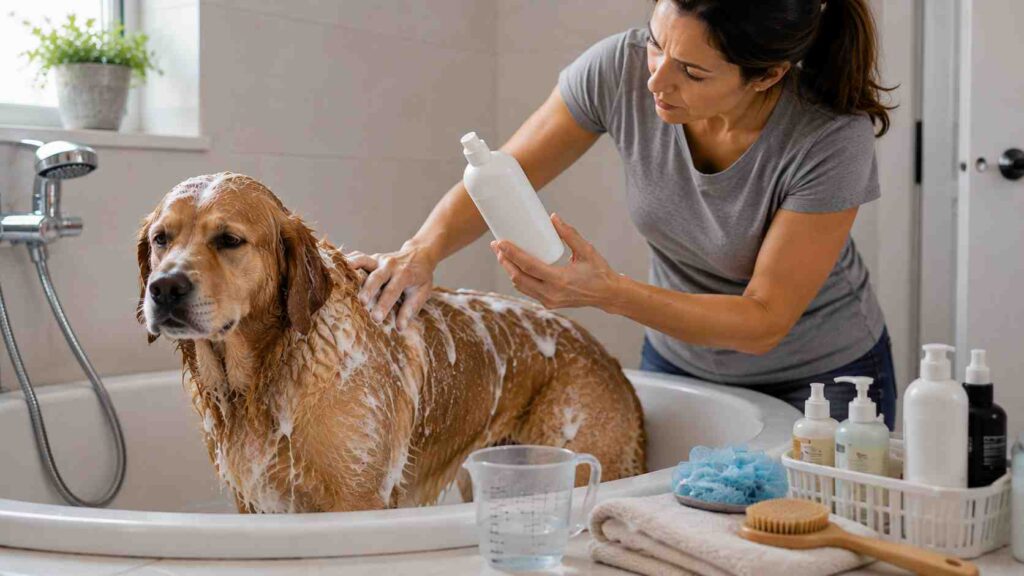
- Assuming every product labelled “pet shampoo” is interchangeable
- Reading only the front of the bottle
- Believing “safe for cats” automatically means “safe for dogs”
- Treating “natural” as a safety guarantee
- Using medicated shampoo like an ordinary cleanser
- Treating flea or tick shampoo as routine grooming shampoo
- Ignoring minimum-age or weight restrictions
- Skipping dilution when the label requires it
- Leaving a product on longer than directed
- Using much more shampoo than necessary
- Rinsing too quickly or incompletely
- Allowing shampoo into the eyes, mouth, or ear canals
- Using an unfamiliar product on broken or inflamed skin
- Repeatedly re-bathing an irritated dog in an attempt to fix the reaction
Sometimes the Shampoo Isn’t the Real Problem
Skin Signs That Deserve a Closer Look
If your dog has persistent itching, a recurring odour, a greasy coat, marked dandruff, pustules or skin lesions, hair loss, or repeated skin infections, the bigger issue may not be the shampoo at all.
Those signs can occur with allergies, bacterial or yeast infections, parasites, and other skin conditions. Switching shampoos repeatedly can delay finding the actual cause, so recurring or worsening symptoms are worth discussing with your veterinarian.
Don’t Replace a Vet-Prescribed Shampoo on Your Own
If your dog is already using a prescribed shampoo, don’t swap it for the cat’s product, even temporarily.
Medicated shampoos may be selected for a specific active ingredient, concentration, contact time, and bathing schedule. Those details can affect how well treatment works, so a product with a similar-looking ingredient list is not automatically an equivalent substitute.
What to Tell Your Vet After a Shampoo Reaction
If you need veterinary advice, have the following information ready:
- Exact product name
- Bottle, packaging, or a clear photo of the label
- Active ingredients and concentration, if listed
- Roughly how much was used
- Whether the shampoo was diluted
- Whether your dog licked or swallowed any
- When the exposure happened
- Symptoms you’ve noticed
- Whether the product was rinsed off
- Whether your dog has an existing skin condition or takes other treatments
Keeping the bottle is especially useful after exposure to a medicated or flea-and-tick product because treatment decisions can depend on the exact active ingredients.
Consider Veterinary Guidance When
Contact your veterinarian if irritation persists or worsens, your dog already has significant skin disease, a medicated or pesticide product was used incorrectly, a puppy was exposed to a product outside its labelled age range, or your dog swallowed a significant amount.
Seek urgent veterinary care for severe signs such as breathing difficulty, marked facial swelling, tremors, seizures, profound weakness, or collapse.
A 30-Second Decision Guide for the Shampoo in Your Hand
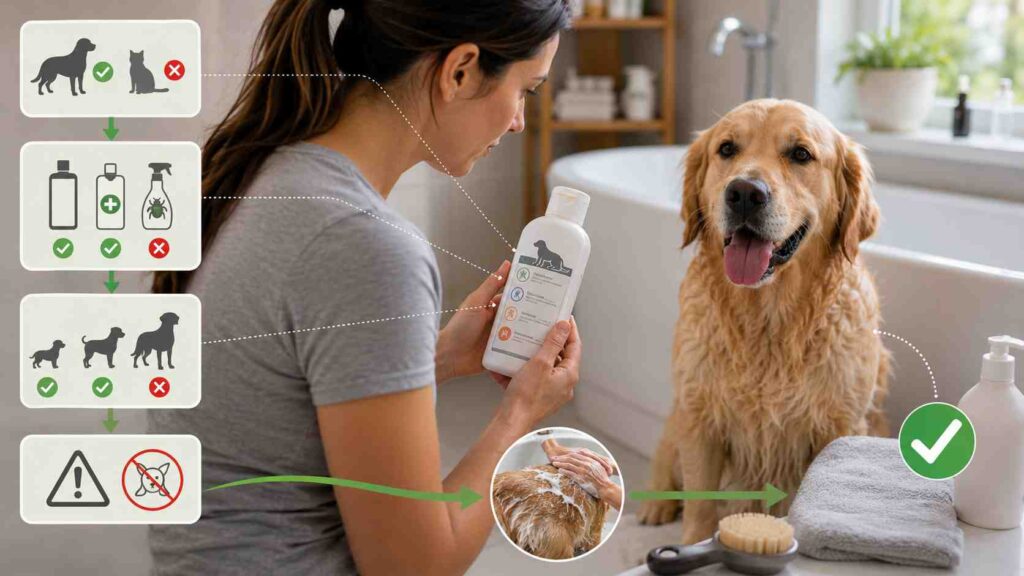
Step 1: Is the Product Explicitly Labelled for Dogs and Cats?
Yes: Check the age restrictions, directions, dilution instructions, and warnings. If your dog meets those requirements, follow the label.
No: Move to Step 2.
Step 2: Is It Cat-Only?
Choose a dog-appropriate shampoo rather than assuming a cat-only formula is interchangeable.
If the bath isn’t urgent, waiting or using lukewarm water for minor dirt is usually more sensible than experimenting with another product.
Step 3: Is It Medicated or a Flea/Tick Shampoo?
Don’t improvise across species.
These products contain active ingredients intended for a specific medical or parasite-control purpose. Follow the species listed on the label and ask your veterinarian if you’re unsure.
EPA guidance for flea-and-tick products specifically says to use them only on the animal species and size or weight stated on the label.
Step 4: Did You Already Use It?
Check three things:
- What type of product was it?
- Was it rinsed off thoroughly?
- Is your dog showing any symptoms?
A healthy dog that seems completely normal after an accidental bath with an ordinary cleansing product is a different situation from a dog exposed to a medicated or pesticide shampoo.
Step 5: Is Your Dog Showing Serious Symptoms?
If your dog develops breathing difficulty, major swelling, tremors, seizures, marked weakness, collapse, or another rapidly worsening reaction, the veterinary problem now takes priority over the shampoo question.
Key Takeaways
- Check the species listed on the label before anything else.
- Ordinary grooming, medicated, and flea-and-tick shampoos should not be treated as the same type of product.
- A shampoo explicitly labelled for both dogs and cats can be used according to its directions.
- One accidental use of an ordinary shampoo does not automatically mean your dog has been poisoned.
- The exact product and your dog’s symptoms determine what to do next.
- Keep a dog-specific or properly labelled dual-species shampoo available for routine bathing.
The Bottom Line
There’s no useful blanket answer to every bottle sold as “cat shampoo.”
A plain grooming shampoo accidentally used once and rinsed thoroughly from a healthy dog is a very different situation from using a medicated or flea-and-tick product without checking the label. Start with the intended species, identify what kind of shampoo you’re dealing with, and pay attention to how your dog looks and acts afterward.
For routine bathing, a dog-specific or properly labelled dual-species product removes the guesswork. And if your dog is repeatedly itchy, smelly, greasy, flaky, or developing skin lesions regardless of what shampoo you use, another bottle probably isn’t the answer—it’s time to investigate the skin problem itself.
Frequently Asked Questions
1.Can I Use Cat Shampoo on My Dog Just Once?
A single accidental use of an ordinary, non-medicated cat grooming shampoo may cause no obvious problem in a healthy adult dog, particularly if it was rinsed off thoroughly.
That doesn’t make cat-only shampoo a good routine choice. Check the ingredients and label, and watch for redness, itching, vomiting, weakness, or other unusual signs afterward.
2.What If the Shampoo Bottle Says “For Dogs and Cats”?
That’s an important exception. If the manufacturer explicitly labels the product for both species, follow its directions for age, dilution, application, contact time, rinsing, and frequency.
Dual-species labelling does not mean every product is suitable for every medical condition, especially if it is medicated.
3.I Already Used Cat Shampoo and My Dog Seems Fine — What Should I Do?
If it was an ordinary grooming product, your dog was rinsed thoroughly, and they’re behaving normally, there usually isn’t a reason to immediately shampoo them again.
Keep the bottle and monitor your dog for irritation or unusual behaviour. If the product was medicated, flea/tick-related, or contains an ingredient you’re unsure about, contact your veterinarian for product-specific advice even if your dog currently seems normal.
4.Can I Use Kitten Shampoo on a Puppy?
Don’t assume that a product intended for kittens is automatically appropriate for puppies because both are young animals.
Check the label for the intended species and minimum age. Puppies can be particularly vulnerable to products with age restrictions, especially parasite-control products.
5.Can I Use Cat Flea Shampoo on My Dog?
Only if the specific product label explicitly includes dogs and your dog meets its age, size, and other restrictions.
One important correction to a common misconception: permethrin is used in some dog flea-and-tick products and is particularly dangerous to cats—not the other way around. Merck Veterinary Manual notes that permethrin can be highly toxic to cats, while EPA warns never to swap flea-and-tick products between species unless the label permits it.
So the safe rule is not “cat flea products are safer” or “dog flea products are stronger.” The rule is: use the product only on the species listed on its label.
6.Can I Use Medicated Cat Shampoo on My Dog?
Not as a casual substitute.
Some medicated shampoos are approved for both dogs and cats, while others are species-specific. The active ingredient alone doesn’t tell you enough; concentration, indication, contact time, and directions also matter.
If your dog already has a diagnosed skin condition or prescribed bathing plan, check with your veterinarian before switching products.
7.Is Hypoallergenic Cat Shampoo Safe for Dogs?
Not necessarily.
“Hypoallergenic” describes how a product is formulated or marketed; it does not mean the product is automatically approved for another species. Check whether dogs are included on the label and review the ingredients and directions before use.
#. Related Articles: