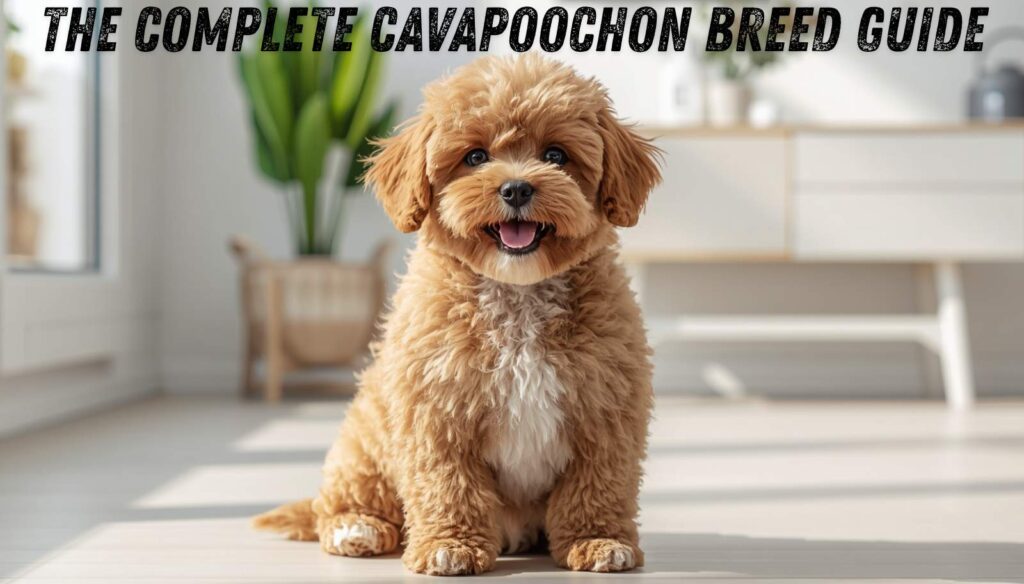
Cavapoochon Breed Guide: If you’re considering this teddy-bear-like companion, it’s worth looking beyond the photos before deciding whether one genuinely fits your life. Scroll through any dog-lover’s social feed and you’ll quickly see the appeal — a round face, fluffy coat and a dog that’s easy to fall for on looks alone.
But the puppy in the photo and the adult dog sharing your home for the next decade or more may not match every expectation you had at eight weeks old. Cavapoochons are not a standardised pedigree breed with one fixed breed standard. They combine Cavalier King Charles Spaniel, Bichon Frise and Poodle ancestry, so adult size, coat, shedding and temperament can vary between breeding lines and individual dogs.
This guide is designed to help you work out whether a Cavapoochon genuinely suits your household, daily routine and budget — not simply whether you like the teddy-bear look.
Start With the Dog You’re Actually Considering
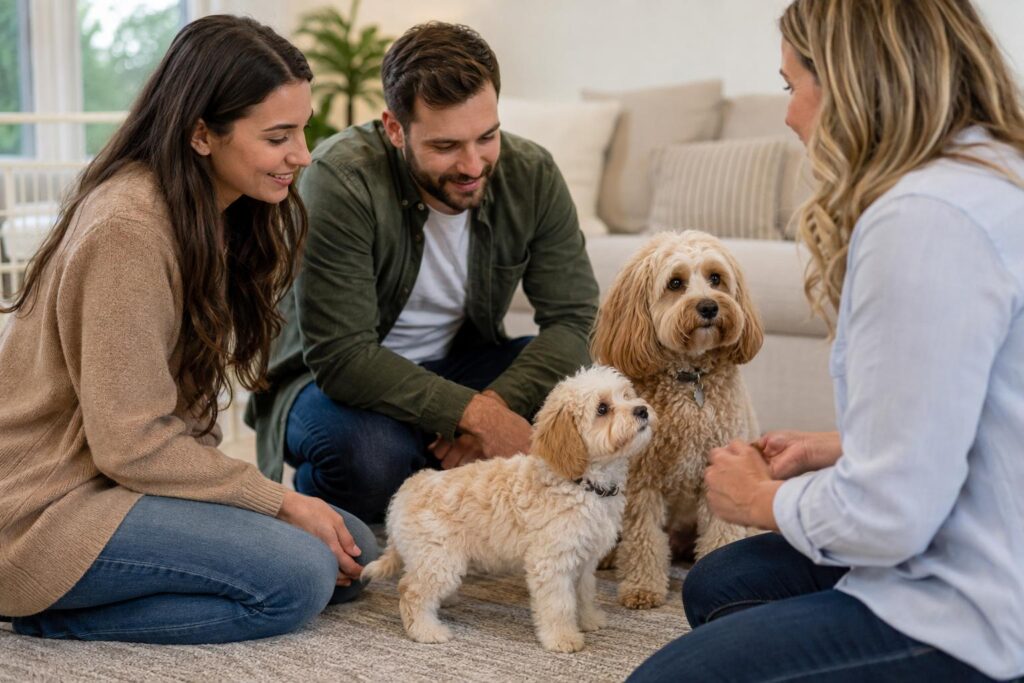
Why “Cavapoochon” Can Mean Slightly Different Things
The name can describe dogs produced through different breeding routes. Depending on the parents and generations involved, two dogs both sold as Cavapoochons may differ noticeably in size, coat and personality.
Treat the label as a starting point for research rather than a guarantee. When evaluating a puppy, the actual parents, their size, temperament, coat and health screening are more useful than the breed name alone.
The Common Cavalier + Bichon + Poodle Mix
A common breeding route is a Cavachon — a Cavalier King Charles Spaniel × Bichon Frise cross — bred with a Toy or Miniature Poodle. Other multigenerational combinations may also be described as Cavapoochons.
That matters because there is no single breeding formula that guarantees every Cavapoochon will inherit the same proportion of visible traits.
Why Poodle Size Matters
Whether Toy or Miniature Poodle ancestry appears in the pedigree can influence expected adult size. A dog from smaller parents will generally be expected to mature smaller than one produced from larger parents, but genetics still leave room for variation.
Before reserving a puppy, ask the breeder which Poodle variety was used and the adult height and weight of both parents.
Why Breeder Percentages Don’t Guarantee Adult Traits
You may see puppies advertised with precise breed percentages. Those figures can describe ancestry, but they cannot tell you exactly how an individual puppy will look or behave.
Traits such as size, coat texture and temperament are influenced by multiple genes as well as development, socialisation and environment. A higher percentage of Poodle ancestry, for example, does not automatically guarantee a curly, non-shedding coat.
What Can You Predict — and What Can You Not?
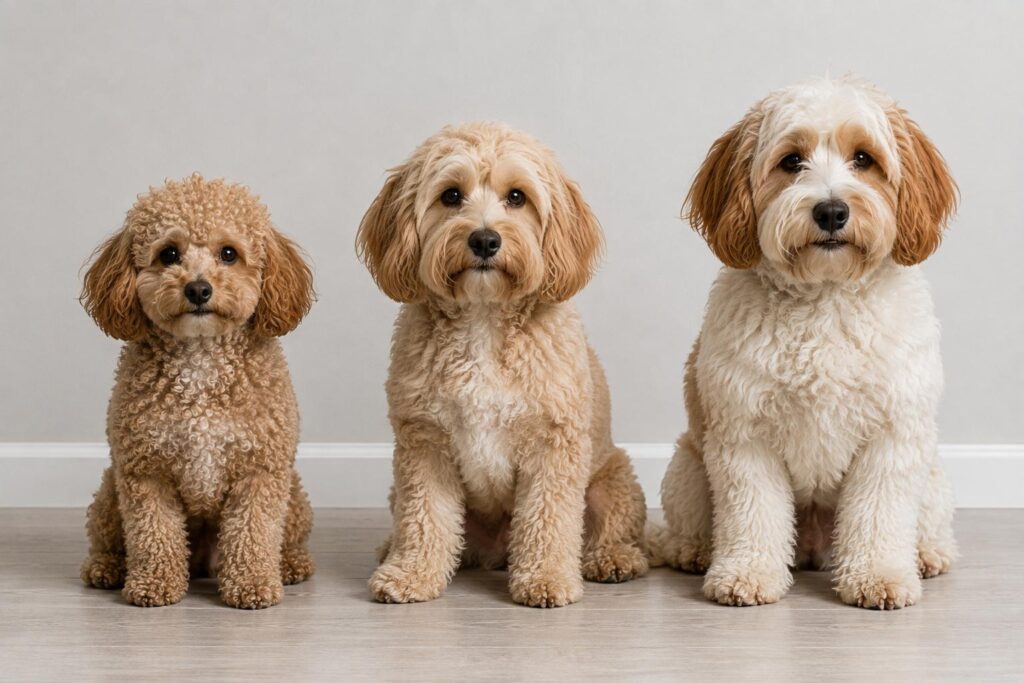
Adult Height and Weight
Cavapoochons are generally small companion dogs, but there is no official Cavapoochon size standard. Estimates around 4–11 kg (9–24 lb) are commonly reported, with Toy-Poodle-influenced lines tending toward the smaller end and Miniature-Poodle-influenced lines potentially growing larger.
Use any predicted adult weight as a range, not a promise. Parent size and previous adult dogs from the same breeding lines are usually more informative than a marketing label such as “mini.”
Why Littermates Can Mature Differently
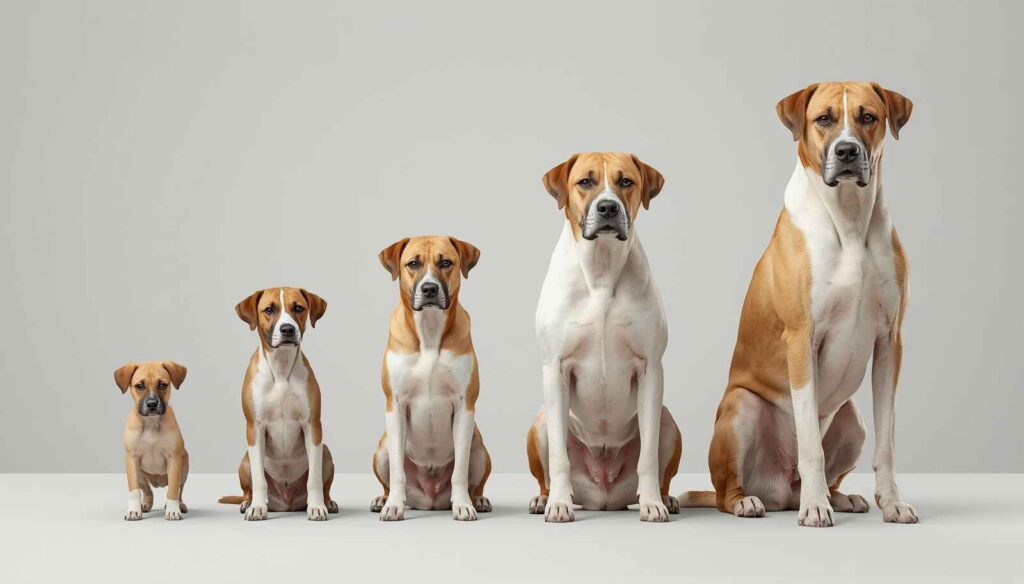
Two puppies from the same litter can finish at noticeably different sizes or develop different coat textures. Each puppy inherits a different combination of genes from its parents.
So if one littermate stays tiny and tightly curled, that does not mean every puppy from the litter will mature the same way.
When They Usually Stop Growing
Small dogs often complete most of their height growth during the first year, although body shape, muscle and overall maturity can continue developing afterwards.
Rather than using a fixed age as a deadline, monitor your dog’s growth with your veterinarian, particularly if weight gain seems unusually rapid or body condition is becoming difficult to maintain.
“Mini,” “Toy,” “Micro” and Other Size Labels
Be cautious with labels such as “micro,” “teacup” or “tiny.” These are not official Cavapoochon size categories.
A breeder promising an unusually small adult dog should be willing to explain the size and health of the parents rather than relying on a marketing term. Choosing for extreme smallness alone can also distract from more important priorities such as sound structure, temperament and health screening.
| Feature | Reasonable Expectation | What Can Vary |
|---|---|---|
| Adult size | Small companion dog | Parent size and breeding line |
| Coat | Wavy to curly | Texture may change with maturity |
| Shedding | Often low | Not guaranteed |
| Colour | Several possible shades | Some colours may lighten or change |
| Temperament | Often people-oriented | Genetics, socialisation and environment all matter |
Coat Reality Before You Fall in Love With the Look
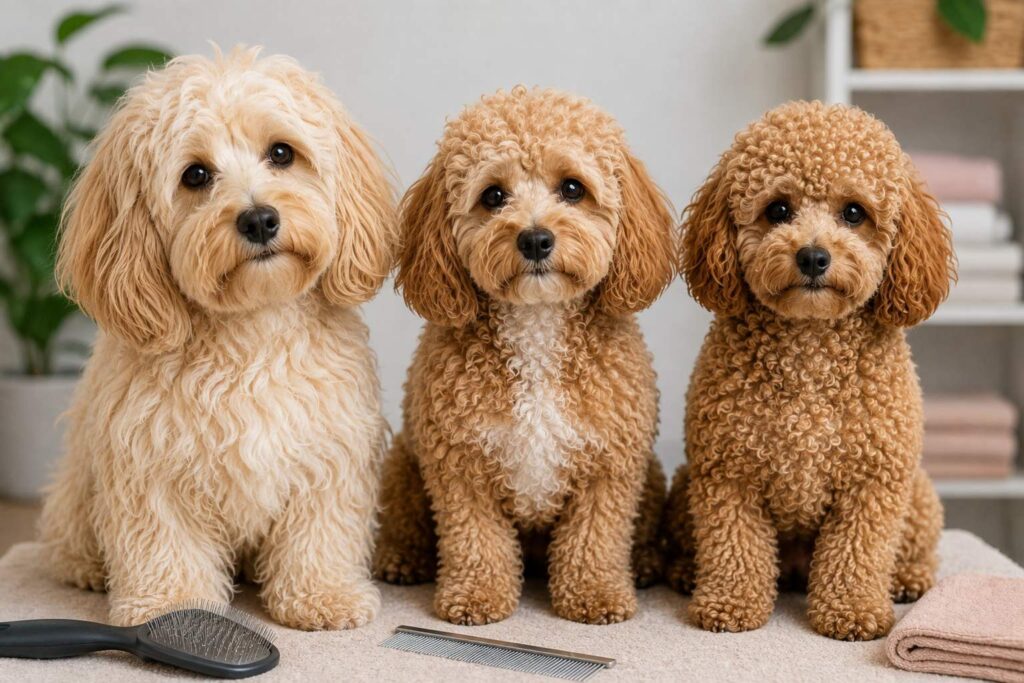
Wavy, Curly and In-Between Coats
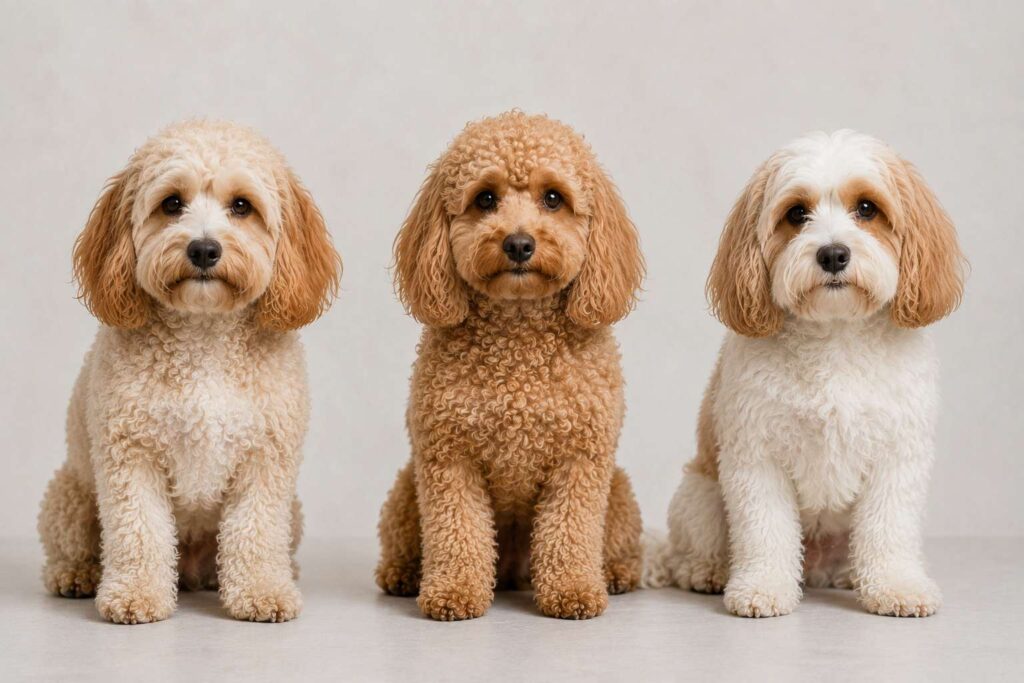
Cavapoochon coats can range from loose waves to tighter curls. Some dogs resemble their Poodle ancestry more strongly, while others develop a softer, looser coat.
A puppy’s appearance gives clues, but it cannot perfectly predict the adult coat.
Can the Puppy Coat Change?
Yes. As the softer puppy coat is replaced by the adult coat, texture, density and ease of grooming can change. A puppy that was simple to brush may require much more coat maintenance later.
This is one reason to start brushing, combing and handling practice during puppyhood, before mats become a problem.
Do Cavapoochons Shed?
Many Cavapoochons shed relatively little, but low shedding is not the same as no shedding.
The amount varies between individuals, and there is no reliable way to guarantee that a young puppy will mature into a completely non-shedding adult.
Are They Really Hypoallergenic?
No dog can be guaranteed hypoallergenic. The American Academy of Allergy, Asthma & Immunology (AAAAI) explains that there are no truly hypoallergenic dog breeds and that pet-allergy reactions can be triggered by proteins found in dander, skin flakes, saliva and urine — not simply by loose hair. Some people may tolerate an individual dog better than another, but coat type alone cannot guarantee that someone won’t react. If a family member has significant dog allergies or asthma, discuss the issue with their healthcare professional and spend meaningful time around the specific dog or closely related adult dogs before committing.
Why Low Shedding Can Mean More Grooming
This catches many first-time owners by surprise. In curly or wavy coats, loose hair can remain trapped instead of dropping easily onto the floor. Without thorough brushing and combing, that trapped hair can contribute to tangles and mats close to the skin.
Low shedding may therefore reduce the hair you see around the house while increasing the grooming work required.
Warning: No Cavapoochon can be guaranteed hypoallergenic. A curly coat does not guarantee allergy safety, and low shedding does not mean low maintenance. Severe matting can pull painfully on the skin and should be treated as a welfare issue, not just a cosmetic problem.
The Daily Personality You’re Likely to Live With
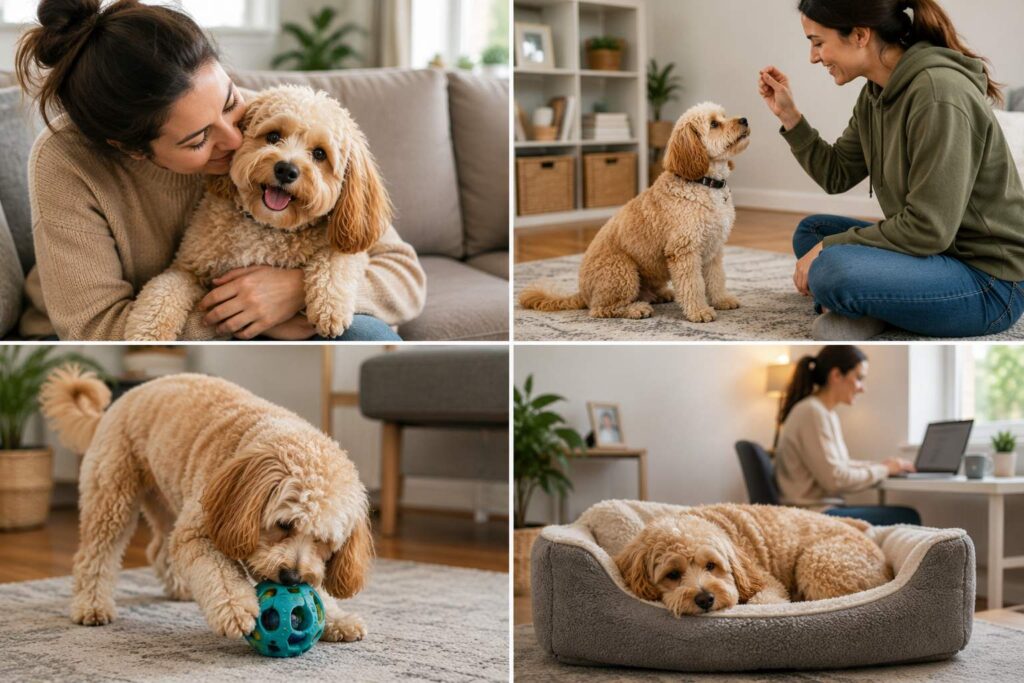
Cavapoochons are often described as affectionate, sociable companion dogs that enjoy being close to their people. That can make them rewarding household pets, but individual temperament still depends on the parents, early experiences, socialisation and training.
Strong attachment also means independence should be taught rather than assumed. A puppy that is never given calm, positive opportunities to relax away from its owner may struggle when everyday life eventually requires separation. Start with brief, manageable periods and build gradually rather than suddenly expecting an older puppy to cope with a full working day alone.
Poodle ancestry can contribute trainability and problem-solving ability, while all three parent breeds have been selected largely for close interaction with people. Reward-based training usually suits this type of dog well, but intelligence does not mean training happens automatically. Toilet training, recall, calm greetings and settling still require consistency.
Some Cavapoochons become enthusiastic alert barkers when someone approaches the home or when exciting things happen outside. Others are relatively quiet. Early training matters because barking that repeatedly gets attention or access to something rewarding can become a habit.
Around strangers and unfamiliar environments, avoid assuming that a naturally friendly-looking puppy will automatically become a confident adult. Positive, controlled socialisation during puppyhood still matters.
Household Fit Matters More Than “Good Family Dog”
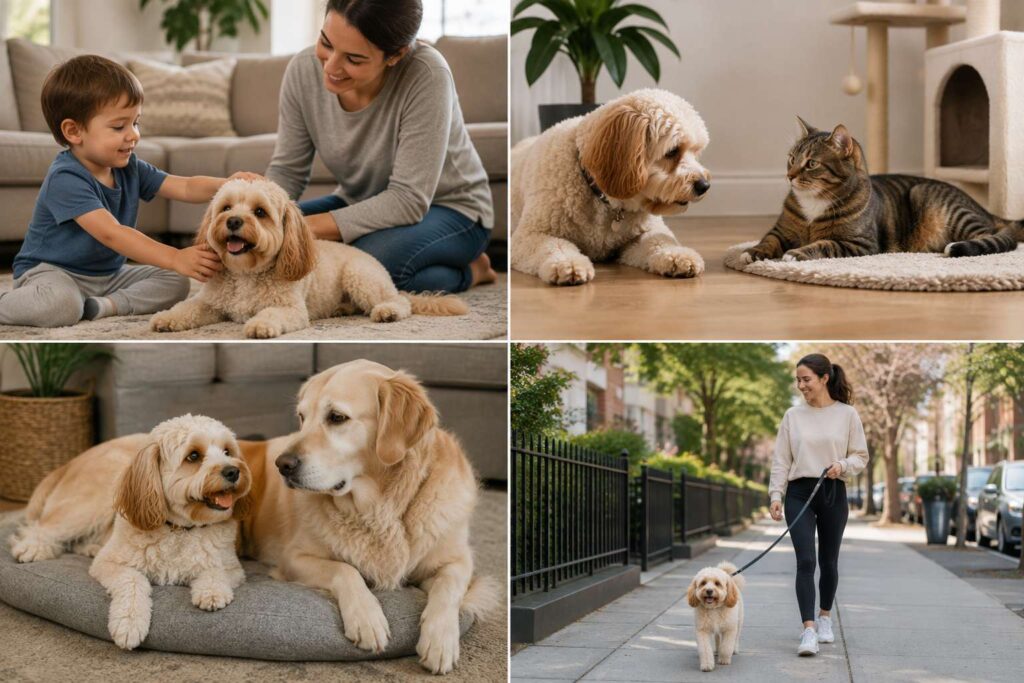
Families With Young Children
A Cavapoochon can fit well into family life, but “good with children” should never be treated as a guarantee.
Young children should be supervised around any dog. Small puppies can be injured by grabbing, dropping or rough handling, while even a tolerant dog needs somewhere quiet to retreat without being followed.
Teach children to let the dog approach them, avoid disturbing it while eating or sleeping, and keep interactions calm.
Living With Cats and Other Dogs
Many Cavapoochons can live successfully with other pets, particularly when introductions are gradual and positive.
Compatibility depends more on the individual animals than the breed label. A resident cat that dislikes dogs, for example, will not automatically accept a Cavapoochon because the puppy is small or friendly.
Apartment Living
Their smaller size can make Cavapoochons practical apartment dogs, but floor space is only part of the equation.
Daily exercise, toilet access, mental stimulation, barking management and the ability to settle calmly indoors matter more than whether the home has a large garden.
Full-Time Workers
This deserves careful thought. A people-oriented dog may struggle in a household that is routinely empty for most of the day, particularly during puppyhood.
If everyone is away for long working hours, consider whether you can realistically provide appropriate toilet breaks, exercise and companionship through arrangements such as a trusted dog walker or suitable daytime care. Daycare is not automatically appropriate for every dog, so choose care based on the individual’s temperament rather than using it as a one-size-fits-all solution.
First-Time Owners
A Cavapoochon can suit a committed first-time owner, especially someone comfortable with reward-based training and close companionship. But small size should not be mistaken for easy ownership.
Before choosing one, be comfortable with:
- regular coat maintenance and professional grooming;
- daily exercise and mental enrichment;
- gradual independence training;
- early socialisation;
- routine dental care;
- ongoing veterinary costs; and
- the fact that adult size, coat and temperament cannot be predicted with complete certainty.
For a first-time owner, the better question isn’t “Is a Cavapoochon easy?” It’s “Do its grooming, companionship and training needs fit the life I can realistically provide?”
Training Priorities That Matter More Than Tricks
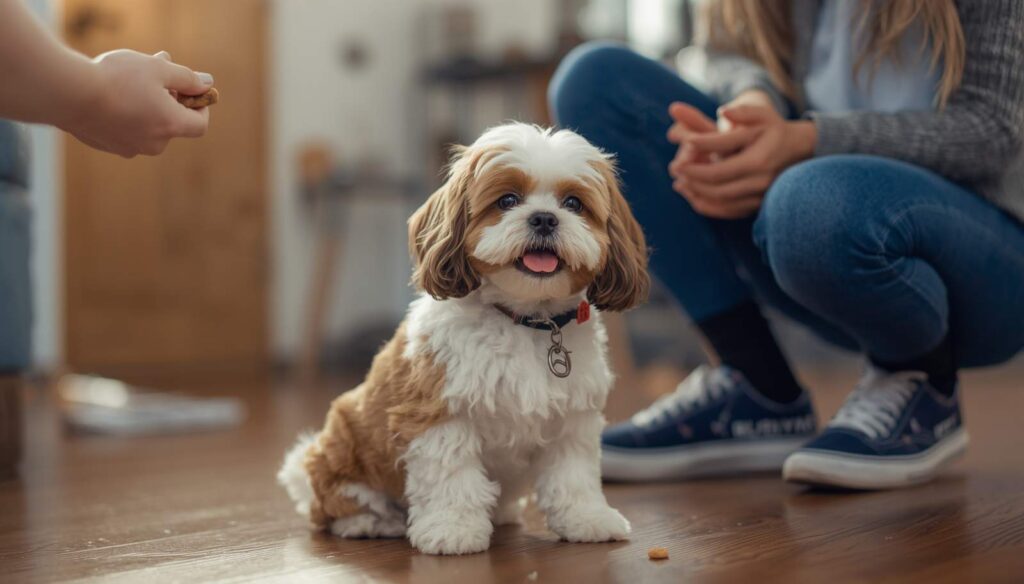
Toilet training and basic manners usually respond well to short, consistent, reward-based sessions. With a young puppy, several brief sessions woven into everyday life are generally more useful than one long period of repetitive drilling.
One training priority that’s easy to overlook is calm independence. Practise short, comfortable periods apart from puppyhood and increase them gradually. The aim isn’t to make the dog unusually independent, but to teach that being alone for manageable periods is normal and safe. If a puppy becomes distressed rather than simply mildly unsettled, shorten the separation instead of repeatedly leaving it to “cry it out.”
Cooperative grooming training is just as important. Get your puppy comfortable with having their paws, ears, mouth, face and coat handled before they actually need a complicated grooming session. Pair brushing, combing, nail handling and gentle face touching with rewards so routine care doesn’t become a struggle later.
Avoid harsh corrections or punishment-based methods. Reward-based training gives the dog a clear way to succeed without adding unnecessary fear or conflict.
How Much Exercise Does a Cavapoochon Actually Need?
Most adult Cavapoochons have moderate exercise needs, but there isn’t one reliable daily number that suits every dog. Age, size, health, fitness and individual energy level all matter. For many adults, a couple of walks combined with play and enrichment will be more appropriate than trying to hit a rigid exercise target.
Puppies need a different approach. Their activity should consist largely of short walks, free movement, play, exploration and plenty of rest, rather than long forced walks or repetitive high-impact exercise. If you’re unsure how much activity is appropriate while your puppy is growing, ask your veterinarian for advice based on their age, body size and development.
Physical exercise is only half the picture. Mental stimulation matters too. Sniffing walks, food puzzles, scent games and short training sessions can help keep an intelligent companion dog occupied without simply adding more mileage.
A dog that is chewing, barking or struggling to settle isn’t automatically “under-exercised,” though. Those behaviours can also be related to stress, overtiredness, frustration or separation problems, so don’t assume that more exercise is always the solution.
Grooming Is Part of the Ownership Cost
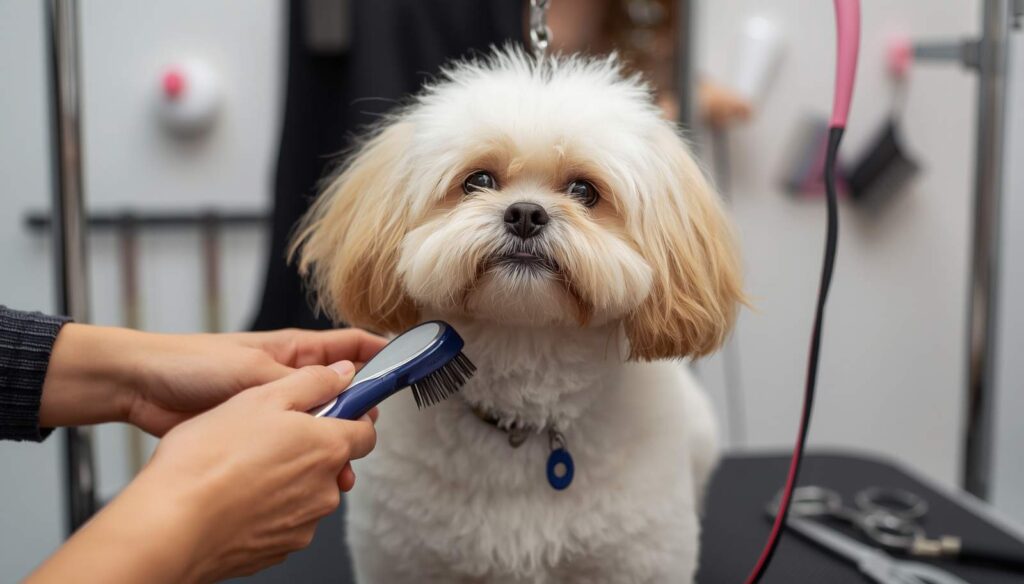
This is one area prospective owners should budget for before bringing a puppy home.
| Task | Typical Frequency | Usually Done |
|---|---|---|
| Brushing and combing | Several times a week; often more for dense or curly coats | At home |
| Coat clipping | Often every 6–8 weeks, depending on coat and style | Professional groomer |
| Nail trimming | As needed | Home, groomer or veterinary clinic |
| Tooth brushing | Ideally daily, or as frequently as practical | At home |
| Ear checks | Regularly | At home; veterinarian if abnormal |
The key detail many new owners miss is that brushing has to reach through the coat, not simply smooth the surface. A coat can look tidy on top while tangles are developing close to the skin.
A metal comb can be useful after brushing: if it won’t move comfortably through the coat from near the skin outward, more detangling may be needed. Don’t repeatedly pull at tight mats, especially around sensitive areas such as the ears, armpits or groin.
Severe matting can pull on the skin, trap moisture and make normal movement uncomfortable. Once mats are tight against the body, professional clipping is often kinder than trying to brush them out at home. Seek veterinary help if you find sores, swelling, discharge, significant redness or obvious pain beneath the coat.
Drop ears also deserve routine attention. Check for redness, unpleasant odour, discharge, excessive scratching or head shaking. Don’t routinely put cleaners or home remedies into a healthy ear unless your veterinarian has recommended them, because persistent ear problems need a diagnosis rather than repeated cleaning.
Dental care is easy to underestimate in a small companion dog. Starting tooth brushing while your Cavapoochon is young can make lifelong oral care much easier.
Health Risks Should Be Traced Back to the Parent Breeds
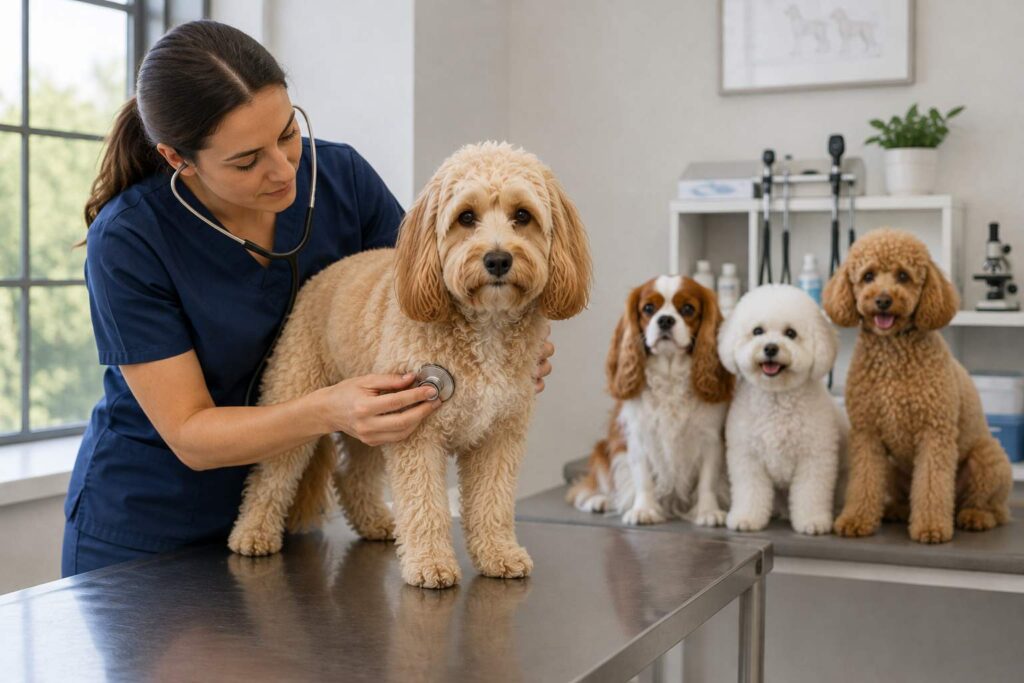
A crossbred dog isn’t automatically healthier than a purebred dog, nor does crossing breeds erase inherited conditions. The most useful approach is to look at the health risks and recommended screening relevant to each parent line.
From the Cavalier King Charles Spaniel side, important concerns include mitral valve disease, as well as Chiari-like malformation and syringomyelia, which can be associated with pain and neurological signs. The Kennel Club identifies mitral valve disease and Chiari-like malformation/syringomyelia as important health priorities for the Cavalier King Charles Spaniel. Certain inherited eye disorders and breed-specific genetic conditions may also be relevant depending on the breeding line.
From the Poodle side, inherited eye disease such as progressive retinal atrophy (PRA) is important to consider. Orthopaedic problems can also occur in small Poodle lines, including patellar luxation. Crucially, not every condition is assessed in the same way: some inherited disorders have DNA tests, while others require physical examination, eye examination, cardiac assessment or imaging.
Bichon Frise ancestry can also bring relevant eye, skin and orthopaedic considerations. Across small companion dogs more generally, dental disease, excess weight, ear problems and kneecap issues are practical concerns worth monitoring throughout life.
That distinction matters when assessing a breeder. A statement such as “both parents are DNA tested” does not necessarily mean every important health risk has been screened. Ask which specific tests and clinical examinations were performed on the actual parents and request the results rather than relying on a general “health tested” claim.
Vet Advice: Contact your veterinarian if your Cavapoochon develops persistent coughing, reduced exercise tolerance, collapse, unexplained pain or yelping, unusual neck sensitivity, weakness, changes in coordination, significant eye changes or recurrent ear problems. These signs have many possible causes and shouldn’t be diagnosed at home.
Being a mix of three breeds doesn’t cancel inherited risk; it changes the combination of risks that may be relevant. Good parent selection, appropriate health screening, preventive veterinary care and maintaining a healthy body condition are more useful safeguards than assuming crossbreeding alone provides protection.
DNA Testing, Health Testing and Vet Screening Aren’t the Same Thing
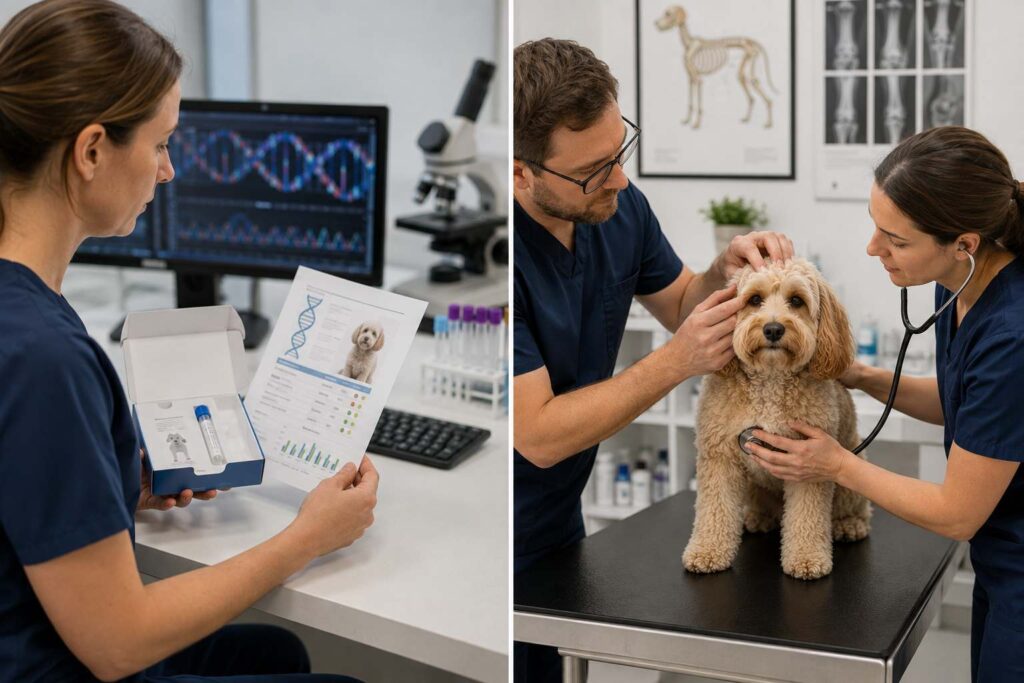
This distinction trips up a lot of puppy buyers. DNA testing identifies specific genetic variants; clinical health screening looks for conditions that cannot be ruled out with a cheek swab or blood test alone.
For example, heart examinations, eye assessments and orthopaedic evaluations may be needed for conditions relevant to Cavalier, Poodle or Bichon ancestry. A breeder showing a DNA certificate may therefore have completed one useful part of health screening without covering the whole picture.
| Breeder Claim | What to Actually Ask For |
|---|---|
| “Health tested” | The specific tests and results for each parent |
| “DNA clear” | Exactly which genetic variants were tested |
| “Healthy parents” | Relevant documented clinical screening results |
| “Hypoallergenic puppies” | Treat this as a marketing claim, not a guarantee |
| “Guaranteed tiny adult size” | Actual parent sizes and a realistic estimated range |
Whenever possible, make sure the results belong to the actual sire and dam of the litter, rather than accepting generic certificates from other dogs in the breeder’s programme.
When Veterinary Advice Shouldn’t Wait
Most Cavapoochon care is routine, but some symptoms deserve prompt veterinary advice rather than a prolonged “wait and see” approach.
Contact a veterinarian promptly for:
- difficulty breathing;
- collapse or sudden weakness;
- persistent or worsening coughing;
- unexplained pain or repeated yelping;
- unusual neck sensitivity or changes in coordination;
- sudden or significant eye changes; or
- severe ear or skin pain.
Breathing difficulty, collapse, severe weakness or rapidly worsening symptoms can be emergencies. If you’re unsure how urgent something is, contact your veterinary clinic or an emergency veterinary service and describe exactly what you’re seeing.
Feeding and Weight Without Obsessing Over a Number
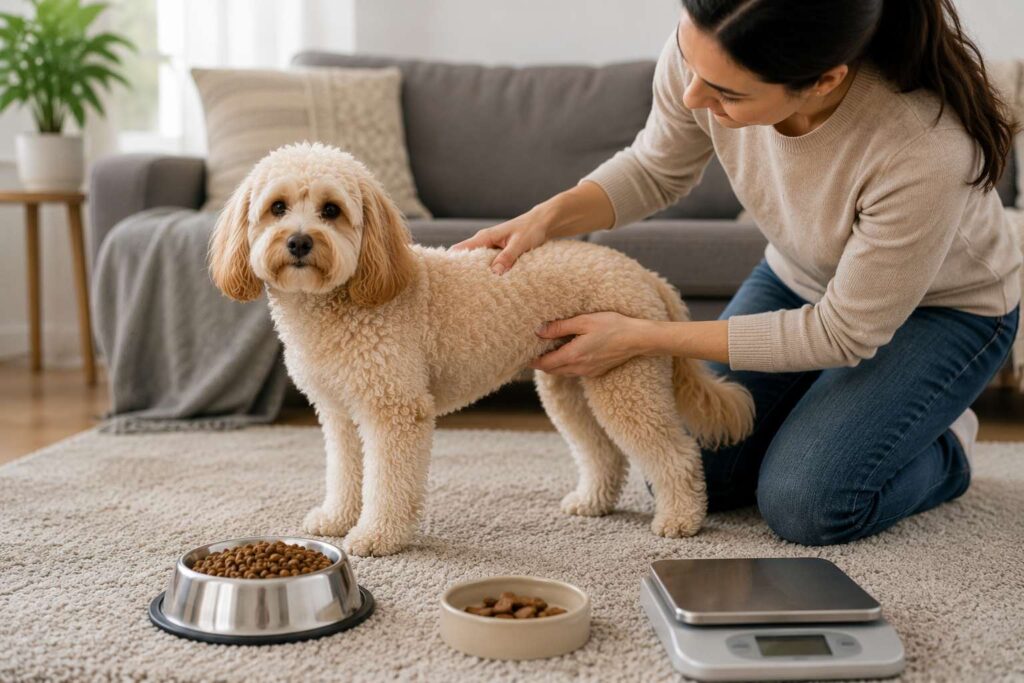
Choose a complete and balanced diet appropriate for your dog’s life stage. Puppies need food formulated to support growth, while adults should move onto an appropriate adult diet once growth is complete.
Don’t judge food quality simply by whether meat appears first on the ingredient list. The overall nutritional formulation, calorie content, quality control and whether the diet meets recognised nutritional standards matter more than ingredient-list marketing.
Treats and extras should remain a small part of the overall diet. Small dogs need fewer calories than many owners expect, so seemingly tiny extras given throughout the day can add up quickly.
Body condition is more useful than chasing an “ideal Cavapoochon weight” because adult size varies. In a healthy body condition, you should generally be able to feel the ribs without pressing hard and see a waist when viewed from above. Ask your veterinarian to show you how to assess body condition if you’re unsure.
The Real Cost of Owning One
Budget for more than the purchase price. Regular expenses can include:
- professional grooming;
- food and treats;
- routine veterinary care and vaccinations;
- parasite prevention where appropriate;
- dental care;
- training;
- insurance; and
- unexpected veterinary treatment.
Grooming is particularly easy to underestimate. A coat that needs clipping throughout life creates a recurring expense, not a one-off puppy cost.
Dental treatment can also become significant in small companion dogs, making preventive home care worth establishing early.
Cavapoochon vs Similar Crosses
| Trait | Cavapoochon | Cavapoo | Cavachon |
|---|---|---|---|
| Main ancestry | Cavalier + Bichon + Poodle | Cavalier + Poodle | Cavalier + Bichon |
| Coat predictability | Variable | Variable | Variable |
| Shedding tendency | Often low, not guaranteed | Often low, not guaranteed | More variable |
| Grooming demand | Usually high | Usually high | Moderate to high |
| Size predictability | Variable | Variable | Variable |
The biggest structural difference is the ancestry. A Cavachon combines Cavalier and Bichon without Poodle ancestry, while a Cavapoo combines Cavalier and Poodle without the Bichon component.
That doesn’t mean one is automatically healthier, easier or better for allergies. The individual parents, coat, temperament, health screening and household fit matter more than the name attached to the cross.
Before You Reserve a Puppy, Check the Breeder
A responsible breeder should be able to explain the parents’ temperament and health history, show relevant health-screening results, describe how the puppies are being raised and socialised, and answer questions without rushing you into a decision.
You should normally be able to see the puppy with its mother where appropriate. The sire may live elsewhere, but the breeder should still be able to identify him and provide relevant information and health results.
Registration or pedigree paperwork can provide ancestry information, but paperwork alone does not prove good health, sound temperament or responsible breeding practices.
Buyer Checklist
Before paying a deposit, check that you:
- have seen the puppy with its mother where possible;
- know the identity and adult size of both parents;
- know whether Toy or Miniature Poodle ancestry is involved;
- have seen relevant health-screening results for the actual parents;
- understand that predicted adult size is an estimate;
- know the adult coat may differ from the puppy coat;
- understand low shedding is not guaranteed;
- have received appropriate veterinary and vaccination information;
- have asked how the puppies are being socialised and handled;
- have reviewed the written contract; and
- feel able to ask questions without being pressured to buy.
Breeder Red Flags Worth Walking Away From

Be cautious if a breeder:
- guarantees a “100% hypoallergenic” puppy;
- guarantees an exact adult weight;
- heavily markets “micro,” “teacup” or extreme tiny sizing;
- cannot provide relevant parent health documentation;
- presents a basic DNA panel as complete health screening;
- won’t clearly identify the parents;
- keeps many litters with little transparency about how puppies are raised;
- pressures you to send money immediately; or
- places rare colour or unusually small size ahead of health and temperament.
Some concerns need context, but claims such as guaranteed hypoallergenic status or guaranteed adult size should never be treated as reliable biological promises. Several red flags together are a strong reason to walk away.
Common Mistakes New Owners Make
Common mistakes include:
- choosing a puppy mainly for appearance or colour;
- assuming adult size is guaranteed;
- believing a curly coat means allergy-safe;
- delaying grooming until mats develop;
- brushing only the surface of the coat;
- failing to teach comfortable independence;
- treating chaotic dog-to-dog interaction as “socialisation”;
- underestimating mental enrichment;
- neglecting dental care;
- assuming a small dog needs very little exercise;
- accepting breeder size predictions without checking the parents; and
- reserving a puppy before reviewing parent health screening.
Is a Cavapoochon Actually Right for Your Life?
Before committing, ask yourself:
- Can I keep up with frequent brushing and regular professional grooming?
- Can I afford the lifelong grooming cost?
- Will the dog receive enough companionship without being taught to depend on constant attention?
- Can I practise gradual independence from puppyhood?
- Am I comfortable with some uncertainty in adult size, coat and shedding?
- Can I budget for routine veterinary care, dental care and unexpected illness?
- Can I provide daily exercise, training and mental enrichment?
- Will interactions with young children be supervised?
- Am I prepared to verify breeder health claims rather than accepting them at face value?
If most answers are yes, a Cavapoochon may fit your lifestyle well. If one or two areas are difficult, practical changes such as arranging midday care or budgeting for a regular groomer may solve the problem.
If the grooming commitment, companionship needs or uncertainty around mixed-breed traits already feel frustrating, another dog may be a better fit. Choosing the right dog is more important than choosing the breed name you originally had in mind.
Final Thoughts
A Cavapoochon can be an affectionate, engaging and highly trainable companion, but the name alone cannot tell you exactly what adult dog you’ll get.
Look beyond the puppy photo. Pay attention to the actual parents, health screening, temperament, expected grooming workload and how the dog fits your everyday routine.
Before paying a deposit, verify the evidence behind the breeder’s claims and make sure you’re comfortable with the realities of ownership as well as the appealing teddy-bear appearance.
Frequently asked questions
1.Is a Cavapoochon an officially recognised breed?
No. The Cavapoochon is a crossbreed rather than a standardised pedigree breed recognised by major kennel clubs. That is one reason characteristics such as size, coat and appearance can vary considerably.
2.What does F1 or F1b mean for a Cavapoochon?
These terms describe generations of crossbreeding, but their use with three-breed crosses such as the Cavapoochon is not always consistent between breeders.
Rather than relying on the label alone, ask the breeder to show you exactly which dogs were crossed to produce the litter.
3.Why did my Cavapoochon grow larger than expected?
Natural genetic variation and the sizes of the dogs in the pedigree can both affect adult growth. Toy versus Miniature Poodle ancestry may also influence expected size.
A breeder’s prediction should always be treated as an estimate rather than a guarantee.
4.Do Cavapoochon colours fade with age?
They can. Some dogs develop lighter or altered coat colouring as the adult coat comes through. A gradual colour change on its own is usually a cosmetic change rather than a sign of illness.
Sudden hair loss, skin changes or abnormal coat quality are different and should be discussed with your veterinarian.
5.Can Cavapoochons be left alone during the day?
Adult dogs vary considerably. Many Cavapoochons enjoy close human company, so independence should be introduced gradually rather than expecting a puppy to cope immediately with long periods alone.
Regular, long, uninterrupted working days may require arrangements such as an appropriate dog walker or other suitable daytime care.
6.How often do Cavapoochons need professional grooming?
Many need professional grooming approximately every 6–8 weeks, although the ideal interval depends on coat texture, length, lifestyle and how well the coat is maintained at home.
Brushing and combing are still required between appointments.
7.Are Cavapoochons healthier than purebred dogs?
Not automatically. Genetic diversity can influence disease risk, but a Cavapoochon can still inherit health problems associated with Cavalier, Poodle or Bichon ancestry.
The more useful question is whether the actual breeding parents received appropriate health screening for the conditions relevant to their lines.
#. Related Articles: