
The short answer is: yes, most dogs can eat cheese — but it comes with some important caveats. Not all cheeses are created equal, not all dogs digest dairy the same way, and portion size matters more than most owners realise.
This guide covers everything — which cheeses are safe, which to avoid, how much is too much, what to do if your dog goes overboard, and the real reason vets have mixed feelings about it.
Is Cheese Actually Safe for Dogs?
Cheese isn’t toxic to dogs. That’s the good news. But “not toxic” doesn’t automatically mean “a great snack.” Dogs are not designed to digest large amounts of dairy, and cheese is high in fat, salt, and calories — all of which can cause problems if you’re not careful.
Think of cheese like a treat, not a food group. A small cube of cheddar as a reward during training? Totally fine for most dogs. Half a block of brie as an afternoon snack? That’s where things get messy — literally.
The simple rulePlain, low-fat, low-sodium cheese in small amounts = generally fine. Rich, salty, or flavoured cheeses in large amounts = a problem waiting to happen.
Why Some Dogs Can’t Handle Cheese
Lactose intolerance in dogs
Dogs produce much less lactase (the enzyme that breaks down lactose) than humans do. Puppies produce more of it — which is why they can digest their mother’s milk — but adult dogs have significantly reduced lactase levels.
This means many adult dogs are at least mildly lactose intolerant. They won’t necessarily keel over after a bite of cheese, but they may experience gas, bloating, loose stools, or an upset stomach — especially with softer, higher-lactose cheeses.
Hard cheeses like cheddar and parmesan actually have much lower lactose content than soft cheeses. The ageing process breaks down most of the lactose, which makes them easier on your dog’s digestive system.
High fat content and pancreatitis risk
This is the bigger concern that many guides gloss over. Cheese is high in saturated fat. Dogs — particularly certain breeds like Miniature Schnauzers, Cocker Spaniels, and Cavalier King Charles Spaniels — are prone to pancreatitis, a painful and potentially serious inflammation of the pancreas triggered by high-fat meals.
If your dog has a history of pancreatitis or digestive sensitivity, skip the cheese entirely and use a lower-fat treat instead.
Breed noteSmall breeds and breeds prone to weight gain (Dachshunds, Pugs, Beagles) should have even stricter cheese limits. Their calorie budget is tiny, and cheese is calorie-dense.
Which Cheeses Are Safe for Dogs?
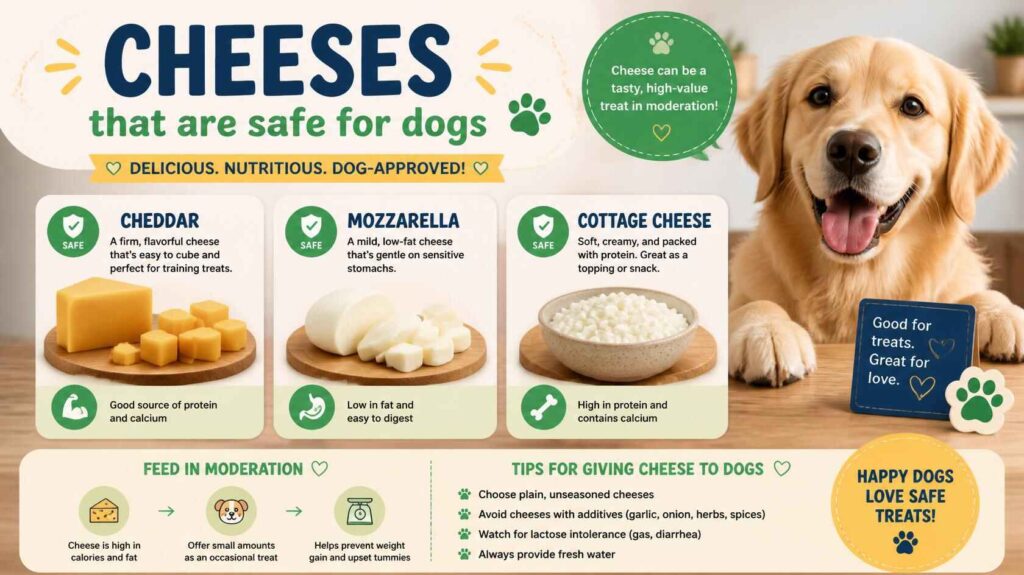
Here’s a practical breakdown. The “safe” options are generally lower in fat, salt, and lactose. The “avoid” ones contain ingredients that are genuinely harmful.
Safe Cottage Cheese -> Low in fat and lactose. Gentle on digestion. One of the best options for dogs.
Safe Mozzarella -> Low in salt and relatively low fat. Good for occasional use as a training treat.
Safe Cheddar (mild) -> Aged hard cheese = low lactose. Stick to mild varieties with lower salt content.
Safe Ricotta -> Soft, mild, and lower in salt than many cheeses. Use sparingly due to fat content.
Caution Parmesan -> Low lactose (aged) but very high in sodium. Only tiny amounts, infrequently.
Caution Feta -> High sodium content. A nibble won’t hurt a healthy dog but avoid regularly.
Avoid Blue Cheese / Stilton -> Contains roquefortine C — a mould compound that can cause seizures in dogs.
Avoid Brie / Camembert -> Very high fat, soft rind contains moulds. Can cause digestive upset and pancreatitis.
Avoid Flavoured Cheeses -> Garlic, chives, onion — all toxic to dogs. Always check the ingredients.
Important: Blue cheese is not just “bad” — it’s dangerousStilton, Roquefort, Gorgonzola and similar blue cheeses are produced using Penicillium moulds. These can produce roquefortine C, a toxin that can cause vomiting, diarrhoea, high temperature, and even seizures in dogs. Even a small amount can cause serious problems. This is one cheese to keep completely out of reach.
How Much Cheese Can a Dog Have?
Treats — including cheese — should make up no more than 10% of your dog’s daily calorie intake. In practice, that’s smaller than most people think.
| Dog Size | Example Breeds | Max Daily Cheese | Rough Serving |
|---|---|---|---|
| Small (under 10 kg) | Chihuahua, Pug, Shih Tzu | 1–2 small cubes | ~10–15g |
| Medium (10–25 kg) | Cocker Spaniel, Staffy, Beagle | 2–3 cubes | ~20–30g |
| Large (25–40 kg) | Labrador, Boxer, Border Collie | 3–4 cubes | ~30–40g |
| Giant (over 40 kg) | Great Dane, Bernese | 4–5 cubes | ~40–50g |
These are upper limits, not targets. Cheese should be a special treat — not a daily habit. Give it a few times per week at most, and always factor it into your dog’s total daily food intake.
Practical tip
For training sessions, break the cheese into tiny pea-sized pieces. Your dog doesn’t know the difference in size — they care about the frequency of reward. Smaller pieces mean more rewards for the same amount of cheese, which is better for training and better for their waistline.
Can Puppies Eat Cheese?
Yes, puppies can have small amounts of cheese — but even more cautiously than adult dogs. Their digestive systems are still developing, and a sudden introduction of rich, fatty food can cause stomach upset.
If you want to use cheese as a training reward for a puppy, start with a tiny piece of plain, low-fat cottage cheese or mild mozzarella. Wait 24 hours to see how they respond. If there’s no loose stool or vomiting, it’s likely fine in small quantities.
Avoid strong or aged cheeses for puppies — they’re too rich. And skip cheese entirely if your puppy is already on a sensitive stomach formula.

Signs Your Dog Has Had Too Much Cheese
Watch for these after giving your dog cheese — especially the first time, or after a larger amount than usual:
- Excessive gas or bloating — very common with higher-lactose cheeses
- Loose stools or diarrhoea — usually within a few hours
- Vomiting — more likely with rich, high-fat cheeses like brie or cream cheese
- Lethargy or loss of appetite — could indicate pancreatitis; contact your vet
- Trembling, seizures, or high temperature — these are emergencies, especially after blue cheese
Mild gas and loose stools after a first taste of cheese usually resolve on their own within 12–24 hours. Withhold cheese going forward and make sure your dog has access to plenty of fresh water.
When to call your vet immediatelyIf your dog ate a large amount of rich cheese, or any blue cheese, or a flavoured variety containing garlic or onion — don’t wait for symptoms to appear. Call your vet or the nearest emergency animal hospital straight away.
The Real Benefits: Why Cheese Works as a Training Treat
Despite all the cautions above, there are genuinely good reasons that dog trainers have used cheese for decades. It’s not just because dogs love it (though they really do).
- High value reward: Cheese has a strong smell and rich flavour that most dogs find irresistible — making it perfect for high-distraction training environments.
- Soft texture: Easy to break into tiny pieces, which is ideal for training when you need fast, frequent rewards.
- Hides medication: Wrapping a pill in a small piece of soft cheese is one of the most reliable ways to get a fussy dog to take medication.
- Nutritional value: In small amounts, cheese provides protein, calcium, phosphorus, and vitamins A and B12 — all genuinely useful for dogs.

Smarter Alternatives to Cheese
If your dog is overweight, lactose intolerant, or prone to pancreatitis, these alternatives deliver the high-value reward without the downsides:
- Cooked chicken or turkey pieces — high protein, low fat, dogs go mad for them
- Carrot sticks — low calorie, satisfying crunch, good for teeth
- Blueberries — antioxidant-rich, sweet, and a fraction of the calories
- Air-dried meat treats — commercially available and single-ingredient options abound
- Plain, unsalted rice cakes — low calorie and surprisingly popular with dogs
Frequently Asked Questions
1.My dog accidentally ate a lot of cheese — what should I do?
If it was a plain, mild cheese like cheddar or mozzarella, monitor your dog for the next 12–24 hours. Look out for vomiting, diarrhoea, or signs of abdominal pain (hunching, restlessness). Provide plenty of water. If it was blue cheese, heavily salted cheese, or anything containing garlic or onion — call your vet immediately without waiting for symptoms.
2.Can I use cheese to give my dog their medication?
Yes — this is one of the most effective and vet-approved uses of cheese for dogs. Wrap a pill in a small piece of soft mozzarella or mild cheddar and most dogs will swallow it without a second thought. Just check with your vet that the medication doesn’t need to be given on an empty stomach, as food can affect the absorption of some drugs.
3.Is vegan or dairy-free cheese safe for dogs?
Not automatically. Many vegan cheeses contain ingredients that are fine for humans but problematic for dogs — including garlic, onion powder, certain nuts (like cashews or macadamias), and artificial flavourings. Always check the full ingredient list before offering any vegan cheese to your dog. When in doubt, stick to a plain dog-safe treat instead.
4.Should overweight dogs avoid cheese completely?
Not necessarily completely, but it should be very limited or swapped for a lower-calorie alternative. If you need a high-value training treat, a tiny pinch of low-fat cottage cheese is the better option. But for daily rewards, plain cooked chicken or carrots are far more weight-friendly. Ask your vet to calculate your dog’s daily calorie allowance — it’s often much lower than owners expect.
5.How do I know if my dog is lactose intolerant?
The simplest way is to give a very small amount of a mild, low-lactose cheese (like a pea-sized piece of cheddar) and observe your dog for 24 hours. Symptoms of lactose intolerance include excessive gas, bloating, loose stools, or diarrhoea. If you see any of these, your dog likely doesn’t tolerate dairy well — stick to non-dairy treats. If there’s no reaction, small amounts of low-lactose cheese are probably fine.
6.Can dogs with kidney disease eat cheese?
This is one to take directly to your vet. Cheese is high in phosphorus, and dogs with kidney disease often need to follow a low-phosphorus diet. Even cheeses considered “safe” for healthy dogs may not be appropriate for a dog managing kidney problems. Your vet may recommend entirely avoiding dairy and can suggest kidney-friendly treat alternatives instead.
7.What’s the best cheese for dog training?
Mild, low-moisture mozzarella is a top pick for training — it’s low in salt, tears easily into tiny pieces, has a strong enough smell to be motivating, and dogs tend to love it. Mild cheddar is another solid option. Avoid anything crumbly or wet that’s hard to handle during a training session. And always break it into tiny pieces — think smaller than you think necessary.
The Bottom Line
Cheese is one of life’s small pleasures your dog can share with you — as long as you keep it plain, keep it small, and choose the right type. Stick to low-fat, low-salt options like mozzarella or mild cheddar. Keep portions to a few small cubes a day at most. Always check for hidden ingredients in flavoured varieties. And if your dog has any underlying health conditions, check with your vet before making cheese a regular part of their diet. Done right, a little cheese can make training more effective, pill-giving easier, and your dog’s day a little brighter.
#. Related Articles: