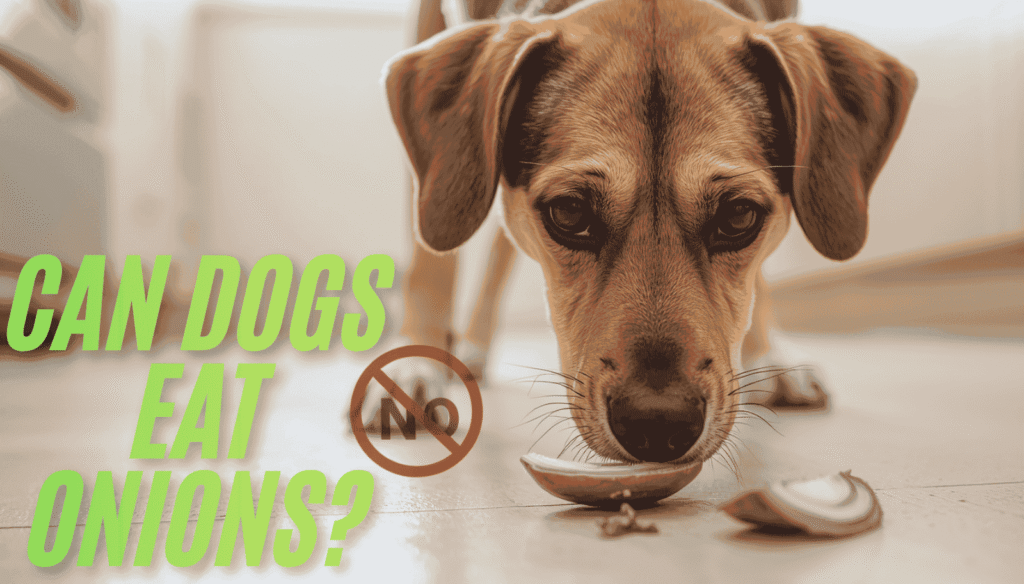
Can Dogs Eat Onions? No — onions should never be fed to dogs on purpose. Raw, cooked, fried, dried, and powdered onions can all pose a risk, including onion hidden in sauces, soups, gravies, seasonings, and takeaway food.
If you’re simply checking whether onion belongs in your dog’s diet, the answer is straightforward: leave it out.
If your dog has already eaten onion, however, the important questions are what was eaten, approximately how much, when it happened, and how your dog is doing now. Don’t rely on a normal appearance alone for reassurance, because onion-related red blood cell damage can develop before obvious signs of anaemia appear.
If your dog has eaten onion or an onion-containing food, contact your veterinarian or an appropriate veterinary poison service promptly for advice rather than waiting for symptoms to develop.
Your Dog Ate Onion: Start With the Exposure, Not the Symptom List
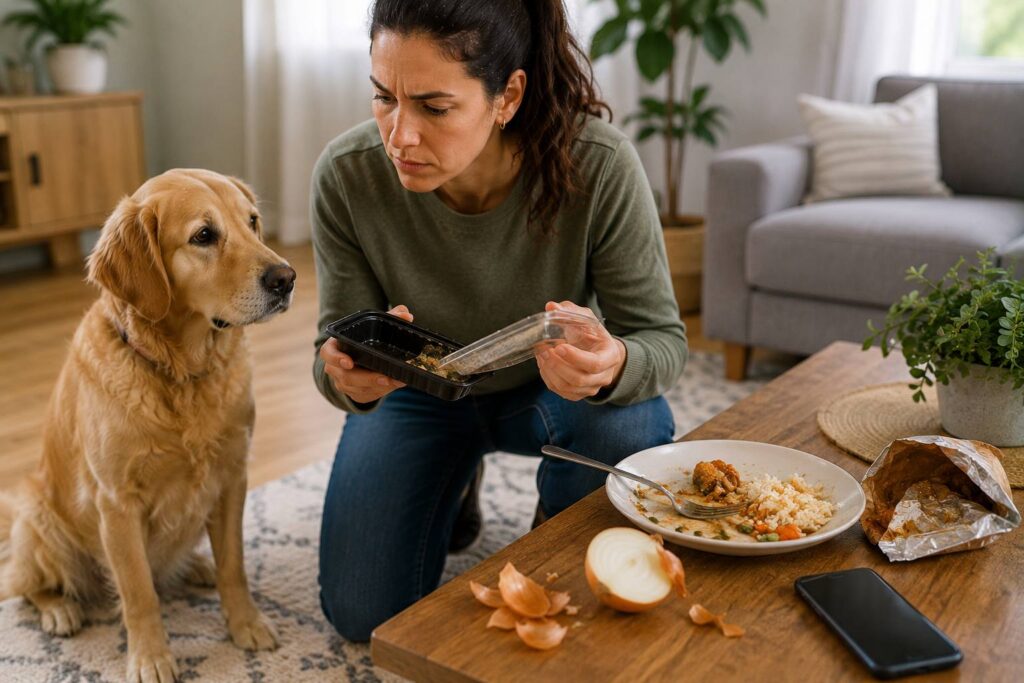
Before searching through symptom lists, get as clear a picture as possible of what happened. These are also the details a veterinarian is likely to find useful when assessing the exposure.
What Was Eaten?
Onion turns up in more forms than many owners expect:
- Fresh raw onion
- Cooked onion, including fried or sautéed onion
- Onion powder
- Dehydrated onion flakes
- Onion salt or seasoning blends
- Stock or soup mixes containing onion
- Sauce, gravy, curry, stuffing, or soup containing onion
- A prepared dish where the ingredients are uncertain
All of these are relevant. Cooking does not make onion safe for dogs, and concentrated dried or powdered products deserve particular attention because a relatively small amount can represent more onion material than its volume suggests.
How Much Can You Honestly Estimate?
Don’t invent a precise number just because it feels more useful.
There’s an important difference between:
- “I watched him eat approximately half an onion.”
- “He ate some of a meal that contained onion.”
- “The curry was on the counter and I don’t know how much he ate.”
If the amount is genuinely unknown, say unknown. That uncertainty is useful information for the veterinarian assessing the exposure.
If the food was homemade, it may help to work out approximately how much onion went into the entire recipe and roughly what fraction of the dish your dog ate. Keep those figures as estimates rather than treating them as exact measurements.
Who Ate It?
Have some basic information about your dog ready:
- Approximate body weight
- Age
- Relevant existing health problems
- Any current medications
- Anything unusual about their behaviour or health today
Body weight is important when assessing many toxic exposures, but it should not be used to create a DIY “safe amount” of onion.
When Did It Happen?

Was the onion eaten minutes ago, several hours ago, yesterday, or at an unknown time?
Timing matters because veterinary recommendations can differ depending on how recently the exposure occurred.
If the ingestion was recent, don’t try to induce vomiting yourself unless a veterinarian or veterinary poison professional specifically instructs you to do so. Home methods can create additional complications and are not appropriate for every dog or every situation.
What Else Was in the Food?
This step is easy to overlook.
A dog that steals a prepared human meal may have been exposed to more than onion. Check the full recipe or ingredient list for other potentially harmful ingredients, including:
- Garlic, leeks, chives, or other Allium ingredients
- Chocolate
- Grapes or raisins
- Xylitol in sugar-free products
- Alcohol
- Other ingredients your veterinarian may need to assess
Don’t assume the onion is automatically the only concern.
How Is Your Dog Acting Right Now?
Record what you can observe, whether your dog seems completely normal, mildly unwell, or clearly sick.
Potential signs following onion exposure can include gastrointestinal upset and, as red-blood-cell damage becomes clinically significant, signs such as:
- Vomiting or diarrhoea
- Reduced appetite
- Lethargy or unusual weakness
- Pale gums
- Faster breathing
- Increased heart rate
- Reduced willingness to exercise
- Red or brown urine
- Collapse in severe cases
A dog appearing normal shortly after eating onion does not rule out a problem. Clinically important anaemia can take time to develop.
Checklist: Information to Have Ready Before You Call
- Dog’s approximate weight
- What food or product was eaten
- Which form of onion was involved
- Estimated amount — or clearly state that it’s unknown
- Approximate time of ingestion
- Current symptoms, if any
- Other ingredients in the food
- Relevant health conditions or medications
- Packaging, ingredient label, recipe, or photo if available
Keeping the packet or photographing the ingredient list can be particularly useful when onion appears as part of a seasoning or prepared food.
“It Was Only in the Food” Is Where Onion Exposure Gets Complicated

Most real onion exposures aren’t a dog stealing a whole onion from a chopping board. They’re hidden inside ordinary human food, which makes the amount much harder to judge.
The Onion Pieces Were Removed
Picking visible onion pieces out of a meal does not make an onion-containing dish an appropriate food for a dog.
Onion may have been finely chopped, blended, cooked down, or incorporated into the surrounding sauce, stock, or gravy. What you can still see on the plate isn’t necessarily a good measure of what was used in the recipe.
The Recipe Used Onion but You Don’t Know How Much
Homemade curries, soups, gravies, stocks, sauces, and stuffing commonly contain onion that becomes difficult to identify once cooked.
If you made the meal yourself, useful information includes:
- Approximately how much onion went into the whole recipe
- Approximately how much food the recipe produced
- Roughly how much of the finished dish your dog ate
If you cannot estimate those things, tell the veterinarian that the amount is unknown rather than assuming the exposure was insignificant.
Restaurant or Takeaway Food
Takeaway and restaurant exposures are particularly difficult to calculate because you may not know:
- How much onion was used
- Whether onion powder or seasoning was added
- Whether garlic or other Allium ingredients were present
- What other potentially harmful ingredients were included
Don’t use how strongly the meal tasted of onion as a toxicity test. If necessary, keep the receipt, menu description, packaging, or ingredient information available when seeking veterinary advice.
Seasoning Can Be Easy to Miss
Onion isn’t always listed or served as obvious pieces.
Check for:
- Onion powder
- Dried or dehydrated onion
- Onion flakes
- Onion salt
- Stock cubes or powders
- Soup mixes
- Seasoning packets
- Spice blends containing onion
Concentrated products deserve careful attention. The useful distinction isn’t that powdered onion becomes a completely different poison; it’s that dry, concentrated forms can deliver onion-derived material in a much smaller volume than fresh onion.
Onion Form Changes the Assessment, Not the Basic Answer
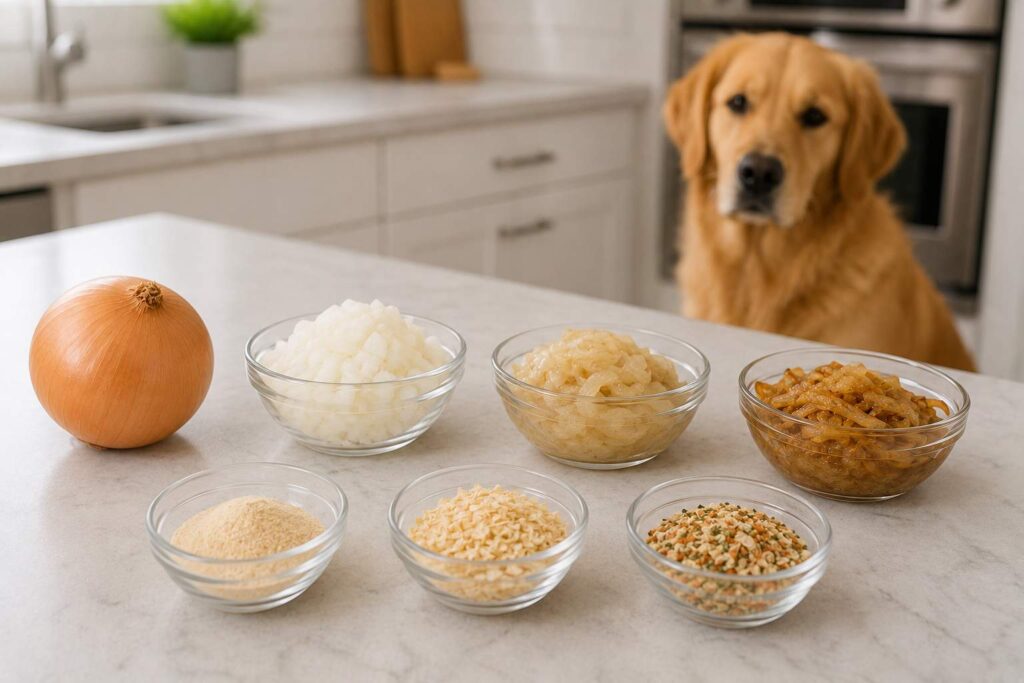
It’s tempting to rank onion products from “probably fine” to “definitely dangerous.” That’s not a reliable way to assess an exposure.
| Onion exposure | What owners may assume | What actually needs consideration |
|---|---|---|
| Raw onion | Only raw onion is dangerous | Amount eaten, dog’s weight, timing, and circumstances |
| Cooked onion | Heat made it safe | Cooking does not make onion safe for dogs |
| Fried or sautéed onion | Small cooked pieces don’t matter | Onion exposure plus other ingredients in the dish |
| Onion powder | A tiny amount must mean tiny risk | Concentration and amount consumed |
| Dried flakes | Less significant than fresh onion | Concentration and total exposure still matter |
| Sauce or gravy | Removing visible onion solved the problem | Onion may already be incorporated throughout the food |
| Seasoning blend | Onion is low on the ingredient list | The actual quantity consumed may be difficult to estimate |
| Unknown prepared meal | If I can’t calculate it, I can’t do anything | Tell the veterinarian that the quantity and recipe are uncertain |
The purpose isn’t to rank one form as “safe.” Raw, cooked, dried, and powdered onion all belong in the exposure assessment.
Why Onion Can Affect a Dog Even After the Meal Is Gone
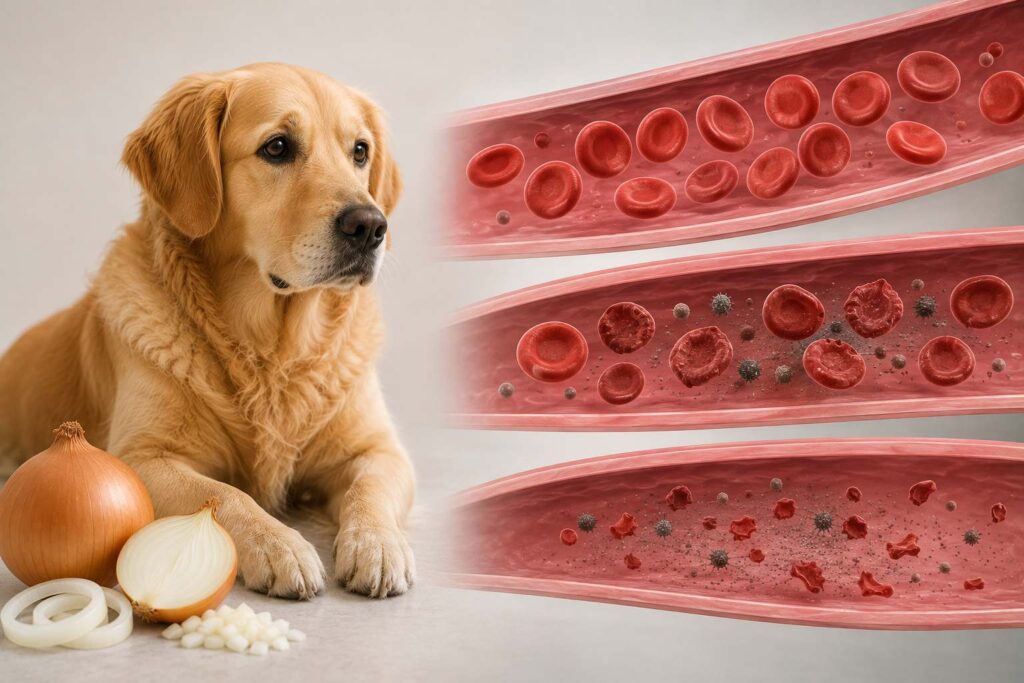
Understanding what onion does to red blood cells explains why waiting for obvious symptoms isn’t a reliable strategy.
From Onion Exposure to Oxidative Stress
Onions belong to the Allium group of plants and contain compounds capable of causing oxidative damage to canine red blood cells.
Red blood cells are responsible for carrying oxygen around the body. When oxidative damage alters the haemoglobin and structure inside these cells, they become abnormal and more vulnerable to removal or destruction.
When Damaged Red Blood Cells Become an Anaemia Problem
You may encounter several medical terms if your dog is examined or has blood tests:
- Erythrocytes — another name for red blood cells.
- Heinz bodies — deposits of damaged haemoglobin that can form inside oxidatively injured red blood cells.
- Haemolysis — destruction or breakdown of red blood cells.
- Haemolytic anaemia — anaemia caused when red blood cells are destroyed faster than the body can adequately replace them.
- Haemoglobinuria — haemoglobin released from damaged red blood cells appearing in the urine, which can contribute to a red or brown appearance.
A veterinarian may use findings such as these alongside the exposure history, physical examination, complete blood count, haematocrit/packed cell volume, blood-smear findings, and other tests to assess the dog.
What a Dog Owner Actually Needs to Understand
You don’t need to memorise the biochemistry.
The useful sequence is:
Onion exposure → oxidative red-blood-cell damage → red-cell destruction → possible haemolytic anaemia → visible illness
The important detail is that those stages do not necessarily happen all at once. A dog can look normal early in the process, which is why “I’ll wait until symptoms appear” is not a good way to decide whether an onion exposure needs professional advice.
Veterinary assessment should be based on what was eaten, the estimated or unknown quantity, your dog’s size and circumstances, when it happened, and how your dog is doing now—not on symptoms alone.
The Dangerous Part of the Timeline: “He Looks Fine”
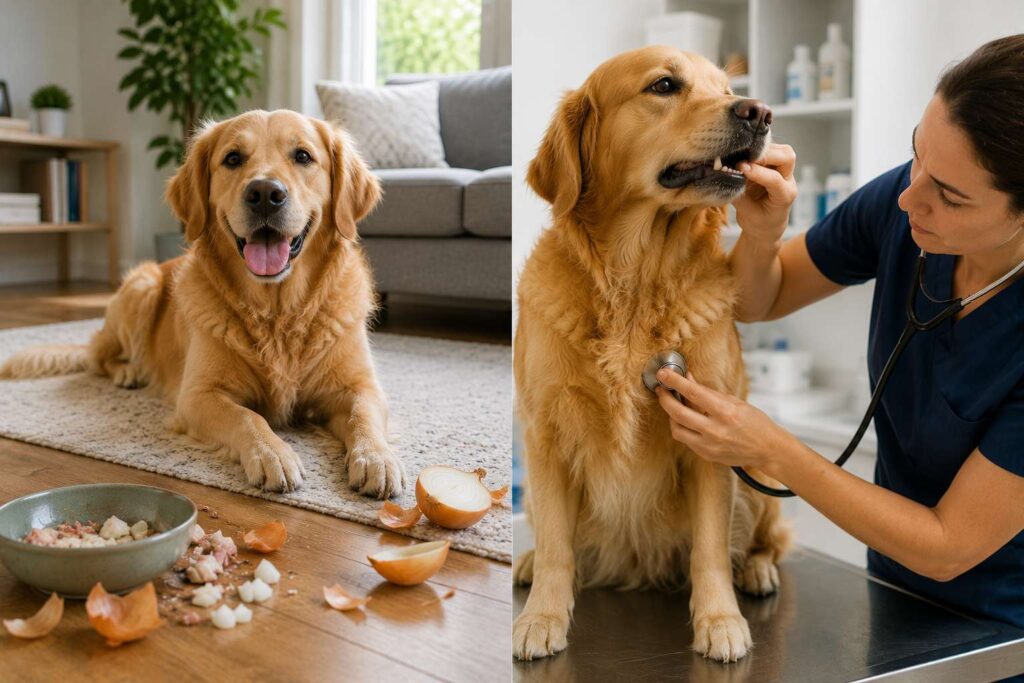
This is where owners can understandably relax too soon. Onion-related red blood cell damage may develop before obvious illness appears, so a dog looking normal shortly after exposure does not rule out a problem.
Signs That May Appear Earlier
Some dogs develop gastrointestinal signs relatively early, including:
- Vomiting
- Diarrhoea
- Reduced appetite
- Abdominal discomfort or a hunched, uncomfortable posture
Others may show no obvious early signs at all.
Signs That Can Become Concerning Later
As red blood cell damage progresses, signs associated with anaemia can appear later rather than immediately:
- Lethargy
- Weakness
- Pale gums
- Rapid or laboured breathing
- A noticeably faster heart rate
- Reduced tolerance for exercise or normal activity
- Red or brown urine
- Collapse in severe cases
These signs warrant prompt veterinary attention, especially if onion exposure is known or suspected.
Why No Symptoms Right Now Doesn’t Close the Case

There is no exact symptom clock that applies to every dog. The timing and severity depend on factors such as the amount and form of onion eaten, the dog’s size and individual susceptibility, and whether exposure happened once or repeatedly.
The practical point is simple: “he seems fine right now” only describes the present moment. It should not be used on its own to decide that an onion exposure is harmless.
Timeline at a Glance
| Stage | What you might notice | Why it matters |
|---|---|---|
| Shortly after exposure | Nothing, or digestive upset | A lack of symptoms does not rule out later effects |
| Developing red-cell injury | Your dog may still appear relatively normal | Blood-cell changes can develop before obvious illness |
| Clinically significant anaemia | Weakness, pale gums, breathing changes, dark urine | Prompt veterinary assessment may be needed |
Not every dog follows the same progression or develops severe illness. That’s why veterinary advice should be based on the exposure itself as well as symptoms, rather than waiting to see whether the dog becomes unwell.
Warning: Don’t use symptoms as a countdown
- Don’t wait for symptoms before seeking advice if your dog has eaten a potentially concerning amount of onion or the amount is unknown.
- Don’t induce vomiting or give home remedies unless specifically instructed by a veterinarian or veterinary poison professional. Whether decontamination is appropriate depends on the dog, the exposure, and how much time has passed.
- Don’t use an online toxic-dose calculator as proof that an exposure is safe. A calculator cannot reliably account for uncertain quantities, concentrated products, repeated exposure, individual susceptibility, or other ingredients in the food.
“How Much Onion Is Toxic?” Needs Context, Not Just a Number
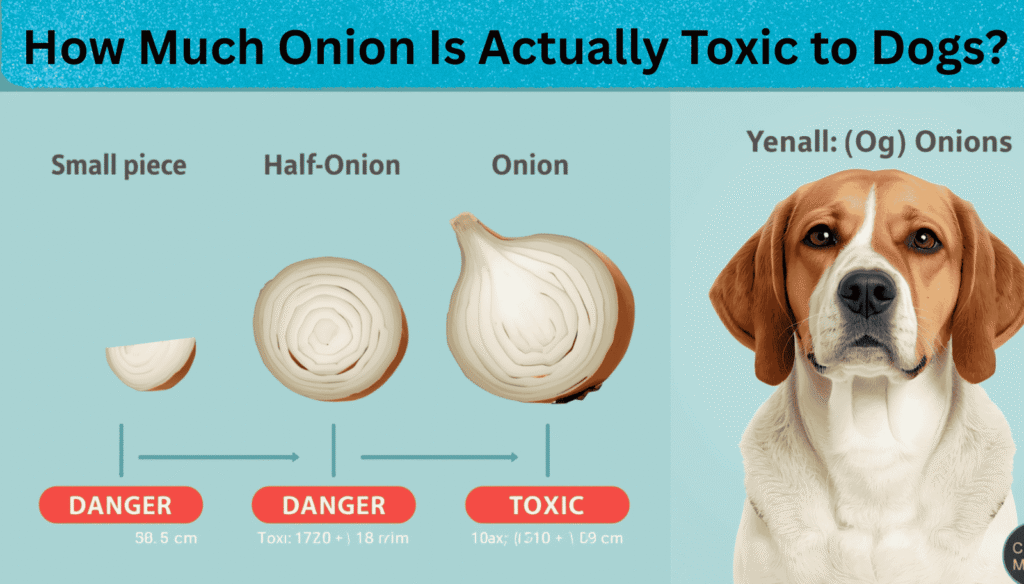
You’ll find plenty of charts online that convert a dog’s body weight into a supposed toxic amount of onion. Those figures can provide context, but they are easy to misuse.
Toxicity Data Is Not a Feeding Allowance
Published toxicology data describe amounts associated with adverse effects in dogs. They do not establish a guaranteed-safe amount below which every dog will be unaffected.
Turning a reported toxic dose backwards into a “safe serving” creates false precision. Onion should not be intentionally fed to dogs, and an accidental exposure is better assessed using the full circumstances rather than one number alone.
Five Variables Change the Real-World Assessment
- Amount eaten — known, estimated, or unknown
- Form and concentration — fresh onion, cooked onion, powder, flakes, or a prepared food
- Dog’s body weight — an important part of toxicology assessment
- Time since ingestion — relevant to veterinary management and monitoring
- Individual circumstances — including health status, repeated exposure, and other ingredients eaten at the same time
Onion powder deserves particular care when estimating exposure because it is a concentrated form, so comparing a spoonful of powder with the same volume of fresh onion can be misleading.
One Exposure vs Repeated Smaller Exposures
A single exposure and repeated smaller exposures should not automatically be treated as the same situation.
Repeated onion ingestion can matter because oxidative injury may accumulate when exposure occurs over time. There is no practical dog-specific formula owners can use to calculate a guaranteed “safe cumulative limit.”
If your dog has been receiving onion-containing leftovers repeatedly, tell the veterinarian about the pattern of exposure, not just the most recent meal.
Does Breed Matter?
Some dogs may be more susceptible to onion-induced oxidative red blood cell damage. Certain Japanese breeds, including Akitas and Shiba Inus, are often discussed in veterinary literature because inherited red blood cell characteristics may increase susceptibility in some individuals.
That does not mean other breeds are protected. Breed is only one factor in the assessment and should never be used to dismiss an exposure in a dog of another breed.
Five Real-Life Onion Incidents That Don’t Have the Same Answer

Onion exposures rarely look like textbook examples. The details matter, especially the amount, form, timing, dog’s size, and what else was eaten.
Scenario 1 — A large dog eats one visible piece of cooked onion.
Known: what was eaten, roughly how much, and when. This is relatively straightforward information to give a vet, but “large dog, small piece” should not be treated as an automatic all-clear.
Scenario 2 — A small dog gets into onion-powder seasoning.
Unknown: exactly how much powder was consumed. Worth flagging: onion powder is concentrated, and the dog’s smaller body weight is relevant when the exposure is assessed.
Scenario 3 — A dog finishes leftover curry.
Unknown: how much onion was in the recipe and what else was present. Garlic and other potentially problematic ingredients may also be involved. The absence of visible onion pieces doesn’t tell you how much was cooked into the dish.
Scenario 4 — Onion was eaten yesterday, and the dog seems completely normal today.
Worth remembering: onion-related red blood cell damage can be delayed. A normal appearance today does not, by itself, rule out changes that may still be developing.
Scenario 5 — Small amounts of onion-containing leftovers have been shared repeatedly.
Worth telling the vet: the pattern of exposure, not just the most recent meal. Repeated smaller exposures need to be considered differently from one isolated accident.
None of these scenarios can be diagnosed at home from the description alone. What they have in common is a mixture of known and unknown details, and those are exactly what a veterinarian or veterinary poison service needs to assess the situation properly.
What Your Veterinarian May Be Looking For

The Exposure History Is Part of the Assessment
The information gathered earlier — onion form, estimated amount, timing, your dog’s weight, current symptoms, and other ingredients — helps a veterinarian judge the significance of the exposure.
Bring or photograph packaging and ingredient labels where possible. If the amount is unknown, say so rather than trying to create a precise estimate.
Why Blood Testing May Matter
Onion toxicity can damage red blood cells before obvious anaemia becomes apparent.
Depending on the exposure and your dog’s condition, a veterinarian may recommend tests such as:
- A complete blood count (CBC)
- Packed cell volume (PCV) or haematocrit, which helps assess the proportion of red blood cells in the blood
- A blood smear to look for abnormal red blood cell changes, including Heinz bodies
These findings are interpreted alongside the dog’s examination and exposure history rather than being used in isolation.
What Treatment May Involve
Treatment depends on how recently the onion was eaten and whether red blood cell damage or other complications have developed. Veterinary care may include:
- Decontamination when the exposure is recent and it is considered appropriate
- Clinical monitoring and, when indicated, repeat blood testing
- Supportive care such as intravenous fluids
- Oxygen support in more severely affected dogs
- Blood transfusion if significant anaemia develops
Do not try to induce vomiting or give a home remedy unless a veterinarian or veterinary poison professional specifically instructs you to do so.
Why Follow-Up May Sometimes Matter
Red blood cell injury does not always become obvious immediately. For that reason, a veterinarian may recommend follow-up examination or repeat blood testing even if the initial assessment is reassuring.
The need for follow-up depends on the individual exposure; not every dog that eats onion will require the same monitoring or treatment.
Onion Has Relatives: Check the Rest of the Recipe
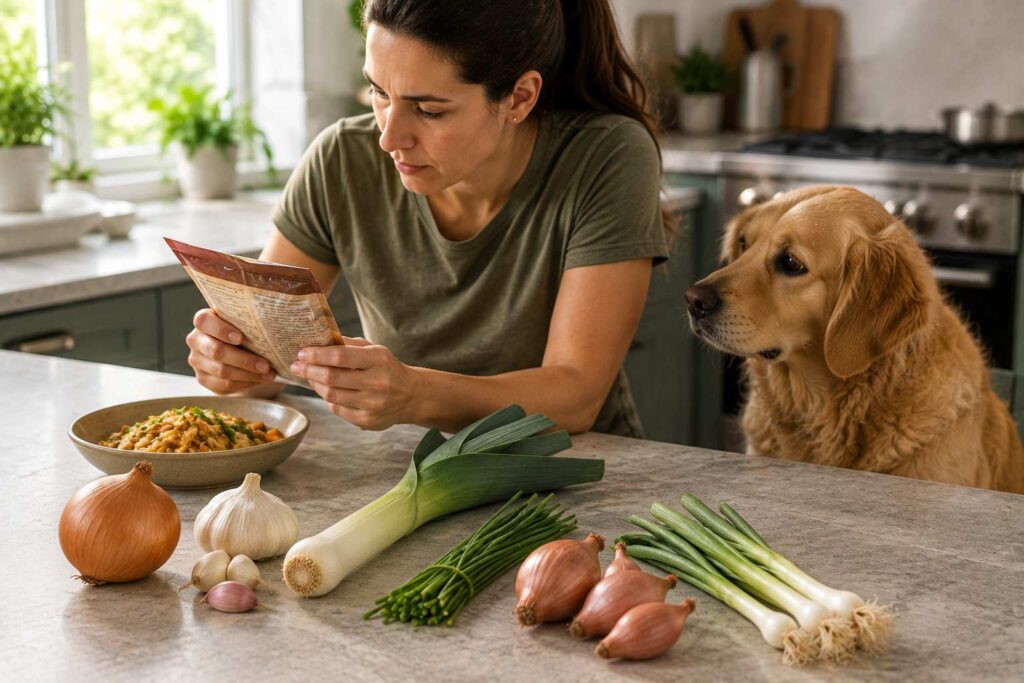
Onion belongs to the Allium group, which also contains several other foods that can cause similar oxidative red blood cell injury in dogs.
Other Alliums Worth Recognising
- Garlic
- Leeks
- Chives
- Shallots
- Scallions or spring onions
If garlic was involved, see our separate guide on Can Dogs Eat Garlic? for a closer look at that exposure.
When More Than One Allium Was in the Dish
Onion and garlic frequently appear together in curries, sauces, stocks, soups, marinades, and seasoning blends.
If your dog ate a food containing more than one Allium, tell the veterinarian about all of them rather than assessing the onion alone. The full recipe is often more useful than focusing on the ingredient you happened to notice first.
Common Mistakes After an Onion Exposure
| Common thinking | Better approach |
|---|---|
| “He looks fine, so I’ll wait.” | Consider the exposure itself as well as current symptoms |
| “Cooked means safe.” | Cooking does not make onion safe for dogs |
| “I removed the onion pieces.” | Onion may already be incorporated into the dish |
| “It’s only seasoning.” | Powdered and dried onion can be concentrated |
| “I need an exact gram amount before I call.” | An honest “unknown” is useful information |
| “My dog has eaten onion before and been fine.” | A previous uneventful exposure does not guarantee the next one will be harmless |
| “An online calculator says we’re below the risky amount.” | Published dose figures are not guaranteed safe thresholds for individual dogs |
| “I’ll make him vomit myself.” | Only induce vomiting if a veterinary professional specifically directs you |
Quick Tips: Make Future Onion Incidents Less Likely
- Keep onions, garlic, and other Allium foods out of reach
- Secure bins and food-waste containers
- Don’t leave cooked meals unattended on counters or tables
- Check ingredient labels before sharing human food
- Store seasoning packets, soup mixes, and stock products securely
- Avoid routinely sharing leftovers unless you know exactly what they contain
- Make sure everyone in the household knows onions are off-limits
- Be especially careful during food preparation, when chopped ingredients and scraps can fall to the floor
A Final 30-Second Onion Exposure Check
Before contacting your veterinarian or a veterinary poison service, gather what you can:
- What exactly did my dog eat?
- What form of onion was involved?
- Roughly how much was eaten — or is the amount unknown?
- What does my dog weigh?
- When did the exposure happen?
- Were garlic or other potentially harmful ingredients present?
- Is my dog showing any symptoms now?
- Do I have the packaging, ingredient list, receipt, or recipe?
- Have I contacted a veterinary professional rather than waiting for symptoms?
Frequently Asked Questions
1. Can dogs eat cooked onions if they’re well done?
No. Cooking does not make onion safe for dogs. Raw, cooked, dried, and powdered onion can all be relevant to onion toxicity.
2. Is onion powder more dangerous than fresh onion?
Onion powder is a concentrated dried form, so a relatively small volume can contain a meaningful amount of onion-derived material. That makes it particularly easy to underestimate in gravies, stocks, seasoning blends, and packaged foods. It should not be treated as safer simply because only a small amount of powder is visible.
3. Are spring onions (scallions) treated the same as regular onions?
Yes. Spring onions or scallions are Allium plants and should not be intentionally fed to dogs. If your dog has eaten them, include that information when discussing the exposure with your veterinarian.
4. If my dog ate onion yesterday and seems completely fine today, is it safe to assume nothing happened?
No. Onion-related red blood cell damage and haemolytic anaemia can develop after the initial exposure, so the absence of symptoms today does not prove that the exposure was harmless. Contact your veterinarian for advice based on what was eaten and how much may have been consumed.
5. What if I genuinely don’t know how much onion was in a curry or gravy my dog ate?
Tell your veterinarian exactly that. An unknown quantity is useful information and is better than inventing a precise estimate. If possible, provide the recipe, packaging, restaurant details, or ingredient list as well.
6. Can small amounts of onion-containing leftovers add up if they’re shared repeatedly?
Repeated exposure is worth discussing with a veterinarian because it is not the same situation as one isolated accidental bite. There is no reliable home formula for calculating a universally safe cumulative amount, so mention the frequency and approximate amounts rather than assessing only the most recent meal.
7. Can a vet tell if onion has affected my dog’s blood even without obvious symptoms?
Sometimes. Depending on the circumstances, a veterinarian may use a CBC, PCV or haematocrit, and a blood smear to look for evidence of red blood cell injury or anaemia. Whether testing or repeat monitoring is needed depends on the individual exposure and the dog’s clinical condition.
#. Related Articles: