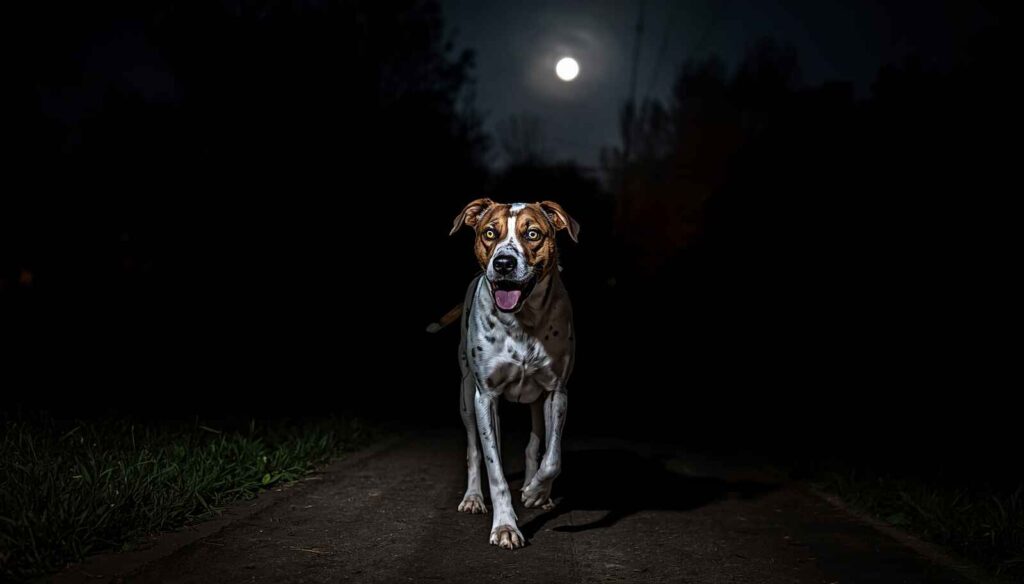
Can dogs see in the dark? My old Labrador used to walk straight through the house at 2 a.m. without so much as clipping a chair leg, while I stood in the doorway squinting and feeling along the wall for the light switch. It is a familiar sight for many dog owners: your dog seems to know exactly where everything is, even when the lights are off.
But “seeing in the dark” is not one single ability. There is a major difference between dusk, a dimly lit room and complete darkness, and dogs respond differently to each.
So, what can your dog actually see when the light fades? What happens inside their eyes to make low-light vision possible? And how can you tell normal nighttime caution from a vision problem that deserves veterinary attention?
The Short Answer Changes Depending on How Dark It Actually Is
At dusk or in a room with some ambient light, dogs generally see more effectively than people. They are especially good at detecting movement, noticing outlines and navigating familiar spaces. Fine detail is less clear, so your dog may notice that someone is moving across the room without being able to make out their facial expression.
As the light drops further, vision becomes less reliable. Dogs depend increasingly on light-sensitive rod cells, while colour and fine detail become less useful. A dark, motionless object on a dark floor may be difficult to spot, even if the dog can still move around the room confidently.
This is also when smell, hearing and memory begin doing much more of the work.
In complete darkness—a sealed room with no available light—neither dogs nor humans can form a normal visual image. Eyes need at least some light to reflect from objects and reach the retina. Dogs cannot see in true pitch-black conditions; they are simply much better at using very small amounts of available light.
The key distinction is this: dogs have greater low-light sensitivity than humans, but that does not give them perfectly sharp vision, and it does not allow them to see when no light is present.
What Actually Gives Dogs Their Low-Light Edge?
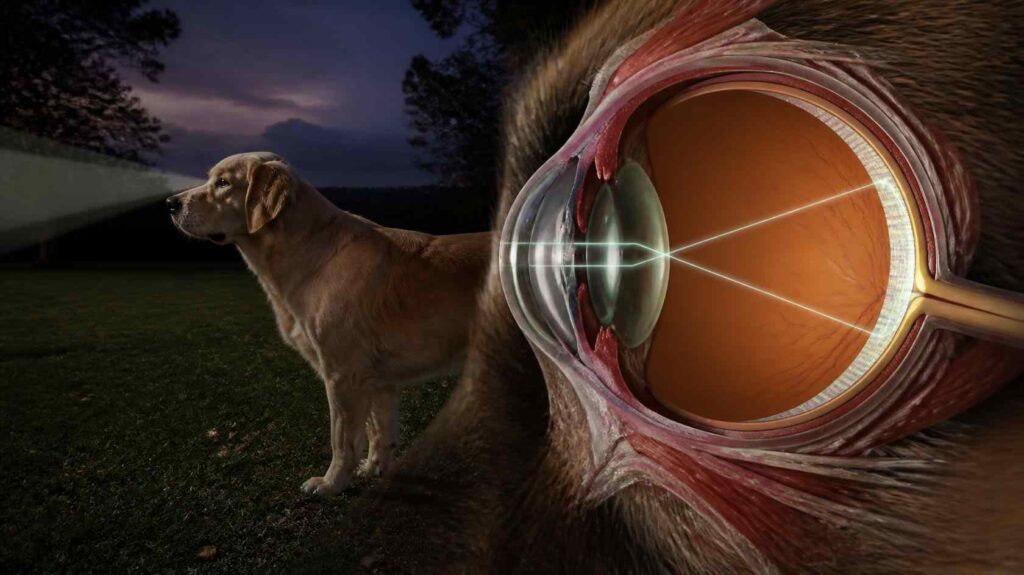
Several features of the canine eye work together to improve vision in dim conditions.
Rod Cells Prioritise Light and Movement
A dog’s retina contains a high proportion of rod photoreceptors. Rods are highly sensitive to low levels of light and are particularly useful for detecting movement.
Cone cells, which support colour vision and fine visual detail, play a smaller role in low-light conditions. This creates an important trade-off: dogs can often detect that something is present or moving without seeing it sharply.
For example, your dog may notice you walking across a dark garden before they can clearly identify your face.
Wider Pupils Gather More Available Light
A dog’s pupils can dilate to allow more light into the eye. This improves visual sensitivity at dusk and in dim indoor spaces.
However, pupil dilation cannot create light. Once there is no available light to collect, wider pupils provide no further advantage.
The Tapetum Lucidum Reflects Light Through the Retina
Behind the retina sits a reflective structure called the tapetum lucidum. Light that passes through the retina can be reflected back through it, giving the photoreceptors another opportunity to respond.
This improves low-light sensitivity, but it does not create perfectly detailed night vision. Reflected light can also reduce image precision, which helps explain why dogs may detect movement well while seeing less fine detail.
The tapetum lucidum is also responsible for the green, gold, blue or yellow glow sometimes visible in a dog’s eyes under a camera flash or torch beam. This glow, known as eyeshine, is reflected light—not light produced by the eye and not proof that the dog has healthy or unusually sharp vision.If you’d like to learn more about the anatomy of a dog’s eye, the Merck Veterinary Manual’s overview of canine eye structure provides an excellent veterinary reference.
Vision Is Not Doing This Alone
It is easy to give a dog’s eyes all the credit for confident nighttime movement, but vision is usually only one part of the picture.
A dog’s sense of smell helps identify the location of beds, bowls, doorways, people and other familiar features. Hearing provides information about footsteps, voices, movement and objects outside the dog’s visual field.
Memory may be just as important. A dog that has lived in the same home for years may know the position of every chair, doorway and step. That dog may continue to move confidently even when eyesight has begun to decline.
This ability to compensate can hide a genuine vision problem.
A dog with reduced eyesight may appear completely comfortable in a familiar living room but struggle in:
- A hotel room
- Someone else’s home
- A garden with unfamiliar obstacles
- A room after the furniture has been rearranged
- A new staircase or uneven outdoor path
A sudden loss of confidence in unfamiliar or dimly lit places does not confirm an eye disorder, but it is worth monitoring—especially if the behaviour is repeated, worsening or accompanied by other changes.
What Dogs Notice First When Light Is Low
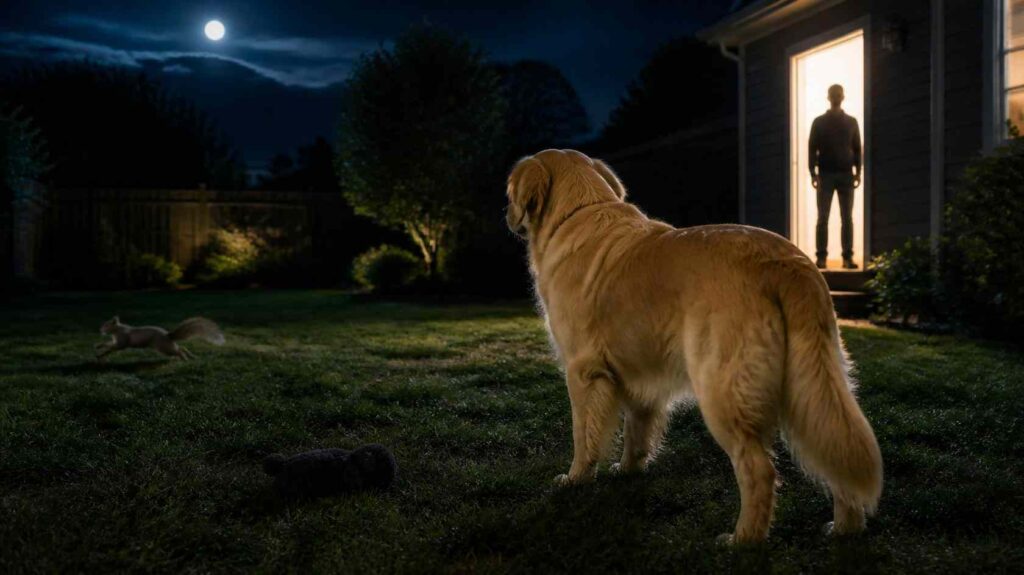
Dogs generally find moving and high-contrast objects easier to detect than stationary objects that blend into the background.
Moving Objects
In dim conditions, a dog may quickly notice:
- A person walking across the garden
- Another animal moving nearby
- A ball rolling across the floor
- A hand gesture made against a bright background
Movement activates rod-based vision more effectively than a motionless object.
High-Contrast Shapes
Contrast also matters. A pale object on dark flooring or a person standing in a lit doorway is usually easier to see than an object with a similar colour and brightness to its surroundings.
This is why a dog may avoid a white chair in a dim room but walk into a dark box placed on a dark carpet.
Stationary, Low-Contrast Objects
The hardest objects to detect are often those that are:
- Motionless
- Poorly lit
- Similar in colour to the floor or background
- Positioned near shadows or glare
- Located in an unfamiliar place
Dark toys on dark flooring, unmarked step edges and objects placed in shadows can all be difficult for a dog to notice.
Colour Becomes Less Useful as Light Fades
Dogs have dichromatic vision, meaning they see a more limited colour range than humans. Blues and yellows are generally easier for them to distinguish, while reds and greens may appear duller or less distinct.
However, dogs do not see only in black and white.
As lighting decreases, colour becomes less useful for both dogs and people. In very dim conditions, movement, brightness and contrast usually matter more than the object’s colour. A blue or yellow toy may be easier to locate than a red one in suitable light, but even a brightly coloured toy can disappear visually if it is motionless, poorly lit and sitting against a similar background.
How Vision Changes Across Lighting Conditions
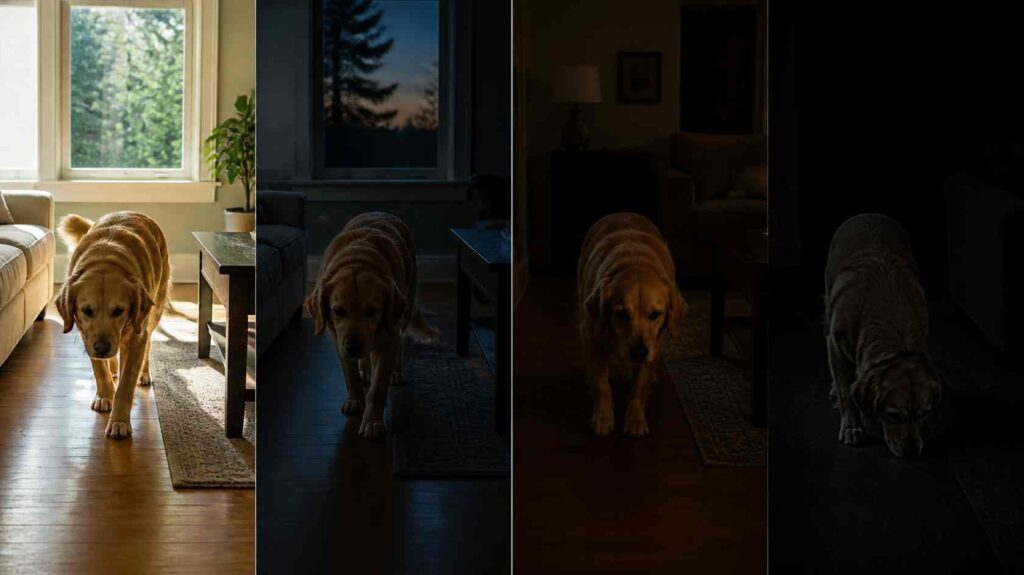
| Lighting condition | Movement detection | Fine detail | Colour usefulness | Reliance on smell and hearing | Typical behaviour |
|---|---|---|---|---|---|
| Bright daylight | Strong | Best available | Most useful | Moderate | Confident, relaxed navigation |
| Dusk | Very strong | Reduced | Limited but present | Increasing | Tracks movement easily |
| Dim indoor light | Moderate to strong | Poorer | Less useful | High | Relies more on memory and scent |
| Very low light | Limited | Very limited | Minimal | Very high | Moves more cautiously |
| Complete darkness | No normal visual image | None | None | Essential | Relies on smell, hearing and memory |
Dogs vs Humans and Cats at Night
Compared with humans, dogs can make better use of small amounts of available light and are especially good at detecting movement in dim conditions. Humans have the advantage in daylight visual detail and colour range, so seeing better at night does not mean dogs see a sharper image overall.
Cats are generally even more specialised for low-light vision, with highly light-sensitive retinas and a reflective tapetum lucidum. However, exact claims that one species sees a certain number of times better than another should be treated cautiously. Results vary with the light level, the method used to measure vision and the individual animal.
The same caution applies to breed comparisons. Head shape, eye position, age and eye health can influence how a dog uses visual information, but there is not enough evidence to rank breeds reliably by night vision. In many popular comparisons, light sensitivity is also mistaken for visual sharpness.
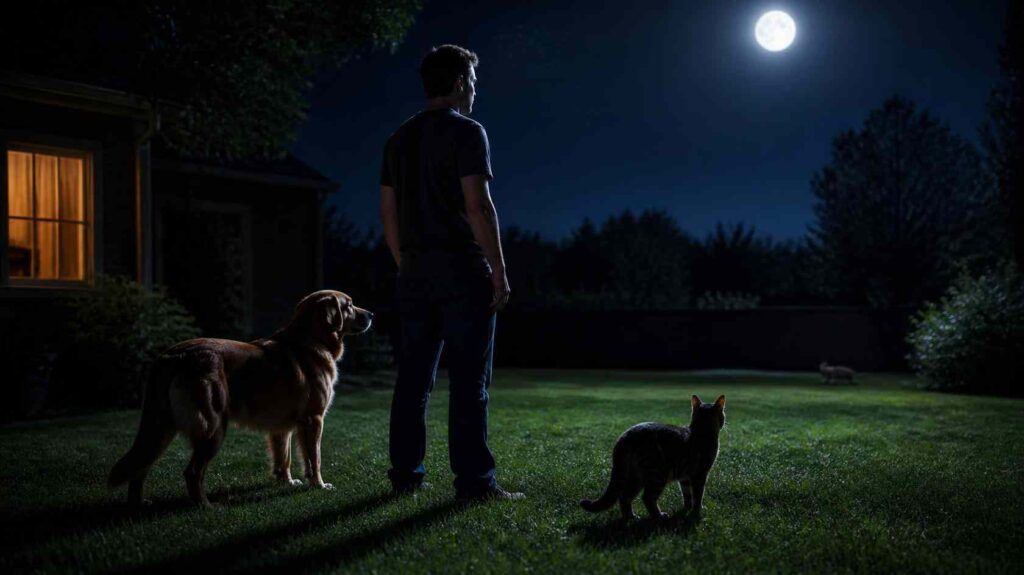
Everyday Situations Where This Matters
A dog moving confidently through a dark house may be using a memorised layout as much as vision. Smell and hearing help locate beds, bowls, doorways and people, which is why gradual sight loss can remain hidden in familiar surroundings.
Outside in the garden, performance depends on the amount of moonlight, street lighting or light from nearby windows. Dogs may quickly detect a moving person or animal while missing a dark, stationary object lying in their path.
Stairs deserve particular attention. Judging a step edge in low light requires contrast and depth perception, but hesitation does not always mean poor eyesight. Arthritis, joint pain, weakness or a previous slip can produce similar behaviour. Repeated stair difficulty, especially when it is new or worsening, deserves a veterinary assessment rather than a home vision test.
For evening play, moving toys are easier to follow than stationary ones. Blue or yellow toys may also stand out better to dogs than red, green or dark-coloured toys, although good contrast with the ground matters more than colour alone.
A brief pause when a dog moves from a brightly lit room into a dark garden is usually normal while the eyes adjust. It becomes more concerning if the hesitation is persistent, worsening or accompanied by collisions, missed steps, unusually wide pupils or reluctance to enter familiar spaces.
Making Nighttime Easier for Your Dog
A few small changes can make nighttime movement safer and less stressful:
- Use soft, even ambient lighting rather than a harsh light that creates glare and deep shadows.
- Keep stairs, landings and doorways visible.
- Consider a stair gate for senior, unsteady or visually impaired dogs.
- Clear floor-level clutter and keep furniture in consistent positions.
- Choose high-contrast blue or yellow toys for evening play.
- Add a textured mat near steps or exits as a tactile cue.
- Keep food, water and bedding in fixed locations.
- Use a lead in unfamiliar outdoor areas after dark.
- Record any repeated or unusual nighttime behaviour for your veterinarian.
Do not rearrange furniture, build obstacle courses or force a hesitant dog down stairs to test their eyesight. These methods can cause fear or injury and cannot identify the cause of a vision problem.
Does Your Dog Actually Need a Night-Light?
A healthy adult dog moving through a familiar home usually does not need a night-light, provided there is enough ambient light to navigate safely. Leaving a soft light near stairs, hallways or doors may still be helpful, particularly in an unfamiliar environment.
Puppies may benefit from a dim light mainly because it makes a new sleeping area feel less unfamiliar. It does not improve their natural eyesight, but it may support confidence while they settle into a new home.
Senior dogs often benefit most from consistent, low-level lighting. Age-related eye changes, slower reflexes, reduced mobility and cognitive changes can make shadows, steps and sudden changes in brightness more difficult to manage.
Dogs with partial vision loss usually do best with:
- Even lighting near stairs and exits
- Clear, uncluttered walkways
- Furniture kept in familiar positions
- Textured floor cues
- Verbal cues before steps or obstacles
For anxious dogs, it is important to separate fear from a possible vision problem. Noise sensitivity, separation anxiety, pain and canine cognitive dysfunction can all cause nighttime hesitation or restlessness. A night-light may provide comfort, but it will not treat the underlying cause.
Persistent changes, repeated collisions or sudden disorientation should be discussed with a veterinarian, even if the dog still moves confidently during the day.
Why Do Dogs’ Eyes Glow at Night?
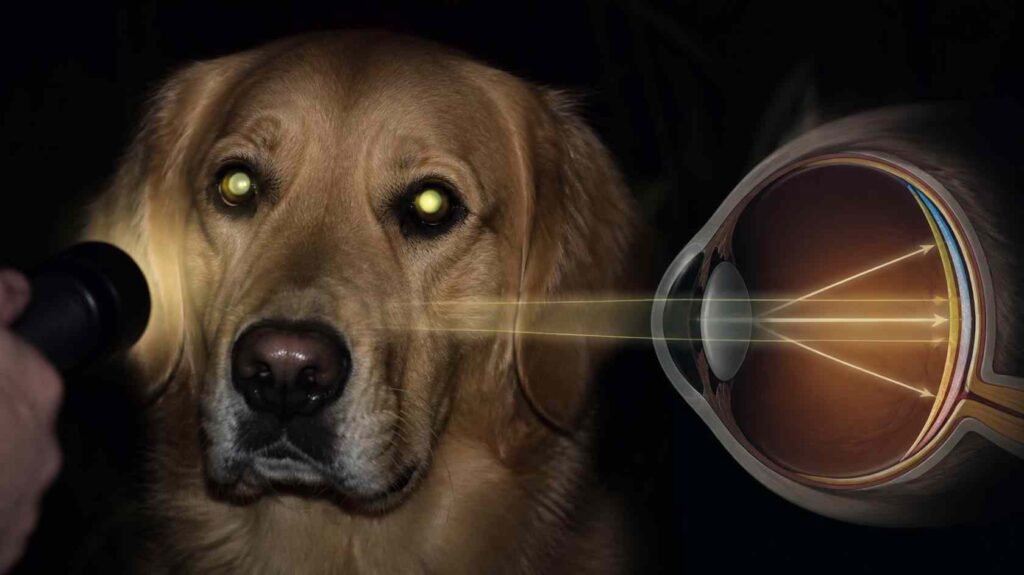
That eerie glow in photographs or torchlight is caused by the tapetum lucidum, a reflective layer behind the retina. It sends some incoming light back through the retina, giving the eye another chance to use it in dim conditions.
The colour of the glow can vary—often gold, green or blue—depending on the viewing angle, pigmentation, lighting and camera settings. That variation is usually normal.
What eyeshine cannot tell you is whether the eye is healthy. It does not confirm good vision, and it does not rule out retinal disease or other eye problems. A photograph is never a substitute for a proper veterinary eye examination.
When Night time Difficulty Might Signal a Real Problem
Early changes can be easy to miss. A dog may:
- Move more slowly after sunset
- Refuse to enter dark rooms
- Hesitate at kerbs or stairs
- Struggle to find food or water bowls
- Misjudge jumps
- Become unusually clingy at night
Pay particular attention to signs of one-sided vision loss, such as repeatedly bumping into objects on the same side or startling when approached from one direction. One healthy eye can compensate surprisingly well, so the problem may not be obvious during normal daytime activity.
It also matters whether the change is gradual or sudden. A slow decline over weeks or months—especially when night vision worsens before daytime vision—suggests a different set of causes from sudden, severe disorientation.
Sudden collisions, panic in familiar surroundings or a rapid loss of navigation ability should be treated as urgent.
Normal or Worth a Vet Visit?
| Observation | Usually not concerning | More concerning when | Suggested action |
|---|---|---|---|
| Brief hesitation after the lights go off | Happens only while the eyes adjust | Repeats frequently or worsens | Monitor the pattern |
| Careful movement in a new room | Improves as the dog explores | The dog continues colliding with objects | Book a veterinary check |
| Trouble finding a dark toy | The toy blends into the floor | The dog also struggles to find familiar objects | Watch for additional signs |
| Stair hesitation | Occurs only on unfamiliar stairs | Appears suddenly, worsens or leads to falls | Restrict access and contact your vet |
| Bumping into objects | A single isolated incident | Repeated, progressive or consistently one-sided | Arrange a veterinary assessment |
| Nighttime disorientation | Briefly occurs after waking | Sudden, severe or accompanied by eye changes | Seek prompt veterinary care |
Medical Causes a Vet May Investigate
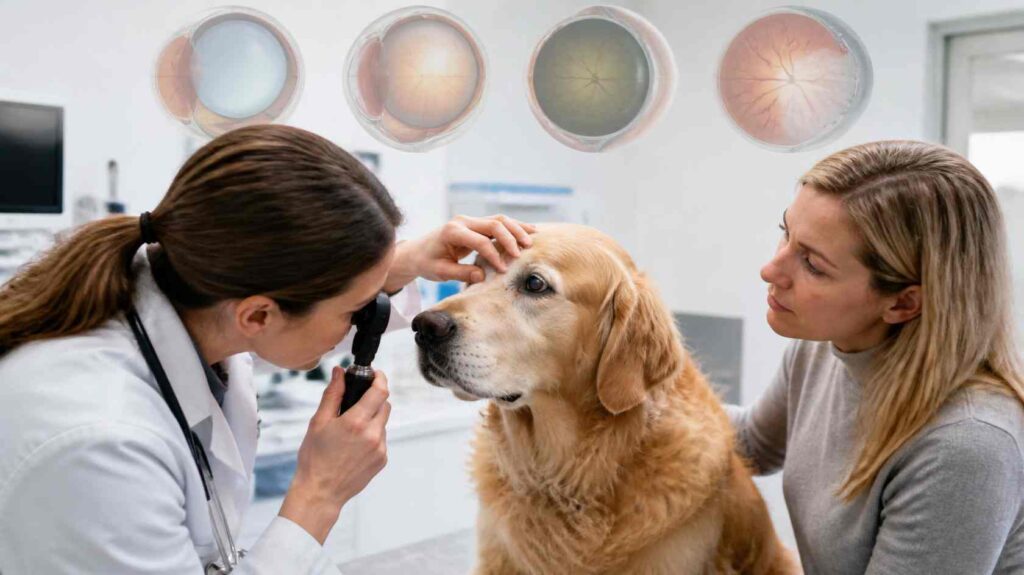
Several conditions can affect low-light vision.
Progressive retinal atrophy (PRA) often affects rod cells first, which is why difficulty seeing at night may appear before obvious daytime vision loss. It usually progresses gradually, although the rate varies between dogs.
Cataracts reduce the amount of light reaching the retina. They are not the same as nuclear sclerosis, a common age-related change that can make a senior dog’s lenses look blue-grey. Owners cannot reliably distinguish the two by appearance alone.
Glaucoma and uveitis are painful eye conditions that need urgent attention. They may cause redness, squinting, tearing, swelling or obvious discomfort.
Retinal detachment and other retinal disorders can cause sudden, severe vision loss and require prompt assessment.
Not every case of nighttime clumsiness begins in the eyes. Other possibilities include:
- Canine cognitive dysfunction
- Neurological disease
- Arthritis or joint pain
- General weakness
- Fear after a previous fall
- Anxiety around slippery floors or dark spaces
For example, a dog that hesitates only on stairs may be struggling with pain or depth perception—or both. A dog that paces and appears confused at night without bumping into objects may need assessment for cognitive or neurological causes as well as eye disease.
For additional information about common eye diseases, symptoms, and when to seek veterinary care, see the PDSA guide to common eye problems in dogs.
What to Tell Your Vet
Useful details include:
- When the behaviour began
- Whether it is getting worse
- Whether it happens only in dim light
- Whether unfamiliar places are more difficult
- Whether one side appears more affected
- Any redness, cloudiness, squinting or pupil changes
- A history of diabetes, trauma or new medication
A short video of the behaviour in a naturally occurring situation can be very helpful. Do not create an obstacle course or put your dog in danger to record it.
Warning
Seek veterinary care promptly for sudden blindness, severe disorientation, eye pain, redness, persistent squinting, unequal pupil sizes, a cloudy or swollen eye, recent trauma or a sudden refusal to move through familiar spaces.
Do not use human eye drops, shine powerful lights into your dog’s eyes, rearrange furniture as a vision test or force a hesitant dog down stairs. These actions cannot diagnose the problem and may cause pain, fear or injury.
Frequently Asked Questions
1.Can dogs see in complete darkness?
No. Without any available light, the eye cannot form a normal visual image. Dogs are excellent at using very small amounts of light, but they cannot see in absolute darkness.
2.Do dogs see better than humans at night?
Dogs are generally more sensitive to dim light and better at detecting movement. Humans still have the advantage in fine daytime detail and colour range.
3.What colours can dogs see at night?
Dogs can distinguish blues and yellows better than reds and greens. However, as light fades, colour becomes less useful and movement, brightness and contrast become more important.
4.Why do senior dogs sometimes bump into things at night?
Possible causes include cataracts, retinal disease, reduced contrast sensitivity, cognitive decline, arthritis or caution around unfamiliar surfaces. Because several problems can look similar, repeated or worsening changes should be checked by a veterinarian.
5.Does eyeshine mean my dog’s eyes are healthy?
No. Eyeshine only shows that light is reflecting from the tapetum lucidum. It is not a vision test and cannot rule out eye disease.
6.Should I leave a light on for my dog overnight?
A healthy adult dog in a familiar home usually does not need one. Soft ambient lighting may help puppies, senior dogs and dogs with partial vision loss move more confidently, especially near stairs, hallways and exits.
7.How can I tell whether nighttime hesitation is caused by vision, anxiety or joint pain?
Look for patterns:
Vision problems: collisions, missed steps, difficulty in unfamiliar places or problems affecting one side
Anxiety: pacing, panting, vocalising or clinginess without consistent collisions
Joint pain: reluctance around stairs, jumping or getting up, even when lighting is good
These signs can overlap, so persistent, worsening or sudden changes should be assessed by a veterinarian.
#. Related Articles: