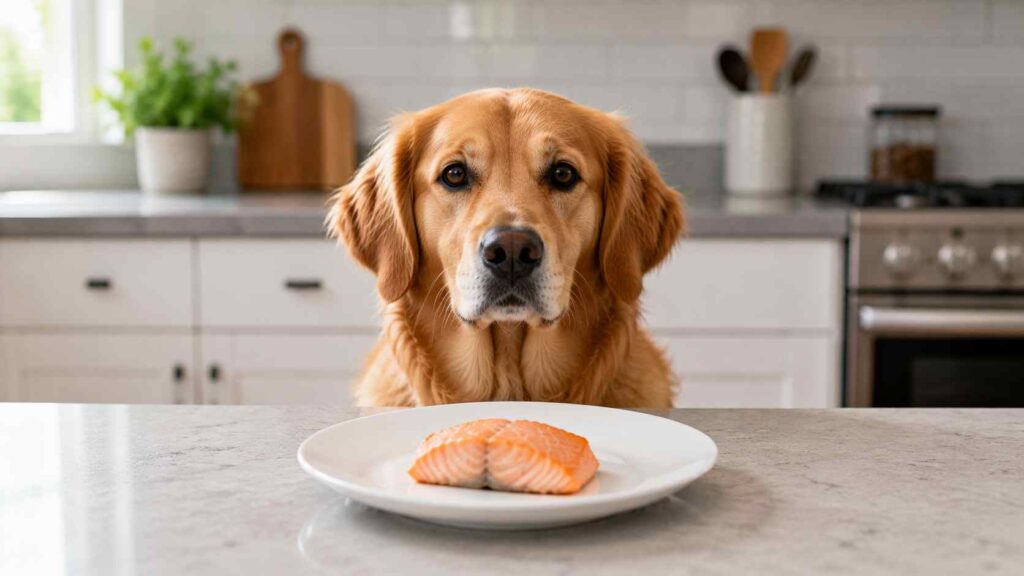
Can dogs eat salmon? Yes—plain, thoroughly cooked, boneless, unseasoned salmon in a sensible amount is generally suitable for most healthy dogs. But raw salmon, fish containing bones, smoked salmon, or salmon covered in garlic butter is a different question entirely.
The useful way to judge salmon isn’t simply “safe or unsafe.” Look at what form it’s in, how it was prepared, how much your dog ate, and whether your dog has a health condition that changes the risk. That’s also the approach to take if your dog has already helped themselves to some—which is often the real reason you’re searching in the first place.
Start With the Salmon in Front of You
Before worrying about portions or nutritional benefits, look at what you’re actually holding.
Plain cooked salmon—baked, poached, steamed, or grilled without seasoning—is the simplest option. It should be cooked through, carefully checked for bones, allowed to cool, and served without sauces or toppings.
Raw or undercooked salmon is a different risk category. Raw fish can expose pets and people to harmful microorganisms, while raw or undercooked salmonids can also transmit parasites. In parts of the Pacific Northwest, infected fish can transmit salmon poisoning disease to dogs. “Fresh,” “previously frozen,” or “sushi-grade” shouldn’t be treated as an automatic safety exemption.
Salmon with sauces, butter, or seasoning needs an ingredient check before your dog gets any. Rich oils and butter can trigger digestive upset, while onion and garlic are toxic to dogs and can damage red blood cells. Restaurant salmon is therefore best kept off the dog menu unless you know exactly how it was prepared.
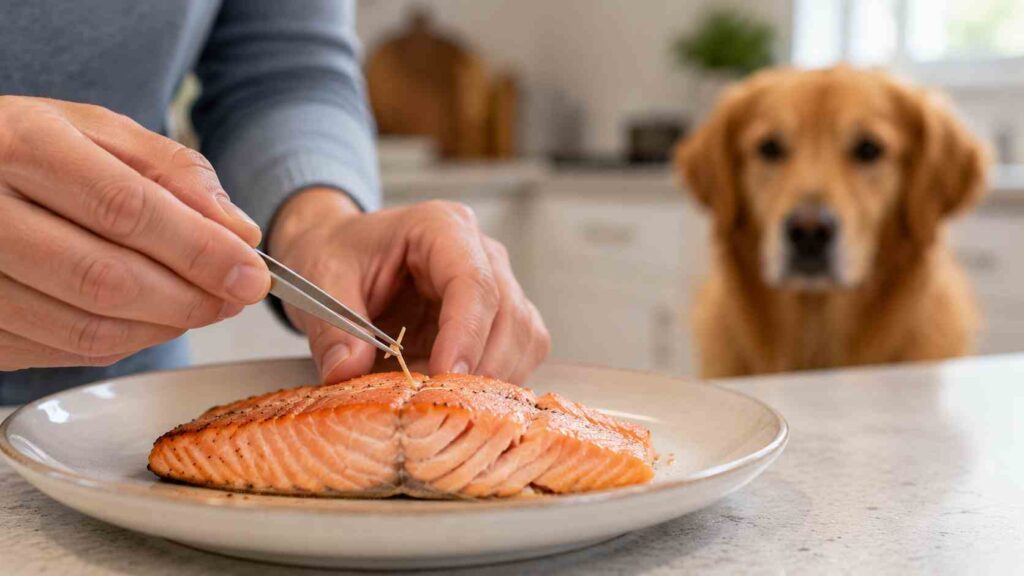
Salmon with bones turns a feeding question into a physical-safety problem. Small bones can be difficult to spot, while swallowed bones can contribute to choking, digestive blockage, or internal injury. PDSA advises against feeding bones because they can damage teeth, obstruct the gut, or cause tears.
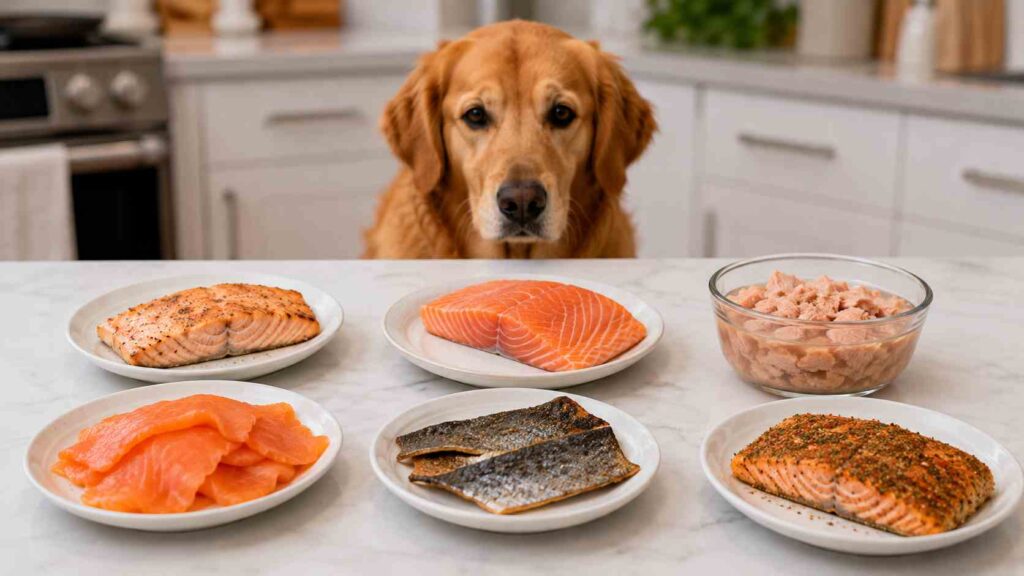
Which Salmon Is Suitable for Dogs? Quick Reference
| Salmon type | Generally suitable? | Main concern | What to check |
|---|---|---|---|
| Plain baked salmon | Yes | Overfeeding | Fully cooked and boneless |
| Plain grilled salmon | Yes | Added oil/seasoning | Plain and not heavily charred |
| Poached salmon | Yes | Added ingredients | Cooked through in plain water |
| Raw salmon | No | Parasites, bacteria | Don’t intentionally feed |
| Undercooked salmon | No | Same raw-fish hazards | Cook thoroughly before serving |
| Canned salmon in water | Usually | Added sodium | Prefer plain, lower-sodium options |
| Salmon in brine | Best avoided as a routine treat | High salt | Choose a lower-sodium alternative |
| Salmon in oil | Caution | Extra fat and calories | Prefer salmon packed in water |
| Smoked salmon | Best avoided as a routine treat | Salt, curing, preparation | Choose plain cooked salmon instead |
| Cooked salmon skin | Small amounts may be suitable | Higher fat content | Plain, cooked and bone-free |
| Raw salmon skin | No | Raw-fish hazards | Don’t intentionally feed |
| Salmon with bones | No | Choking or internal injury | Remove bones carefully |
| Garlic-butter salmon | No | Toxic ingredients, excess fat | Don’t intentionally share |
| Complete commercial salmon dog food | Yes, when appropriate for the dog | Individual dietary needs | Check that it is nutritionally complete for the intended life stage |
My Dog Already Ate Salmon — Judge the Situation Before You Panic

If your dog beat you to the plate, don’t judge the situation by the word salmon alone. Start with the details.
First, identify what was eaten. Was it raw or cooked? Plain or seasoned? Smoked, canned, packed in oil or brine? Were bones present? Roughly how much disappeared, and when did it happen? If it came from a packet, tin, restaurant meal, or prepared dish, keep the label or ingredient information handy.
Then consider your dog. The amount eaten relative to body size matters, but so does health history. Puppies, older dogs, and dogs with pancreatitis, kidney disease, sensitive digestion, food-allergy trials, or prescription diets may need more individualized advice.
A small amount of plain, thoroughly cooked, boneless salmon is generally a lower-concern situation for an otherwise healthy dog. Avoid giving more, provide normal access to water, and watch for problems such as repeated vomiting, diarrhoea, loss of appetite, abdominal discomfort, or unusual lethargy. Mild stomach upset can occur after an unfamiliar or rich food, but persistent or worsening symptoms deserve veterinary advice.
Raw salmon, swallowed bones, or salmon containing garlic or onion deserves more caution. Raw or undercooked salmonids are associated with salmon poisoning disease in affected geographic areas, and raw animal foods can carry harmful bacteria even where that particular disease isn’t a local concern. Bones pose a separate choking and gastrointestinal-injury risk, while garlic and onion introduce a toxicity concern.
A practical way to sort the situation:
- Plain + thoroughly cooked + boneless: usually lower concern; monitor your dog.
- Raw or undercooked: contact your veterinarian for advice, particularly after a meaningful exposure or if symptoms develop.
- Bone swallowed: call your vet for guidance; breathing difficulty, choking, or severe distress requires urgent veterinary care.
- Garlic or onion present: contact your veterinarian rather than waiting for symptoms to appear.
- Repeated vomiting, diarrhoea, marked lethargy, weakness, fever, loss of appetite, or worsening illness after raw salmon exposure: seek veterinary advice promptly. Merck lists fever, vomiting, diarrhoea, weakness, weight loss, and enlarged lymph nodes among signs associated with salmon poisoning disease.
Don’t induce vomiting or try a home remedy unless a veterinarian specifically tells you to. The appropriate response depends on what your dog swallowed, and a sharp bone creates a very different problem from an ordinary food indiscretion.
The Raw Salmon Risk Most Owners Misunderstand

This is one piece of salmon advice worth understanding properly, because the risk is more specific than “raw fish might upset your dog’s stomach.”
Salmon poisoning disease isn’t caused by a toxin in the salmon. Dogs become infected after eating raw or undercooked salmonids carrying the fluke Nanophyetus salmincola when that fluke is infected with the bacterium Neorickettsia helminthoeca. Merck Veterinary Manual describes the disease as a particular concern in the Pacific Northwest of North America, including affected areas of the northwestern United States and southwestern Canada.
If you’re in the UK or Australia, this specific disease doesn’t carry the same regional significance, but that isn’t a reason to feed raw salmon. Raw animal foods can still expose dogs—and the people handling them—to harmful bacteria. The FDA has identified pathogens including Salmonella and Listeria monocytogenes as concerns associated with raw pet foods.
Symptoms of salmon poisoning disease don’t necessarily appear straight after the meal. Merck reports that signs typically begin around a week after infected fish is eaten, although onset can be delayed. Warning signs can include fever, loss of appetite, weakness, vomiting, diarrhoea, dehydration, weight loss, and enlarged lymph nodes.
That delay matters. A dog acting completely normal a few hours after eating raw salmon doesn’t rule out a problem.
Frozen or “sushi-grade” salmon shouldn’t be treated as a safe exception for dogs. Freezing may be used to control certain parasites in fish intended for people, but it doesn’t turn raw salmon into the equivalent of thoroughly cooked salmon or remove every food-safety concern. The same applies to dogs already eating a raw diet—the underlying hazards of raw salmon don’t disappear because they’re accustomed to raw food.
Warning: If your dog has eaten raw or undercooked salmon, especially in an area where salmon poisoning disease occurs, contact your veterinarian for advice rather than waiting for symptoms. Tell them where the fish came from, how much was eaten, when it happened, and whether your dog has developed any signs of illness.
Bones Turn This Into a Physical Injury Problem, Not a Nutrition One
Salmon bones can be thin and surprisingly easy to miss. Once swallowed, the concern is no longer whether salmon is nutritious—it’s whether the bone could become lodged or injure the digestive tract.
It helps to separate two situations. Choking is an airway emergency: a dog may struggle to breathe, gag, paw at the mouth, panic, or collapse. A bone that has already been swallowed can cause a different problem later, such as irritation, a blockage, or internal injury. Vomiting, loss of appetite, abdominal pain, lethargy, or difficulty passing stool after swallowing a bone warrants veterinary attention. PDSA advises against feeding bones because they can damage teeth, obstruct the gut, and cause tears.
If your dog swallows a salmon bone, don’t feed bread, more food, or additional bones in an attempt to “push it through,” and don’t induce vomiting unless a veterinarian specifically instructs you to. Call your vet and describe the size and type of bone, your dog’s size, and any symptoms. If your dog is struggling to breathe or actively choking, treat it as an emergency.
Canned, Smoked and Skin-On Salmon Need Their Own Rules
Canned salmon depends heavily on the label. Plain salmon packed in water or spring water, ideally with no added salt, is the simplest choice. Brine adds unnecessary sodium, while oil-packed salmon adds extra fat and calories. Also check for flavourings or seasonings rather than assuming every tin contains only fish.
Smoked salmon trips people up because it looks ready to eat. It is typically salty, and cold-smoking in particular isn’t the same as thoroughly cooking the fish. Rather than trying to work out whether a particular smoked product is suitable, plain cooked salmon is the safer and simpler choice for your dog.
Salmon skin can be offered in a small amount if it is thoroughly cooked, plain, and free of bones. However, it’s richer than the flesh, so portions should stay modest. Skip it for dogs that need a low-fat diet or have a history of pancreatitis unless your veterinarian has specifically said it’s appropriate.
Before You Serve It, Run This Safety Check
- Salmon is thoroughly cooked
- All visible bones have been carefully removed
- The fish is plain, without sauces or seasoning
- No garlic or onion is present anywhere in the dish
- The portion is small, especially on the first try
- The salmon has cooled before serving
- It fits within your dog’s normal treat allowance
- Your dog isn’t on a prescription, elimination, or fat-restricted diet that makes extra salmon inappropriate
If this is your dog’s first taste of salmon, start with a small piece rather than a full serving. If vomiting, diarrhoea, itching, or another reaction develops, stop offering it and speak with your vet if symptoms are persistent or significant.
How Much Salmon Belongs in a Dog’s Diet?
Think of fresh salmon as a treat or topper, not a replacement for a nutritionally complete diet. A bowl of salmon and rice may sound wholesome, but by itself it doesn’t provide the balanced nutrition a dog needs long term.
There isn’t one serving size that fits every dog. Body size matters, but so do calorie needs, body condition, the rest of the diet, how the salmon was prepared, and any medical conditions. For a healthy dog trying it for the first time, a small amount is more useful than trying to hit an arbitrary number of grams.
Salmon included in a complete commercial dog food is different from adding fresh salmon to the bowl. In a complete diet, the ingredients are formulated together to meet nutritional requirements; an extra piece from your dinner is simply an additional food and needs to stay proportionate.
Healthy Food Doesn’t Mean Right for Every Dog
| Dog or situation | Main consideration | Why extra caution matters | Best next step |
|---|---|---|---|
| Healthy adult dog | Portion and preparation | Even safe salmon adds calories | Follow the safety checklist |
| Puppy | Complete growth nutrition | Treats shouldn’t displace a balanced puppy diet | Offer only a small amount |
| Senior dog | Individual health conditions | Kidney, digestive, or weight issues may change what’s appropriate | Consider existing conditions first |
| Overweight dog | Extra calories | Salmon and especially skin can add meaningful calories | Keep portions small; skip unnecessary extras |
| Pancreatitis history | Dietary fat | Rich additions may conflict with a prescribed low-fat approach | Ask your vet before feeding |
| Kidney disease | Therapeutic nutrition | Renal diets may deliberately control nutrients such as phosphorus, sodium, and protein | Don’t add salmon without veterinary guidance |
| Food elimination trial | Strict ingredient control | An unplanned protein can invalidate the trial | Feed only foods approved for the trial |
| Prescription diet | Condition-specific formulation | Extras can interfere with the diet’s purpose | Check with your vet first |
| Sensitive stomach | Digestive tolerance | Rich or unfamiliar foods may trigger vomiting or diarrhoea | Start very small or avoid if advised |
It’s also worth clearing up a common misconception: salmon is not automatically hypoallergenic. It may appear in some novel-protein diets because an individual dog hasn’t eaten it before, but dogs can still develop adverse reactions to dietary proteins. A single episode of loose stool after salmon doesn’t prove an allergy, either. Proper diagnosis generally involves a carefully controlled elimination diet followed by a dietary challenge, rather than simply switching proteins at random.
What Salmon Actually Adds Nutritionally

Salmon provides high-quality protein along with EPA and DHA, two long-chain omega-3 fatty acids that play roles in normal skin, coat, and inflammatory function. It also supplies vitamin B12 and other useful micronutrients. Those are real nutritional advantages, but they shouldn’t be turned into treatment claims. If your dog has persistent itching, joint pain, or another medical problem, adding salmon isn’t a substitute for finding and treating the underlying cause with your vet. Veterinary sources likewise use EPA and DHA in specific nutritional plans rather than treating an occasional piece of fish as therapy.
Salmon meat and salmon oil also aren’t interchangeable. Salmon meat provides protein, fat, nutrients, and calories, while salmon oil is a concentrated source of fat and EPA/DHA that can be measured more precisely. Oil still contributes calories—it is not a calorie-free supplement—and the appropriate amount depends on the product and the dog’s needs. If you’re considering omega-3 supplementation for a medical reason, ask your veterinarian about a suitable product and dose rather than estimating it from pieces of salmon.
Quick Tips for Sharing Salmon Without Overcomplicating It
- Choose plain salmon and cook it thoroughly.
- Check carefully for bones, including small pin bones.
- Skip smoked salmon as a routine treat.
- Prefer plain canned salmon in water over salty, flavoured, or oil-packed versions.
- Start with a small amount the first time.
- Count salmon as part of your dog’s daily treats rather than an extra meal. WSAVA recommends keeping treats to no more than about 10% of daily calorie intake.
- Don’t use salmon as a DIY treatment for skin, joint, or other health problems.
- If your dog eats an unsuitable salmon product, keep the packaging or ingredient list—you may need it when speaking with your vet.
Common Mistakes That Turn a Healthy Fish Into a Poor Choice
- Assuming “natural” or “fresh” means raw salmon is safe.
- Treating sushi-grade salmon as automatically dog-safe.
- Forgetting to check for small pin bones.
- Sharing restaurant salmon without knowing what’s in the sauce or seasoning.
- Treating smoked salmon like plain, thoroughly cooked fish.
- Ignoring the oil, brine, and sodium in canned varieties.
- Overfeeding because “it’s healthy”—nutritious food still adds calories.
- Assuming salmon cannot trigger an adverse food reaction.
- Adding salmon to a prescription or elimination diet without checking first.
- Assuming salmon-based dog food means raw salmon is safe to feed.
When Salmon Becomes More Than a Feeding Question

Contact your vet after a meaningful raw or undercooked salmon exposure if you’re concerned, particularly if the fish came from an area where salmon poisoning disease occurs or your dog develops vomiting, diarrhoea, fever, weakness, loss of appetite, or enlarged lymph nodes. Merck Veterinary Manual identifies raw or undercooked infected salmonids as the route of infection for salmon poisoning disease.
Seek prompt veterinary help after a bone-related incident if you notice difficulty breathing, repeated gagging or retching, trouble swallowing, obvious distress, persistent vomiting, abdominal pain, or an inability to keep food or water down. Breathing difficulty or active choking is an emergency.
Call about potentially harmful seasonings, especially garlic, onion, or a sauce with unknown ingredients. Don’t wait for obvious symptoms if you know your dog has eaten something potentially toxic.
Ask before feeding salmon regularly if your dog has pancreatitis, kidney disease, significant gastrointestinal disease, a suspected food allergy, or a therapeutic diet. In dogs with chronic kidney disease, for example, veterinary diets may deliberately control several nutrients, so casually adding food can work against the nutritional plan.
When you call, have these details ready: your dog’s approximate weight, the type of salmon (raw, cooked, smoked, or canned), roughly how much was eaten, whether bones were involved, any sauces or seasonings, when it happened, and any symptoms you’ve noticed.
The Bottom Line
Plain, thoroughly cooked, boneless, unseasoned salmon can be a nutritious occasional treat or topper for many healthy dogs. The bigger concerns are raw or undercooked fish, bones, salty smoked products, excessive portions, and preparations containing unsafe ingredients.
Keep it simple: cook it thoroughly, remove the bones, serve it plain, and keep the portion modest. If your dog has eaten raw salmon, swallowed a bone, consumed a potentially toxic seasoning, or developed worrying symptoms, veterinary advice is safer than trying to judge the risk from the size of the bite alone.
Frequently Asked Questions
1.Can dogs eat frozen salmon?
Yes, if it is subsequently thoroughly cooked and served plain and boneless. Freezing should not be treated as a reason to intentionally feed salmon raw; cooking remains the safer choice.
2.Is sushi-grade salmon safe for dogs?
Not as a raw treat. “Sushi-grade” doesn’t create a veterinary safety exemption from the risks associated with feeding raw fish. Cook it thoroughly before offering any to your dog.
3.Can dogs eat salmon packed in oil?
A small amount may not cause a problem for a healthy dog, but it isn’t the best choice for routine feeding. The oil adds extra fat and calories. Plain salmon packed in water, ideally without added salt, is the simpler option.
4.Can dogs eat salmon and rice?
Yes, dogs can eat plain cooked salmon with plain cooked rice if both foods are individually suitable for them. However, the combination is not nutritionally complete for long-term feeding and shouldn’t be used as a homemade treatment for digestive illness without veterinary guidance.
5.Is Atlantic salmon different from Pacific salmon for dogs?
For routine feeding, the core rule is the same: serve salmon thoroughly cooked, plain, and boneless. However, geography matters when discussing salmon poisoning disease. The fluke associated with the disease is found particularly in the northwestern United States, southwestern Canada, and other parts of the northern Pacific Rim.
6.Why can salmon-flavoured dog food be safe if raw salmon isn’t?
A properly manufactured commercial dog food is a formulated finished product rather than a raw fillet. Cooking or other validated processing steps, ingredient controls, and the complete diet formulation make it a different feeding situation from offering raw salmon directly.
7.Is salmon better than tuna or sardines for dogs?
Not universally. The best choice depends on the product, preparation, portion, and your dog’s diet. Salmon is a useful source of protein and omega-3 fats; sardines can also be convenient when plain and appropriately prepared, while tuna requires more attention to species, portion, and frequency. Whichever fish you choose, plain preparation and sensible portions matter more than trying to crown one fish as the healthiest.
#. Related Articles: