
Can dogs eat rice? Yes, plain, fully cooked rice is generally safe for most healthy dogs in moderation. But whether you should feed it depends on what kind of rice it is, what has been added to it, and why your dog is eating it in the first place. A spoonful of plain boiled rice is very different from a bowl of biryani, fried rice, or rice cooked with onion and garlic.
Plain, fully cooked rice is generally safe for most healthy dogs in moderation. Rice cooked with onion, garlic, stock, butter, sauces, or other ingredients needs a different assessment because the main risk may come from what was added rather than the rice itself.
And if you’re considering rice because your dog has diarrhoea or vomiting, the question changes again. Rice may be suitable in some situations, but it is not a treatment for the underlying cause of gastrointestinal illness.
This guide helps you work out which situation you’re dealing with before deciding what to do next.
First, Work Out What Actually Happened
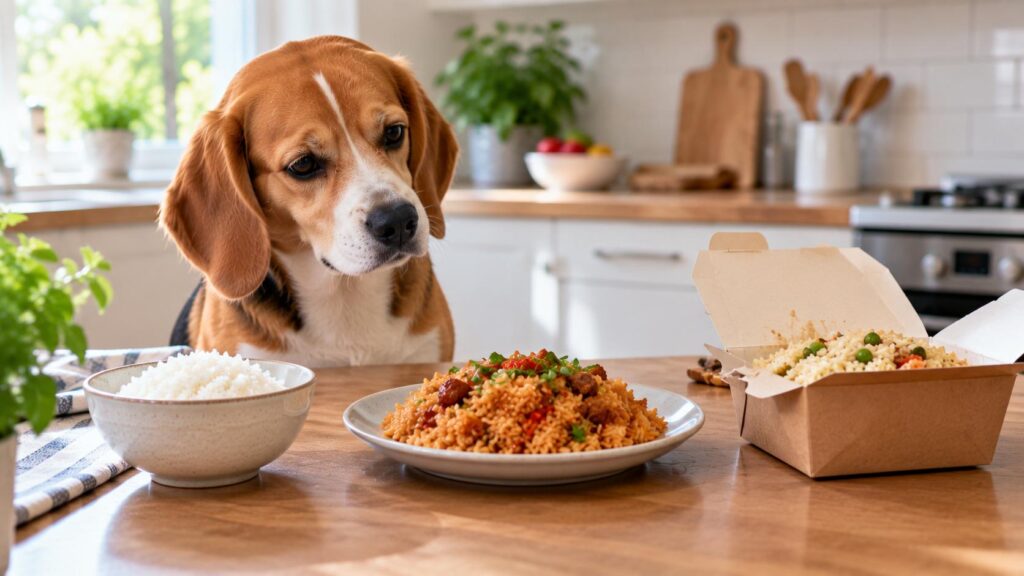
Before worrying about white versus brown rice or portion sizes, identify what your dog actually ate:
- Plain home-cooked rice: boiled in water, fully cooked, with nothing added.
- Rice from your dinner: potentially containing stock, sauce, butter, oil, salt, onion, garlic, or other ingredients.
- An unexpected steal: your dog grabbed rice from a plate, pan, takeaway container, or counter and you aren’t completely sure what was in it.
If your dog has already eaten the rice, try to establish what was in the dish, roughly how much was eaten, your dog’s size, when it happened, and whether any symptoms have appeared. If veterinary advice becomes necessary, those details are much more useful than simply saying, “My dog ate rice.”
Quick Checklist
Before deliberately feeding rice—or deciding how concerned to be after an accidental helping—check:
- Was the rice fully cooked?
- Was it plain?
- Did it contain onion, garlic, leeks, or chives?
- Was it cooked with stock, broth, bouillon, or a seasoning mix?
- Did it contain sauce, butter, or a lot of oil?
- Was it restaurant or takeaway food?
- Roughly how much did your dog eat?
- Is your dog behaving normally?
- Is your dog on a prescription diet or elimination trial?
If it was a small amount of plain, cooked rice and your otherwise healthy dog is acting normally, the rice itself is usually not a major concern.
If the dish contained potentially harmful ingredients—or you cannot work out what was in it—assess the whole meal, not just the rice.
Safe Doesn’t Mean Necessary

Two different questions often get mixed together: Can a dog eat rice? and Does a dog benefit from having rice added to their diet?
Rice mainly provides digestible carbohydrate and energy. It can be a useful food ingredient, but a few spoonfuls of rice should not be treated as a nutritional supplement or canine “superfood.”
A healthy dog eating a complete and balanced diet does not need extra rice to fill a nutritional gap. Adding it is simply an optional extra, and those extra calories still count.
There is also an important difference between rice included in a formulated commercial dog food and rice spooned onto an already complete meal. In commercial food, the entire recipe is formulated to provide the required balance of protein, fat, vitamins, minerals, and energy. Adding table rice on top changes that balance without adding complete nutrition.
White Rice vs Brown Rice: A Purpose Comparison, Not a Ranking
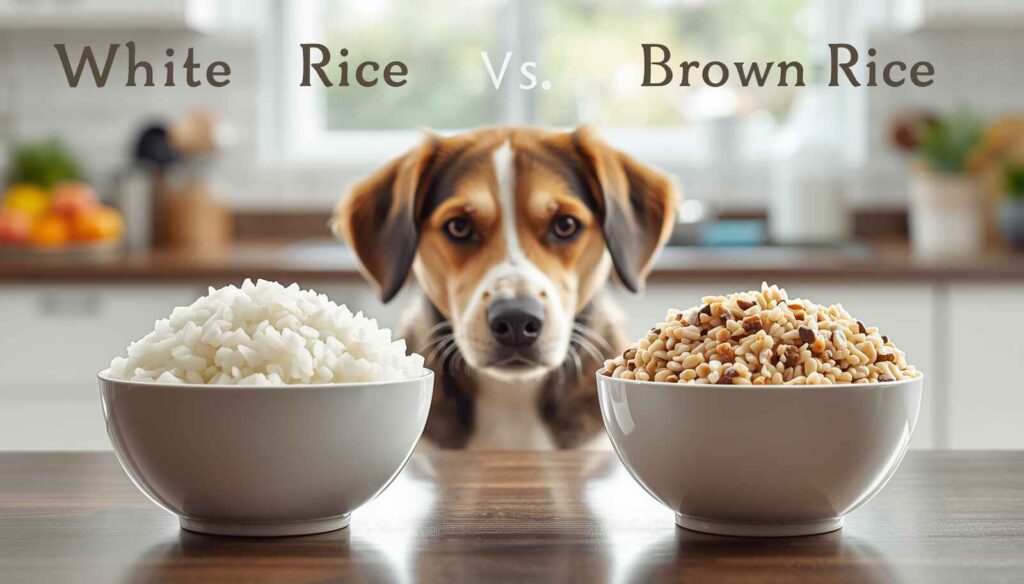
Brown rice is often assumed to be the healthier choice because of how it is discussed in human nutrition. For dogs, the better choice depends on why you’re feeding it and how well that individual dog tolerates it.
| Rice type | Digestibility | Fibre | Possible use | Main caution |
|---|---|---|---|---|
| White rice | Generally easy to digest | Lower | Small occasional servings; sometimes used in short-term GI diets | Adds calories; portion control matters |
| Brown rice | Less refined and often slower to digest | Higher | Healthy dogs that tolerate it | Extra fibre may not suit every dog with GI upset |
| Basmati rice | Similar principles to other white or brown rice | Depends on type | Occasional plain serving | What is added during cooking matters |
| Jasmine rice | Generally similar to white rice | Lower | Occasional plain serving | Avoid seasoning and sauces |
| Sticky or sushi rice | Depends on preparation | Varies | Only when genuinely plain | Prepared sushi rice may contain sugar, vinegar, or seasoning |
| Microwave or packet rice | Depends on product | Varies | Ingredient-dependent | May contain salt, oils, flavourings, onion, or garlic |
White rice isn’t automatically the “bad” option, and brown rice isn’t automatically better. White rice contains less fibre and is often easier to digest, which helps explain its traditional use in bland diets. Brown rice retains the bran layer and contains more fibre, but extra fibre isn’t always desirable when a dog’s gastrointestinal tract is already irritated.
For most owners, preparation matters more than the variety. Plain, properly cooked brown rice is a very different food from white rice fried in oil and seasoned with garlic.
The Rice Dish Risk Map

Rice itself is rarely the most concerning part of a human rice dish. The ingredients cooked with it often matter much more.
Lower-concern examples include:
- Plain boiled white rice
- Plain basmati or jasmine rice
- Plain brown rice
- A small amount of properly stored leftover plain rice
Foods that deserve a closer ingredient check include:
- Microwave or packet rice
- Rice cooked in broth or stock
- Flavoured rice mixes
- Restaurant or takeaway rice
Human dishes such as fried rice, curry rice, biryani, risotto, Spanish-style rice, Mexican-style rice, rice pudding, and some rice-and-bean dishes cannot be judged simply by asking whether dogs can eat rice. Their safety depends on everything else in the recipe.
Warning Box: Check the Whole Dish
Pay particular attention to:
- Onion, garlic, leeks, and chives: members of the Allium family can damage dogs’ red blood cells. Raw, cooked, dehydrated, and powdered forms can all be a problem. Concentrated powders are especially easy to overlook in seasoning mixes, stocks, and sauces.
- Grapes, raisins, currants, or sultanas: potentially dangerous to dogs and sometimes found in pilafs, biryani, and other rice dishes.
- Large amounts of butter, oil, fatty meat, or rich gravy: may cause gastrointestinal upset and can be particularly unsuitable for dogs with certain medical conditions.
- Excess salt: common in stock cubes, sauces, packet rice, and takeaway meals.
- Unknown sauces or seasoning blends: don’t assume they are safe simply because the rice looks plain.
If onion or garlic was involved, don’t try to calculate the risk from appearance alone. Toxicity depends on factors including the amount, concentration, and dog’s size, and signs of red-blood-cell damage can be delayed. Contact your veterinarian or an appropriate animal poison service if the exposure may have been significant.
“Plain rice is generally safe” and “this rice dish is safe” are two completely different conclusions.
Why Are You Adding Rice? The Reason Changes the Answer

As an Occasional Treat or Topper
A little plain cooked rice can be given occasionally to a healthy dog that tolerates it.
Keep the portion modest and remember that it is an extra, not a replacement for complete food. Regularly adding generous amounts of rice can quietly increase calorie intake while diluting the nutrient density of the overall diet.
Because Your Dog Has Diarrhoea
White rice has traditionally been used as part of a bland diet because it is low in fibre and generally easy to digest. That does not mean rice treats diarrhoea or that every dog with loose stools should be switched to rice.
A single mild episode in an otherwise bright, comfortable dog is very different from diarrhoea accompanied by:
- Repeated vomiting
- Blood
- Marked lethargy
- Abdominal pain
- Poor appetite
- Dehydration
- Suspected toxin or foreign-object ingestion
- Symptoms that persist or keep returning
In those situations, deciding what caused the illness is more important than choosing a bland food.
Because Your Dog Is Vomiting
Be more cautious with vomiting.
A dog that is repeatedly vomiting, retching, becoming weak, or unable to keep water down needs veterinary assessment rather than repeated attempts to feed rice. Giving food does not solve dehydration, obstruction, poisoning, pancreatitis, or other conditions that can cause vomiting.
Because Your Dog Is a Picky Eater
Adding a little rice may make a meal more appealing, but routinely improving every refused meal with extras can create its own problem.
If a dog that normally eats well suddenly becomes reluctant to eat, look for a reason rather than assuming they’re bored with their food. Dental pain, nausea, gastrointestinal disease, medication effects, stress, and other problems can alter appetite.
Because You Want to Feed a Homemade Diet
Rice can be one ingredient in a properly formulated homemade diet, but rice alone—or chicken and rice—is not a complete long-term diet.
Dogs require specific amounts and proportions of amino acids, fatty acids, vitamins, minerals, and other nutrients. Simply combining foods that seem healthy does not guarantee those requirements are met.
If you want to feed homemade food long term, ask your veterinarian about a recipe formulated for your individual dog by an appropriately qualified veterinary nutrition professional.
Chicken and Rice: Where the Usual Advice Needs an Update

Chicken and rice has been recommended as a “bland diet” for years, so it’s understandable that many owners reach for it whenever a dog develops diarrhoea.
The idea makes sense on the surface: plain skinless chicken provides a relatively lean protein source, while well-cooked white rice is generally easy to digest. But modern veterinary guidance is more cautious about treating this combination as the default answer for every upset stomach.
Gastrointestinal signs can have many causes, and chicken and rice does not diagnose or treat them. A dog with uncomplicated, mild symptoms is very different from one with recurrent diarrhoea, repeated vomiting, abdominal pain, blood in the stool, dehydration, or a possible foreign body.
There is another important limitation: homemade chicken and rice is not nutritionally complete or balanced. Veterinary nutrition guidance from VCA notes that the traditional chicken-and-white-rice mixture is deficient in multiple essential nutrients. It should therefore not become an ongoing replacement for a complete diet simply because a dog eats it willingly.
If your dog needs dietary support for a gastrointestinal problem, your veterinarian may recommend a complete veterinary gastrointestinal diet instead. These diets are formulated to provide appropriate nutrition while meeting the needs of dogs recovering from specific digestive problems.
If symptoms persist, return after improving, or repeatedly require you to fall back on chicken and rice, the next step should be finding out why the gut keeps becoming unsettled, not keeping the dog on a homemade bland diet indefinitely.
When Rice Is Probably the Wrong Choice

Rice may be safe for most healthy dogs, but there are situations where adding it routinely deserves more caution:
- Dogs with diabetes: White rice can produce a relatively rapid rise in blood glucose, and consistent feeding matters when diabetes is being managed. Don’t add rice regularly without discussing it with your veterinarian.
- Dogs on a weight-management plan: Rice adds calories without necessarily adding anything the diet is missing. Small toppers at every meal can quietly become a significant calorie source.
- Dogs on a prescription veterinary diet: Extra foods can change the calorie or nutrient balance the diet was designed to provide.
- Dogs on an elimination or food-allergy trial: Even an ordinarily safe ingredient can interfere with the trial if it wasn’t part of the prescribed plan.
- Dogs with chronic digestive disease: Recurrent diarrhoea, vomiting, or other GI signs need an individual feeding strategy rather than repeated homemade bland diets.
- Dogs with a history of pancreatitis: Plain rice itself is low in fat, but the rest of the meal matters. Butter, oils, fatty meat, gravy, and rich sauces can make an otherwise simple rice dish much less appropriate.
If your dog has a medical condition or is eating a veterinary-prescribed diet, WSAVA recommends checking with your veterinary healthcare team before adding conventional treats or extras.
My Dog Already Ate Rice — What Now?

Start with the whole dish rather than the word “rice.”
| What happened? | What matters most | General direction |
|---|---|---|
| Small amount of plain cooked rice | Amount eaten and how your dog seems | Usually low concern in an otherwise healthy dog |
| Large amount of plain rice | Dog’s size and any digestive symptoms | Monitor closely and contact your vet if concerns develop |
| Fried or seasoned rice | Complete ingredient list | Check what else was in the dish |
| Biryani or curry rice | Onion, garlic, raisins, fat, sauces, other ingredients | Higher concern; assess the ingredients rather than the rice |
| Rice with an unknown sauce | Unidentified ingredients | Contact your vet if a toxic ingredient may have been present |
| Rice followed by vomiting or diarrhoea | Severity and duration of symptoms | Treat it as a medical question, not simply a rice question |
| Puppy ate rice and seems unwell | Age, hydration, symptoms, amount eaten | Have a lower threshold for calling your vet |
If onion or garlic was involved, remember that signs of Allium poisoning may not appear immediately. Merck Veterinary Manual notes that red-blood-cell damage can develop after ingestion and clinical signs may take several days to become obvious.
Before calling your vet, have as much of the following information ready as you can:
- Your dog’s weight and age
- Existing medical conditions
- Exactly what was eaten
- Approximate amount
- Packaging or an ingredient list, if available
- When it was eaten
- Any symptoms and when they started
Signs That Need a Vet, Not a Home Remedy
Rice stops being the important part of the story if your dog develops:
- Repeated vomiting or retching
- Blood in the stool or vomit
- Marked lethargy or weakness
- Abdominal pain or a swollen-looking abdomen
- Inability to keep water down
- Signs of dehydration
- Rapidly worsening symptoms
- Suspected exposure to onion, garlic, raisins, or another toxic ingredient
- Possible swallowing of packaging, bones, or other foreign material
- Significant illness in a puppy, senior dog, or dog with an existing medical condition
None of these problems can be fixed simply by switching to rice. Contact your veterinarian promptly rather than repeatedly trying different bland foods at home.
How Much Rice Actually Belongs in the Bowl?

There isn’t a reliable tablespoon-or-cup rule that suits every dog. A 3 kg terrier and a 30 kg retriever have very different energy needs, and two dogs of the same weight may still need different amounts depending on body condition, activity level, age, and their usual food.
For a healthy dog receiving rice as an occasional extra, a better rule is to keep the portion small and count it alongside all other treats and extras.
WSAVA recommends that treats collectively provide no more than about 10% of an average healthy adult dog’s daily calories, leaving the great majority of calories for a complete and balanced diet. That 10% is an upper limit for all extras combined—not a target amount of rice to feed each day.
Quick Tips
- Serve rice plain and fully cooked.
- Start with a small amount rather than a human-sized serving.
- Measure portions instead of adding an unrestricted scoop to every meal.
- Count rice alongside biscuits, chews, table scraps, and other treats.
- Reduce or skip it if your dog is overweight or on calorie restriction.
- Stop feeding it if it consistently triggers digestive upset.
- Don’t add rice to a prescription or elimination diet without veterinary approval.
Common Rice-Feeding Mistakes
- Assuming every rice dish is as safe as plain rice. The ingredient and the finished meal are not the same thing.
- Using broth or stock without checking the label. Onion and garlic powders can appear in products that otherwise seem harmless.
- Serving human-sized portions. A modest-looking scoop can represent a large calorie addition for a small dog.
- Feeding chicken and rice for days or weeks without veterinary guidance. Traditional homemade chicken-and-rice diets are not complete and balanced; VCA notes that the combination is deficient in multiple essential nutrients.
- Assuming brown rice is automatically healthier. More fibre is not always helpful, particularly when a dog’s gut is already upset.
- Using rice whenever diarrhoea appears without asking why. Recurrent or severe digestive signs deserve investigation rather than repeated dietary patch-ups.
- Adding rice to a prescription or elimination diet. Even a normally safe extra can undermine the purpose of a carefully controlled diet.
- Forgetting that rice still contains calories. “Healthy” extras can still contribute to unwanted weight gain.
- Deciding your dog has a rice allergy after one loose stool. A single digestive episode does not identify the cause.
- Focusing on the rice while overlooking the risky ingredient beside it. In real-world exposures, onion, garlic, raisins, rich sauces, or excessive fat may matter far more than the rice itself.
What This Looks Like in Practice

If your healthy adult dog is already eating a complete and balanced commercial food, you don’t need to add rice to fill a nutritional gap. If you simply want to use a little plain rice as an occasional topper, keep the portion modest and count it alongside other treats and extras.
If your dog has mild, short-lived diarrhoea but is otherwise bright, drinking normally, and not vomiting, a veterinarian may sometimes recommend a temporary bland or highly digestible diet. However, homemade chicken and rice should not automatically be treated as the default solution for every upset stomach, and it is not complete and balanced for long-term feeding.
If diarrhoea persists, keeps returning, or is accompanied by vomiting, blood, lethargy, abdominal pain, dehydration, or loss of appetite, call your veterinarian rather than continuing to adjust the rice.
The Bottom Line
Plain, fully cooked rice is generally a low-risk food for most healthy dogs when served in moderation. But “Can dogs eat rice?” and “Is this rice appropriate for my dog right now?” are not the same question.
Before feeding it, consider three things:
- What is actually in the rice dish?
- Why are you giving it?
- Is your dog otherwise healthy and behaving normally?
If it is plain rice being offered occasionally to a healthy dog, there is usually little cause for concern. If the rice contains onion, garlic, raisins, rich sauces, or unknown ingredients—or your dog is vomiting, lethargic, painful, or otherwise unwell—the situation deserves a closer look and, when appropriate, veterinary advice.
Rice can be a useful food ingredient, but it does not need to be part of every dog’s bowl, and it should never be used to delay care for a dog that is genuinely sick.
Frequently Asked Questions
1. Can dogs eat rice cakes?
Plain, unsalted rice cakes are generally low-risk in small amounts, but they offer little nutritional benefit. Many shop-bought versions contain added salt, flavourings, onion or garlic powder, chocolate, or other ingredients that may be unsuitable for dogs, so check the label first.
2. Does rice cause allergies in dogs?
Dogs can develop adverse reactions to many dietary ingredients, but you cannot diagnose a rice allergy from a single episode of loose stool or itching.
If symptoms repeatedly appear after eating rice—especially ongoing itching, recurrent ear or skin problems, vomiting, or diarrhoea—speak to your veterinarian. Proper food-allergy investigation usually requires a controlled diet trial rather than guessing which ingredient is responsible.
3. Can dogs eat rice pudding?
It’s best skipped.
Rice pudding usually contains milk, added sugar, and sometimes other flavourings. Milk can also cause digestive upset in dogs that do not tolerate lactose well. More importantly, some recipes may contain raisins or other ingredients that are unsafe for dogs.
Plain cooked rice is a much simpler choice.
4. Is rice in commercial dog food just a filler?
Not necessarily.
In a properly formulated dog food, rice can provide digestible carbohydrate and energy while contributing to the overall texture and composition of the diet. The quality of a dog food should be judged by whether the whole diet is complete, balanced, appropriate for the dog, and produced with sound nutritional formulation, rather than by whether rice appears on the ingredient list.
5. Can dogs eat rice cooked in chicken broth?
Only if you know exactly what’s in the broth.
Many stock cubes, bouillon products, and ready-made broths contain onion, garlic, large amounts of salt, or other seasonings. Onion and garlic are toxic to dogs, and powdered forms can be concentrated.
If you want to flavour rice for your dog, use only a broth you have checked carefully and know is free from unsafe ingredients—or simply cook the rice in water.
6. Do dogs need carbohydrates in their diet at all?
Dogs do not have a specific dietary requirement for carbohydrate in the same way they require certain amino acids and fatty acids. However, they can digest and use cooked carbohydrates efficiently as an energy source.
That makes rice optional, not essential. A nutritionally complete dog food may contain rice or other carbohydrate sources, while another complete diet may use very little.
7. Can senior dogs eat rice?
Yes, many senior dogs can eat small amounts of plain, fully cooked rice.
Age alone isn’t the main issue. Body condition, calorie needs, diabetes, kidney disease, digestive problems, and any prescription diet matter more. If your older dog has a medical condition or is on a therapeutic diet, check before adding rice regularly.
#. Related Articles: