

You’re chopping cauliflower for dinner, your dog is staring at you with those hopeful eyes, and you’re wondering — is it actually safe to toss them a floret?
Good news: yes, dogs can eat cauliflower — but like most human foods, there’s a right way and a wrong way to share it. This guide covers everything you need to know, from how to prepare it safely to how much is too much (and a few things most articles don’t tell you).
Is Cauliflower Safe for Dogs?
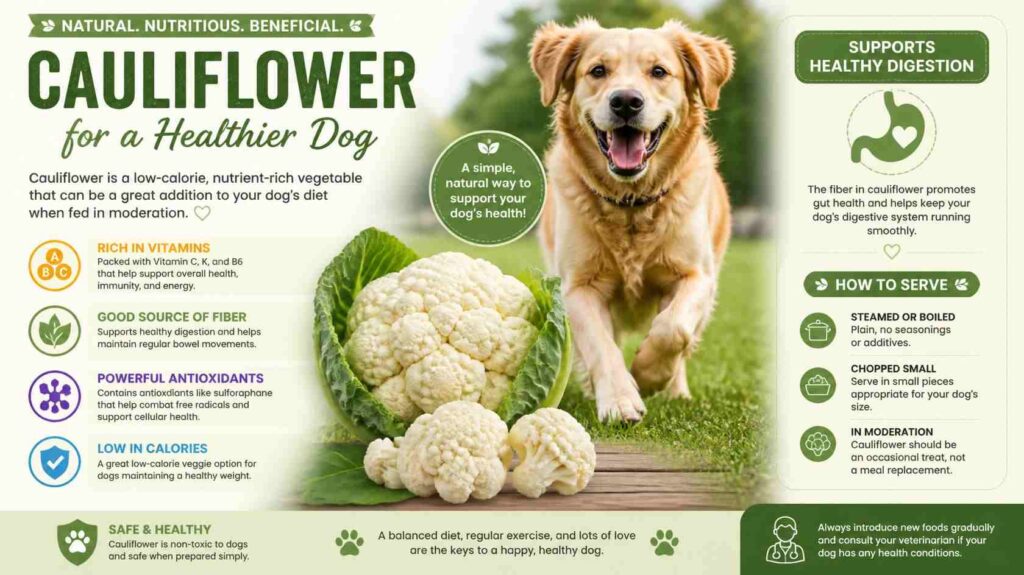
Yes, cauliflower is non-toxic to dogs and considered safe when prepared and served correctly. It’s not on any veterinary “dangerous foods” list alongside grapes, onions, or xylitol.
That said, safe doesn’t mean unlimited. Cauliflower contains compounds that can cause digestive upset if your dog eats too much — more on that in a moment.
The short answer: a little cauliflower, prepared simply, is a healthy occasional treat for most dogs.
Nutritional Benefits of Cauliflower for Dogs
Cauliflower punches above its weight nutritionally. Here’s what’s inside that pale floret that’s actually useful for your dog:
- Vitamin C — supports immune function and helps fight oxidative stress
- Vitamin K — important for bone health and blood clotting
- Folate (Vitamin B9) — supports cell growth and DNA repair
- Choline — supports healthy brain function and liver health; often overlooked but genuinely valuable
- Fibre — promotes healthy digestion and gut motility
- Antioxidants — cauliflower contains sulforaphane and indole-3-carbinol, compounds linked to anti-inflammatory effects in studies on both humans and animals
- Low in calories — roughly 25 calories per 100g, making it a smart snack for dogs watching their weight
One thing competitors rarely mention: cauliflower also contains isothiocyanates, sulphur-containing compounds that give it that faint smell when cooked. These are the same compounds that can cause gas. They’re not harmful, but they’re worth knowing about if you have a gassy dog breed.
Potential Risks: What You Actually Need to Watch For
1. Gas and Bloating
This is the most common issue. Cauliflower is a cruciferous vegetable — the same family as broccoli, cabbage, and Brussels sprouts. These veggies ferment during digestion and produce gas.
For most dogs, a small amount is fine. But if you give your dog a large portion, don’t be surprised if the evening gets a little fragrant.
Real-life tip: If you already know your dog has a sensitive stomach or tends toward bloating, start with just one or two small florets and watch how they respond over 24 hours.
2. Thyroid Concerns with Large Amounts
Here’s something most articles skip: cauliflower contains goitrogenic compounds — substances that, in very large quantities, can interfere with thyroid function. This is rarely a problem with occasional treats, but if your dog has a diagnosed thyroid condition, check with your vet before adding cruciferous vegetables regularly.
This isn’t a reason to panic. It’s just good to know.
3. Choking Risk (Especially with Raw Cauliflower)
Large, dense chunks of raw cauliflower can be a choking hazard — particularly for small breeds or dogs that eat quickly. Always cut florets into bite-sized pieces appropriate for your dog’s size.
4. Allergies (Rare But Possible)
Cauliflower allergies in dogs are uncommon, but any new food carries a small risk. Introduce it gradually and watch for signs like itching, hives, swelling around the face, vomiting, or diarrhoea.
Raw vs. Cooked Cauliflower: Which Is Better?
Both are technically safe, but there are real differences worth knowing.
Raw Cauliflower
- Retains more nutrients
- Higher fibre content (can cause more gas)
- Firmer texture = more chewing required = greater choking risk
- Some dogs simply don’t like the texture or taste
Cooked Cauliflower
- Easier to digest
- Softer texture, safer for small dogs and seniors
- Loses some water-soluble vitamins during cooking
- Steaming is the best cooking method — it preserves the most nutrients while softening the texture
Bottom line: Lightly steamed or raw cauliflower (in small pieces) are both fine. What matters more is how you prepare it, not whether it’s raw or cooked.
How to Safely Prepare Cauliflower for Your Dog
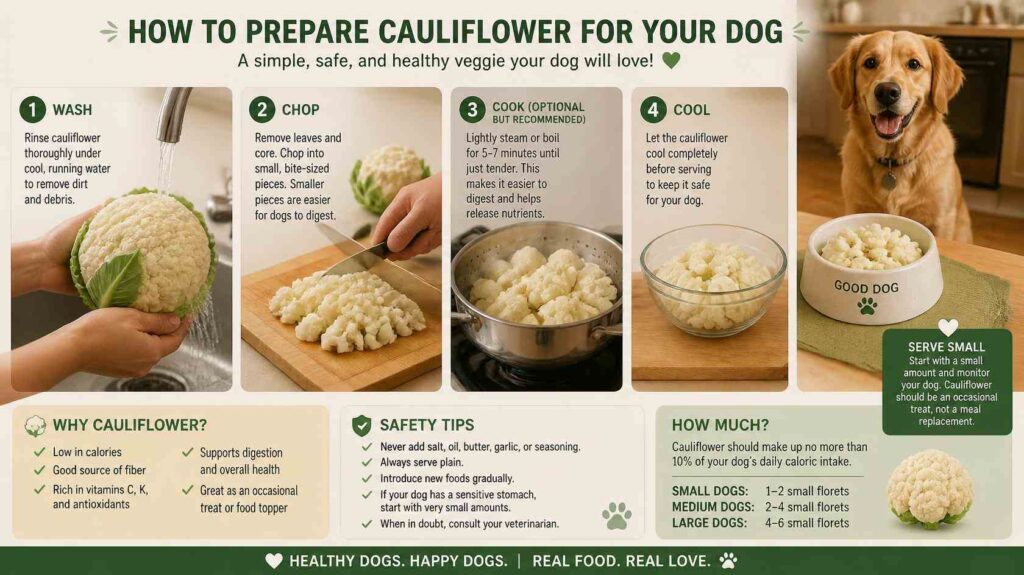
Follow these simple steps:
- Wash thoroughly — remove any pesticides or residue
- Remove leaves — cauliflower leaves are not toxic, but they have a bitter taste most dogs don’t enjoy and can be tough to digest
- Cut into small pieces — match the size to your dog; a Chihuahua needs tiny pieces, a Labrador can handle a whole small floret
- Steam or serve raw — no oil, no butter, no seasoning
- Serve alone or mixed into their regular food — many dogs enjoy it mixed in with their kibble
What to Avoid
- Cauliflower cheese — the dairy and salt are harmful to dogs
- Cauliflower rice dishes — often contain garlic or onion, which are toxic to dogs
- Roasted cauliflower — usually made with oil, salt, and spices; none of which your dog needs
- Cauliflower as part of a human meal — seasonings, sauces, and dressings are the danger, not the cauliflower itself
How Much Cauliflower Can Dogs Eat?
Use the 10% rule as your guide: treats (including vegetables) should make up no more than 10% of your dog’s daily caloric intake.
Here’s a rough serving guide:
| Dog Size | Weight | Suggested Amount |
|---|---|---|
| Extra small (toy breeds) | Under 5 kg | 1–2 small florets |
| Small | 5–10 kg | 2–3 florets |
| Medium | 10–25 kg | A small handful of florets |
| Large | 25–40 kg | Up to half a cup, chopped |
| Extra large | Over 40 kg | Up to one cup, chopped |
How often? Two to three times per week is a reasonable frequency. It doesn’t need to be an everyday thing — variety in treats is actually healthier than repetition.
Can Puppies Eat Cauliflower?
Yes, but with extra caution. Puppies have more sensitive digestive systems than adult dogs. Their gut bacteria are still developing, and new foods can cause diarrhoea more easily.
If you’d like to introduce cauliflower to a puppy:
- Wait until they’re at least 12 weeks old and fully weaned
- Start with a single tiny piece — smaller than a fingernail
- Wait 48 hours before offering more
- Steam it first to make it as easy to digest as possible
Signs Your Dog Didn’t Tolerate Cauliflower Well
Most dogs handle cauliflower without issue, but keep an eye out for:
- Excessive gas or bloating — more than their usual amount
- Loose stools or diarrhoea — usually passes within 24 hours
- Vomiting — if it happens once and they seem fine, monitor; if it continues, call your vet
- Lethargy or loss of appetite — less common, but worth noting
- Itching, hives, or swollen face — these suggest an allergic reaction; contact your vet promptly
If you see mild gas or soft stools after the first time, simply reduce the amount. That’s your dog telling you what their limit is.

Cauliflower vs. Other Dog-Safe Vegetables
Wondering how cauliflower stacks up against other options? Here’s a quick comparison:
| Vegetable | Safe for Dogs? | Best Benefit |
|---|---|---|
| Cauliflower | ✅ Yes | Antioxidants, low calorie |
| Carrots | ✅ Yes | Great for teeth, high in beta-carotene |
| Broccoli | ✅ In small amounts | High vitamin C (stems preferred) |
| Cucumber | ✅ Yes | Very low calorie, hydrating |
| Spinach | ⚠️ Occasionally | High oxalates — limit frequency |
| Onion | ❌ No | Toxic to dogs |
| Garlic | ❌ No | Toxic, even in small amounts |
If your dog doesn’t seem interested in cauliflower, carrots and cucumber are often bigger hits and just as healthy.
When to Ask Your Vet
You don’t need to call your vet every time you give your dog a new vegetable. But do check in if:
- Your dog has a diagnosed thyroid condition
- They’re on a prescription or therapeutic diet
- They have a history of pancreatitis (the low-fat content of cauliflower is fine, but always check with any dietary addition)
- They show signs of an allergic reaction after eating it
- Your dog is a senior with kidney or liver issues
A quick message to your vet’s practice (many UK, Australian, and Canadian vets now offer online consultations) can save you unnecessary worry.
FAQ: Can Dogs Eat Cauliflower?
1.Can dogs eat cauliflower every day?
Technically yes, in small amounts, but daily isn’t necessary or ideal. Two to three times a week is plenty. Rotating vegetables gives your dog more variety and a broader range of nutrients.
2.Is cauliflower good for dogs with allergies?
Cauliflower is not a common allergen and doesn’t contain gluten or meat proteins, so it can be a good treat for dogs with food sensitivities. That said, any new food can trigger a reaction — always introduce it slowly.
3.Can dogs eat cauliflower stems and leaves?
Stems are safe and actually easier to chew than florets for some dogs. Leaves are also non-toxic but are bitter and tough, so most dogs will turn their nose up at them. No harm if they eat them, though.
4.My dog ate a lot of cauliflower — should I be worried?
A large amount might cause gas, bloating, or loose stools, but it’s unlikely to cause serious harm. Monitor them for 24–48 hours. If they’re vomiting repeatedly or seem very uncomfortable, call your vet.
5.Can cauliflower cause gas in dogs?
Yes — this is the most common side effect. It’s caused by the sulphur compounds in cruciferous vegetables fermenting in the gut. It’s harmless but unpleasant. Reducing the portion size usually solves it.
6.Is frozen cauliflower safe for dogs?
Yes, as long as it’s plain with no added salt or seasoning. Thaw it first or lightly steam it — very cold hard chunks can be uncomfortable and a choking risk.
7.What’s the safest way to serve cauliflower to a small dog?
Steam it until soft, cut it into pea-sized pieces, and offer just one or two at a time. Small breeds have small digestive systems, so less is always more.
Final Thoughts
Cauliflower is a genuinely solid occasional treat for dogs — low in calories, full of useful nutrients, and easy to prepare. The key is keeping portions sensible, skipping any seasoning or sauces, and paying attention to how your individual dog responds.
Not every dog will love it (some are just not vegetable fans, and that’s fine), but for those who do, it’s a healthy addition to their treat rotation.
When in doubt, start small, watch your dog, and let their reaction guide you. You know your dog better than any article does.
#. Related Articles: