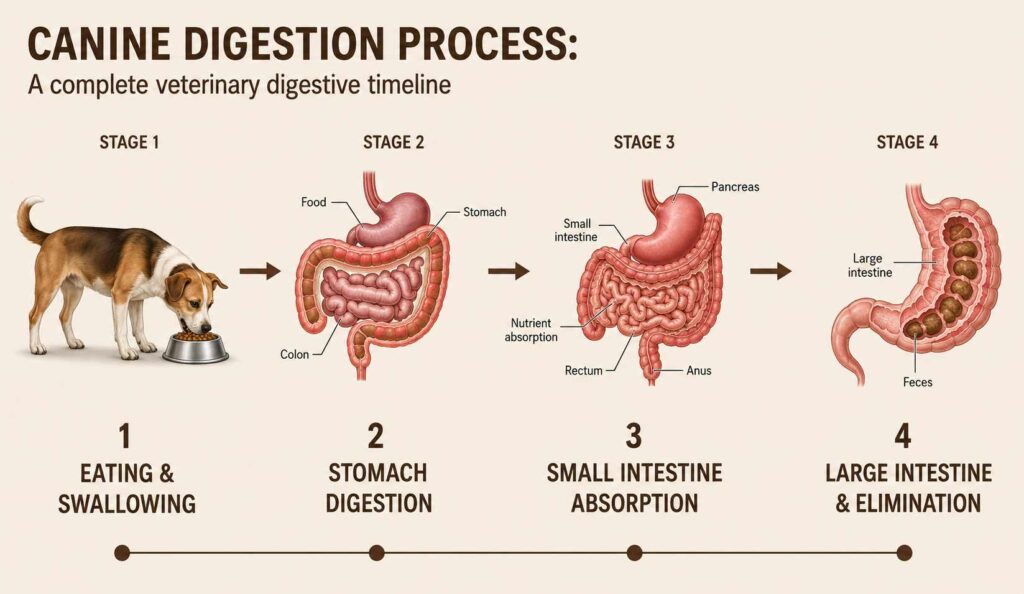
How long does it take a dog to digest food? The answer isn’t one fixed number. If you’ve ever watched your dog poop twenty minutes after breakfast and wondered, “Wait, did that meal really just go straight through?” you’re not alone. A dog’s digestion involves several different processes happening on different timelines: food leaving the stomach, nutrients being absorbed, material moving through the intestines, and finally passing stool. Veterinary references also treat digestion, absorption, gastrointestinal motility, and elimination as distinct digestive functions.
That means there is no single digestion time that applies to every dog or every meal. Two healthy dogs can eat similar food and still process it differently, and even the same dog’s timing can vary from one meal to the next.
One Meal, Several Different Clocks
The easiest way to understand dog digestion is to stop thinking about one clock. There are several.
Clock 1: Food Leaving the Stomach
This is gastric emptying. The stomach mixes food with gastric secretions and gradually releases its contents into the small intestine.
Gastric emptying is an important milestone, but it does not mean digestion is finished. It only tells us that material is moving out of the stomach.
Clock 2: Breaking Food Down and Absorbing Nutrients
Once food moves into the small intestine, digestion and absorption continue as digestive enzymes and bile help break nutrients into forms the body can use. The small intestine is also a major site of nutrient absorption.
This is one reason “How long until my dog poops?” and “How long until my dog digests a meal?” are not the same question.
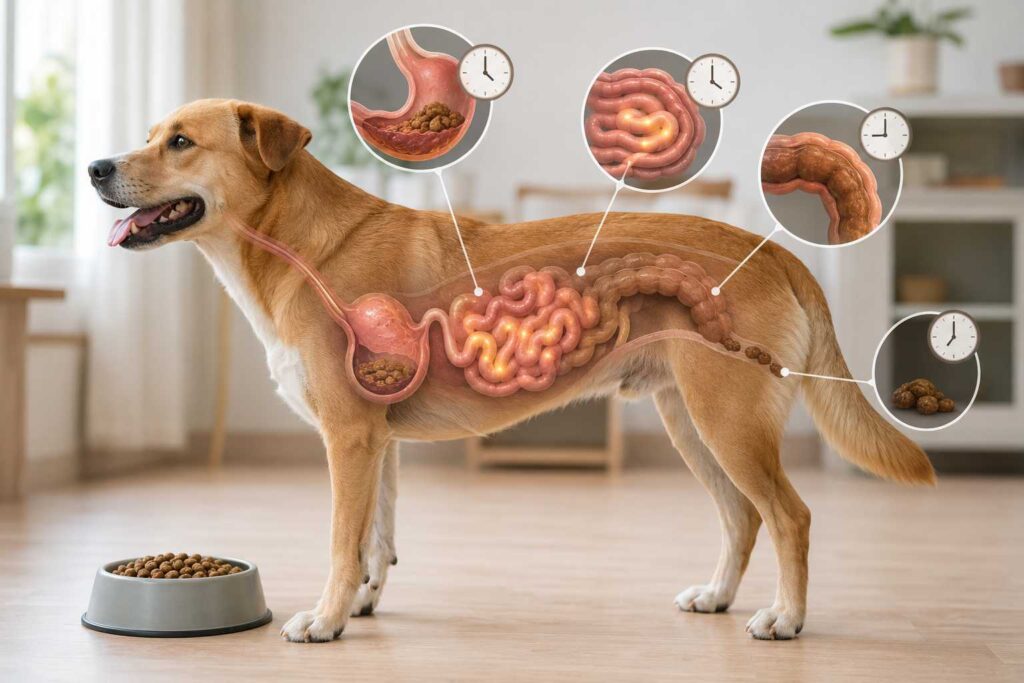
Clock 3: Moving Through the Rest of the Intestines
After much of the usable nutrition has been absorbed, the remaining material continues through the intestinal tract. In the large intestine, water and electrolytes are handled further and fecal material is stored before elimination.
Clock 4: Finally Passing Stool
This is the part owners can actually see. But a bowel movement doesn’t tell you exactly which meal produced it.
A dog that poops shortly after breakfast has not necessarily moved that breakfast from bowl to backyard in a few minutes. The stool being passed was generally already much farther along in the digestive tract.
Key takeaway: stomach emptying, nutrient digestion, intestinal transit, and pooping do not run on the same clock. Treating them as one process is why digestion-time estimates can sound so contradictory.
What Does “Digestion Time” Actually Mean?
| Term | What It Refers To | Commonly Mistaken For | Practical Meaning |
|---|---|---|---|
| Gastric emptying | Food leaving the stomach | Complete digestion | Only one stage of the process |
| Digestion and absorption | Food being broken down and nutrients absorbed | Poop timing | Happens mainly earlier in the GI tract |
| Intestinal transit | Material moving through the intestines | Stomach emptying | A separate process |
| Whole-gut transit | Overall passage through the gastrointestinal tract | One fixed digestion time | Can vary considerably |
| Post-meal poop | Stool already far along and ready to be passed | The meal just eaten | Usually not that newly eaten meal |
This distinction also explains why studies can report very different “digestion” or gastric-emptying times. Researchers may be measuring different stages, using different meal types, or tracking markers that do not behave exactly like ordinary food. For example, one study using small markers alongside kibble found that progressively larger portions of those markers left the stomach over several hours rather than at one fixed moment.
Following the Meal, Without Turning It Into a Stopwatch
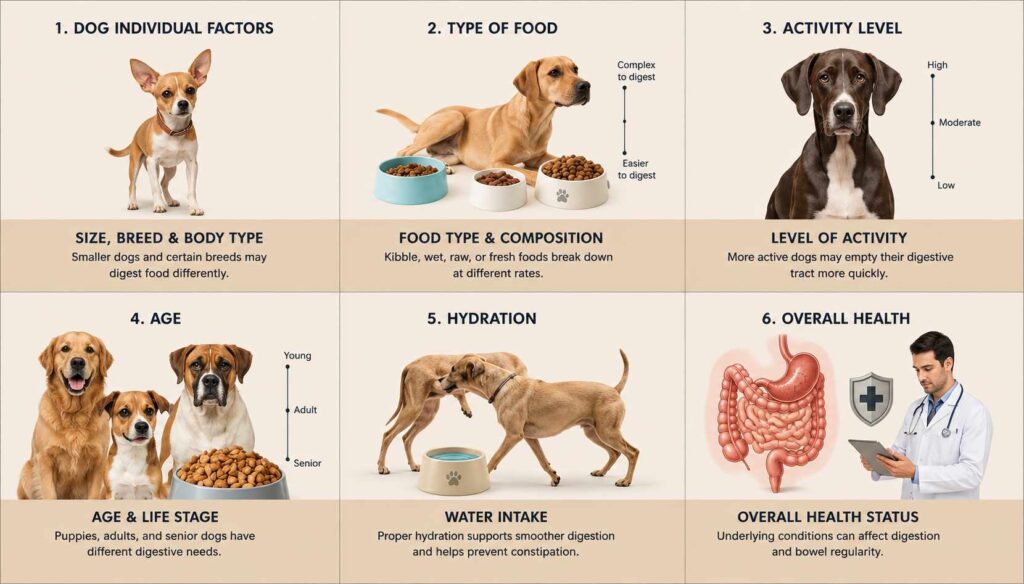
Eating and Swallowing
Digestion begins in the mouth with chewing and salivation, followed by swallowing and movement through the oesophagus into the stomach.
Dogs vary widely in how thoroughly they chew. Some take their time; others seem determined to finish dinner before you’ve put the food scoop away. Either way, the important point is that swallowing is only the beginning of a much longer digestive process.
The Stomach Does More Than Hold Food
Once food arrives, the stomach mixes and processes it before gradually releasing material into the small intestine.
How quickly that happens depends partly on the characteristics of the meal. Research in dogs shows that meal volume can influence gastric emptying, and dietary fat can also alter how long material remains in the stomach.
That is why a large, rich meal should not be expected to behave exactly like a dog’s usual smaller meal.
Where Most Nutrient Absorption Happens
The small intestine does much of the nutritional heavy lifting. Pancreatic enzymes help digest food, while bile supports fat digestion, and the intestinal lining absorbs nutrients so they can be used by the body.
By this stage, “how long until poop?” still doesn’t tell you how effectively the dog is digesting and absorbing nutrients.
What Happens Before Stool Is Ready
Material that remains after digestion and absorption moves into the large intestine. Here, fluid and electrolytes are handled further, gut bacteria interact with the remaining material, and feces are stored until the dog defecates.
So the bowel movement you see is the end of a multi-stage process, not a direct timestamp for the meal that just went into the bowl.
Why Your Dog May Poop Soon After Eating
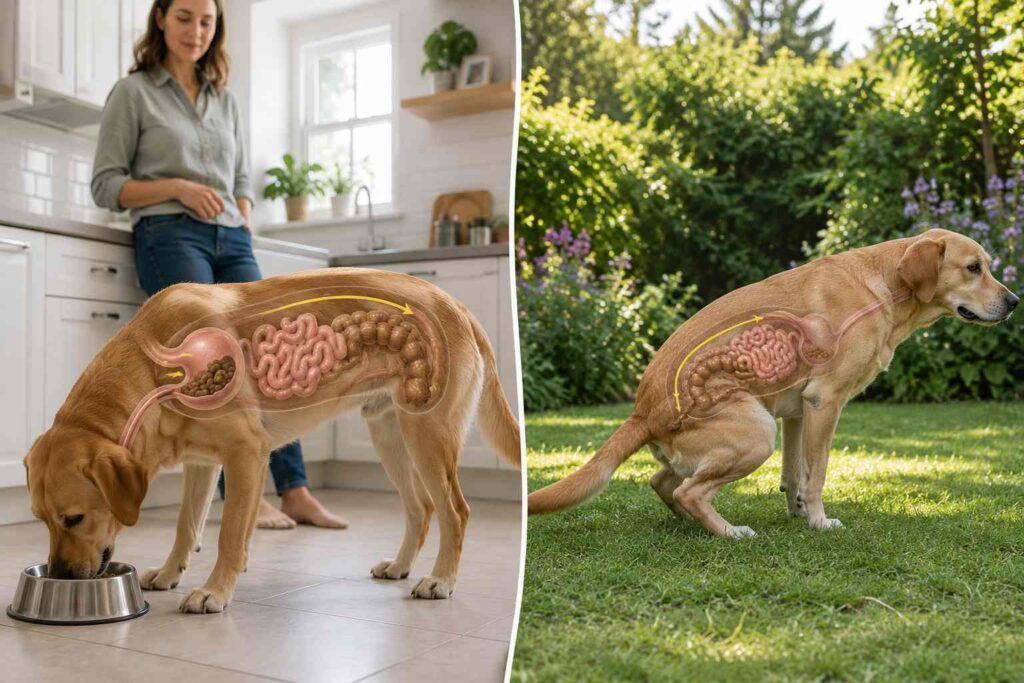
The Breakfast-to-Bathroom Myth
Imagine your dog eats breakfast at 7:00 a.m. and asks to go outside at 7:20.
It is tempting to think breakfast travelled through the stomach, small intestine, large intestine, and out the other end in twenty minutes. It didn’t.
That bowel movement is far more likely to contain material that was already much farther along in the digestive tract before breakfast started.
Eating Can Trigger Movement Farther Down the Gut
Eating can stimulate gastrointestinal motility, including activity farther along the tract. In practical terms, putting new food into the digestive system can help prompt already-formed or nearly formed stool toward elimination.
This is why a predictable after-meal bathroom trip can be completely normal and does not prove that your dog has unusually “fast digestion.”
Puppies May Need to Go Out Even Faster
Puppies often need a toilet break soon after eating, which is why taking them outside after meals is useful during house-training.
But an immediate post-meal poop should not be interpreted as that meal having already passed through the entire digestive system. Their bathroom schedule and the transit time of the food they just ate are two different things.
Why the Same Dog Can Have Different Timing From One Meal to the Next
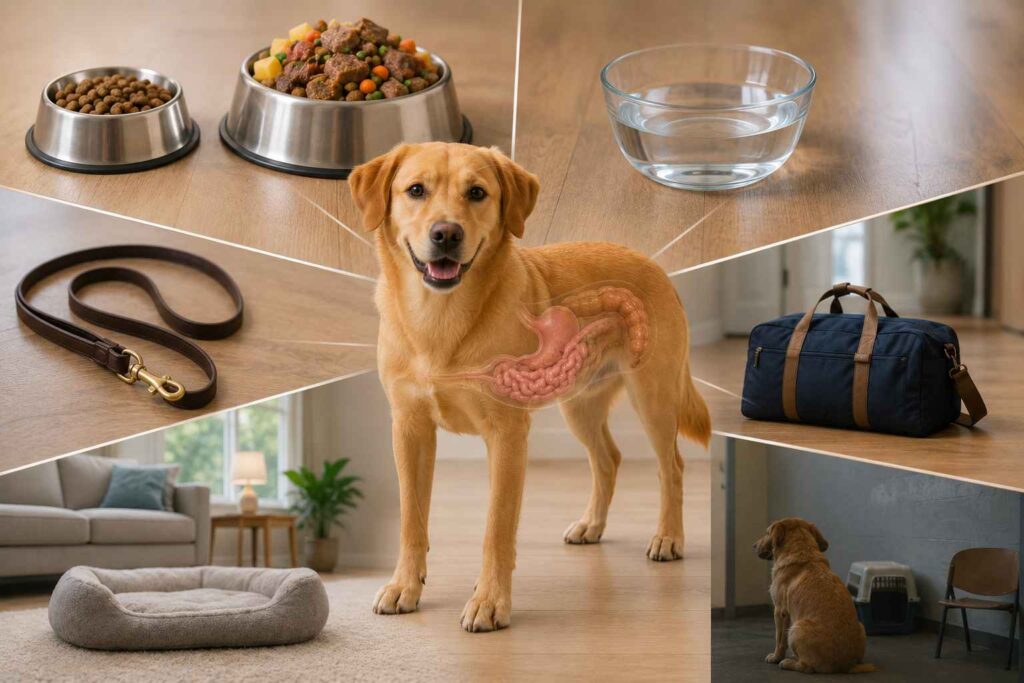
What Changed About the Meal?
Meal characteristics matter.
Factors that may influence gastrointestinal processing include:
- meal size
- fat content
- fibre content and type
- moisture
- physical form of the food
- whether the meal was unusually rich or different from the dog’s normal diet
Fibre is a good example of why simple rules don’t work well. Different types of fibre can affect gastric emptying, small-intestinal transit, stool water content, and colonic activity in different ways.
So “more fibre makes digestion faster” or “more fibre slows digestion” is too simplistic.
What Changed About the Dog?
Age and life stage can influence feeding patterns and bowel habits, but they still cannot tell you an exact digestion time.
More important is what is normal for your individual dog. A change in gastrointestinal function may also be associated with:
- illness
- changes in appetite
- medications
- gastrointestinal inflammation
- pancreatic or intestinal disease
- constipation or abnormal motility
Repeated vomiting, ongoing diarrhea, weight loss, loss of appetite, abdominal discomfort, or a major change from your dog’s usual bowel pattern deserves more attention than whether a meal took a particular number of hours to pass.
What Changed Around the Dog?
Routine matters too.
Travel, boarding, veterinary hospitalization, unfamiliar environments, changes in activity, stress, and altered access to water can all coincide with changes in eating or bowel habits.
That does not mean every unusual poop during a stressful week is a medical problem. Look at the whole picture: Is your dog eating normally, comfortable, hydrated, energetic, and otherwise acting like themselves?
If digestive changes persist or appear alongside vomiting, abdominal pain, loss of appetite, bloating, weakness, dehydration, or difficulty passing stool, contact your veterinarian. Merck Veterinary Manual lists vomiting or regurgitation, diarrhea, constipation, appetite loss, abdominal pain and bloating, straining, bleeding, shock, and dehydration among signs associated with digestive-system disease.
Why Body Size Shouldn’t Be Used as a Stopwatch
It’s tempting to say, “small dogs digest faster, large dogs digest slower,” but body size isn’t reliable enough to predict an individual dog’s digestion time. Size may play a role, but meal composition, portion size, health, age, stress, and normal individual variation can matter just as much.
So avoid breed- or size-based charts that promise an exact number of hours. Your own dog’s usual pattern is far more useful than a generic stopwatch.
Kibble, Wet, Fresh and Raw Food: What Can You Actually Compare?
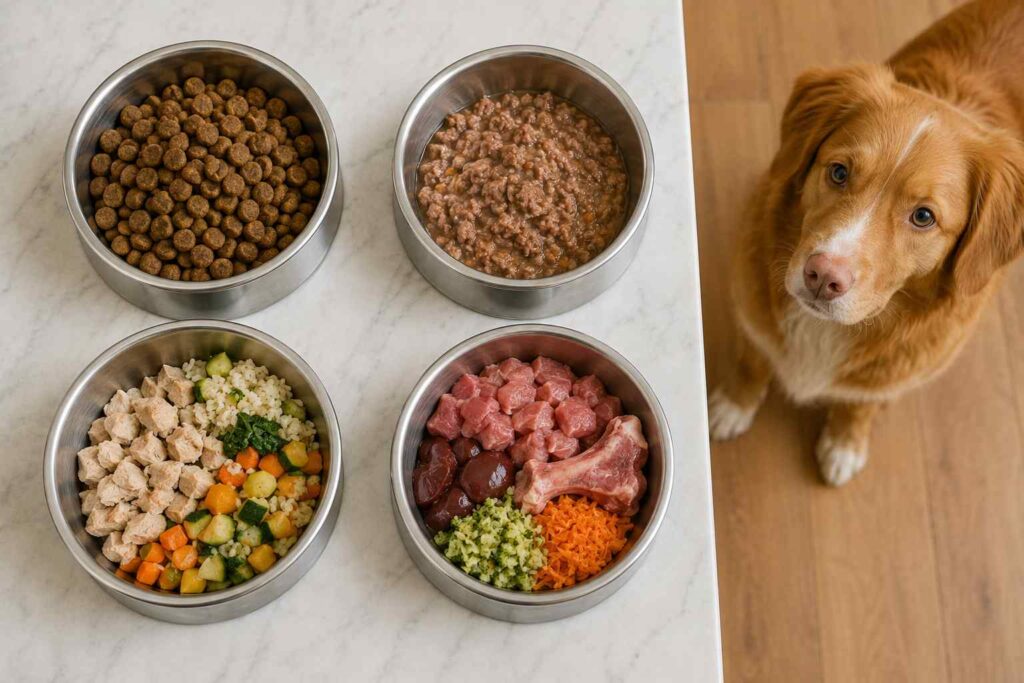
Why Moisture and Physical Form May Matter
The physical form and moisture content of a meal can influence how the stomach handles it, but that doesn’t translate into a universal digestion time for kibble, canned food, fresh food, or raw food.
A dog’s response also depends on how much was eaten, the nutrient composition of the meal, and the individual dog.
Why “Faster” Doesn’t Mean “More Digestible”
Digestion speed and digestibility are not the same thing.
A food that moves through the gastrointestinal tract more quickly is not automatically better absorbed, more nutritious, or healthier. Digestibility refers to how much of a food’s nutrients the body can break down and absorb; transit time describes how material moves through the digestive tract.
That distinction matters when comparing dog foods. Faster is not automatically better.
Why Raw Food Shouldn’t Get Its Own Guaranteed Timeline
You’ll often see claims that raw food “digests in X hours” or is healthier because it supposedly passes through faster. Those claims are too broad to apply to every dog.
Raw meals can differ enormously in fat content, ingredients, portion size, and physical form, so assigning one digestion time to the entire category is misleading. The same caution applies to blanket claims about kibble, wet food, or fresh diets.
Meal Size May Matter as Much as the Label on the Bowl
What your dog eats matters, but so does how much they eat.
A large or unusually rich meal may behave differently from the dog’s normal portion, regardless of whether it is kibble, wet, fresh, or raw. This is why food type alone isn’t a dependable way to predict digestion time.
What Normal Digestion Looks Like From the Outside
A Consistent Pattern Matters More Than a Perfect Schedule
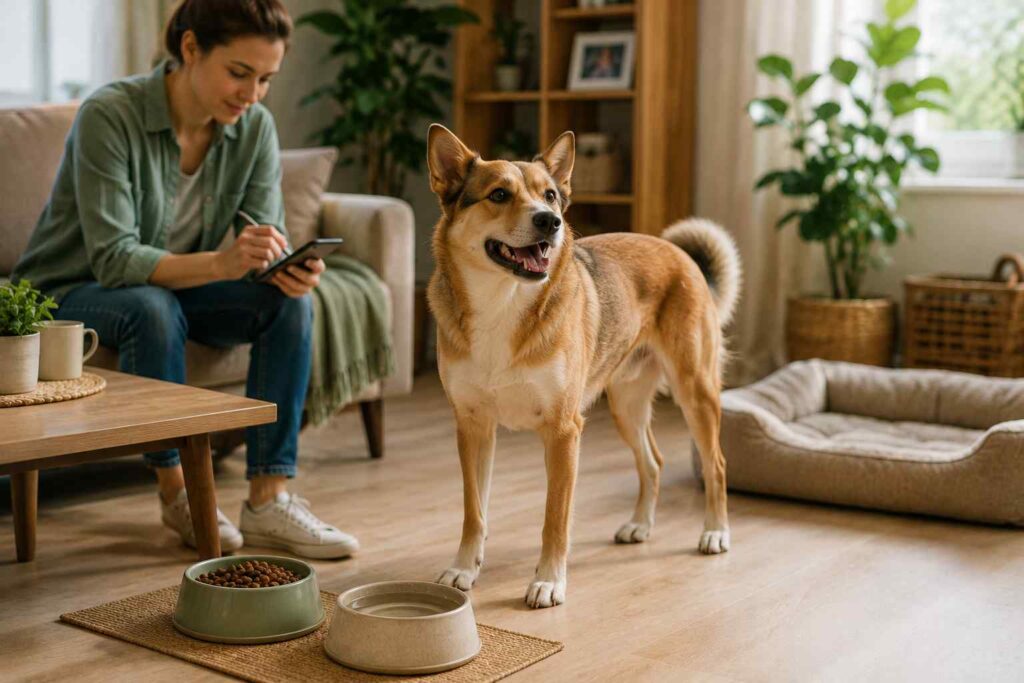
You can’t watch nutrient absorption happening at home, so focus on the things you can observe:
- normal appetite
- comfort after meals
- usual energy levels
- regular bowel habits
- reasonably consistent stool quality
- no repeated vomiting, straining, or abdominal discomfort
The goal isn’t for food to move through as quickly as possible. What matters more is that your dog is comfortable and their eating and bowel habits remain reasonably consistent for them.
One Odd Bowel Movement Isn’t a Transit-Time Test
One soft, unusually timed, or slightly different stool doesn’t tell you how fast your dog’s entire digestive system is working.
Look for patterns instead. A repeated change in stool quality, frequency, appetite, or comfort is more meaningful than a single bowel movement—especially if other symptoms appear at the same time.
A Better Way to Track Your Dog’s Digestion
- Note what your dog ate.
- Record roughly when they ate it.
- Note unusual treats, table scraps, or scavenged food.
- Track vomiting and regurgitation separately.
- Record bowel movement timing.
- Note stool consistency and any unusual colour.
- Watch appetite and water intake.
- Note abdominal discomfort, swelling, or bloating.
- Record new medications or supplements.
- Note recent food changes, travel, boarding, or stress.
- Compare changes with your dog’s normal pattern, not a fixed number found online.
- Contact your vet if concerning symptoms appear or changes keep recurring.
When “Fast Digestion” Is Really Something Else
Diarrhoea doesn’t prove that the most recent meal raced through your dog. The timing of loose stool alone usually can’t identify exactly which meal triggered it.
Frequent bowel movements don’t automatically mean nutrients aren’t being absorbed properly either. Stool frequency can change for many reasons, including diet, fibre intake, stress, gastrointestinal irritation, and changes in routine.
Undigested-looking material also needs context. A one-off episode is different from repeatedly seeing food in vomit or stool alongside weight loss, poor appetite, diarrhoea, or other signs of illness.
It’s also useful to distinguish vomiting from regurgitation. Vomiting is typically an active process that may involve nausea, retching, and abdominal contractions. Regurgitation is generally more passive, with food or fluid coming back up with little warning or effort.
If either happens repeatedly, particularly after meals, veterinary assessment is appropriate rather than trying to calculate how long the food should have stayed in the stomach.
When “Slow Digestion” Is Really Something Else
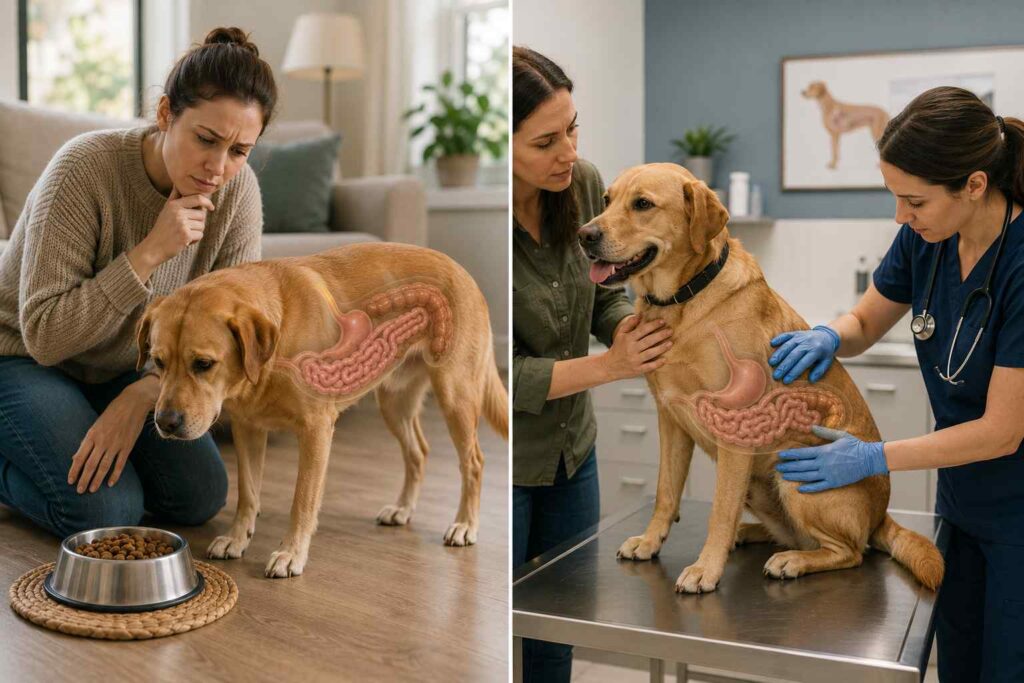
Constipation is not the same thing as delayed stomach emptying. They involve different parts of the digestive tract and can have very different causes.
Likewise, a dog not producing stool doesn’t tell you exactly where the problem is. Reduced food intake, dehydration, constipation, gastrointestinal disease, medication effects, or an obstruction can all change bowel habits.
Repeated vomiting several hours after meals also shouldn’t be explained away as “slow digestion.” If it keeps happening—especially with appetite loss, abdominal pain, lethargy, bloating, or difficulty keeping water down—it deserves veterinary attention.
Important: Normal Digestion Rules Don’t Apply to Swallowed Objects
If your dog has swallowed a toy, sock, corn cob, bone fragment, string, or another non-food object, do not use normal food digestion timelines to decide whether it is safe to wait.
A foreign object may move differently from food, become lodged, or cause a partial or complete obstruction. Passing some stool afterward does not prove that the object has passed safely.
Do not induce vomiting unless a veterinarian specifically instructs you to do so.
Contact a veterinarian promptly if you know or suspect your dog has swallowed something they shouldn’t have—particularly if they develop:
- repeated vomiting or retching
- loss of appetite
- abdominal pain or swelling
- unusual lethargy or weakness
- difficulty passing stool
- repeated straining
- inability to keep water down
With suspected foreign-body ingestion, symptoms and the type of object matter far more than an estimated digestion time.
When Digestion Timing Stops Being a Nutrition Question
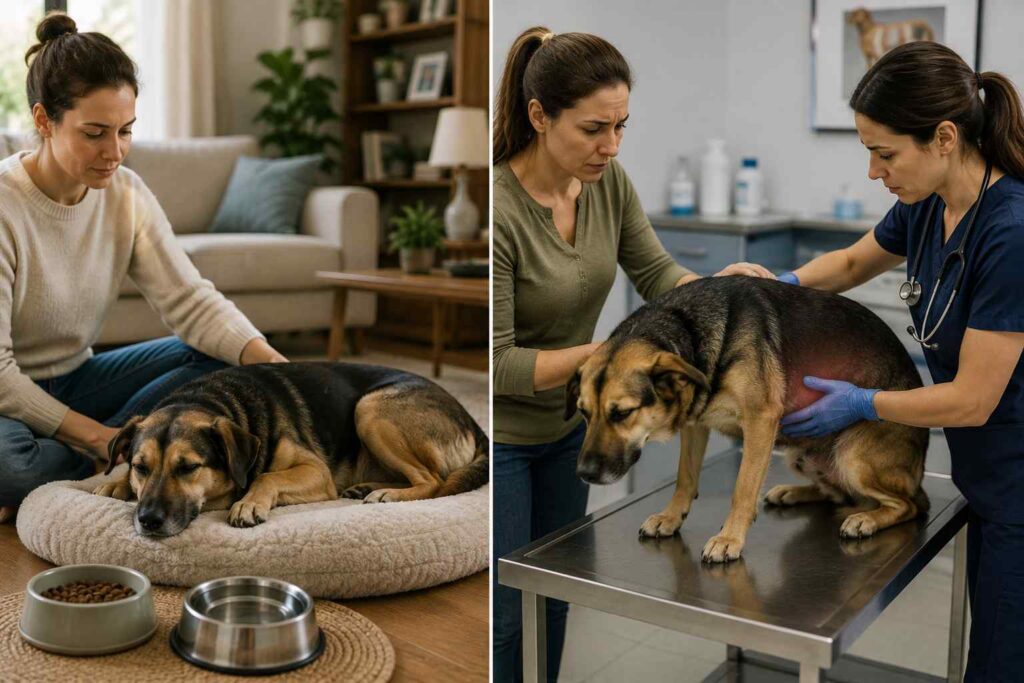
Signs That Deserve Prompt Veterinary Advice
Contact your vet if your dog has repeated vomiting, loss of appetite, persistent diarrhoea, repeated straining, marked lethargy, unusual abdominal discomfort, or signs of dehydration.
A change in digestion timing matters far more when it appears alongside other symptoms or is clearly different from your dog’s normal pattern.
Signs That Can Be an Emergency
Seek urgent veterinary care for:
- a distended or swollen abdomen
- repeated attempts to vomit that bring little or nothing up
- collapse or marked weakness
- severe abdominal pain
- suspected foreign-object ingestion
- blood in vomit or stool, or black, tarry stool
- repeated vomiting or an inability to keep water down
A swollen abdomen combined with repeated unproductive retching is particularly concerning because it can occur with gastric dilatation-volvulus (GDV, or bloat), a life-threatening emergency.
Gastrointestinal obstruction is another emergency possibility. Merck Veterinary Manual notes that intestinal obstruction may be partial or complete and can cause vomiting, appetite loss, lethargy, abdominal pain or swelling, dehydration, and potentially shock.
Medical conditions that can genuinely alter gastrointestinal function include gastroenteritis, pancreatitis, intestinal obstruction, motility disorders, exocrine pancreatic insufficiency, and chronic intestinal disease. “Slow digestion” shouldn’t be diagnosed from stool timing alone. The same outward symptom can have several possible causes, and your vet can determine whether further examination or testing is needed.
What Information Helps Your Vet Most
If you need to call your vet, having a few details ready can make the situation much easier to assess:
- Your dog’s usual feeding schedule
- Exactly what food and treats they ate
- Approximate amount eaten
- Time of the most recent meal
- Whether they vomited or regurgitated
- Time of the last normal bowel movement
- Changes in stool colour, consistency, or frequency
- Appetite and water intake
- Any abdominal swelling or apparent pain
- Possible foreign-object or toxin exposure
- Current medications and supplements
- Recent diet changes
- A simple timeline of when symptoms began and how they have changed
If you suspect your dog swallowed something, tell the vet what the object was, approximately how much or how large it was, and when it happened if you know.
Common Mistakes That Make Digestion Timing More Confusing
- Treating one digestion-time number found online as universal
- Assuming a poop immediately after dinner contains that dinner
- Calling constipation “slow stomach digestion”
- Assuming diarrhoea means the latest meal moved through instantly
- Thinking faster digestion automatically means healthier or more digestible food
- Assuming raw, wet, or fresh food has a guaranteed faster timeline
- Using body size to predict an exact number of digestion hours
- Giving probiotics or digestive enzymes simply to “speed things up”
- Making repeated food changes after one unusual stool
- Waiting for a swallowed object to pass because “food takes 24–48 hours”
Quick Tips for an Easier GI Routine
- Keep your dog’s feeding schedule reasonably consistent
- Make diet changes gradually when appropriate
- Avoid sudden unusually large or rich meals
- Keep fresh water available
- Track patterns rather than isolated bowel movements
- Don’t add digestive supplements automatically
- Know your dog’s normal appetite, stool frequency, and stool quality
- Pay attention to combinations of symptoms rather than digestion timing alone
- Seek veterinary advice when your dog’s normal pattern changes and stays changed
The Practical Takeaway
There’s no universal stopwatch for dog digestion. Stomach emptying, nutrient digestion and absorption, intestinal transit, and elimination are different processes, and their timing varies with the meal, the individual dog, and their health and circumstances.
The most useful thing you can do isn’t memorise one number. Learn what’s normal for your dog—when they usually eat, how often they poop, what their normal stool looks like, and how they behave after meals. That makes a genuine change much easier to spot.
And when vomiting, pain, bloating, weakness, significant stool changes, or possible foreign-object ingestion enters the picture, symptoms matter more than the clock.
Frequently Asked Questions
1.How long does it take a dog to digest food completely?
There isn’t one fixed number because “digestion” includes several stages. Food leaving the stomach can occur well before the remaining material completes its journey through the intestines. Total gastrointestinal transit can extend into roughly one to two days in healthy dogs, with considerable individual and meal-to-meal variation. That is why an exact hour count is rarely useful for judging whether a dog is healthy.
2.Why does my dog poop right after eating?
Eating can stimulate movement in the colon, encouraging stool that was already farther along the digestive tract to be passed. So a bowel movement shortly after breakfast or dinner is generally not that newly eaten meal travelling through the entire digestive system in minutes.
3.Does kibble take longer to digest than wet food?
Physical form, moisture, meal size, and nutrient composition can affect how the stomach processes food, but there isn’t a reliable universal timetable saying kibble takes a certain number of hours and wet food another. The individual dog and the complete meal matter too.
4.Do puppies digest food faster than adult dogs?
Puppies often need to toilet soon after meals, but that doesn’t mean the meal they just ate has already travelled through their entire digestive tract. Post-meal bowel stimulation and overall gastrointestinal transit are different processes.
5.Does diarrhoea mean food moved through too quickly?
Not necessarily. Diarrhoea can have many causes, including sudden dietary changes, gastrointestinal inflammation, infection, parasites, stress, or other illness. Timing alone usually can’t tell you which meal caused it.
If diarrhoea is severe, persistent, bloody, accompanied by vomiting or lethargy, or your dog seems dehydrated or unwell, contact your vet. Merck Veterinary Manual notes that substantial fluid loss from diarrhoea can lead to dehydration and electrolyte imbalance.
6.Is regurgitation different from vomiting?
Yes. Vomiting is an active process that commonly involves nausea, retching, and abdominal contractions. Regurgitation is generally more passive, with food or fluid coming back up with little abdominal effort.
A single episode can have a relatively minor explanation, but repeated vomiting or regurgitation—particularly around meals—deserves veterinary assessment.
7.Can normal digestion time tell me when a swallowed object will pass?
No. Toys, bones, socks, string, and other foreign objects do not behave like normal food.
Some small objects may pass, but others can cause partial or complete obstruction, and deciding whether an object can be safely monitored is a veterinary decision. Merck Veterinary Manual notes that clinically stable dogs with certain foreign bodies may sometimes be monitored using serial imaging—rather than simply waiting for a predetermined number of hours.
If you know or suspect your dog swallowed a foreign object, contact your veterinarian for advice rather than relying on a normal food-transit estimate.
#. Related Articles:
1. How Much Food Should a Puppy Eat?