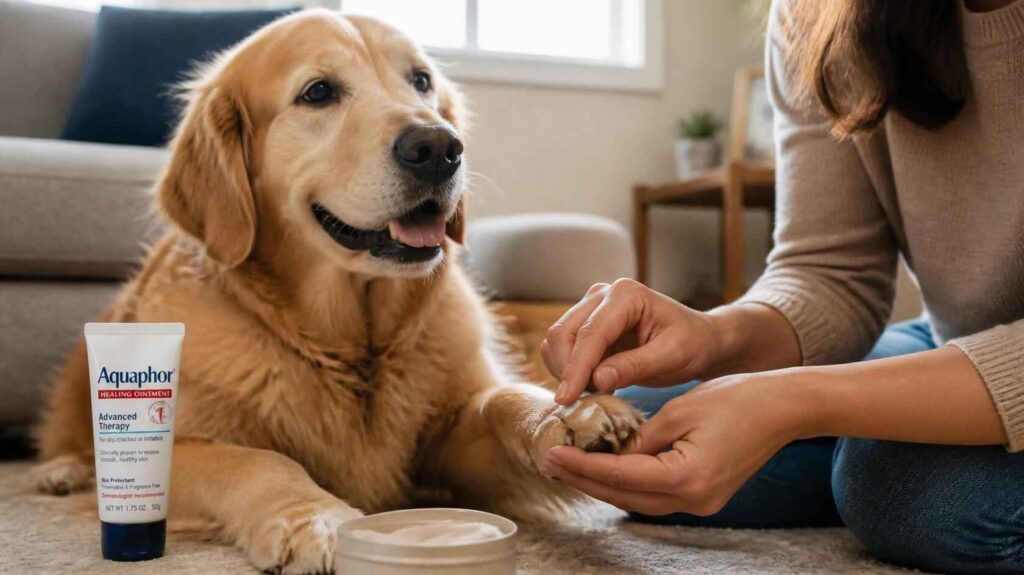
Is Aquaphor safe for dogs? In some situations, a small amount of standard Aquaphor Healing Ointment may be reasonable on mildly dry, intact skin—but that doesn’t mean it’s suitable for every dog or every skin problem.
You may be standing in the bathroom with the Aquaphor tub in one hand, looking at your dog’s rough paw pads. Or perhaps you’ve already applied some and now your dog is licking it off. Either way, what matters is the exact product, what your dog’s skin looks like, where you’re using it, and whether your dog can lick it.
Quick answer: Standard Aquaphor Healing Ointment is a petrolatum-based skin protectant. A small amount may be reasonable on mildly dry, intact skin, such as rough paw pads, provided the area isn’t painful, inflamed or infected and your dog isn’t repeatedly licking it. Aquaphor isn’t a veterinary medicine, so don’t use it to treat wounds, hot spots, infections or recurring skin problems without veterinary advice.
This guide will help you decide when a simple barrier ointment may be reasonable, what to do if your dog has already licked some, and when the skin problem matters more than the moisturiser.
Before You Use Aquaphor, Answer These Four Questions

A dry paw pad and a cracked, bleeding one are completely different problems, even though they’re on the same paw. Before reaching for Aquaphor, these four questions are more useful than simply asking whether it can go on a particular body part.
Which Aquaphor Product Do You Actually Have?
“Aquaphor” isn’t one product. Standard Aquaphor Healing Ointment contains petrolatum along with ingredients such as mineral oil, ceresin, lanolin alcohol, panthenol, glycerin and bisabolol. The brand also sells other products, and formulations can vary by product and market.
Check the exact product name and current ingredient list on the container. Don’t assume advice about standard Healing Ointment applies to every product carrying the Aquaphor name.
If yours contains additional active or medicated ingredients, check with your veterinarian before using it on your dog.
What Does Your Dog’s Skin Actually Look Like?
Look closely in good light. Is the skin:
- Mildly dry or rough, but otherwise normal?
- Cracked—and are the cracks shallow or deep?
- Red, swollen or unusually warm?
- Raw, wet, oozing or crusted?
- Bleeding?
- Obviously painful or very itchy?
The further down that list you go, the less this looks like a simple moisturising problem.
Where Are You Planning to Put It?
Paw pads, elbows and external dry skin are different from areas between the toes, inside the ears, around the eyes or mouth, wounds and surgical incisions.
Those more sensitive locations can be difficult to assess at home and may be hiding a problem that needs diagnosis rather than another topical product.
Can Your Dog Reach and Lick the Area?
One quick lick is different from repeatedly licking off every application. Repeated licking means more product may be swallowed, but it can also tell you something about the skin.
Dogs often lick areas that itch, hurt or feel irritated. If your dog won’t leave a spot alone, the reason for the licking may matter more than the dryness itself.
What Aquaphor Can Do (and What It Can’t)
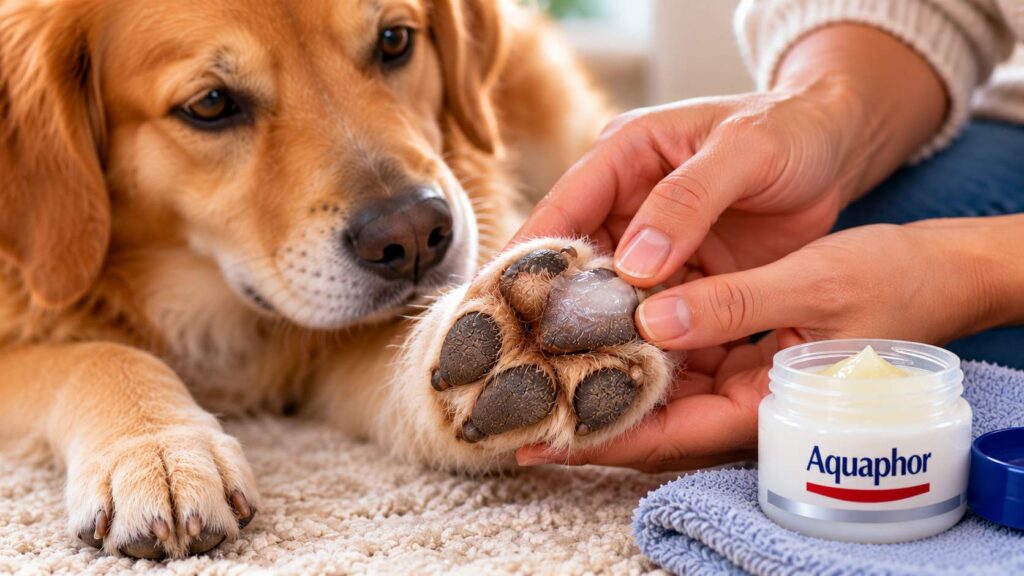
Think of Aquaphor as a moisture barrier, not a dog medicine. Petrolatum forms an occlusive layer over the skin surface that reduces moisture loss. That can support mildly dry, intact skin in an appropriate situation, but it doesn’t treat the reason the skin became abnormal.
| Aquaphor may help with | Aquaphor is not |
|---|---|
| Slowing moisture loss from dry skin | An antibiotic |
| Supporting mildly dry, intact skin | A treatment for allergies |
| Protecting the skin surface in suitable cases | An antifungal or yeast treatment |
| Acting as a basic moisture barrier | A treatment for deep or infected wounds |
| Short-term supportive skin care | A diagnosis for recurring skin problems |
It won’t cure bacterial or yeast infections, allergies, parasites or inflammatory skin disease. It also won’t tell you why a paw keeps cracking.
That’s an important distinction: skin looking softer after an ointment doesn’t mean the underlying problem has been fixed.
Let the Skin, Not the Body Part, Make the Decision
Here’s a more useful way to judge the situation.
Mildly Dry and Intact
Think rough paw pads, a dry pressure point on an elbow or mild flaking on external skin, with no bleeding, discharge, significant redness or obvious pain.
This is the type of situation where a thin layer of a simple barrier ointment may be reasonable as short-term supportive care. If the dryness keeps returning, though, don’t keep treating the surface indefinitely—find out why.
Cracked but Not Obviously Infected
A few shallow surface cracks are different from deep fissures.
If a crack is deep, bleeding, painful, swollen or causing your dog to limp, it deserves veterinary attention. Once skin is deeply cracked, its normal protective barrier is compromised and infection becomes a greater concern.
Don’t assume a deeper crack simply needs a thicker layer of ointment.
Red, Itchy or Repeatedly Licked
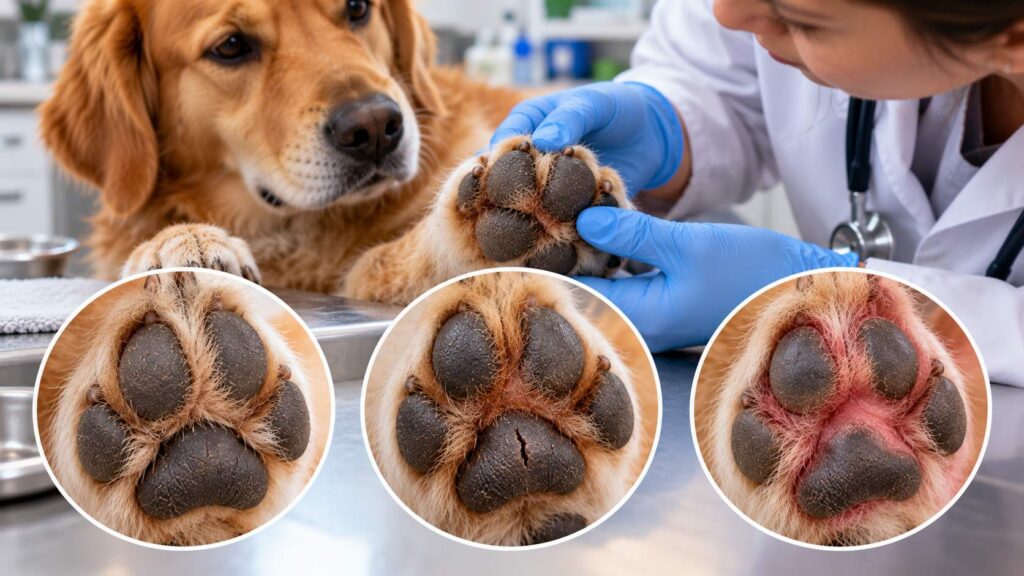
Now the question changes from “How do I moisturise this?” to “Why is this inflamed?”
Allergic skin disease, contact irritation, parasites, infection, foreign material and other problems can cause redness and persistent licking. Aquaphor won’t distinguish between them or treat most of them.
Raw, Wet, Oozing or Infected-Looking
This needs assessment rather than a moisturiser.
A hot spot, for example, is an active inflamed skin lesion, not simply dry skin. Avoid covering unexplained wet, raw or infected-looking areas with a thick occlusive layer unless your veterinarian has specifically advised it.
Deep Wound, Puncture, Bite or Burn
Skip the home moisturiser and contact your veterinarian.
Punctures and bites can be particularly deceptive because the opening on the surface may look small while deeper tissues have been damaged or contaminated.
⚠️ Stop Home Experimentation If You See Any of These
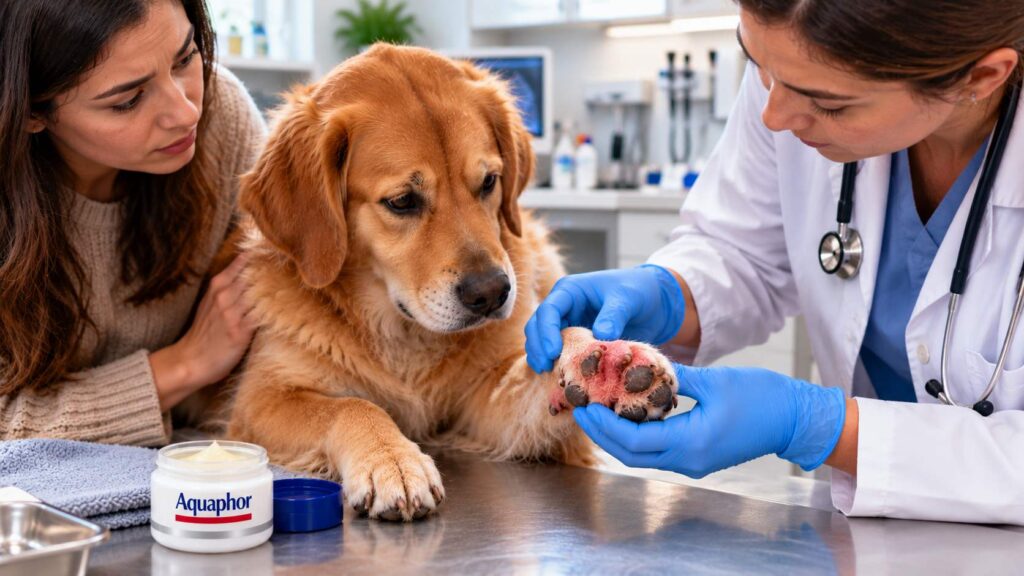
Don’t use Aquaphor—or another home skin remedy—to delay veterinary care if your dog has:
- A deep wound, puncture or bite
- Significant or persistent bleeding
- Pus, discharge or an unpleasant smell
- Spreading redness, swelling or heat
- Significant pain or limping
- A serious burn
- An injury involving the eye
- A problem with a surgical incision
- A lesion that’s worsening quickly
- Persistent licking or chewing that is damaging the skin
- A problem that improves briefly but keeps returning
If you’re unsure whether you’re looking at simple dryness or damaged skin, contact your veterinary clinic rather than trying a succession of creams and balms.
A Situation-by-Situation Guide
| Situation | Key question | Main concern | General direction |
|---|---|---|---|
| Mildly dry paw pad | Is the skin intact? | Licking, underlying dryness | A thin layer may be reasonable; monitor |
| Deeply cracked paw | Painful or bleeding? | Injury, infection | Veterinary assessment may be needed |
| Dry outer nose | Mild or persistent? | Underlying cause | Supportive care may be reasonable; investigate persistent changes |
| Dry elbow | Is the skin intact? | Pressure and friction | Barrier care may help if otherwise normal |
| Red, itchy skin | Why is it inflamed? | Allergy, infection or irritation | Find the cause first |
| Hot spot | Is it moist or raw? | Active skin disease | Not a simple moisturising problem |
| Superficial scrape | Is the skin actually open? | Contamination, irritation | Avoid guessing with topical products |
| Deep or puncture wound | How severe is it? | Tissue damage, infection | Veterinary care |
| Surgical incision | Did your vet approve it? | Healing complications | Follow veterinary instructions only |
| Near the eye | Could ointment enter the eye? | Eye irritation or injury | Avoid casual application |
The ears deserve special mention. Don’t put Aquaphor into your dog’s ear canal. Redness, discharge, odour, head shaking or persistent scratching can have several causes that require proper examination and treatment.
If Aquaphor Is Appropriate, Keep It Simple
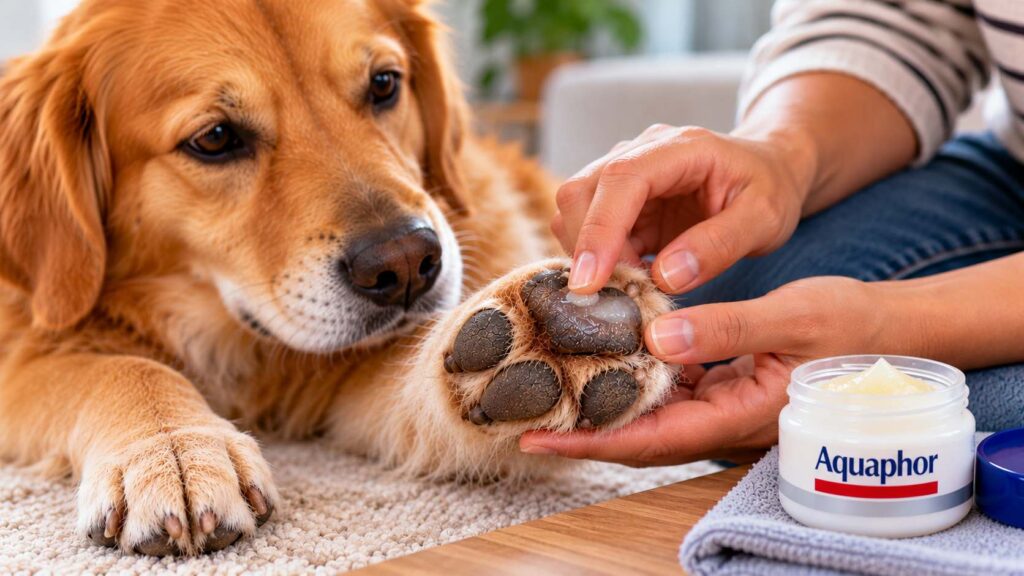
Run through this checklist before anything goes on your dog’s skin:
- Confirm the exact product and read the current ingredient label.
- Check the area for redness, swelling, discharge, bleeding or obvious pain.
- Ask whether this is a one-off problem or something that keeps coming back.
- Check whether your dog can easily lick the spot.
- Use Aquaphor only if the skin problem genuinely fits a simple barrier-care situation.
- Monitor the area rather than repeatedly reapplying the ointment.
- Stop if the skin becomes more irritated, and contact your vet if any red flag appears.
Why “More” Isn’t Better
If Aquaphor is appropriate, a thin film is enough. A thick layer doesn’t address the underlying problem and simply gives your dog more product to lick off.
There’s no established one-size-fits-all Aquaphor dosing schedule for dogs, so avoid treating it like a veterinary medication. If you find yourself repeatedly applying it just to keep the skin comfortable, that’s a clue that the cause of the dryness may need attention.
Break the Lick-and-Reapply Cycle
If your dog licks the product off and you immediately put more on, you’ve created a loop without solving the problem.
Use distraction after application and prevent access to the area when practical. A properly fitted Elizabethan collar may be useful for a determined licker. Be cautious with socks or coverings: they can trap moisture, slip, become too tight or be chewed and swallowed, so don’t use a tight or prolonged covering unless your veterinary team has advised you how to do it safely.
Most importantly, notice what happens when no Aquaphor is present. If your dog still keeps licking or chewing the spot, treat that behaviour as a symptom rather than simply an inconvenience.
Quick tips
- Take a clear photo before starting so you can compare changes.
- Note when the problem started and whether your dog licks or chews the area.
- Check nearby skin and the other paws for similar changes.
- Keep the product packaging and ingredient list handy.
- Tell your vet about every cream, balm or topical medication you’ve already tried.
Already Put Aquaphor on Your Dog? Here’s What to Do
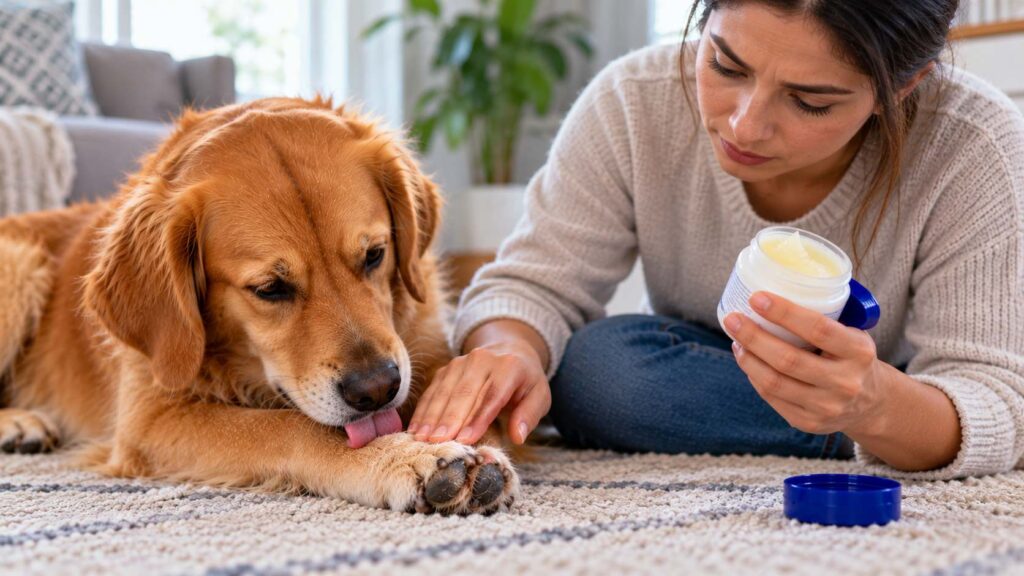
You Applied It and Your Dog Hasn’t Licked It
Monitor the skin rather than automatically adding more. Watch for new redness, swelling, itching, discomfort or worsening of the original problem.
If irritation develops, stop using the product. If the problem persists or keeps returning, the underlying skin condition matters more than the moisturiser.
Your Dog Took a Small Lick
A small incidental lick of standard Aquaphor Healing Ointment is different from eating a noticeable amount from the container. Check the exact product first, because Aquaphor formulations aren’t all identical.
After a small exposure, monitor your dog for gastrointestinal signs such as vomiting or diarrhoea. If symptoms develop, your dog seems unwell, or you’re uncertain about the product or amount swallowed, contact your veterinarian for advice.
Your Dog May Have Eaten a Larger or Unknown Amount
Don’t try to calculate the risk from a generic internet “toxic dose.” Contact your veterinarian or an appropriate animal poison service and have these details ready:
- The exact product and ingredient list
- The container or a clear photo of its label
- Your best estimate of how much is missing
- Your dog’s approximate weight and age
- When the exposure happened
- Any symptoms you’ve noticed
For readers in different countries, use a veterinary clinic or recognised animal poison service available in your region rather than assuming advice or phone services are the same worldwide.
Do not make your dog vomit unless a veterinarian or animal poison professional specifically instructs you to. Whether vomiting is appropriate depends on what was swallowed, when it happened and your dog’s individual circumstances.
Your Dog Chewed the Tube or Container
Now there are two separate concerns: the ointment and the packaging.
Missing pieces of plastic, foil, a cap or other packaging may create a foreign-body risk. If part of the container is unaccounted for, contact your veterinarian even if your dog currently seems normal. Problems caused by swallowed foreign material may not be obvious immediately.
Symptoms Appeared After Eating It
Contact your veterinarian if your dog develops repeated vomiting or diarrhoea, marked lethargy, loss of appetite, abdominal discomfort or otherwise seems unwell after an exposure.
There’s no responsible single “toxic dose” that can be applied to every Aquaphor product and every dog. The exact formulation, amount swallowed, your dog’s size and any packaging ingestion all matter.
Aquaphor, Vaseline or a Dog-Specific Balm?
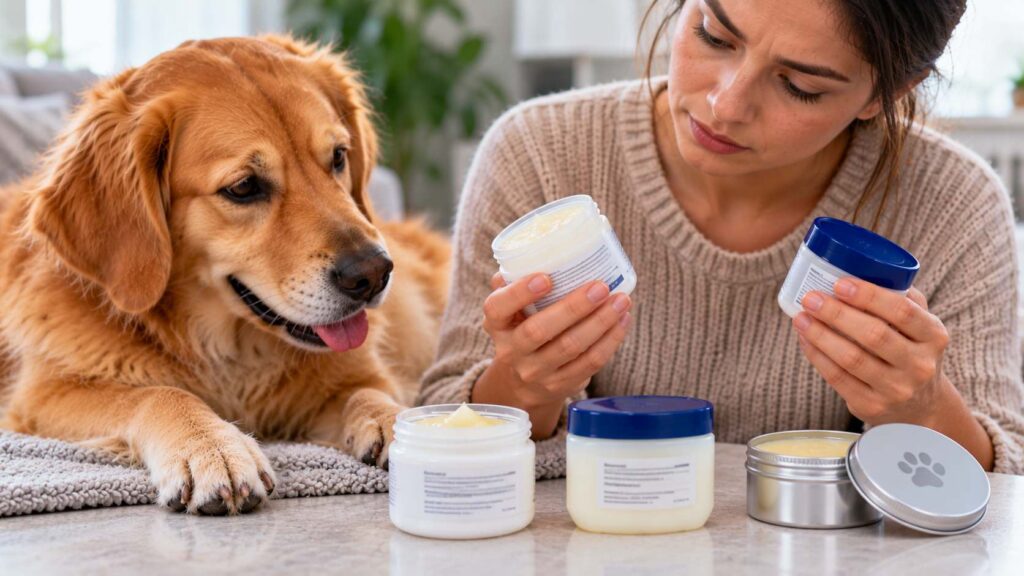
| Factor | Aquaphor Healing Ointment | Plain petroleum jelly | Dog-specific balm |
|---|---|---|---|
| Main purpose | Human skin protectant/barrier | Basic human skin barrier | Usually formulated for dog paws, noses or skin |
| Ingredients | Petrolatum plus additional ingredients | Typically a simpler petrolatum formulation | Varies considerably by product |
| Designed specifically for dogs? | No | No | Usually |
| Label check needed? | Yes—check the exact formulation | Yes | Yes |
| Licking consideration | Prevent repeated ingestion | Prevent repeated ingestion | Still check ingredients and directions |
| Treats underlying skin disease? | No | No | Usually not unless specifically medicated |
There’s no universal winner. Plain petroleum jelly generally has a simpler formulation, while Aquaphor Healing Ointment contains additional ingredients such as lanolin alcohol. A dog-specific balm may be formulated with canine use in mind, but that doesn’t automatically make every product suitable for every dog—or safe to eat in unlimited amounts.
Don’t choose solely on labels such as “natural,” “human-safe” or “made for dogs.” Check the actual ingredients and, more importantly, make sure you’re treating simple dryness rather than covering up a skin condition that needs veterinary care.
When a Veterinary Product Is a Different Category
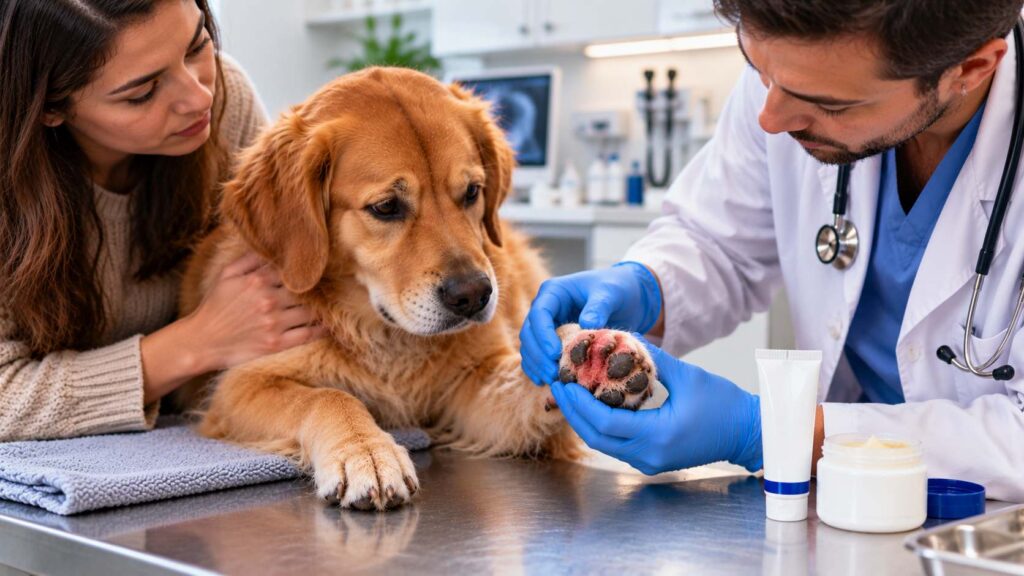
A barrier ointment mainly helps reduce moisture loss. A veterinary medication may be prescribed to treat a diagnosed problem such as bacterial or fungal infection, inflammation or allergic skin disease.
If your veterinarian has prescribed a topical treatment, follow those instructions rather than substituting Aquaphor, petroleum jelly or a cosmetic paw balm. The products may look similar in the jar, but they aren’t doing the same job.
Common Mistakes That Make a Simple Skin Problem Worse
- Assuming “safe for babies” automatically means appropriate for dogs
- Treating all Aquaphor products as though they have the same ingredients
- Skipping the ingredient-label check
- Applying ointment before properly looking at the skin
- Using more product because the area looks very dry
- Letting your dog lick it off, then immediately reapplying
- Treating Aquaphor as an antibiotic or medicated skin treatment
- Using it on skin that looks infected, raw or oozing
- Moisturising a recurring problem without asking why it keeps returning
- Assuming “natural” remedies are automatically safer
- Trying several home remedies while the skin continues to worsen
- Assuming a dry nose by itself means dehydration
- Inducing vomiting after ingestion without veterinary or poison-service guidance
Why Does Your Dog Keep Needing a Moisturiser?
When Repeated Dryness Is Information
A little dryness after exposure to cold, dry weather or rough surfaces can happen. Dryness that repeatedly returns deserves more attention.
Possible causes include environmental or contact irritation, allergic skin disease, repeated friction or trauma, infection, excessive licking, hyperkeratosis and other skin conditions. You can’t reliably tell which one is responsible just by looking at a dry patch, so persistent or worsening changes are worth discussing with your veterinarian.
When Paw Licking Is More Than an Aquaphor Problem
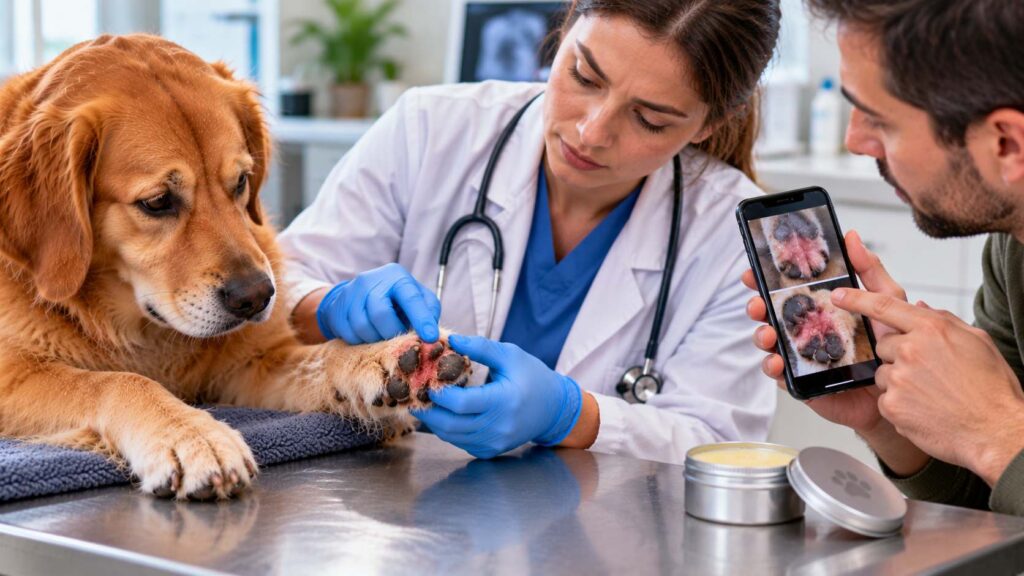
Paw licking can be driven by itch, pain, inflammation, irritation, a foreign object or an underlying skin problem.
A useful clue is what your dog does when no Aquaphor is present. If the same paw is repeatedly licked or chewed anyway—especially if you notice redness, swelling, tenderness or changes between the toes—the licking itself deserves attention.
Temporary Improvement Doesn’t Mean It’s Solved
Softer-looking skin isn’t necessarily healthy skin.
If the dryness, cracking or licking returns whenever you stop applying a barrier product, the underlying trigger may still be present. At that point, repeatedly changing balms is less useful than finding out why the problem keeps returning.
Getting More Out of the Vet Visit
If you book an appointment, bring the product or be ready to share:
- The exact product name and a photo of the ingredient label
- Where you applied it, approximately how much and when
- Whether your dog licked or swallowed any
- Whether any part of the packaging is missing
- When the skin problem started and whether it has happened before
- Photos showing how the area has changed over time
- Any other creams, balms, shampoos or medications you’ve tried
- Any vomiting, diarrhoea, appetite changes or other new signs
Call rather than keep watching if you notice a rapidly worsening lesion, pus or other signs of infection, significant pain or limping, a deep wound, eye involvement, a problem with a surgical incision, substantial or unknown ingestion, swallowed packaging, or concerning symptoms after ingestion.
Key Takeaways
- Whether Aquaphor is appropriate depends on the exact product, skin condition, application site and likelihood of licking.
- Standard Aquaphor Healing Ointment is a barrier product, not a treatment for infection, allergies or underlying skin disease.
- Mild dryness on intact, comfortable skin is the type of situation where a small amount may be reasonable.
- Avoid using it as DIY treatment for hot spots, deep wounds, infected-looking skin, surgical sites or problems involving the eyes or ear canals.
- A small incidental lick is different from eating a significant or unknown amount. A chewed container adds a separate foreign-body concern.
- If the skin problem keeps returning, stop treating only the surface and find out why.
The Question to Ask Before You Reach for It Again
Before picking up the tub, ask:
What am I actually trying to treat? Is the skin intact? Is this a one-off problem or does it keep returning? Can my dog lick the area? Which exact product do I have? Are there any warning signs?
If everything points to mild, uncomplicated dryness on intact skin, a small amount of an appropriate barrier product may be reasonable with supervision.
If the area is painful, red, wet, bleeding, swollen, repeatedly licked or simply keeps coming back, the better question is no longer which moisturiser to use. It’s what’s causing the problem.
Frequently Asked Questions
1. Is Aquaphor safe for puppies?
Don’t assume that a human skin product is automatically appropriate just because the amount seems small. Puppies may also be more likely to lick products or chew containers. Check the exact formulation, and ask your veterinarian before using Aquaphor on a puppy with irritated, damaged or unexplained skin changes.
2. Can I put Aquaphor between my dog’s toes?
Be cautious. Redness, moisture, swelling or persistent licking between the toes can be associated with irritation, infection, allergies, foreign material or other problems. Because this area is also easy for dogs to lick, recurring interdigital problems are better assessed than repeatedly covered with ointment.
3. Can I put Aquaphor on bleeding or deeply cracked paws?
Deep, bleeding or painful cracks should be assessed by a veterinarian, particularly if your dog is limping, constantly licking the paw or the surrounding tissue is swollen or discoloured. Don’t assume that sealing a deeper crack under more ointment will solve the problem.
4. What should I do if Aquaphor gets in my dog’s eye?
Don’t intentionally apply Aquaphor in or around the eye. If accidental exposure occurs, contact your veterinarian promptly if your dog develops squinting, redness, excessive tearing, pawing at the eye, cloudiness or obvious discomfort. Avoid putting additional products into the eye unless a veterinary professional advises you to do so.
5. What if my dog chewed the Aquaphor tube?
The ointment and the packaging are separate concerns. Missing plastic, foil, caps or other pieces may create a foreign-body risk. Contact your veterinarian if any packaging may have been swallowed, even if your dog initially seems well. Vomiting, abdominal discomfort, reduced appetite or difficulty passing stool warrant prompt veterinary attention.
6. Why does my dog keep licking the area after I apply it?
Some dogs may simply be interested in the product, but persistent licking can also indicate itch, pain or inflammation. Watch what happens when no ointment is present. If your dog continues targeting the same area, especially if the skin is changing, have the underlying problem assessed rather than repeatedly reapplying Aquaphor.
7. Is a dog-specific paw balm better than Aquaphor?
Not automatically. A dog-specific balm may be formulated with canine use and licking in mind, but ingredients and intended uses still vary. Read the label and choose according to the actual skin problem. Neither a cosmetic paw balm nor Aquaphor should replace veterinary treatment for persistent, painful, inflamed or infected skin.
#. Related Articles:
1. Can You Put Sudocrem on a Dog?