So you’ve brought home a brand-new puppy — congratulations! Now your kitchen floor is telling a different story.
If you’re standing in a puddle right now wondering where you went wrong, don’t panic. Every puppy owner has been exactly there. The good news? Learning how to train a puppy to pee outside is completely doable, even if you’re a first-timer. You just need the right approach, a bit of patience, and this guide.
Let’s get into it.
Why Puppies Struggle to Pee Outside (And It’s Not Their Fault)
Before you can fix the problem, it helps to understand why it happens.
Puppies under 12 weeks have almost no bladder control. Their bodies physically can’t hold it for long — often as little as one hour per month of age. So a 10-week-old pup? That’s roughly a 2-hour window, if you’re lucky.
They’re also learning everything from scratch. They don’t yet know that outside is the “right” place. To them, the carpet and the garden are equally valid options.
Understanding this removes frustration and replaces it with a plan.
Step 1: Set a Consistent Toilet Schedule
The single most effective thing you can do is build a predictable routine. Puppies thrive on it.
Take your puppy outside at these key moments — every single day:
- First thing in the morning (before they’ve even had breakfast)
- After every meal (usually within 15–20 minutes)
- After naps
- After playtime
- Before bed
- Every 1–2 hours in between for very young pups
Yes, this sounds like a lot. It is. But it’s temporary, and the payoff is a house-trained dog in weeks rather than months.
Set phone reminders if you need to. Treat it like a meeting you can’t skip.
Step 2: Pick One Specific Spot Outside
This tip gets overlooked far too often — and it makes a massive difference.
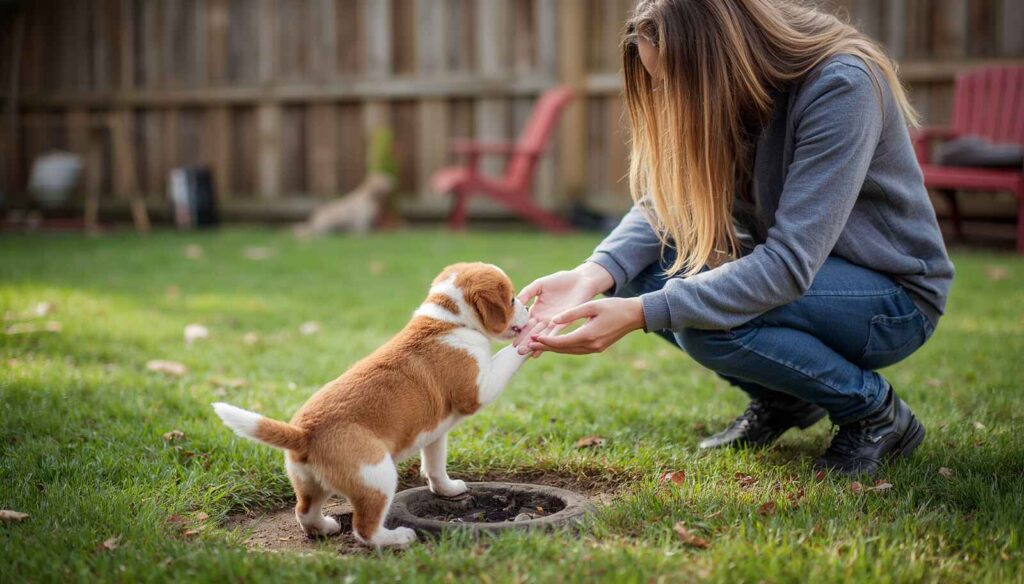
Choose one consistent spot in your garden or on your walk route, and always take your puppy there first. The smell from previous visits builds up and acts as a natural trigger. Over time, that spot becomes a very clear signal: this is where we go.
If you’re in a flat or apartment (very common in UK cities and Australian urban areas), even a small balcony patch or a short trip to the nearest grass counts. What matters is the consistency of location.
Step 3: Use a Toilet Cue Word
This one’s a game-changer that many beginner guides skip.
Pick a short phrase like “go wee,” “outside,” or “toilet time” — whatever feels natural to you. Say it calmly as your puppy starts to sniff around or squat. Over time, that word becomes associated with the act of going.
Eventually? You can say that word and your dog will actually try to go on command. Incredibly useful before long car journeys or bedtime.
Keep it consistent. Whoever walks the dog in your household should use the same cue word.
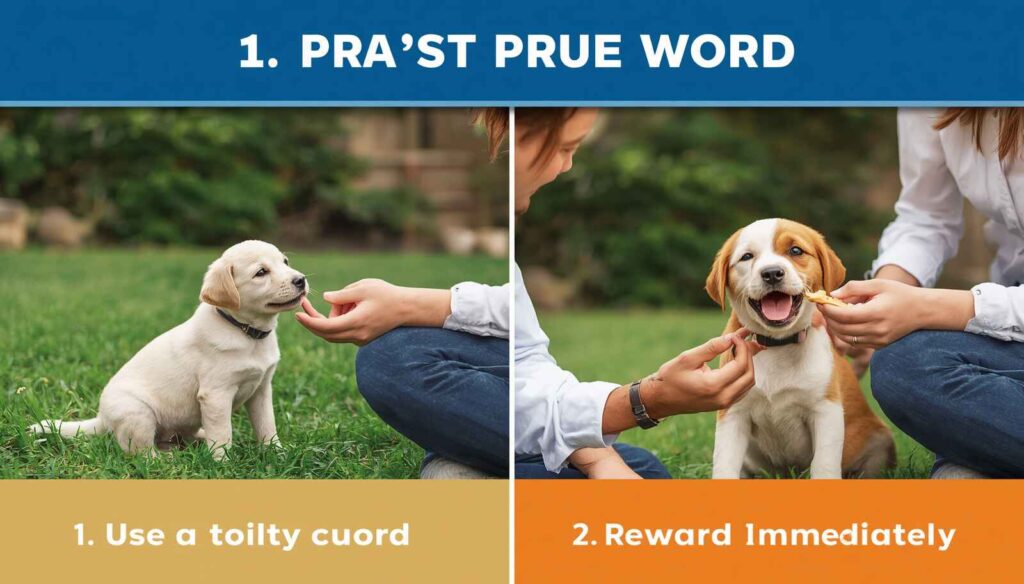
Step 4: Reward Immediately (Timing Is Everything)
Here’s where a lot of owners make a critical mistake — they praise the puppy after they’ve come back inside. But by then, your pup has no idea what they’re being rewarded for.
You need to praise within 2–3 seconds of them finishing outside. That means:
- Stay outside with them (don’t just let them out alone)
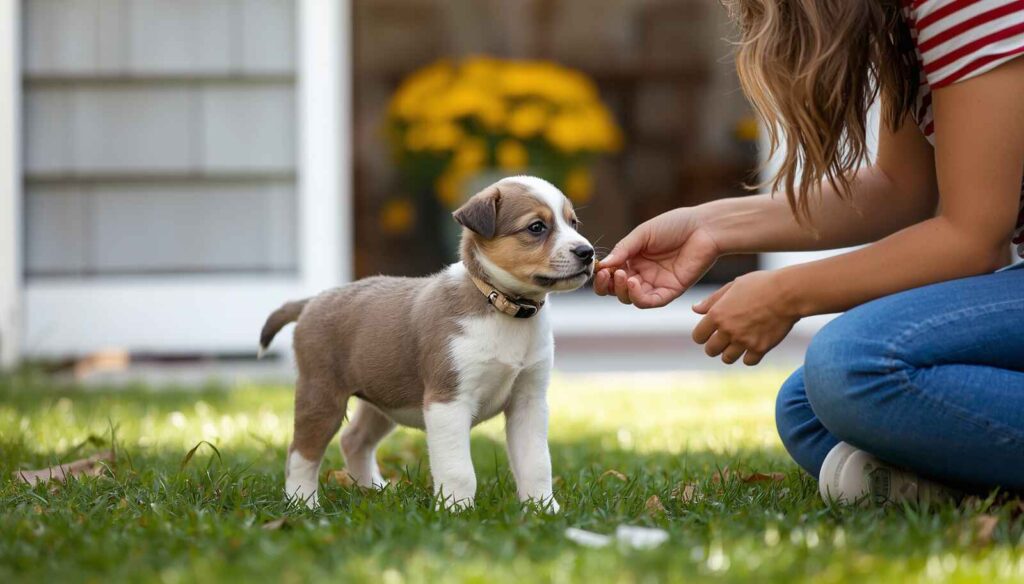
- The moment they finish, say “Yes!” or click a clicker in an upbeat voice
- Give a small treat right then and there
- Add a bit of happy fuss — puppies love your enthusiasm
Use soft, small treats so they don’t get full. Something like a tiny piece of cooked chicken or a puppy training treat works perfectly.
The connection in their brain forms: peeing outside = great things happen. That’s the whole foundation of this.
Step 5: Manage the Indoor Environment
While you’re training, you want to limit the opportunity for accidents indoors. This isn’t about punishment — it’s about setting your puppy up to succeed.
Use a crate or playpen. Puppies instinctively avoid soiling where they sleep. A crate sized just large enough for your pup to stand, turn, and lie down encourages them to hold it until you take them out. Don’t leave them crated for longer than their age in hours (plus one), though.
Tethering works too. Attach your puppy’s lead to your belt loop or nearby furniture when you’re home. It keeps them close and means you’ll notice the pre-pee signals — sniffing the floor, circling, squatting — before an accident happens.
Close off unsupervised rooms. If your pup sneaks off to the bedroom and you don’t notice, that’s a missed training opportunity. Keep them in eyesight.
Step 6: Handle Accidents the Right Way
Accidents will happen. That’s part of the process.
When they do:
- Don’t scold, shout, or rub their nose in it. This genuinely doesn’t work and can make your puppy anxious or afraid of you.
- If you catch them mid-squat, say a calm “outside” and immediately take them to the correct spot.
- If you find it after the fact, just clean it up. They’ve already forgotten.
Use an enzymatic cleaner (widely available in the UK, Canada, and Australia at pet shops like Pets at Home or PetBarn). Regular floor cleaner often doesn’t break down the urine scent fully, which means your puppy’s nose will still detect it — and they may return to the same spot.
Common Mistakes That Slow Down Potty Training
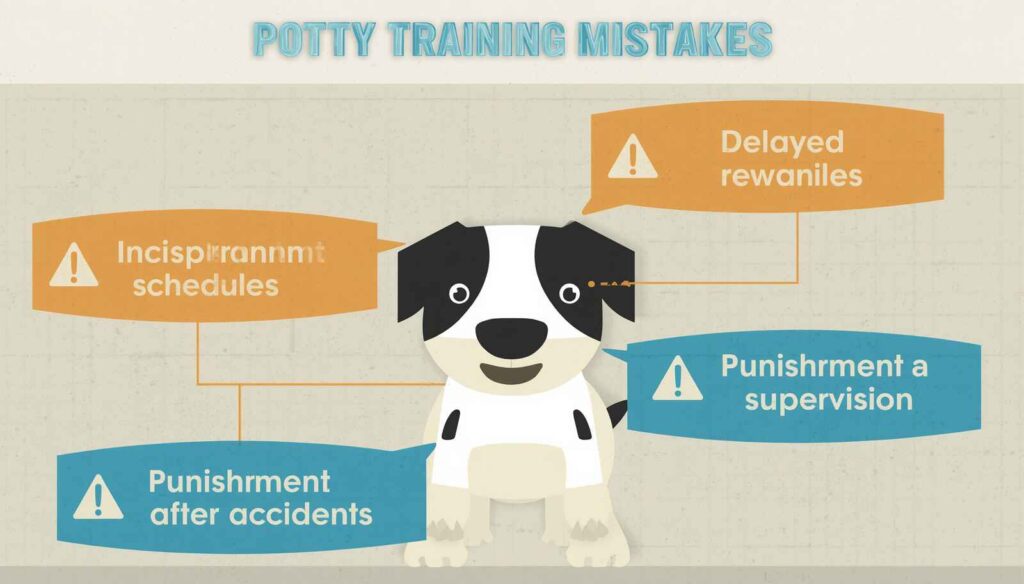
Even well-meaning owners do these things. Here’s what to avoid:
- Expecting too much too soon. Most puppies aren’t reliably house-trained until 4–6 months, and some take longer. Don’t panic.
- Being inconsistent. If you skip the schedule on weekends or let someone else handle it differently, it slows everything down.
- Giving too much indoor freedom too soon. Free-roaming access to the whole house before they’re trained is a recipe for hidden accidents.
- Going back inside the moment they pee. Some puppies learn that staying outside is more fun than going back in, so they hold it on purpose. Stay out a little longer after they go, so the trip doesn’t immediately end.
What About Rainy Days? (Because It Rains a Lot in the UK)
British dog owners, this one’s for you — and it’s relevant in Canada and parts of Australia too.
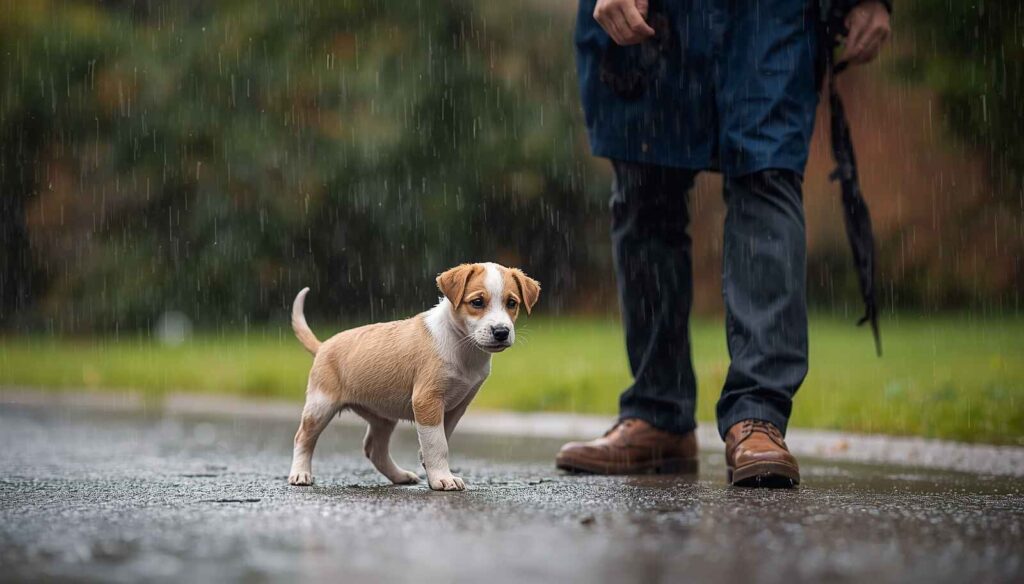
Some puppies are fussy about wet grass. They’ll stand at the door, look at the rain, and refuse to budge.
A few things that help:
- Put on a waterproof jacket and just go with them. Your attitude sets the tone.
- Try a covered spot in the garden if you have one.
- Use an umbrella and stand near them.
- Never skip the trip just because of weather early in training — it teaches them rain is a valid excuse.
Most dogs adapt quickly once they realise rain isn’t negotiable.
When to See a Vet
If your puppy is straining to pee, going very frequently, peeing blood, or crying when they go, see a vet promptly. These can be signs of a urinary tract infection (UTI), which is common in young dogs and needs treatment — not training.
A puppy that’s suddenly regressing after being mostly reliable may also be unwell. Trust your gut.
FAQ: How to Train a Puppy to Pee Outside
1.How long does it take to house-train a puppy?
Most puppies show real progress within 4–6 weeks of consistent training. Full reliability usually comes between 4–6 months of age. Smaller breeds sometimes take longer due to smaller bladders.
2.My puppy pees outside AND inside — why?
Often it’s because they weren’t fully finished outside, or they were distracted during the toilet trip. Make sure you wait until they’ve actually finished before coming in. Some pups also need two trips close together.
3.Should I use puppy pads?
Puppy pads can be a useful short-term bridge (especially in flats or in bad weather), but they can also confuse puppies — teaching them it’s okay to go indoors. If your goal is outdoor training, try to skip them or phase them out quickly.
4.What if my puppy won’t pee outside at all?
Stay calm, stay outside, and give it time. Bring a high-value treat and wait. The moment they go, celebrate. If they’re consistently refusing and you’ve ruled out a health issue, try changing the outdoor spot — some dogs are particular about surfaces.
5.Can I train a puppy to pee outside in a flat or high-rise apartment?
Absolutely. It just takes more trips (since you can’t simply open a back door). Use a sling bag or treat pouch to make the journey quick, and pick a consistent spot nearby. Many flat-dwellers in Australia and the UK do this successfully.
6.Is it normal for a puppy to pee every hour?
Yes, for very young puppies (under 12 weeks), this is completely normal. As their bladder develops and they learn to hold it, the frequency will naturally reduce.
7.Should I punish my puppy for accidents indoors?
No. Punishment after the fact confuses puppies and damages trust. Focus entirely on rewarding what you want — peeing outside — rather than reacting to what you don’t want.
Wrapping Up
Training a puppy to pee outside isn’t complicated — but it does require commitment. The routine, the rewards, the supervision, the patience. It all stacks up.
The puppies who get trained fastest aren’t the smartest ones — they’re the ones with the most consistent owners. You’ve already put in the effort to read this far, which means you’re already ahead of the game.
Stick with it. In a few weeks, you’ll barely remember the puddles — and your pup will be bounding to the door every time nature calls.
This article is intended as general guidance for dog owners in the UK, Canada, and Australia. Always consult your vet if you have health concerns about your puppy.
#. Related Articles:
1. How to Potty Train a Puppy?