

A Dalmatian Breed Guide should tell you more than what this spotted dog looks like. Before bringing one home, you need to understand what daily life actually involves — from exercise and training to shedding, companionship, and breed-specific health concerns. The spots are the easy part; deciding whether a Dalmatian truly fits your lifestyle takes a little more thought.
If your main reference point is the film dog, it is worth resetting expectations. The Dalmatian is an athletic, intelligent, people-oriented breed with a long history as a coach dog. That background helps explain why many Dalmatians thrive on purposeful activity, regular training, and being involved in family life rather than simply being given access to a garden.
Two health topics are especially important to understand before buying or adopting. Dalmatians have a recognised risk of congenital deafness, which is why responsible breeding programmes use BAER hearing testing. They also have a breed-specific tendency toward high urinary uric acid and urate stone formation. Neither issue means every Dalmatian will be affected, but both are important when assessing breeders, planning veterinary care, and recognising problems early.
This guide is not trying to turn the Dalmatian into a list of facts. It is designed to answer the more useful question: would living with one actually fit your week?
Start Here — Would a Dalmatian Fit Your Actual Week?
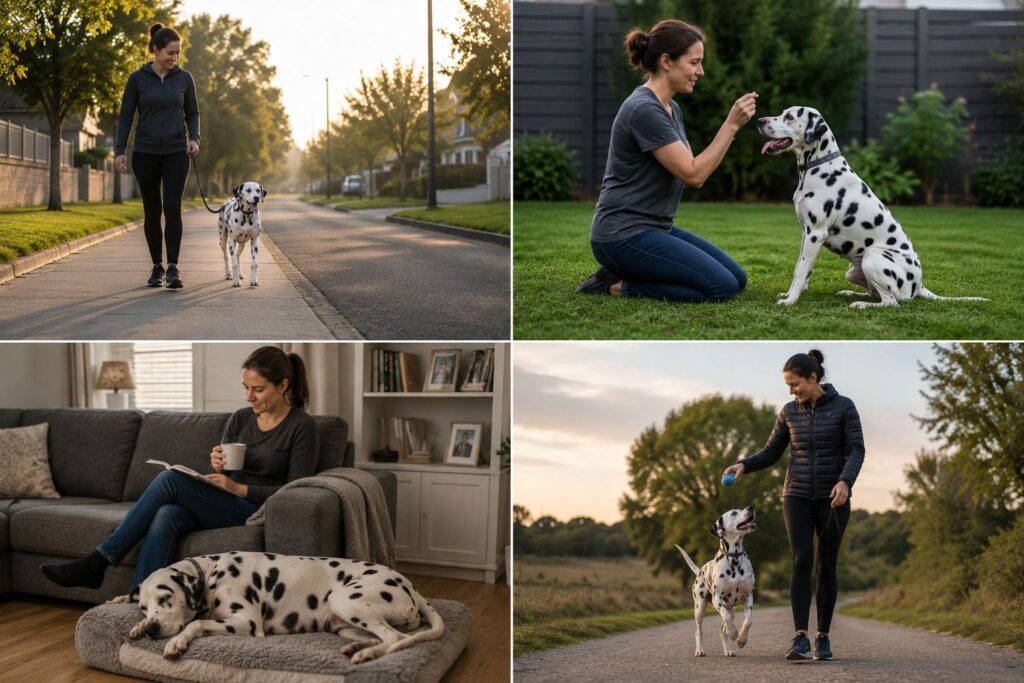
Likely a Strong Match If…
- You have an active daily routine and enjoy spending time outdoors.
- You genuinely enjoy training a dog rather than expecting good behaviour to develop on its own.
- Someone is available for meaningful interaction, or you can build alone time gradually.
- You can live with noticeable shedding on clothes and furniture.
- You are willing to provide mental enrichment as well as physical exercise.
- You are prepared to ask detailed questions about health screening before buying or adopting.
Think Carefully If…
- Your dog would routinely be left alone for most of the working day.
- Your idea of exercise is one short lead walk.
- You want a naturally low-effort pet that requires little ongoing training.
- Shedding is a major problem for your household.
- You have little interest in enrichment or structured activity.
- You are choosing the breed mainly because of its appearance.
First-Time Owner? Possible, but Not Automatically Easy
Being a first-time owner is not an automatic reason to rule out a Dalmatian. What matters more is whether you are prepared for the breed’s activity level, training needs, adolescence, shedding, and health considerations.
A well-prepared beginner who attends training classes, learns canine body language, uses reward-based methods, and builds a sensible routine may cope far better than an experienced owner who assumes all dogs fit the same lifestyle.
If you are new to dog ownership, getting professional training support early is much easier than trying to undo unwanted habits later.
Mini Checklist — 30-Second Dalmatian Fit Check
- Active household
- Time for daily training and enrichment
- Safe places for appropriate exercise
- Comfortable with regular shedding
- Time for genuine companionship, not just feeding and walking
- Budget for routine and unexpected veterinary care
- Willing to research breeders or rescues carefully
- Comfortable learning about breed-specific health screening
Dalmatian at a Glance — What Life With One Usually Means
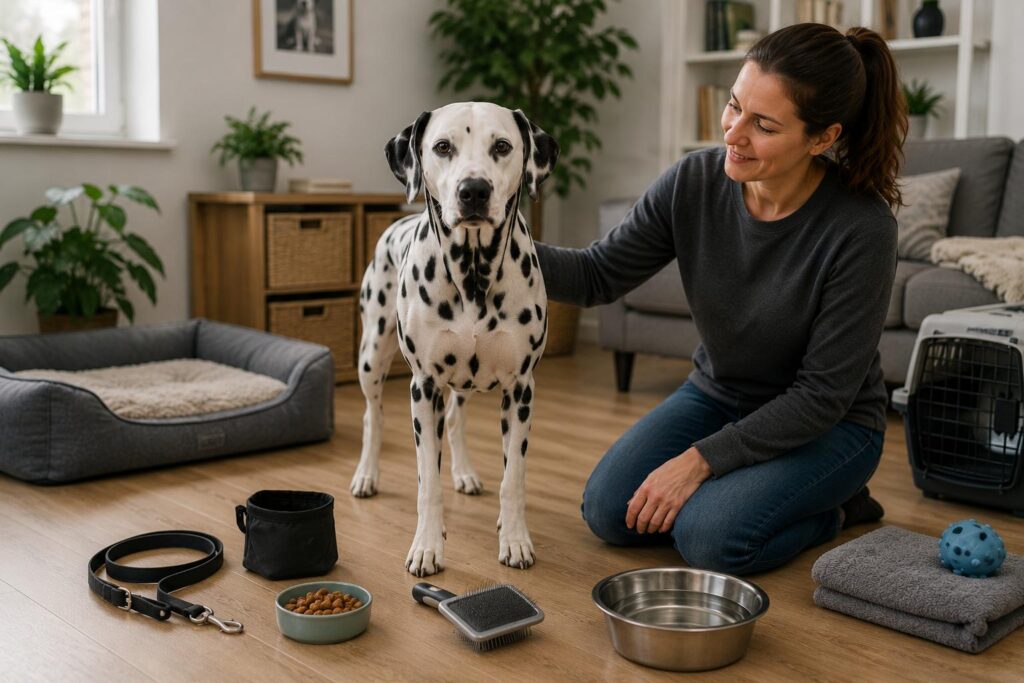
| Trait | Typical Dalmatian Reality | What It Means for You |
|---|---|---|
| Activity | High | Structured daily activity is important |
| Trainability | Intelligent, but engagement matters | Consistent reward-based training works best |
| Mental stimulation | Important | Walking alone may not meet every need |
| Shedding | More noticeable than the short coat suggests | Regular brushing and home cleaning |
| Grooming complexity | Relatively simple | Easy coat care does not mean no maintenance |
| Family potential | Often good in suitable homes | Individual temperament and supervision matter |
| Alone time | Usually needs gradual preparation | Do not assume all-day independence |
| Health planning | Breed-specific considerations | Screening and veterinary awareness matter |
Don’t Judge the Personality by the Spots
What “Energetic” Actually Looks Like Day to Day
Many Dalmatians like to move, explore, interact, and take part in whatever their owners are doing. In the right home, that enthusiasm can make them enjoyable companions for walking, hiking, training, scent work, and other activities.
When their needs are poorly matched, however, owners may see restlessness, attention-seeking, destructive behaviour, or difficulty settling. Those behaviours should not automatically be written off as a Dalmatian being “stubborn” or “hyper.”
Before blaming the breed, look at the dog’s routine, age, training, sleep, stress level, and opportunities for both physical and mental activity.
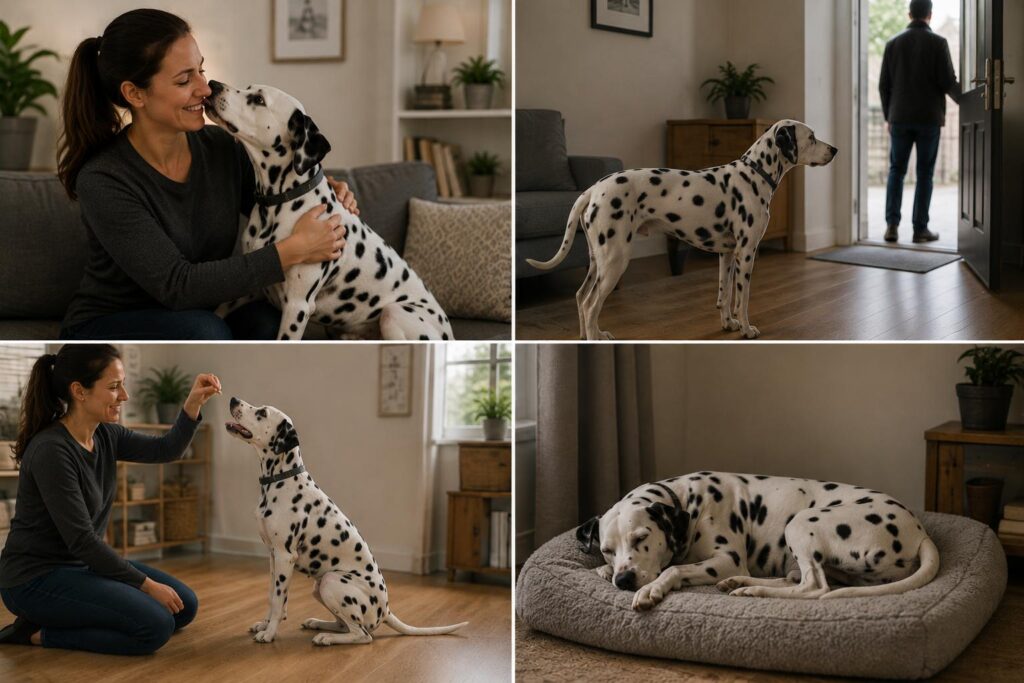
Intelligent Doesn’t Mean Automatically Easy to Train
A quick learner can learn useful behaviour and unwanted behaviour equally efficiently.
A Dalmatian that gets attention every time it jumps up may learn that jumping works. One that repeatedly steals food from an accessible counter may become very good at checking that counter.
Clear household rules, reward-based training, and consistency are more useful than trying to dominate or out-stubborn the dog.
Focus early on practical behaviours such as:
- Recall
- Loose-leash walking
- Waiting at doors
- Calm greetings
- Settling on a bed or mat
- Comfortable handling for grooming and veterinary care
Affectionate at Home, Reserved With Strangers
Many Dalmatians are strongly attached to their families. Some may be more reserved with unfamiliar people rather than immediately sociable.
That is not the same thing as aggression.
Temperament varies between individuals and is influenced by genetics, early experiences, socialisation, training, and previous handling. Puppies should be exposed gradually and positively to different people, places, surfaces, sounds, and everyday situations without being forced into interactions that frighten them.
High Energy vs Hyperactivity
A high-energy dog wants activity.
A dog that cannot settle may have a different problem.
Constant pacing, frantic behaviour, poor sleep, or an inability to relax can be associated with inadequate enrichment, over-arousal, inconsistent routines, anxiety, pain, or other behavioural or medical issues.
One common mistake is trying to solve every behaviour problem by adding more intense exercise. That can simply create a fitter dog.
Dalmatians also benefit from learning how to switch off through calm training, sniffing, problem-solving, predictable routines, and adequate rest.
A Realistic Day With an Adult Dalmatian
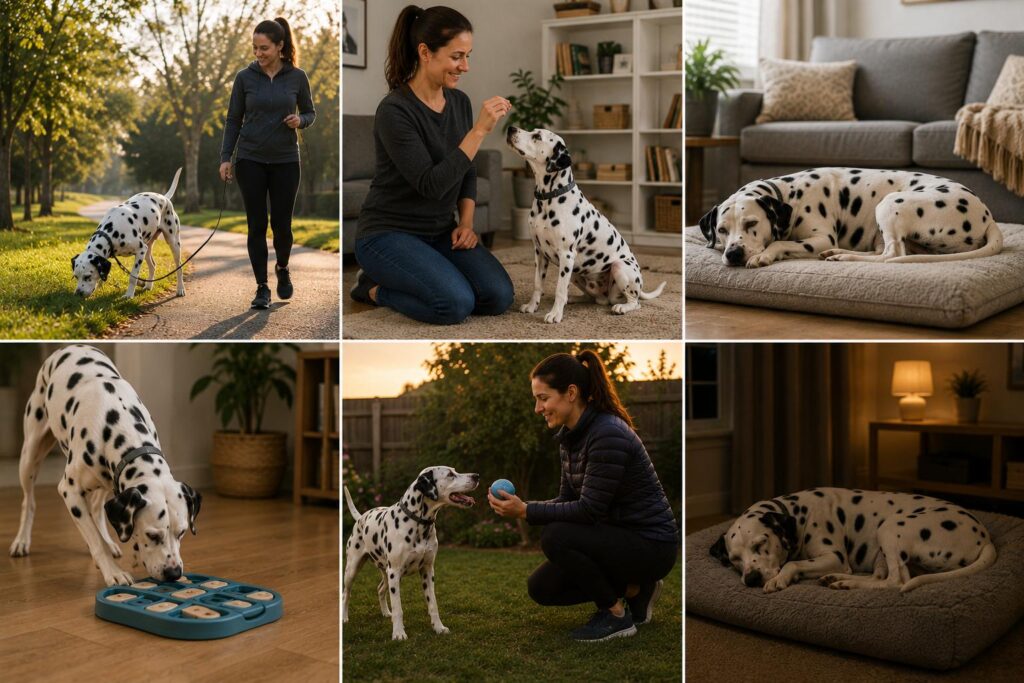
Morning
Start with a toilet break followed by meaningful activity appropriate to the individual dog. That might include a brisk walk, sniffing opportunities, training, or another form of controlled exercise.
A short training session can be more valuable than simply adding extra distance. Practising recall, loose-leash walking, impulse control, or scent work engages the dog’s brain as well as the body.
During the Day
A healthy adult should also be able to rest.
If the dog spends some time alone, appropriate enrichment such as a food puzzle, safe chew, or stuffed feeding toy can help, provided the item is suitable for that dog and does not present a choking or ingestion risk.
Alone time should be developed gradually rather than introduced suddenly, especially in puppies and newly adopted dogs.
Persistent barking, destructive behaviour, house-soiling, drooling, escape attempts, or distress when left alone should not automatically be dismissed as boredom. These signs can also occur with separation-related problems and are worth discussing with a veterinarian or qualified behaviour professional.
Evening
Another period of exercise or interactive activity usually suits an active adult, followed by something calmer.
A short training session, scent game, or food-search activity can work well before encouraging the dog to relax on a mat or bed while the household settles for the evening.
Teaching calmness is a genuine life skill for an energetic dog.
Why a Garden Doesn’t Replace Exercise
Outdoor space is useful, but access to a garden is not the same as physical exercise, social experience, training, or mental stimulation.
A dog usually does not provide itself with a complete exercise programme simply because a large garden is available.
An engaged owner living in a flat who provides appropriate walks, training, enrichment, and companionship may meet a Dalmatian’s needs better than someone with a large property who rarely interacts with the dog.
Housing size matters less than what the dog’s actual day looks like.
Exercise Is Only Half the Equation
Physical Activity
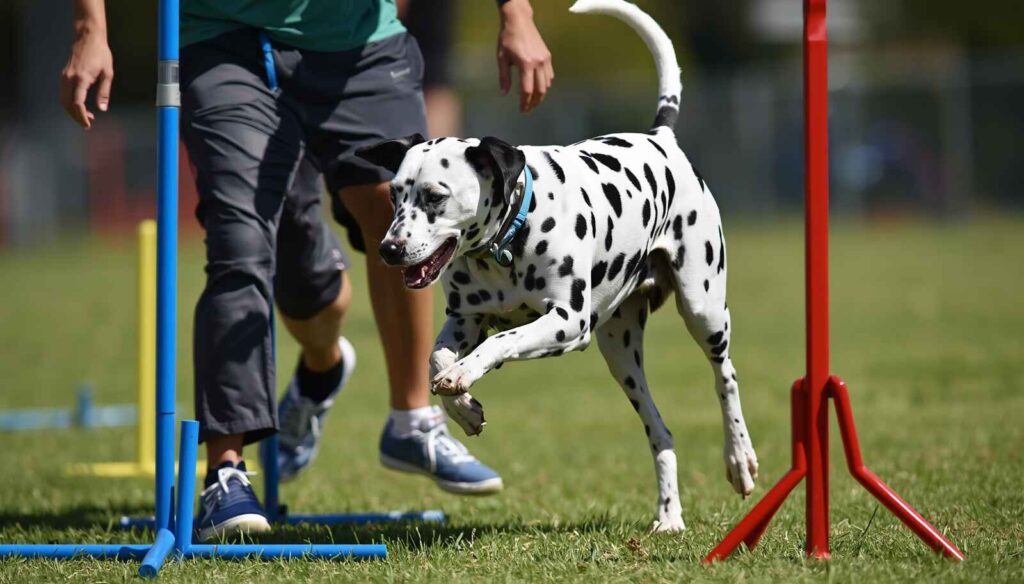
Walking, hiking, supervised off-lead exercise in secure areas, agility-style activities, and — once physically mature — running with an owner can all suit an athletic Dalmatian. The right amount and intensity depend on the dog’s age, fitness, health, and experience rather than on a fixed breed-wide target.
Mental Work
Scent games, food puzzles, obedience practice, trick training, and simple search games give the brain something to do as well as the body. For an intelligent, active dog, adding purposeful mental work can be just as important as adding another mile to a walk.
Teach an Off-Switch, Too
It’s tempting to assume that a restless Dalmatian simply needs more exercise. Sometimes more appropriate activity helps, but a dog that never learns how to settle may still struggle to relax when physically tired.
Practising calm time on a bed or mat, rewarding relaxed behaviour, and allowing enough undisturbed rest can help prevent every waking hour from becoming another activity session.
Puppies Aren’t Miniature Endurance Dogs
A Dalmatian puppy may look ready to keep going long before their growing body is ready for repetitive high-impact exercise. Forced distance running, repeated jumping, and other strenuous structured activities should be introduced cautiously as the dog develops.
Your veterinarian can help you judge appropriate activity for your puppy’s age, growth, body condition, and any orthopaedic concerns.
Seniors and Dogs With Medical Conditions
Exercise should change with the individual dog. Older Dalmatians and dogs with joint, heart, respiratory, neurological, or other medical problems may need shorter sessions, different surfaces, more recovery time, or lower-impact activities.
A veterinarian who knows your dog’s medical history is best placed to advise when activity needs modifying.
Quick Tips — Better Activity Balance
- Mix sniffing and exploring with purposeful movement.
- Keep training sessions short enough that the dog stays engaged.
- Rotate enrichment rather than using the same activity every day.
- Actively teach relaxation instead of waiting for it to happen.
- If behaviour suddenly becomes harder, don’t automatically add more distance or intensity. Consider stress, sleep, pain, training, and the dog’s overall routine first.
Training Priorities That Matter More Than Party Tricks
Start With Life Skills
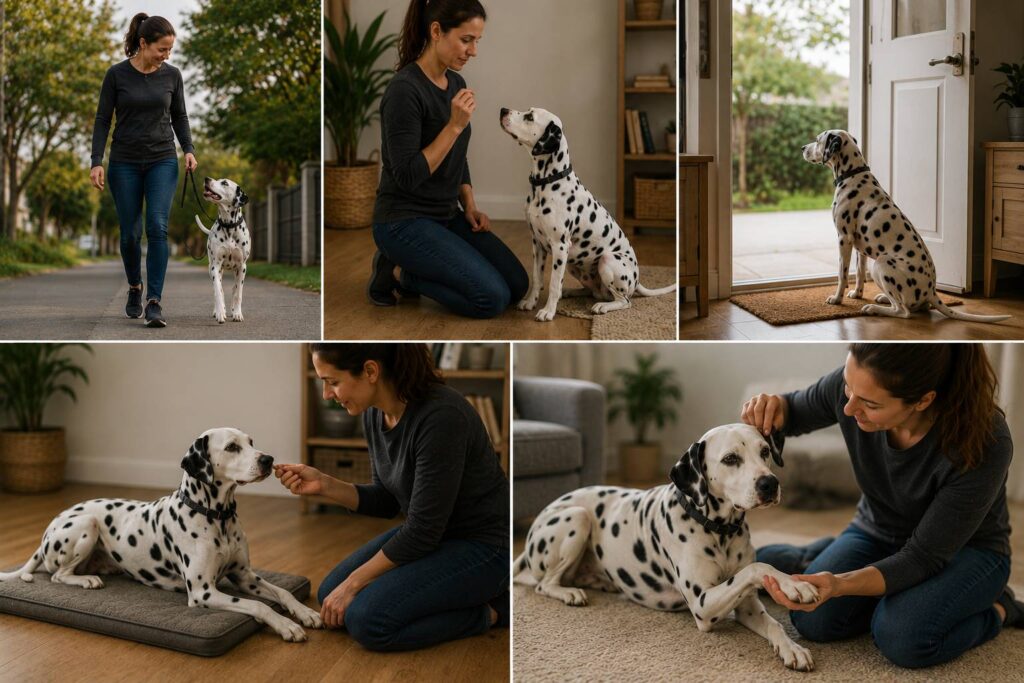
Recall, loose-lead walking, impulse control, settling on cue, polite greetings, and being comfortable with handling of the paws, ears, and mouth are far more useful in everyday life than an impressive repertoire of tricks.
These skills matter particularly with a strong, athletic dog. A reliable recall or calm greeting can make daily life safer and easier in a way that “shake paws” never will.
Socialisation Means More Than “Meeting Other Dogs”
Good socialisation is about helping a puppy become comfortable with the world, not simply arranging as many dog interactions as possible.
Positive, age-appropriate exposure can include different people, environments, surfaces, household sounds, traffic at a safe distance, gentle handling, and calm observation of other animals. Quality matters more than quantity, and frightened puppies should not be forced into interactions in the name of socialisation.
Reward-Based Training and Consistency
Clear household rules, predictable cues, and rewards that genuinely motivate your individual dog usually make training easier to understand and repeat.
Consistency does not mean being harsh. It means making it clear which behaviours work, rewarding the ones you want, and avoiding situations where unwanted habits are practised over and over.
Behaviour That May Actually Be Boredom
Destructive chewing, attention-seeking barking, restlessness, and difficulty settling can occur when a dog lacks suitable physical activity, mental stimulation, or routine.
But don’t assume every difficult behaviour is boredom. Pain, anxiety, fear, adolescence, separation-related distress, and medical problems can look similar. New, severe, or persistent behaviour changes deserve a closer look, and unexplained changes are worth discussing with your veterinarian.
Home Compatibility — Test the Situations Separately
Dalmatians and Children
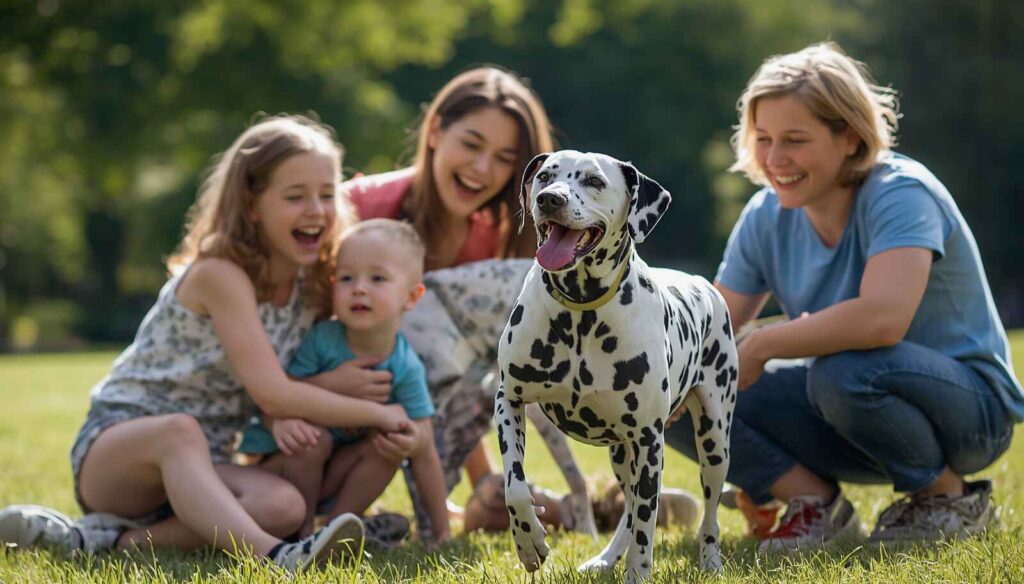
Dalmatians can live successfully with children, but “good family dog” should never be treated as a guarantee about an individual animal.
Supervision matters, especially with younger children. An excited adult Dalmatian can knock a small child over without intending any harm, and children should also learn not to disturb a dog while eating, sleeping, or trying to move away.
Dalmatians and Other Dogs
Breed alone cannot predict whether two dogs will get along. Age, temperament, previous experiences, social skills, and the way introductions are handled all matter.
Calm, gradual introductions in an appropriate setting are more useful than assuming another dog will automatically become a friend.
Dalmatians and Cats or Smaller Pets
Chase and prey-related behaviour varies between individuals. Some Dalmatians can live peacefully with cats or other animals, particularly when introduced appropriately, while others may find moving small animals highly exciting.
Use gradual, supervised introductions and provide the smaller animal with safe escape areas. Breed reputation alone cannot guarantee compatibility.
Apartment Living
Apartment living is possible, but it isn’t automatically easy. Square footage matters less than whether the dog receives sufficient exercise, enrichment, training, toilet opportunities, and time with people.
A well-managed Dalmatian in a flat may be better served than one with a large garden but very little interaction.
Being Left Alone
Tolerance for being alone varies considerably between dogs and should be built gradually, particularly in puppies and newly adopted dogs.
If a Dalmatian repeatedly barks, destroys doors or furniture, attempts to escape, toilets indoors, drools heavily, or appears distressed when left, don’t assume the answer is simply more exercise. Separation-related behaviour may require veterinary or qualified behavioural help.
The Coat Is Easy — the Hair Everywhere May Surprise You
Black-Spotted vs Liver-Spotted
Black and liver are recognised Dalmatian spot colours. This is an appearance difference, not a reliable predictor of personality, intelligence, or trainability.
How the Spots Develop
Dalmatian puppies are born predominantly white, with their characteristic spots becoming visible as they develop over the following weeks. Pigmentation can also be present on the skin beneath the coat.
The Shedding Reality
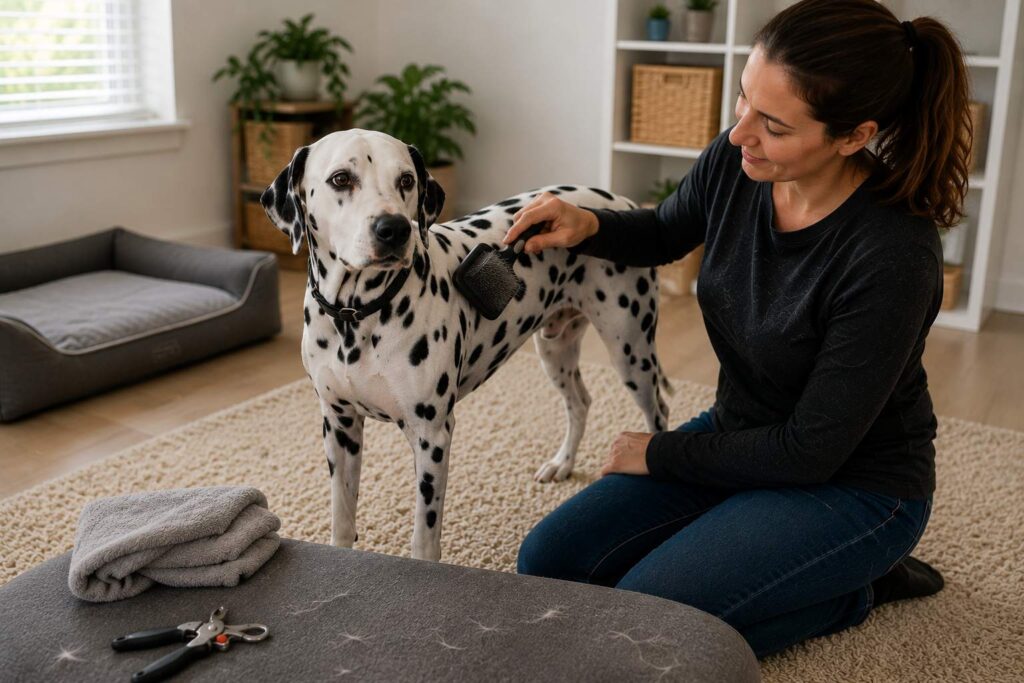
Short coat does not mean low shedding. Dalmatians can shed throughout the year, and their short, stiff hairs are particularly noticeable on clothing, carpets, and upholstery.
Regular brushing can remove loose hair before more of it reaches the furniture, although it won’t eliminate shedding completely.
Basic Grooming Routine
Routine care is relatively straightforward:
- Brush regularly to remove loose hair.
- Bathe when needed rather than automatically on a rigid schedule.
- Keep nails at a comfortable length.
- Check the ears for irritation, odour, or discharge.
- Include regular dental care.
Persistent itching, skin redness, hair loss, ear inflammation, or unusual odour warrants veterinary attention rather than simply more bathing.
Feeding a Dalmatian Without Falling for Internet Diet Rules

Start With Complete and Balanced Nutrition
Choose food appropriate to the dog’s life stage, and adjust the amount according to body condition, activity, and individual health rather than relying only on the serving guide printed on the packet.
A growing puppy, an athletic young adult, and an older Dalmatian with a medical condition may all need different feeding approaches.
Does Every Dalmatian Need a Special Low-Purine Diet?
Not automatically.
Dalmatians have a breed-specific tendency toward increased urinary uric acid, but that does not mean every Dalmatian should immediately be placed on a restrictive diet. Feeding decisions should take account of the individual dog’s health history, urine or stone findings where relevant, and veterinary advice.
This distinction matters because not every urinary stone is a urate stone, and different stone types can require different management.
Hydration and Urinary Health
Keep fresh water readily available and give the dog regular opportunities to urinate.
Pay attention to meaningful changes such as urinating more or less often than usual, blood in the urine, repeated squatting, discomfort, or straining. These signs should be assessed by a veterinarian rather than managed through diet changes or home remedies alone.
Supplements
Don’t add supplements simply because a product is marketed for Dalmatians, joints, urinary health, or “detox.”
Whether a supplement is useful depends on the dog, the complete diet already being fed, and the medical reason for using it. Discuss supplements with your veterinarian before adding them routinely.
Two Health Topics Every Dalmatian Owner Should Understand

Hearing and BAER Testing
Congenital deafness is a recognised breed concern in Dalmatians and is associated with pigmentation genetics involved in predominantly white coat patterns.
BAER — Brainstem Auditory Evoked Response — testing objectively assesses hearing and can evaluate each ear separately. The Dalmatian Club of Canada explains that puppies should not be BAER tested before five weeks of age and that results for both ears should be documented. That distinction matters because a puppy with hearing in one ear can still react normally to voices, doors, or food preparation while being deaf in the other ear.
A puppy that appears to “hear fine” has therefore not demonstrated normal hearing in both ears.
When buying a puppy, ask the breeder for the actual BAER result rather than relying on a verbal assurance that the litter can hear.
Hyperuricosuria and Urate Stones
Dalmatians handle uric acid differently from most dog breeds. As a result, traditional Dalmatians tend to excrete more uric acid in their urine, increasing their predisposition to urate crystals and urinary stones.
The important word is predisposition. Not every Dalmatian develops clinically significant stones, and urinary symptoms in a Dalmatian should not automatically be assumed to have been caused by urate.
Understanding the risk is useful because it helps owners recognise urinary problems promptly and makes breeder health information easier to interpret.
HUA vs LUA in Plain English
| Topic | HUA | LUA |
|---|---|---|
| Uric acid handling | Breed-typical increased uric-acid excretion | Lower uric-acid phenotype |
| Urate risk | Greater breed-specific predisposition | Reduced breed-specific predisposition |
| Does it mean the dog will develop stones? | No | No |
| Does LUA mean the dog cannot develop urinary disease? | No | No |
HUA refers to the high-uric-acid phenotype traditionally associated with the breed. LUA Dalmatians descend from a breeding programme that introduced a normal uric-acid gene while retaining Dalmatian characteristics.
LUA reduces the breed-specific urate predisposition, but it does not make a dog immune to urinary disease or other types of bladder stones. Likewise, being HUA does not mean a dog is destined to become a stone former.
Warning: Trouble Urinating Can Be an Emergency
Repeated attempts to urinate, producing only drops or no urine, obvious pain, repeated straining, or increasing distress can indicate a urinary obstruction or another serious urinary problem.
Seek urgent veterinary care if your dog is struggling to pass urine. Do not wait for the problem to resolve on its own, attempt to dissolve a suspected stone with home remedies, or assume that every urinary problem in a Dalmatian is caused by urate stones.
Health Beyond Hearing and Urinary Stones
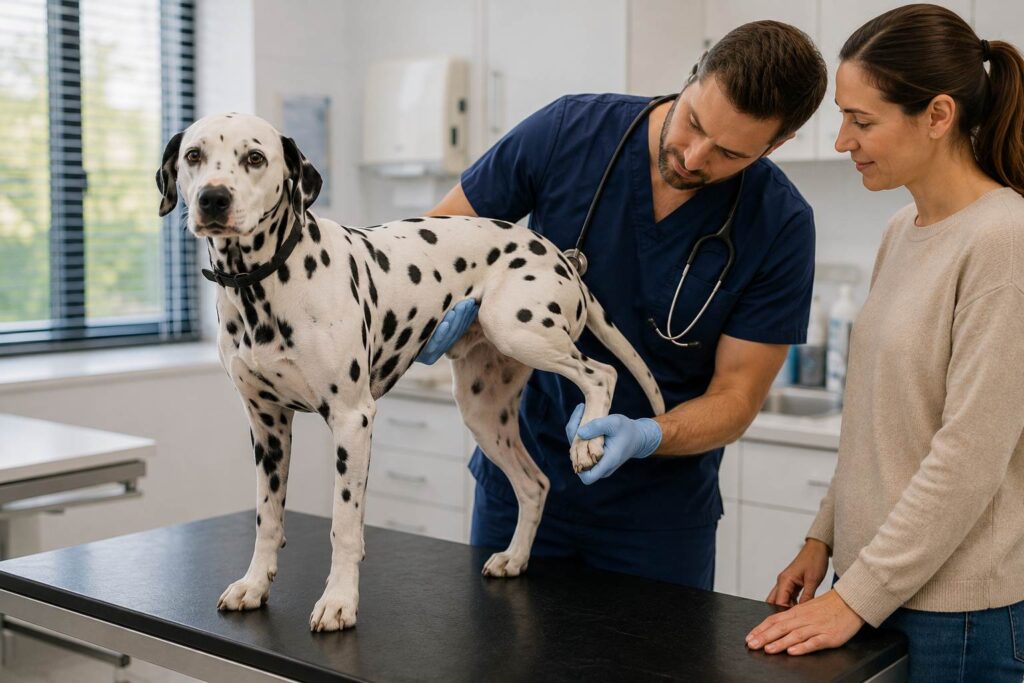
Orthopaedic Health
Hip and elbow health is worth discussing with your vet, particularly during growth and before a young Dalmatian begins repetitive high-impact exercise. If you’re buying a puppy, ask to see the parents’ relevant screening results rather than relying on a breeder saying their dogs have “never had problems.”
Screening can identify risk and support better breeding decisions, but it cannot guarantee that an individual dog will never develop joint disease.
Eyes, Skin, and Other Reported Conditions
Eye abnormalities, allergies and other skin problems are among the additional health concerns reported in Dalmatians. Other conditions may also occur, but they should be kept in perspective: being reported in a breed does not mean every Dalmatian is likely to develop them.
Persistent itching, recurrent ear or skin problems, changes in vision, unexplained pain, seizures, or other new symptoms deserve veterinary assessment rather than being attributed to “the breed.”
Why a Disease List Isn’t a Diagnosis
A breed predisposition tells you which problems deserve extra awareness. It does not predict an individual dog’s medical future.
That distinction matters when reading breed guides. Screening estimates or identifies certain risks; it does not diagnose a healthy dog or guarantee lifelong health. Regular veterinary care and attention to changes in your own dog’s behaviour, mobility, appetite, skin, eyes, hearing, and urination remain more useful than worrying about every condition on a breed-health list.
What Good Breeder Health Screening Actually Looks Like

Don’t Accept “The Parents Look Healthy”
Many inherited problems cannot be identified simply by looking at a dog. A parent can appear athletic, hear everyday sounds, and move normally while still carrying or having a condition relevant to breeding.
Good breeders should be comfortable discussing both the strengths and health concerns in their lines and showing you the relevant test results.
Hearing Documentation
Ask for the puppy’s BAER hearing result, not simply reassurance that the puppy reacts to noises.
Where breed-club or breeding-programme recommendations include hearing testing of breeding dogs, ask about the parents’ results as well. Remember that a dog with hearing in only one ear can still appear to respond normally to everyday sounds.
Genetic and Orthopaedic Screening
The exact schemes and terminology differ between countries, so there isn’t one universal checklist.
For example, The Kennel Club’s current health standard for Dalmatians lists DNA testing for hyperuricosuria (HUU), BAER hearing testing including litter screening, and hip and elbow testing. Recommendations and screening systems differ between countries, so prospective owners should check the current guidance that applies where the puppy was bred.
The practical rule is simple: ask which tests are recommended for Dalmatians where you live, then ask to see the actual results. Registration alone is not the same as health screening.
Temperament Matters Too
Health certificates are only part of responsible breeding. Parent temperament, early puppy-rearing conditions, socialisation, and the breeder’s willingness to match puppies thoughtfully to homes all matter.
A responsible breeder should be able to describe how the puppies have been raised, what they have experienced so far, and any temperament concerns seen in close relatives.
Breeder Checklist — Questions Before Paying a Deposit
- Can I see documented health screening for both parents?
- Has this puppy had BAER testing, and can I see the result?
- What health problems have appeared in close relatives or previous litters?
- How have the puppies been socialised so far?
- Can I meet the mother and learn about the sire’s health and temperament?
- What support is offered after the puppy comes home?
- Is there a written contract?
- What happens if I can no longer keep the dog in future?
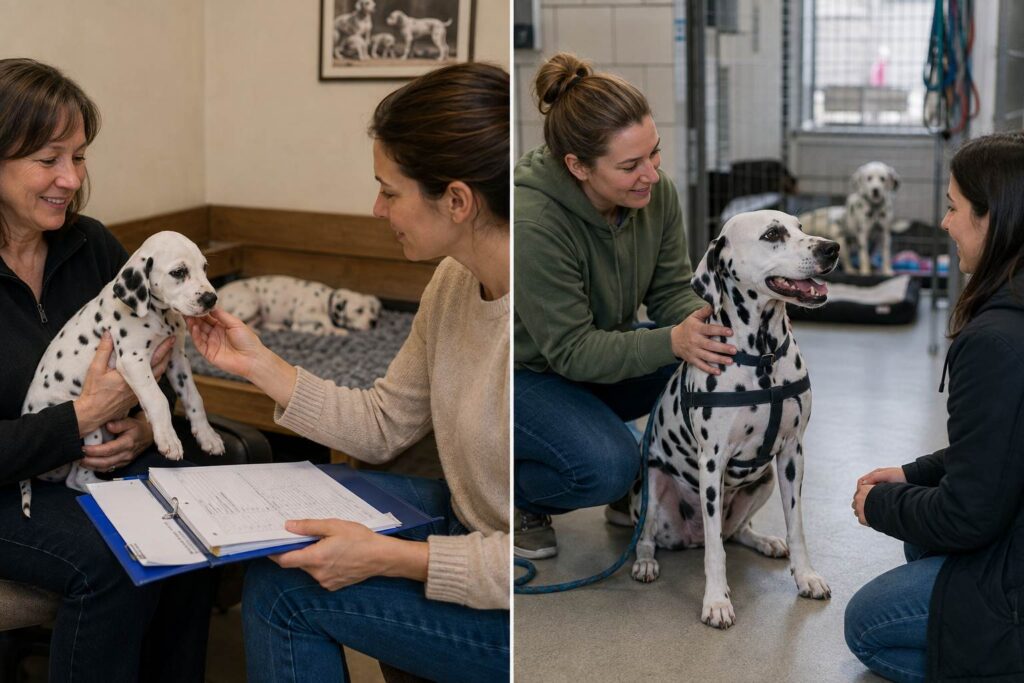
Breeder Puppy or Rescue Dalmatian?
| Consideration | Breeder Puppy | Rescue / Adult |
|---|---|---|
| Temperament visibility | Still developing | Adult behaviour may be easier to assess |
| Training workload | High from the start | Depends on previous experience and training |
| Health history | Parental screening and puppy records can be reviewed | Records may be complete, partial, or unknown |
| Hearing status | Ask for the puppy’s BAER result | Ask what’s documented; testing may be considered if status is unknown |
| Exercise readiness | Growth-related limitations apply | Adult fitness and health still need assessment |
| House skills | Usually need to be taught | May already have some |
| Adjustment period | Puppy development and settling-in period | Individual adjustment or decompression period |
Neither Route Is Automatically “Easier”
A puppy gives you the opportunity to shape habits from the beginning, but it also brings intensive toilet training, socialisation, supervision, and adolescence.
An adult rescue may arrive with established house skills and a more visible personality, but their medical or behavioural history may be incomplete. The better choice is the dog whose needs, temperament, and history best match your household.
Common Dalmatian Ownership Mistakes
- Choosing based on appearance alone — assess lifestyle compatibility first.
- Assuming a garden replaces exercise — purposeful outings and interaction still matter.
- Exercising the body without engaging the brain — include training, sniffing, and problem-solving.
- Over-exercising puppies — adjust repetitive and high-impact activity to growth and development.
- Expecting a short coat to mean little shedding — plan for regular brushing and loose hair around the home.
- Calling every difficult behaviour “stubbornness” — consider training, boredom, fear, stress, pain, and age before applying a label.
- Skipping health documentation — verify screening instead of relying on verbal assurances.
- Assuming a reaction to sound proves normal hearing — ask specifically for BAER results.
- Starting a restrictive diet without a medical reason — discuss urinary-health concerns with your vet first.
- Ignoring difficulty urinating — repeated straining or producing little or no urine requires prompt veterinary attention.
Four Homes, Four Very Different Outcomes
Active Remote Worker
Strong potential fit. Regular availability can make it easier to provide exercise, short training sessions, companionship, and gradual alone-time practice.
Working from home isn’t enough by itself, though. A Dalmatian still needs to learn that being near you doesn’t mean receiving constant attention.
Busy Family With Little Weekday Time
Needs serious planning. A busy household can work if responsibilities for walking, training, supervision, and enrichment are realistic and shared.
If everyone loves the idea of the dog but nobody has reliable time for it Monday to Friday, the fit is much less convincing.
Apartment Owner Who Walks, Trains, and Enriches Daily
Potentially a good fit. Housing size alone does not determine whether a Dalmatian’s needs will be met.
A committed apartment owner with appropriate outdoor access and a strong routine may provide a better life than a large home where the dog receives little structured attention.
Owner Working Long Shifts With Minimal Support
Likely a challenging fit. Long, routine periods alone can be difficult for many Dalmatians, particularly young dogs or individuals that have not been taught to cope comfortably with separation.
A dog walker, trusted carer, suitable daycare, adjusted schedule, or another realistic support plan may change the picture, but those arrangements should exist before bringing the dog home.
Before You Commit — Final Dalmatian Readiness Checklist

Time: Daily exercise, training, enrichment, and genuine interaction
Home: Safe exercise options, household compatibility, and a realistic alone-time plan
Behaviour: Commitment to socialisation, reward-based training, calmness skills, and managing adolescence
Grooming: Comfortable with regular shedding and basic coat, nail, ear, and dental care
Health: Understand BAER testing and urinary risk, recognise urgent urinary signs, and budget for routine and unexpected veterinary care
Acquisition: Responsible breeder or reputable rescue, health and history documentation reviewed, and no impulse decisions based on appearance alone
What to Discuss at Routine Vet Appointments
Puppy or recently adopted dog: hearing status and available records, safe exercise during growth, vaccination and parasite-prevention needs, body condition, diet, and urinary history
Adult: changes in urination, mobility, skin or ears, weight and body condition, exercise tolerance, and any new behavioural changes
Senior: mobility, hearing and vision changes, urinary habits, appetite or weight changes, comfort, and appropriate exercise adjustments
The principle is straightforward: breed information tells you what deserves attention; your veterinarian assesses the individual dog in front of them.
Quick Dalmatian Owner Tips
- Train calmness as deliberately as stamina.
- Let walks include time to sniff and explore.
- Start reward-based training early.
- Don’t confuse a short coat with low shedding.
- Notice changes in urinary habits and act promptly when something seems wrong.
- Keep BAER and other health records somewhere accessible.
- Introduce children and other animals gradually and supervise appropriately.
- Adjust exercise to age, fitness, weather, and health.
- Treat breed tendencies as useful context, not guarantees.
- Judge lifestyle fit before appearance.
Final Thoughts
A Dalmatian isn’t automatically a “difficult” dog. It is a breed that makes a poor match difficult to ignore.
Give one appropriate exercise, mental work, consistent training, companionship, and opportunities to settle, and you can have an engaging, athletic companion. Go into ownership without understanding hearing screening, urinary-health risk, or the breed’s day-to-day demands, and avoidable problems become much more likely.
The spots may catch your attention. The daily reality should decide whether you bring one home.
Frequently Asked Questions
1.Are Dalmatians good for first-time owners?
They can be. Success depends less on whether you’ve owned a dog before and more on whether you’re prepared for consistent training, significant activity, socialisation, shedding, and breed-specific health considerations. A first-time owner who gets support early may be a better fit than an experienced owner who underestimates the breed.
2.Are Dalmatians good family dogs?
Many can be excellent family companions in homes that meet their physical and behavioural needs. Interactions with young children should still be supervised, and individual temperament matters more than a breed label.
3.Can Dalmatians live in apartments?
Yes, some can. The deciding factor is usually the owner’s routine rather than the floor space alone. Regular exercise, enrichment, toilet opportunities, training, and time with people still need to be provided.
4.Can a Dalmatian be left alone during the workday?
Some adults can learn to cope comfortably with periods alone, but tolerance varies and should be developed gradually. Puppies require much more frequent care, and routinely leaving any dog for a long workday without appropriate breaks or support may not be suitable.
5.Do Dalmatians bark a lot?
There isn’t one barking pattern that applies to every Dalmatian. Barking can be influenced by excitement, alerting, frustration, boredom, fear, separation-related distress, training, and the individual dog’s temperament. A sudden increase in vocalisation also deserves attention if pain or illness could be involved.
6.How much mental stimulation does a Dalmatian need?
Mental activity should be a regular part of the routine rather than an occasional extra. Short training sessions, sniffing opportunities, food puzzles, search games, and other enrichment can complement physical exercise without keeping the dog in a constant state of activity.
7.What is the difference between HUA and LUA?
HUA Dalmatians have the breed-typical high-uric-acid trait associated with increased urinary uric acid and a greater predisposition to urate crystals and stones.
LUA Dalmatians carry a normal uric-acid gene introduced through the Dalmatian backcross programme and have a reduced breed-specific urate risk. LUA does not mean a dog cannot develop urinary disease, and HUA does not mean a dog will inevitably develop stones.
#. Related Articles: