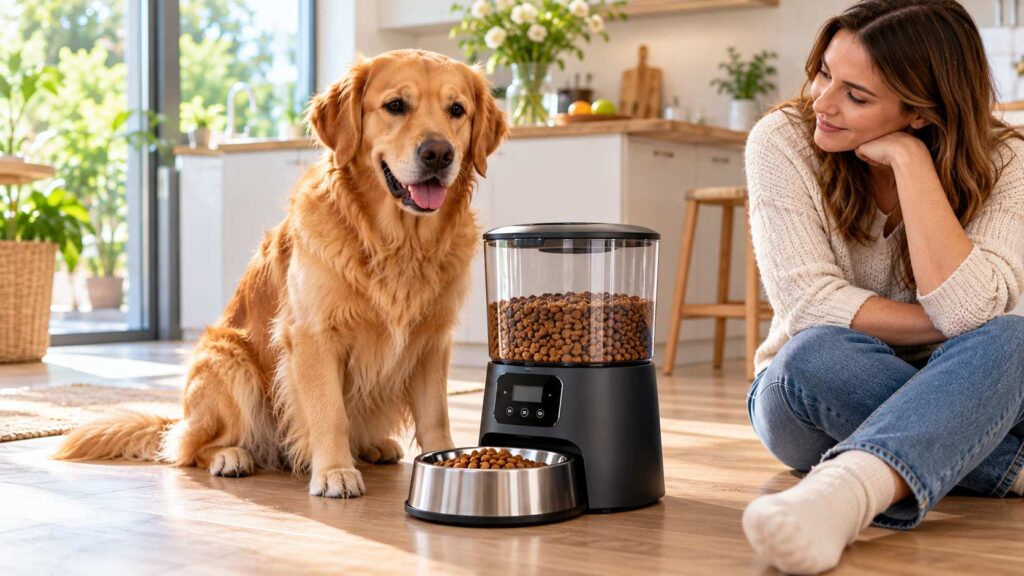
Are automatic dog feeders worth it? For many dog owners, yes—but only when the feeder solves a genuine problem, suits their dog’s needs, and works reliably.
Picture this: your phone buzzes at 7:30 a.m. to say breakfast has been served. Convenient. But did the food actually drop? Did your dog eat it, or did the other dog get there first?
That gap between food being dispensed and food actually being eaten is where automatic feeders can fall short.
Here’s how to decide whether one makes sense for your dog, which features matter, what to test before relying on it, and when traditional feeding may be the better choice.
First, What Problem Would a Feeder Actually Solve?
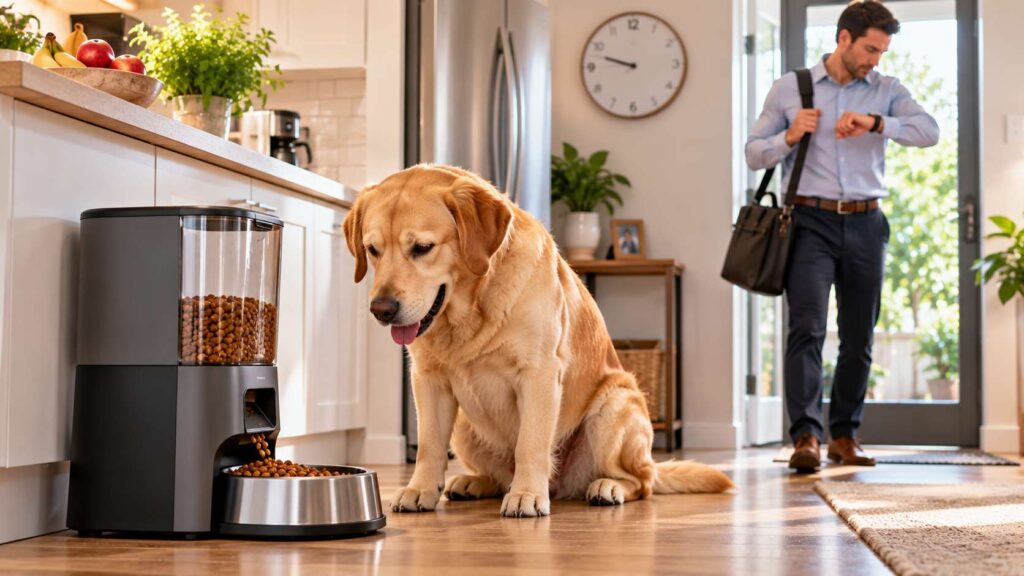
Don’t start with the gadget. Start with the problem. Automatic feeders tend to be most useful in three situations.
Your Dog’s Meals Keep Getting Delayed
Shift work, long commutes, and unpredictable days can push breakfast or dinner back by hours.
A programmable feeder can help maintain a consistent meal schedule, even when you’re running late.
However, predictable mealtimes don’t necessarily mean your dog is comfortable being alone. An automatic feeder cannot replace exercise, toilet breaks, companionship, or appropriate supervision.
You Need More Consistent Portions
When several people share feeding duties, accidental double breakfasts can happen.
A programmable feeder can help reduce this confusion by delivering predetermined amounts of food.
But there’s an important catch: a consistent portion isn’t necessarily the correct portion.
Your dog’s daily food allowance should reflect their age, weight, body condition, activity level, and diet. A veterinarian can help establish an appropriate amount, especially if weight management is a concern.
Once you’ve established that amount, the feeder needs to be calibrated to dispense it accurately.
You Want Convenience, Not a Solution
If you work from home and enjoy feeding your dog yourself, an automatic feeder might add expense and maintenance without offering much practical benefit.
Consider which situation best describes your household:
- Likely useful: Irregular working hours, shared feeding responsibilities, or a veterinarian-guided portion schedule.
- Possibly useful: Occasional early starts, predictable supplementary meals, or short absences when someone is still available to check on your dog.
- Probably unnecessary: You’re normally home at mealtimes, your dog’s portions are consistent, and your current routine works well.
Quick tip: Before buying, identify one specific feeding problem you expect the device to solve. If you can’t identify one, you may not need it.
The Three Promises a Feeder Makes (and What They Really Mean)
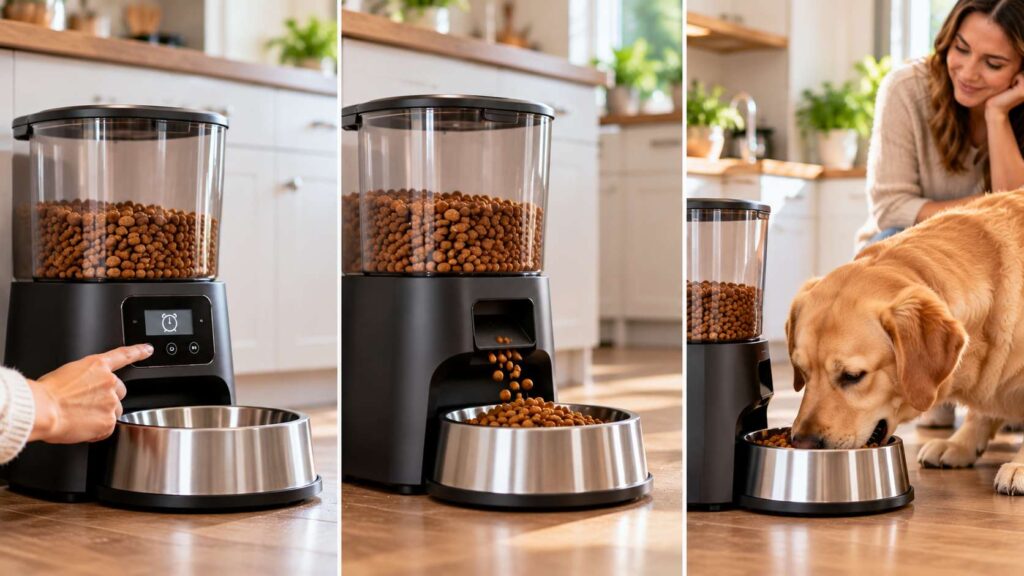
Think of automatic feeding as three separate stages:
Scheduled → Dispensed → Consumed
Understanding the difference is essential because most automatic feeders cannot independently verify every stage.
A Scheduled Meal Isn’t Always a Delivered Meal
A schedule displayed on an app doesn’t prove that food reached the bowl.
Several things can interfere:
- An empty food hopper.
- Kibble becoming stuck in the dispensing mechanism.
- A disconnected power cable or depleted batteries.
- Incorrect programming or clock settings.
- A mechanical failure.
Some models include dispensing alerts or sensors, but their capabilities vary. A notification should never be treated as universal proof that a meal was delivered successfully.
Delivered Food Isn’t Eaten Food
Even when the correct amount reaches the bowl, your dog might not eat it.
A dog feeling unwell may walk away from a full meal. In a multi-dog household, another animal could eat the food first.
Cameras may help owners observe feeding, but they don’t always establish exactly how much each dog consumed.
This matters because a change in appetite can be an early sign of illness.
If your dog suddenly refuses food, particularly alongside vomiting, lethargy, abdominal discomfort, or other symptoms, contact your veterinarian. Puppies and dogs with certain medical conditions may need more urgent assessment.
Portion Control Is Only as Good as Its Accuracy
Many automatic feeders measure food in manufacturer-defined portions rather than grams.
The amount dispensed can change depending on kibble size, shape, density, and the feeder’s mechanism.
For example, switching from small, round kibble to larger, irregular pieces may change the weight delivered at the same setting.
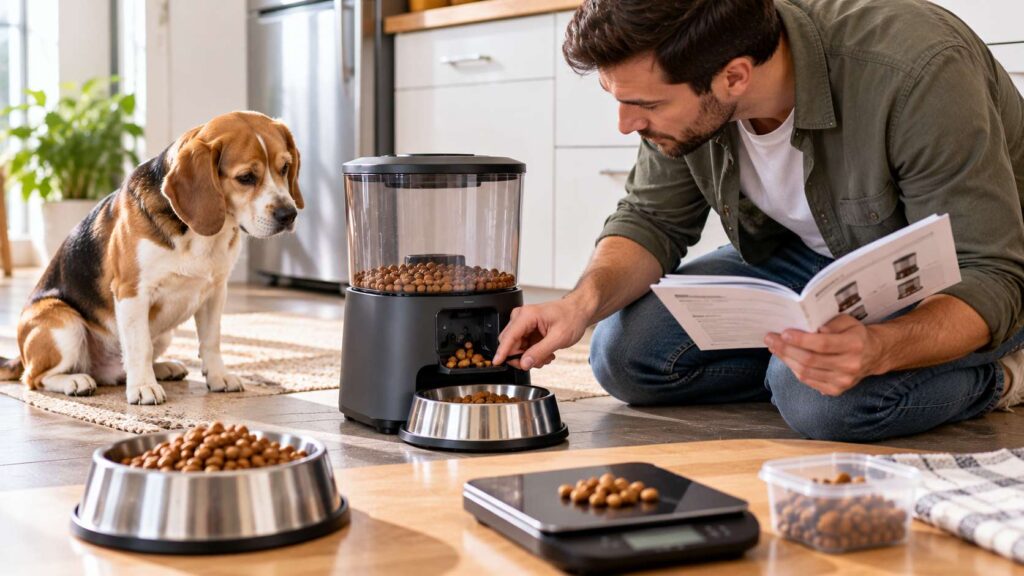
A simple kitchen-scale test helps:
- Set the feeder to dispense one planned portion.
- Collect and weigh the food in grams.
- Repeat the test several times.
- Compare the results with your dog’s intended meal amount.
- Adjust the settings and retest if necessary.
Repeat calibration whenever you change the type or size of kibble.
Expert tip: Check dispensing consistency when the hopper is nearly full and when it is running low. Some mechanisms may perform differently depending on the food level.
Which Dogs Benefit, and Which Need a Different Plan?
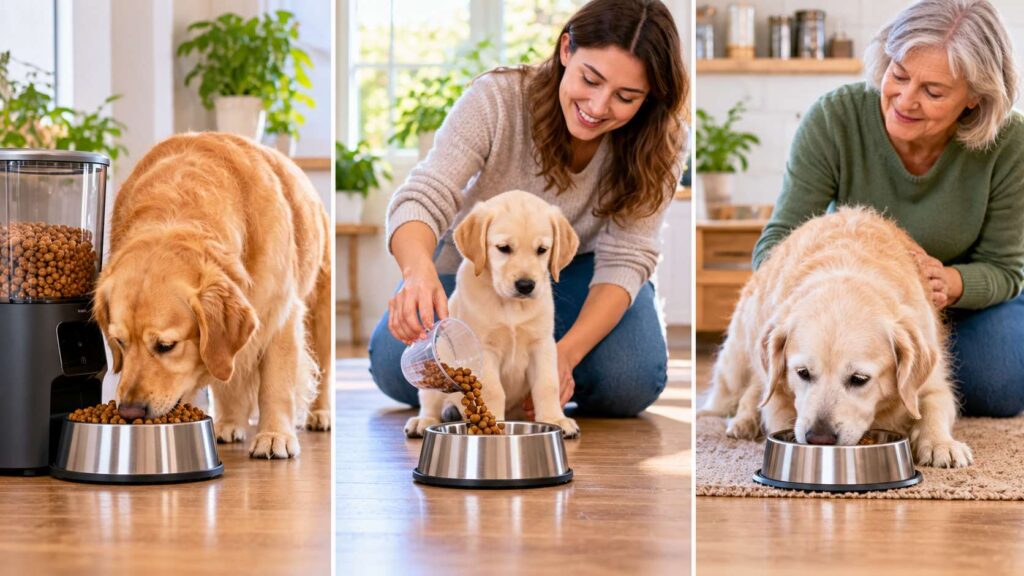
Healthy Adult Dogs on Predictable Diets
A healthy adult dog eating compatible dry food at regular times is often a suitable candidate.
If your dog is comfortable with the equipment, eats reliably, and has no condition requiring close meal supervision, an automatic feeder may simplify daily routines.
Introduce it gradually while you’re home. Observe several complete meals before relying on scheduled feeding during an absence.
Puppies and Senior Dogs
Puppies often require more frequent meals than healthy adult dogs, although the appropriate schedule depends on age, breed, size, and individual needs.
Young puppies also need closer monitoring because changes in appetite or energy can be important warning signs.
Senior dogs may face different challenges:
- Reduced appetite.
- Dental discomfort.
- Mobility limitations.
- Cognitive changes.
- Medical conditions requiring special diets.
A feeder can support an established routine, but it shouldn’t prevent owners from noticing changes in eating behaviour.
For either group, human observation remains important even when meals are automated.
Dogs With Medical or Behavioural Needs
Dogs with diabetes, gastrointestinal conditions, or medications linked to mealtimes need individualized veterinary guidance.
For a dog receiving insulin, the amount of food actually eaten may be particularly important. A feeder delivering food on time does not establish that the dog consumed enough to safely follow their prescribed treatment plan.
Dogs with food guarding or feeding-related anxiety also require careful consideration.
A noisy dispensing mechanism may frighten some dogs, while shared access to one feeder can create competition between pets.
Vet Advice: When to Ask Before You Buy
Speak with your veterinarian before relying on an automatic feeder if:
- Your dog has diabetes or receives medication associated with meals.
- Your dog has a digestive condition or requires a prescription diet.
- Your dog has recently lost interest in food.
- Your dog needs a medically supervised weight-management plan.
- You’re considering a feeder to address persistent fast eating or feeding-related behavioural problems.
An automatic feeder is not a treatment for obesity, separation anxiety, or digestive disease.
Large, deep-chested dogs may also be at increased risk of gastric dilatation-volvulus (GDV), a potentially life-threatening emergency. Feeding practices should be discussed with your veterinarian when appropriate; automatic feeders have not been established as a way to prevent GDV.
Not All Feeders Solve the Same Problem
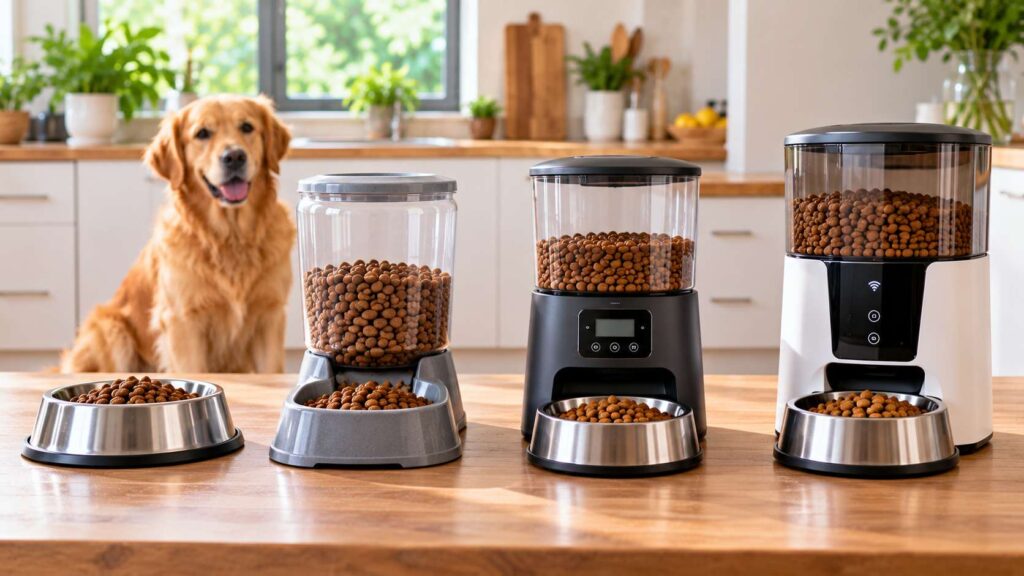
Different feeder designs offer different levels of control. The best choice depends on your dog’s food, feeding habits, and household circumstances.
| Feeding option | Best suited to | Main limitation |
|---|---|---|
| Manual bowl | Owners with consistent routines | Requires someone to serve each meal |
| Gravity feeder | Situations where unrestricted dry-food access is appropriate | Does not provide controlled meal portions |
| Programmable timer feeder | Scheduled feeding without smartphone dependence | Dispensing accuracy and reliability vary |
| Wi-Fi smart feeder | Remote settings, alerts, and feeding records | Some functions depend on connectivity or software |
| Compartment feeder | Pre-portioned meals over a limited period | Restricted capacity and food-storage limitations |
| Selective-access feeder | Certain multi-pet households | Controls access but doesn’t guarantee consumption |
Dry Kibble, Wet Food, and Special Diets
Most hopper-style automatic feeders are designed for dry kibble.
Wet food, fresh food, and raw diets introduce additional storage and hygiene considerations. They may also be incompatible with standard dispensing mechanisms.
Some compartment feeders include cooling features, but cooling performance, food safety, and permitted storage duration depend on the specific design.
Do not assume that a cooling compartment keeps perishable food safe for an entire day. Follow the food manufacturer’s storage instructions and the feeder manufacturer’s specifications.
For prescription diets, check compatibility and discuss any feeding restrictions with your veterinarian.
Essential Features vs Expensive Extras
A feeder doesn’t need every smart feature to be useful.
Prioritize:
- Reliable dispensing: Consistent food delivery with compatible kibble.
- Accurate portions: Settings that can be checked against actual food weight.
- Easy cleaning: Accessible, removable food-contact components.
- Secure construction: A stable base and a lid your dog cannot easily open.
- Power backup: An appropriate backup system if mains power fails.
- Offline scheduling: The ability to maintain programmed meals without an internet connection, where supported.
Cameras, voice recordings, and detailed app histories may be convenient, but they are not substitutes for mechanical reliability.
Remember that battery backup and offline operation are separate features. A feeder may retain its schedule without Wi-Fi yet still stop dispensing food during a power failure.
Quick tip: Choose the simplest feeder that reliably meets your dog’s needs. More technology doesn’t automatically mean better feeding.
The Reliability Test Most Buyers Never Do
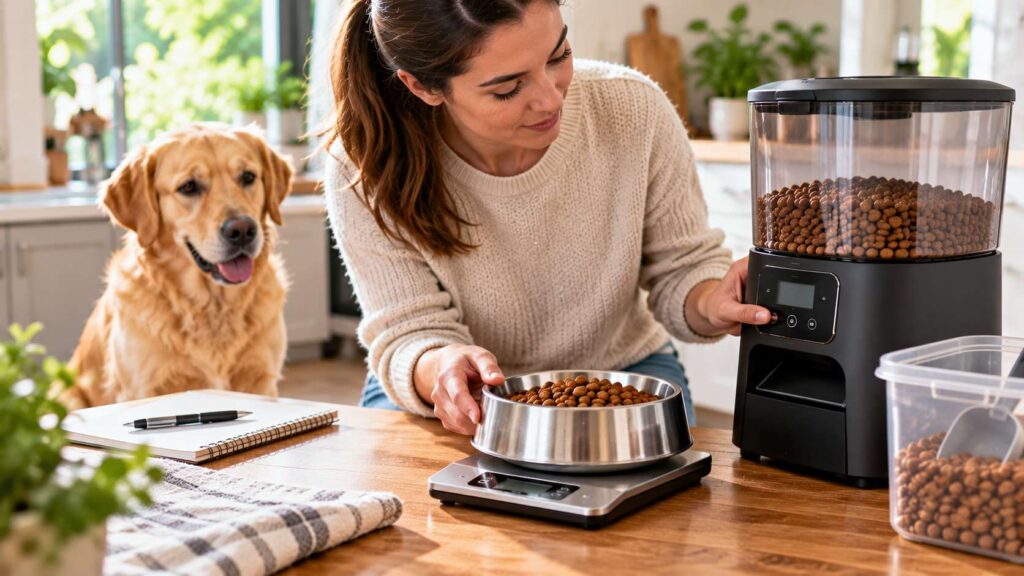
Before relying on an automatic dog feeder, spend several days testing it while you’re home. A feeder that works once isn’t necessarily reliable enough for everyday use.
Check What Happens When Technology Fails
Test what happens during a Wi-Fi outage and, where safe and permitted by the manufacturer, a power interruption.
Check whether the feeder retains its programmed schedule, whether battery backup keeps meals running, and what happens when power returns.
Battery backup and offline scheduling are separate features. A feeder may work without Wi-Fi but stop dispensing during a power cut.
Follow the manufacturer’s testing instructions rather than assuming every model behaves the same way.
Test Whether Your Kibble Dispenses Consistently
Run several dispensing cycles and weigh each portion using a kitchen scale.
Compare the results with your dog’s intended meal amount. Test with the hopper full and nearly empty, as food levels may affect dispensing accuracy in some models.
If you switch kibble brands, sizes, or shapes, repeat the test. The same feeder setting may deliver a different weight.
Watch How Your Dog Responds
Some dogs barely notice an automatic feeder. Others may be startled by its noise, hesitate to approach, or try to force food out of the hopper.
Watch for signs of discomfort, including:
- Backing away when the motor starts.
- Refusing to approach the bowl.
- Repeatedly pawing or biting the dispenser.
- Guarding the feeder from other pets.
If your dog appears frightened, slow the introduction rather than forcing them to eat beside the machine.
Checklist: Before Relying on an Automatic Feeder
- Check the programmed meal times and time zone.
- Confirm compatibility with your dog’s food.
- Weigh several dispensed portions.
- Test Wi-Fi loss and backup power according to the manufacturer’s instructions.
- Check whether schedules survive an interruption.
- Secure the feeder and protect electrical cables.
- Watch your dog eat several meals from it.
- Arrange for someone to intervene if the feeder fails.
Introducing It Gently
Place the switched-off feeder near your dog’s usual eating area and allow them to investigate it at their own pace.
Offer a few treats nearby, then operate the feeder manually while you’re present. Reward calm behaviour without forcing your dog closer.
Once your dog is comfortable, use the feeder for one supervised meal at a time before introducing scheduled feeding.
Some dogs adjust quickly; others need several days or longer. If your dog remains fearful or refuses meals, return to their familiar feeding routine and seek veterinary or qualified behaviour advice if needed.
When Convenience Turns Into a Safety Problem
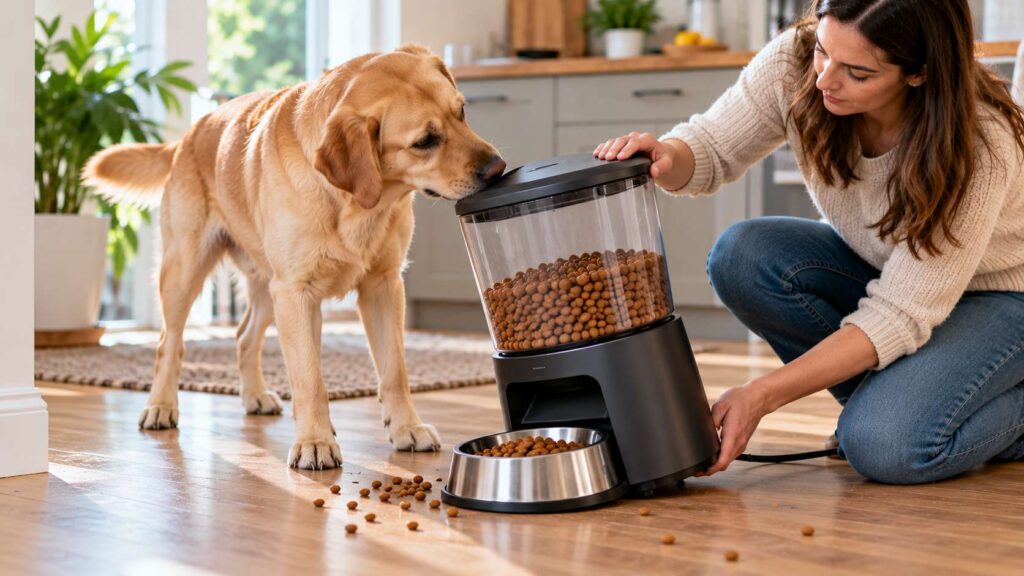
Missed Meals and Unexpected Extra Food
Mechanical jams, incorrect programming, and accidental extra dispensing can leave a dog hungry or overfed.
For an otherwise healthy adult dog, one delayed meal may not cause serious harm. However, missed meals can be more concerning for young puppies, dogs with diabetes, and dogs with certain medical conditions.
If your dog receives insulin and misses a meal or refuses to eat, follow your veterinarian’s individualized instructions and contact them promptly if you’re unsure what to do. Do not adjust insulin doses without veterinary guidance.
Unexpected access to large amounts of food can also be dangerous, particularly if a dog breaks into the hopper. Contact your veterinarian promptly if your dog consumes an unusually large quantity or develops abdominal swelling, repeated unproductive retching, restlessness, or other concerning symptoms.
Hygiene and Damage
Kibble can become stale, while moisture and food residue may encourage mould growth or interfere with dispensing mechanisms.
Dogs may also chew exposed cables, tip over lightweight feeders, or damage lids while trying to reach stored food.
To reduce these risks:
- Keep the feeder in a dry, stable location.
- Clean food-contact components according to the manufacturer’s instructions.
- Remove old food and check for crumbs or moisture buildup.
- Inspect the lid, dispensing mechanism, and cables regularly.
- Allow washed components to dry completely before refilling.
Never use a damaged electrical feeder until it has been safely repaired or replaced.
One Feeder, Two Dogs
Two dogs rarely eat in exactly the same way.
One may finish quickly and steal the other’s meal. Another may need a prescription diet or become defensive when food appears.
For example, if one dog needs a calorie-controlled diet while the other requires larger meals, a shared feeder makes it difficult to monitor what each dog consumes.
Separate feeding areas are generally more reliable when food theft or resource guarding is a concern. Selective-access feeders may help in some households, but they still require supervision and testing.
Warning: An Automatic Feeder Isn’t a Pet Sitter
An automatic feeder cannot replace toilet breaks, exercise, companionship, or regular welfare checks.
A dispensing notification doesn’t prove your dog ate the meal, and a camera cannot reliably assess every health concern.
Never use a feeder as the sole reason to leave a dog unattended for longer than is appropriate for their age, health, behaviour, and individual needs.
If a meal is missed, the feeder malfunctions, or your dog appears unwell, someone must be available to intervene.
What Does an Automatic Dog Feeder Really Cost?

The Price Tag Is Only the Start
The purchase price is only part of the cost.
Consider batteries, electricity, replacement components, cleaning supplies, and how long the feeder is likely to remain usable.
Check whether replacement bowls, lids, and dispensing parts are available. A relatively inexpensive feeder may offer poor value if a minor broken component means replacing the entire unit.
Prices, warranties, electrical compatibility, and customer support also vary across the UK, Canada, Australia, and the United States.
Savings You Shouldn’t Assume
An automatic feeder may reduce accidental overfeeding or food waste when correctly programmed, but these benefits aren’t guaranteed.
It also shouldn’t be treated as a way to eliminate pet-sitting costs. Your dog may still need someone to visit for exercise, toileting, companionship, and health checks.
Similarly, portion-controlled feeding can support weight management, but it won’t prevent obesity without an appropriate overall diet and calorie allowance.
Count only the savings that genuinely apply to your household.
A Simple Cost-Per-Year Check
You don’t need a complicated calculation to judge value.
Estimated annual ownership cost = (Purchase price ÷ Expected years of use) + Annual running and maintenance costs
For example, suppose a feeder costs £120, lasts four years, and requires approximately £10 per year in batteries and maintenance.
Its estimated annual ownership cost would be:
£120 ÷ 4 + £10 = £40 per year
That’s an illustrative calculation, not a verified product price or lifespan.
The more important question is whether that expense solves a problem worth paying for.
A reliable basic timer feeder may perform the same essential job as a premium smart model. Don’t pay extra for features you won’t use.
Five Mistakes That Make a Good Feeder a Bad Purchase
1. Buying features instead of reliability. A feeder with a camera and smartphone app is little use if it regularly jams. Prioritize dependable dispensing and easy cleaning.
2. Treating portion settings as exact weights. Manufacturer-defined portions don’t always equal a fixed number of grams. Weigh the food and recalibrate when changing kibble.
3. Choosing a feeder that can’t handle your dog’s food. Check kibble dimensions, food type, and storage requirements before purchasing.
4. Skipping the supervised trial. Test several complete feeding cycles while you’re home. This helps identify mechanical problems and gives your dog time to adjust.
5. Using automation as a replacement for daily care. A feeder handles scheduled food delivery, not your dog’s wider physical, social, or medical needs.
What Could Work Better Than a Feeder?
A Measured Manual Routine
If you’re usually home at feeding times, a kitchen scale and a simple feeding chart may be all you need.
A shared chart can prevent accidental double feeding, while weighing meals helps maintain consistent portions without buying another device.
Slow-Feeder Bowls and Puzzle Feeders
If your main concern is fast eating, a slow-feeder bowl may be more appropriate than a standard automatic dispenser.
Puzzle feeders can also provide enrichment, although they should suit your dog’s abilities and be used safely.
Some dogs benefit from both scheduled feeding and slower food delivery, but an automatic feeder doesn’t automatically solve rapid eating.
Human Help
If your dog needs attention during the day, a trusted family member, neighbour, dog walker, or pet sitter may provide more value than a feeding device alone.
They can serve meals, refresh water, offer appropriate exercise or toilet breaks, and notice changes in your dog’s behaviour.
For dogs requiring close medical monitoring, reliable human care is particularly important.
The Final Decision: Buy, Wait, or Skip?
| Outcome | When it applies |
|---|---|
| Buy | You have a genuine scheduling or portion-management need, your dog is suitable, the feeder handles their food, and it has passed supervised testing. |
| Wait | Your dog’s medical needs are unclear, the feeder hasn’t been tested, or you’re uncertain about food compatibility or reliability. |
| Skip | Your current feeding routine works well, the device doesn’t suit your dog, or a simpler and less expensive solution meets your needs. |
Five Questions to Answer Before You Spend
- What exact feeding problem am I trying to solve?
- Is my dog suitable for automated feeding?
- Can I verify that the portions are accurate?
- What happens if the feeder fails?
- Would a simpler alternative work just as well?
If you can answer these questions confidently, an automatic feeder may be a worthwhile investment.
Choose a model that fits your dog’s actual needs, check its food compatibility, and test it thoroughly before depending on it.
The best automatic dog feeder isn’t necessarily the smartest or most expensive. It’s one that works reliably, supports your dog’s feeding routine, and makes life easier without compromising their care.
Frequently Asked Questions
1. Are Automatic Dog Feeders Worth It If You Work From Home?
Not always. If you’re home at feeding times and your current routine works well, an automatic feeder may offer little additional value.
However, it can still be useful if you frequently forget scheduled meals, share feeding responsibilities, or need consistent portions.
A kitchen scale and a simple feeding chart may solve these problems at a lower cost.
2. Do Automatic Dog Feeders Work Without Wi-Fi?
Many programmable timer feeders operate without Wi-Fi.
Some smart feeders also store feeding schedules locally, allowing them to continue dispensing food during an internet outage. However, remote controls, notifications, and other app features may stop working.
Check the manufacturer’s specifications and test offline operation before relying on the device.
Remember that working without Wi-Fi doesn’t necessarily mean working without electricity.
3. Can Automatic Feeders Dispense Wet Food Safely?
Some can, but standard hopper-style feeders are generally designed for dry kibble.
Wet food requires careful temperature control and storage because it is perishable. Certain compartment feeders are designed for moist food, sometimes with cooling features.
Always follow the food manufacturer’s storage instructions and the feeder’s guidance. Don’t assume a cooling feature keeps wet food safe indefinitely.
4. How Can You Tell Whether Your Dog Actually Ate the Food?
Check the bowl, observe your dog’s eating behaviour, and monitor their appetite over time.
A camera can help, but an empty bowl doesn’t always prove your dog ate the meal, particularly in a multi-pet household.
If your dog repeatedly leaves food untouched, eats noticeably less, or develops other symptoms, contact your veterinarian.
For dogs whose medication depends on food intake, use a veterinarian-approved monitoring plan rather than relying solely on feeder notifications.
5. Can Automatic Feeders Help Dogs That Wake You Early for Breakfast?
Sometimes.
A scheduled feeder may help break the association between waking an owner and receiving breakfast. However, dogs may also wake early because of habit, noise, toileting needs, or other reasons.
Introduce a consistent routine and avoid changing feeding times repeatedly in response to demanding behaviour.
If early waking is sudden or accompanied by increased hunger, thirst, or other changes, seek veterinary advice.
6. Are Automatic Dog Feeders Suitable for Diabetic Dogs?
They may be useful in certain situations, but only as part of an individualized veterinary management plan.
Dogs receiving insulin often need careful coordination between food intake, medication, and glucose monitoring.
A feeder cannot guarantee that the dog eats the scheduled meal. Missed or incomplete meals may create additional risks.
Ask your veterinarian whether automated feeding is appropriate and what steps to take if your dog refuses food or the device malfunctions.
7. How Often Should an Automatic Dog Feeder Be Cleaned?
Follow the manufacturer’s cleaning schedule and your dog’s food-storage instructions.
As a practical routine, wash the food bowl regularly, inspect the dispensing mechanism for residue, and clean the hopper whenever food oils, crumbs, or moisture accumulate.
Clean immediately if food becomes damp, contaminated, or mouldy.
Always dry washable components completely before reassembly, and never immerse electrical parts unless the manufacturer specifically states that doing so is safe.
#. Related Articles: