
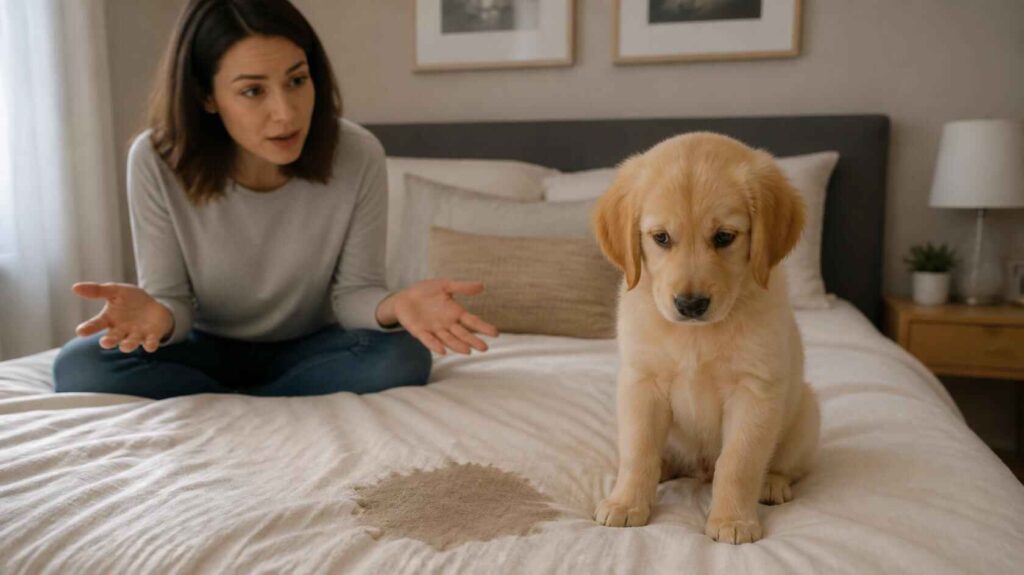
You wake up, roll over, and — oh no. That damp patch. Again. If your puppy is turning your mattress into their personal toilet, you’re not alone, and more importantly, it’s fixable. Let’s get into why it happens and exactly how to stop it.
It’s one of those moments that tests every dog owner’s patience. You let your pup sleep with you because it felt sweet — and now you’re Googling “why does my puppy pee on my bed” at 7am while stripping the sheets. Sound familiar?
The good news: there’s always a reason behind this behaviour. Once you understand it, stopping it becomes a lot more straightforward. This guide covers every cause — from the obvious to the ones most people miss — and gives you practical, real-life steps to deal with it.
Their Bladder Simply Isn’t Ready Yet
This one catches a lot of new owners off guard. Puppies under 12 weeks physically cannot hold their bladder for more than an hour or two. Even puppies up to 6 months old are still developing the muscle control needed to “hold it.”
When your puppy is relaxed, warm, and comfortable — like when they’re snuggled in your bed — their body relaxes too. That often means an accidental wee before they even realise it’s happening.
A rough rule: puppies can hold their bladder for roughly one hour per month of age. A 3-month-old pup needs a toilet trip every 2–3 hours at most.
This isn’t a training failure — it’s biology. If your puppy is younger than 5 months, this alone may explain the accidents.
Incomplete Toilet Training
Puppies don’t generalise rules the way we’d like them to. Just because they’ve learned not to wee on the kitchen floor doesn’t mean they automatically apply that rule to your bedroom. Each new space feels like a new situation.
If you haven’t specifically taught your pup that the bed — and the bedroom — are off-limits for toileting, they genuinely don’t know. It’s not defiance. It’s a gap in their education.

How to close that gap
- Take your puppy outside to toilet before letting them on the bed — every single time
- Reward them generously when they go in the right spot outdoors
- Keep bedroom access limited until toilet training is solid (more on that below)
- Keep a consistent “toilet phrase” like “go wees” so they learn to go on cue
Excitement and Submissive Urination
Some puppies wee when they’re overwhelmed — either with excitement or with submission. If your pup leaks a little when you greet them enthusiastically or when they roll onto their back, this is likely the cause.
It’s especially common in younger pups and in breeds that tend to be more sensitive. The good news? Most dogs grow out of this by 12 months if you handle it calmly and consistently.
Don’t scold your puppy for submissive urination — it makes it worse. Stay calm, keep greetings low-key, and avoid leaning over them (which can feel intimidating to a small pup).
Stress, Anxiety, and Big Life Changes
Dogs are creatures of routine. A new home, a new pet, a new baby, or even just a change in your work schedule can trigger anxiety-driven accidents. The bed carries your scent strongly, and stressed puppies are drawn to it — it’s comforting to them. But that comfort can trigger a wee.
Has anything changed recently in your household? If yes, that might be the trigger you’ve been looking for.
Signs your puppy is stressed
- Accidents only in certain rooms or during certain events
- Yawning, panting, or pacing when no obvious reason
- Clinginess or hiding more than usual
- Destructive chewing or loss of appetite
Territorial Marking — Yes, Even Puppies Do It
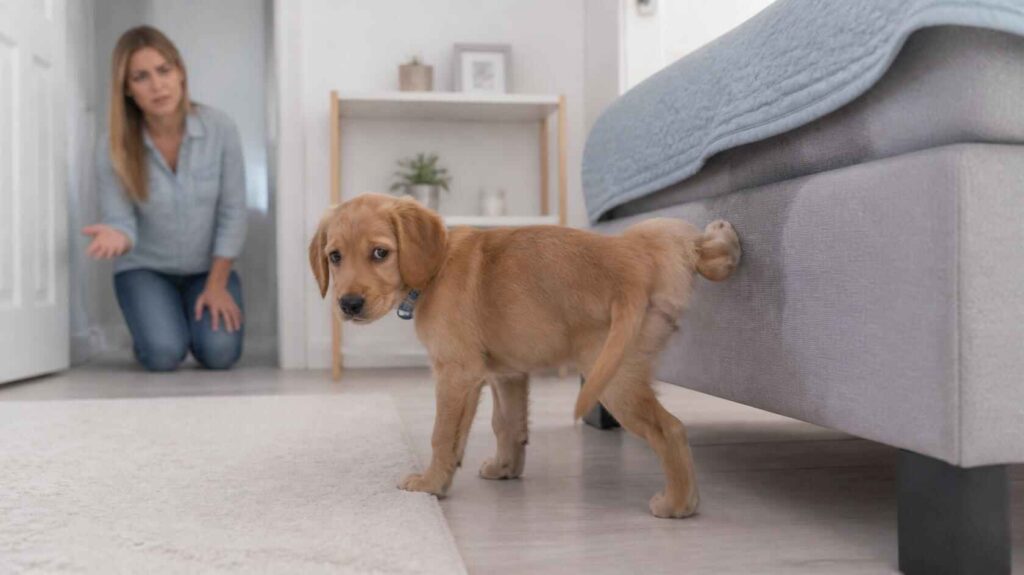
Marking is more common in adult dogs, but puppies — especially males who are approaching or past sexual maturity — can start to mark. Your bed is a prime target because it smells strongly of you, and some dogs want to layer their scent on top.
If the wee is a small amount, left in a specific spot, and your pup seems deliberate about it, marking might be the reason. Desexing (neutering or spaying) significantly reduces marking behaviour — chat to your vet about the right timing for your breed.
Could It Be a Medical Issue?
This is the one people often check last but should check early. If your puppy is suddenly peeing on the bed when they weren’t before — or if they seem to go frequently, urgently, or are drinking more water than usual — it’s worth a vet visit.
Common medical causes of inappropriate urination
- Urinary tract infection (UTI): Very common in young dogs, especially females. Causes urgency and frequent small wees.
- Bladder crystals or stones: Can cause pain and sudden accidents.
- Hormonal incontinence: More common in desexed females; the bladder leaks without the dog realising.
- Diabetes or kidney issues: Cause increased thirst and urination — accidents follow.
If accidents are sudden, frequent, or paired with other symptoms, get it checked out. These conditions are very treatable when caught early.
How to Stop Your Puppy Peeing on Your Bed
Now for the practical part. Here’s what actually works:
Restrict access for now
Until training is solid, keep bedroom doors closed or use a baby gate. Your bed is a privilege to earn.
Toilet before bed time
Always take your puppy outside for a toilet trip right before they join you on the bed.
Use a waterproof mattress protector
Practical and cheap insurance while training is in progress. Saves your mattress from permanent damage.
Reward the right behaviour
Every successful outdoor toilet trip gets praise and a treat. Positive reinforcement is faster than punishment.
Step-by-step approach for the first few weeks
1. Set a toilet schedule
Take your pup out first thing in the morning, after meals, after naps, after play, and right before bed. Consistency builds habit faster than anything else.
2. Limit unsupervised bed time
Don’t let your puppy on the bed when you’re not there to watch. This is when most accidents happen unnoticed, which only reinforces the habit.
3. Clean accidents properly
Soap and water isn’t enough. Puppies return to spots that smell like urine — use an enzymatic cleaner to fully neutralise the odour.
4 .Give them their own sleep space
A crate or a dog bed placed near yours can help your puppy feel close to you without needing to be on your bed. Many dogs settle better in their own defined space.
5. Stay patient and consistent
Progress isn’t linear. Some days will be better than others. Stick to the routine — most puppies get there within a few weeks of consistent effort.
How to Clean Dog Pee Off Your Bed (Properly)
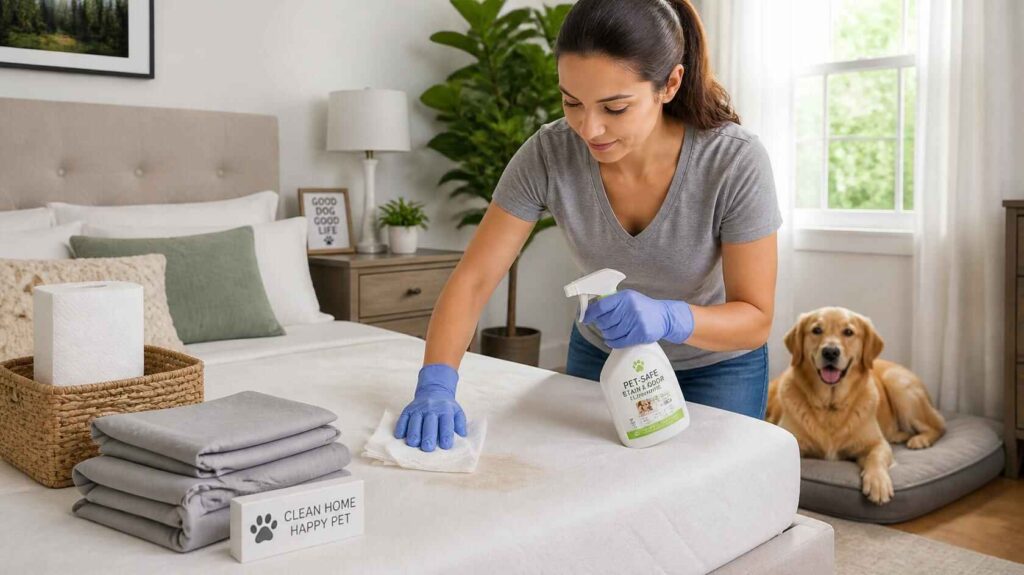
Speed matters. The faster you act, the less damage to your mattress and the less lingering smell that could attract your pup back to the same spot.
- Blot immediately — don’t rub. Use a clean cloth or paper towels and press firmly to absorb as much urine as possible.
- Apply an enzymatic cleaner — spray generously and let it sit for 10–15 minutes. These cleaners break down the uric acid that causes the smell. Regular cleaners just mask it.
- Blot again — press out the cleaner and any remaining moisture.
- Rinse lightly with cold water, then blot again.
- Air dry thoroughly — use a fan or open a window. Don’t put bedding back on until the mattress is completely dry.
Enzymatic cleaners like Simple Solution, Nature’s Miracle, or Petzyme are widely available in the UK, Australia, and Canada — look for them at pet shops or large supermarkets.
What Not to Do
It’s worth covering the mistakes that slow progress down — because most people make at least one of these:
- Don’t punish after the fact. If you didn’t catch the accident happening, your dog has no idea why you’re upset. They can’t connect the punishment to the wee.
- Don’t rub their nose in it. This is outdated advice and genuinely doesn’t work. It creates fear, not understanding.
- Don’t let accidents go unremarked. A calm, firm “no” followed by taking them outside helps them start to make the connection — but only if you catch it in the act.
- Don’t use ammonia-based cleaners. Urine contains ammonia, so cleaning with an ammonia product actually encourages your dog to return to the same spot.
Frequently Asked Questions
1.Why does my puppy only pee on my bed and nowhere else?
Your bed carries your scent strongly, which is both comforting and stimulating for a puppy. Some pups wee in response to that emotional comfort, others are attempting to mark over your smell. Either way, restricting access and consistent toilet training resolves it.
2.My puppy is fine during the day but pees on the bed at night — why?
At night, your pup is deeply relaxed and their bladder is naturally fuller. Young puppies especially can’t hold it through several hours of sleep. Make sure they toilet right before bed and again if you wake in the night. A crate placed nearby can help regulate this.
3.Is it okay to tell my puppy off for peeing on the bed?
Only if you catch them in the act — and even then, a calm “no” and immediately taking them outside is better than shouting. Punishment after the fact achieves nothing and can make your pup anxious, which often makes the accidents worse.
4.How long until my puppy stops having accidents on the bed?
With consistent training, most puppies make major improvements within 4–8 weeks. Fully reliable bladder control usually develops between 6–12 months of age. Younger pups need more patience — accidents are developmentally normal under 5 months.
5.Should I stop letting my puppy on the bed altogether?
Temporarily, yes. Limiting bed access while toilet training is in progress is one of the most effective strategies. Once your pup is reliably trained and can hold their bladder, they can earn the privilege back gradually.
6.My puppy suddenly started peeing on the bed after being fine for weeks. What happened?
A sudden regression usually points to one of three things: a medical issue (UTI is very common), a change in routine or household that caused stress, or a developmental shift like the onset of sexual maturity. If it’s sudden and out of character, see your vet to rule out a health cause first.
7.Does neutering or spaying help stop marking on the bed?
Yes, in many cases. Desexing reduces the hormonal drive to mark significantly — by around 50–60% in most dogs. It’s not a guaranteed fix on its own, but combined with training, it makes a real difference, especially in male dogs.
The Bottom Line
Your puppy peeing on your bed isn’t a personality flaw or a sign they’re misbehaving. It’s usually a combination of a young bladder, incomplete training, and the fact that your bed is basically the cosiest, most you-smelling spot in the house.
The fix isn’t complicated: consistent toilet schedules, supervised bed access, proper clean-up, and a little patience. Most puppies crack it within weeks when owners stay steady and calm.
And if something feels off — sudden changes, frequent urination, or accidents paired with other symptoms — don’t skip the vet. A quick check-up can rule out medical causes quickly and give you peace of mind.
#. Related Articles:
1. Why Is My Dog’s Poop Black?